Red Cedar
More apocalypse, less angst
Post #2049: Work in progress

My in-progress shots from this week. The featured image above is my first ever knit sweater project – pattern is Paulie by Isabell Kramer. All I can really say is so far, so good. It appears that it will fit me, and my stockinette stitch is getting less bumpy the further on I go. It will definitely look like a learning piece at the end – but that’s what it is! I’ve already got two more Isabell Kramer designs picked out for my next sweater projects – I love her aesthetic.
And here is the cape effort from last night: All lining cut out, interfacing attached, lining and cape exterior assembled. When I get back from the cabin I will sew the lining and cape together and then work on the finishing. By the end of the weekend, or Monday at the latest, I should have a finished garment:

Happy Friday everyone!
Post #2048: The start of the new

Now that the sewing room re-do is almost complete (once I get the final furniture pieces I’ll post proper photos here) – I’ve got a tidy and very clean work space to inspire me again. And one of the things I am most happy about in the new configuration is a table that I can stand upright at for cutting out patterns. Back when I lived on the Sunshine Coast I had this set-up (I lived on my own in 1700 square feet so there was plenty of space) but for the last several years I have made do with the dining room table. As I have increasingly made garments in the past few years, it means hauling yards of fabric into the dining room, pinning, and cutting – while trying not to disrupt the use of the space or dinner being served! A dedicated cutting and work table feels like real privilege to me.
I finished the dorm room quilt on Monday (it was delivered the next afternoon), and by Tuesday night I was hauling out fabric and yarn for new projects – I took the photo above after I had decided on my makes:
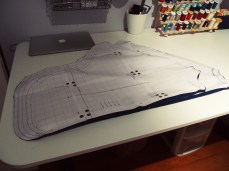 The Woodland Stroll Cape has been in my project queue for about two years- and I’m still not sure about the making of it. I have had a piece of vintage teal wool in mind for this project sitting in my closet for ages – but capes make me hesitant. I love the idea of a cape for fall wear, but I’m not sure about how practical it is, and I worry that I will look like I am wearing a blanket. I don’t have enough of the wool to make a jacket or coat, however, and I can’t really imagine a skirt this scratchy – so I’ve decided to commit to the idea in my head, and just see how it goes. I taped the pattern together and cut it out on Tuesday, and then yesterday picked up a lining and findings for it on my lunch break.
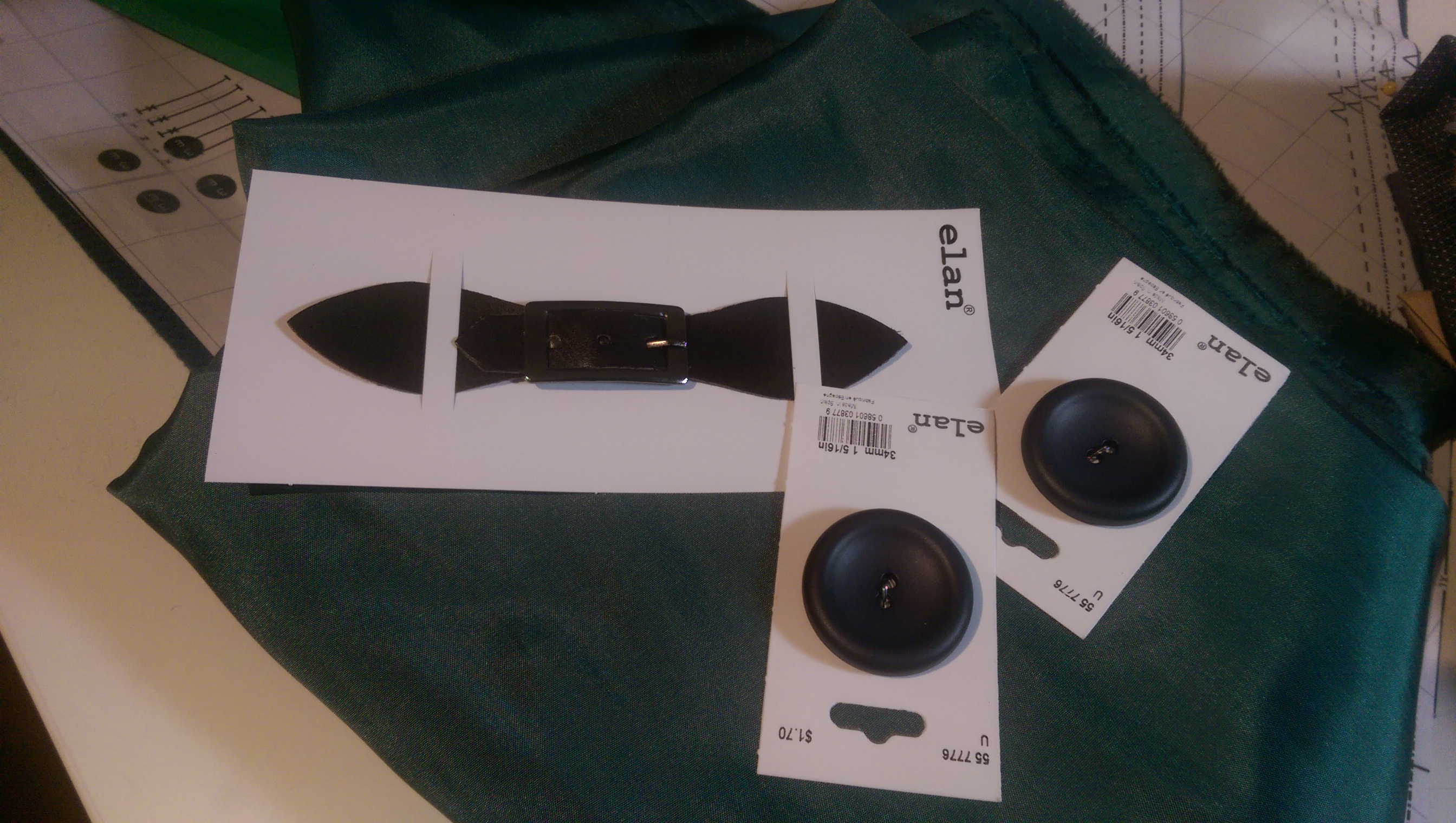
I’m pretty committed at this point, and I do like the fact that the side buttons do provide some minimal shaping (unlike lots of capes and ponchos which just billow around). I chose to start this one first because it seemed the most straight forward and also, there is a short window for wearing such a garment. Once it gets cold and wet, it won’t be nearly enough to keep the elements at bay. This strikes me as much more an autumn garment, which means it has to get done before autumn is over.
My next project following up on that is the Cappuccino Dress, also by Liesl + co. I have now made this pattern twice – once as a dress and once as a blouse – and I have to confess, it’s a bit shapeless for me. On the other hand, I wear the dress version of it all the time at home. It make a great house dress with big pockets for holding things, and a very comfy garment for meditation. Because I am heading to a week-long meditation retreat in November, in a place that is often quite chilly, I’ve decided to make a version in black chambray that I can layer a long sleeve shirt and leggings under. Definitely not a garment with a lot of sex appeal, but truly a very practical item – which is I suppose what meditation garments should be – a bit boring but wearable. This pattern is a dream to follow and I’ve already transferred it to swedish tracing paper, so I expect a quick make (in time for the start of an intensified fall meditation period).
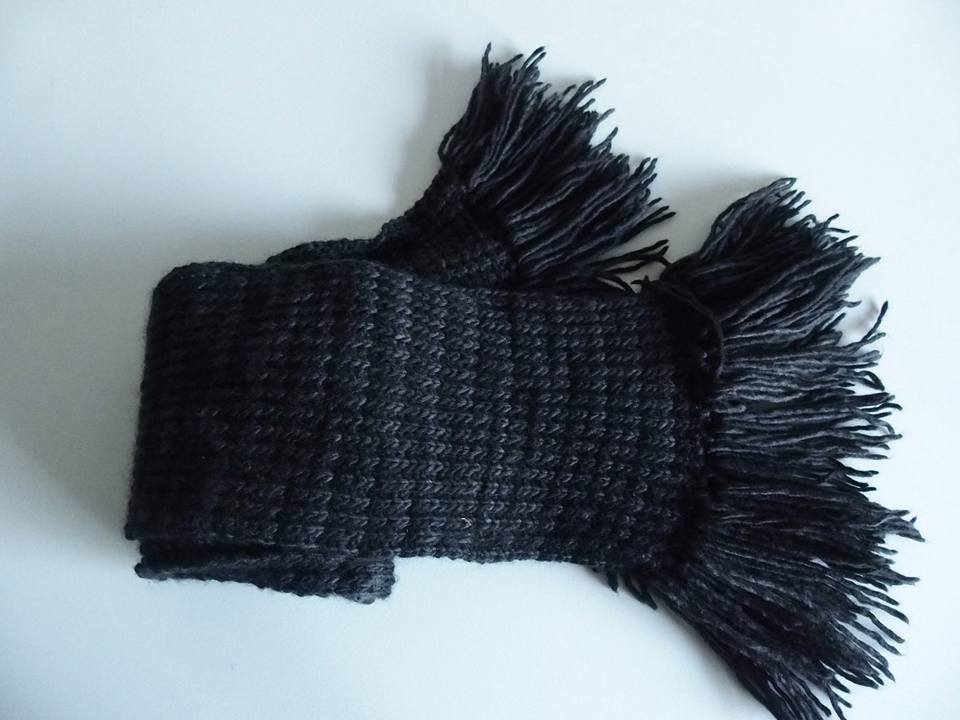
And finally, the Beacon Shawl – which I fell in love with as soon as I saw a picture of it. As a new knitter, I figured it would be something straightforward that I could probably make, and so I ordered the yarn mid-summer. Because I had two (or more) other projects on needles at the time, I’ve been patiently waiting to break out the pattern and start knitting. On Monday night, alongside my quilt finish, I also managed to finish Brian’s winter scarf project which I finally handed to him this morning after unpinning it from blocking:
The Beacon Shawl was cast-on Tuesday, and it’s my current “bus” knitting project – something small enough that I can knit it in transit (unlike the sweater I am in the middle of). I don’t have much to show at the moment, so that will wait for another day, but I’m happy to have something new on the needles.
My afterwork plan for tonight is a drink with workmates and then straight home to work on the cape – once that’s underway, I’ll cut out the dress. And then after that I’m thinking about Purl Soho’s Quilted Vest and a new skirt – but that’s getting far too ahead of myself and I have unfinished objects that are calling me too.
Post #2047: The Dorm Room Quilt
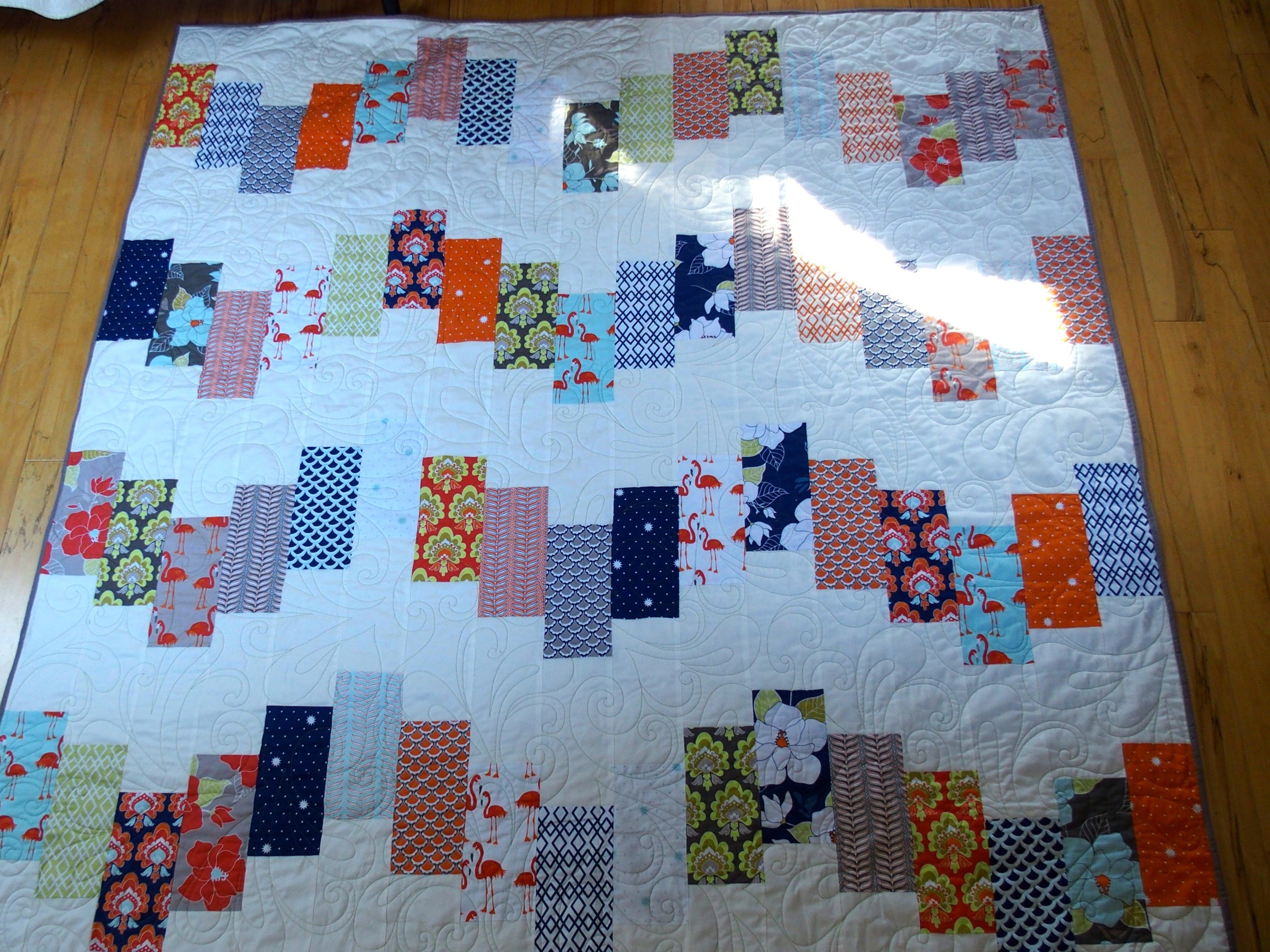
A bit of a drive-by posting this morning to simply show off the quilt that I finished yesterday, just in time for M’s first day of school. She moved into her dorm room last Wednesday, so I’m a little late on the draw, but my sewing room was pulled apart until yesterday so it was all I could do to finish. This is a very straight forward quilt pattern, one that I have now made twice because the ease of putting it together using pre-cut fabrics makes it a perfect gift item (From the book 25 Ways to Sew Jelly Rolls, Layers Cakes and Charm Packs). The quilting on this is by Terry at 6 Ave Quilting – who does great work for a very competitive price.
Lots more photos of the sewing room re-do and other things coming this week….
Post #2046: As we all move into fall…..

It’s only the start of the Labour Day long weekend, but it is sure starting to feel like fall around here. Last week’s wind and rainstorms took the heat off the edge of summer and suddenly I feel the need for an extra blanket on the bed in addition to my thin, summer quilt.
I haven’t had much to say this week, though it’s all transition around our place right now. My step-daughter, M. moved out this week and into residence at the university (not far away from us), Brian’s work is starting to ramp up again as another school year on the hill begins, and I am facing my first September in four years where I am *not* going back to school. Instead, I am focused on bringing order to my newly-painted sewing room, and have immediate plans to finish M’s quilt and and make some garments for myself as soon as the dust has settled.
I’m short of time at the moment – trying to fit in the bits and pieces while gearing up for a busy fall. This weekend we’re going to see my family on Vancouver Island, next weekend is the cabin and Feast of Fields, then it’s hunting season, and on it goes. All my weekends for the next two months are used up and we’re not even out of the gate yet.
But! The canning is pretty much finished for another year, and I’ve got the body of a sweater half-knit. There is time on the ferry tonight to finish the scarf I’m making for Brian, and two fall fairs on the horizon (Saanich tomorrow, Princeton next Saturday) which I’m looking forward to. My sewing room is painted (thanks B!), and I just have to pick up three more pieces of furniture for it. Which is to say that despite being busy, I am well underway on many things and will continue to be. It’s really what I love about fall. Can you feel all that movement?
Post #2045: In which I catch my first salmon…..

Yes. That there is a picture of me on Friday afternoon, holding up 25 pounds of Chinook salmon on the dock at the Lions Gate Marina. That is 25 pounds of salmon that *I landed* on my friend Greg’s boat – and that is the first ever salmon for me.
Truth is, I’ve barely fished at all in my life (despite the fact I work in a fisheries field). I’ve only ever caught small trout (and one rockfish), and nothing larger than two pounds. So this was a bit of a revelation for me. Here are the things I learned on Friday:
- Landing a large fish is hard work! There was a point in the process where I thought that I couldn’t hold on or reel the fish in for one more second – but then what was I going to do? I kept going – and boy, were my arms still sore the next day.
- A large fish is really a two or three person process – there is just no way I could have fought the fish on the line and netted it at the same time. Greg was handling the net while our other compatriot Devona was steering the boat – I just don’t know what you would do out there alone.
- There is a lot of blood. Yes, I know that animals bleed when they die – but there was just a lot more blood than I thought there would be – all over the boat, my pants, and my boots (yay waterproof gear!)
- Catching a fish means processing it right away. It’s great to catch a big fish – but it’s also taking an animal life! In my books, it is pretty much a sin to waste any part of a living creature – which means immediate processing. In this case we dressed the fish on the dock, and I put it in the fridge overnight. The next day, Brian filleted it (video below) and we froze two large portions for later eating (keeping a third out for dinner tonight), started brining one side for smoking yesterday, and turned the spoon meat into fish cakes. All that to say – getting one or two fish at a time is great, but more than that would be a lot of work to process alone.
- I am totally not afraid to be out in the water on a speeding boat – as long as I have something to hold onto. Also, Boston Whalers are really nice and stable – much more than I would have imagined.
- And finally, I’m hooked (no pun intended). I can see what makes fishing so addictive – and I’m ready for more! Maybe not this year, but I am definitely going to look into local charters next year that Brian and I can do together.
A little video of the filleting action:


 Red Cedar