Red Cedar
More apocalypse, less angst
Post #2064: Slow fashion and slow food – another way of saying elite consumer?

While thinking about the slow fashion/clothing movement a couple of weeks ago, I watched the documentary “The True Cost” (available on Netflix) which is about the textile industry and the transition to clothing as disposable consumer items over the last three decades – its really a catalog of environmental catastrophe and labour abuses worldwide and I think that everyone who has every bought a $5 t-shirt and thought yes! what a deal – should watch it. Actually, everyone who wears any mass produced clothing should watch it – just to be informed about what it really does cost all of us to have an endless parade of cheap garments.
Part of that documentary, however, focused on the switch to fair trade products and companies such as People Tree which has environmental and ethical sourcing policies for its clothing – and makes beautiful and fashionable things. I immediately went to their website after watching the documentary to see what they had on offer for dresses – and I loved them! I wanted to buy several right away… because they are great, and not *too* expensive, and with the halo of “doing good” it almost seems like one ought to buy some more things to support this venture – right?
Well – from my perspective on making and slow fashion, my reasons for it – no. And its something I struggle with all the time – because like everyone, I want new things for my wardrobe – but I don’t need nearly the amount of clothing that an endless procession of new things would generate. Whether I purchase ethical, or not, I am still faced with the issue of too much stuff. Too much for me, and too much for the planet to bear – even with the most ethical sourcing policies possible.
And while I see a place for fair trade/local making when it comes to garments, food, and other items – I am afraid that too often “slow” as in slow food and slow fashion, is just another way of saying elite. This is really exemplified in food writing – as pointed out in an article in The Atlantic a couple of years ago – which details the celebration of gluttony by many writers who also espouse “slow food” as an ethic. It’s a real nice bit of hypocrisy to, on the one hand celebrate less overall consumption for everyone, while also stuffing oneself to the point of near-illness. I don’t think the point is lost here when it comes to fair trade shopping either. Too often, people who feel that they can afford to shop fair trade (people like me, for example, a middle class income earner), still purchase far above their actual level of need. And when they are done with those clothes, because they are middle class, they probably donate them to thrift rather than sell them – contributing then to the problem of global over-supply of goods which then destroy local textile markets in the global South. That is, over-consumption is a problem, whether we are talking about $5 t-shirts or $200 dresses. And while the lowest income folks are most definitely consuming the most mass-produced goods, they are still consuming way less goods overall than most of us who have greater disposable incomes (or who are wealthy).
While I believe that systemic change is necessary in order to grapple with the real problem of too much resource use on a finite planet (ie – capitalism is a terrible way or organizing ourselves for sustainability) – on an individual level, I still want to find a way out of this trap of wanting, and having, and discarding. When I started making clothes a few years ago, it was really motivated by a bunch of different impulses – making, body image, learning, creativity – but as I have worked with textiles, I have come to think a lot about the process of the garment industry – both textile making and ready-mades – and how that applies to me.
Garment-making is physically challenging work, and often very dusty, bringing one into contact with chemically treated fabrics and threads. The recognition of this alone has helped me to pare way back on my purchase of ready-made clothing. And when I stick to making my own clothing, I tend to acquire a lot less clothes overall. In a given year I might make two skirts, two dresses, one sweater, maybe a blouse, and some accessory items. This is still quite a lot of stuff (it adds up when I look at what is in my closet from five years of making clothing) – but nowhere near what I would consume in an Old Navy during a sale (I still purchase jeans, underwear and tank tops ready made – and $100 in a place like Old Navy gets one crazy amount of stuff).
But even then, I don’t feel like I’m really doing my part to combat over-consumption – as the act of making, alone, accounts for a huge amount of consumer action. The community of knitters, sewists, and other makers is just as prone to excessive consumption as any other social group – although everyone trumpets their ability to “use every last scrap” a lot of people are very proud of their yarn and fabric stashes – some of which take up storage lockers and whole rooms in a home. Although I purchase a lot of yarn and fabric through thrift stores and de-stashes – I still do my fair amount of new purchase as well. And I did just re-do my sewing room from top to bottom which involved a lot of money spent on Ikea furniture. As makers, we often find ourselves caught in the conundrum of spending resources in order to conserve resources – which in the end cancel each other out. It really points us back to the base problem of living in a system which values growth over life – and its very difficult to get off that wheel individually and collectively.
This post isn’t going to end with an answer, or even an avowal that I will do better. I will try to do better, as I move away from ready-mades, thus limiting the amount of new garments which come into my life on an annual basis. But I see, all the time, that I am still consuming way more than I need, most North American consumers are. Whether we espouse slow and local, or ready-made – the real trick is in living with less — way less.
Post #2063: A little catch-up after a few days of silence

Some fairly intense workload and stress has kept me away from the blog this week – when I don’t get breaks, posts don’t get written – which is shame as I was on such a roll last week!
So the news of the last week catch-up is as follows:
- Brian returned from hunting and our freezer is full of moose meat. One moose split between five people is a reasonable amount (about 100 pounds, perhaps a bit more) without being excessive.
- I have plans to pressure can five pounds of stewing meat – which will probably happen this weekend.
- Apparently our cabin is ready for insulation inspection – all the exterior siding and soffits are on, and the insulation is installed – hopefully we’ll get up there in the next month to see it. But essentially, we are winterized!
- I have started no new sewing or knitting projects because all I want to do now is finish the Paulie Sweater.
- Today is my convocation for my Master’s Degree and I am doing the ceremony this afternoon with Bill Nye the Science Guy (who is receiving an honorary degree and is the keynote speaker) – how cool is that?
And that’s me this week. Now that I’ve caught you all up, I’m going to turn my attention to my slow fashion October post for tomorrow – and see if I can get back on a more regular posting cycle again.
(The above photo is apropos of nothing except the fact that interesting textures have been catching my eye lately – as possibilities for quilt and other textile art designs – this photo was taken on the West Coast of Vancouver Island a few years ago.)
Post #2062: Blogging along with #slowfashionoctober
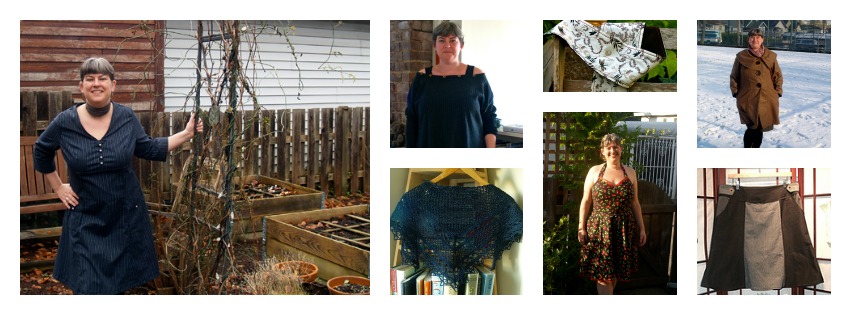
Coming off of Wednesdays’s post on mindfulness and creativity, I feel compelled to join in with October’s blogging theme over at Fringe Association which is Slow Fashion (#slowfashionoctober). Some of you may have noticed that this blog has recently developed two strong themes which are growing from my current interests: meditation/mindfulness/zen and creativity/diy garment-making/textiles. I see these two areas of focus as linked in many ways – and as my meditation practice has developed, so has my approach to making garments and other handworked items.
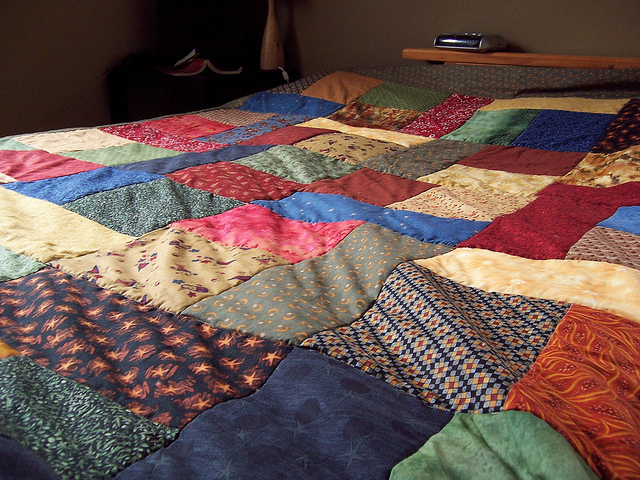
But just to back up, for those who might be visiting through the #slowfashionoctober hashtag, a little bit about me. I am self-taught in quilting, sewing, crochet, and (most recently) knitting – though I did not start to develop these skills until I was in my early thirties owing to the fact that I was told from a young age that I did not have a natural aptitude for anything that involved scissors. While I’ve come to realize that was never the case, what was true is that I did not possess the patience for learning these skills when I was younger – it really took a spell of living on my own in a rural community to find the time and space. Somewhere around 31 I bought a sewing machine with the intention of making some basic household items, took a quilting class in which I learned how to make a potholder, and then proceeded to make a queen-sized quilt as my next project. Super-basic though that quilt was, it still is used in my household, eleven years later.
What I realized at that time is that I wasn’t going to sit down and be creative, or make things, for the sake of it – the items I was/am most interested in producing needed to be somehow useful in addition to bringing beauty or ornament into my life. I made quilts then, and pillows, stitched large tapestry cushions, and sewed up tablerunners and (lots of) potholders – but I never believed I would make garments because I felt that was beyond my skills.
About five years ago something shifted and I bought some fabric and a sewing pattern – and made my first skirt. Following that was a dress, some more skirts, and another couple of dresses. I sewed a lot in 2011/12 – trying out different items, choosing patterns that I thought would be quick to make, and rushing to finish them.
In the summer of 2012, I also learned to crochet, and started making sweaters and accessory items for myself and my family. This past summer I added knitting to my repertoire and am currently working on three different knitted garment items (a sweater, a shawl, and a outdoor vest for my husband).
So really, I haven’t been at the garment making very long when I think about it. I have a goal of a wardrobe that is at least 75% handmade – which I am working towards, though slowly. Although I have made a number of garments, only a few of the early outfits are in my wardrobe still. A lot of them have gone to thrift because either I didn’t know how to choose a pattern that worked for me, or the item had poor fit/wrong fabric issues. On the other hand, I have several items that get weekly wear, including my roses dress (can’t find a picture at the moment), which was made with 2.5 yards of sale fabric, costing me a total of $15. Yesterday I wore a me-made skirt and a me-made sweater to work, in addition to carrying a me-made bag.
The point is that, after five years of making garments, I pretty much have something on or carried every day that was made by my own two hands – and that is pretty satisfying. In the next few weeks, I am going to write more about the whys and hows of my own process and why the movement around *slow* everything is important to me.
I don’t have any particular goals for this month except to add one or two new items to my wardrobe which I’ll write about (as I always do) – but given that I’ve also been thinking a lot about consumer waste – I am going to put some thought towards up-cycling/re-cycling a thrifted garment or the fabric from one. We’ll see if that happens, but it’s not something I’ve had a ton of success with in the past – partly because of my own impatience – but as I’ve developed a more mindful approach to making in the past year, I think it’s time to revisit this.
Post #2061: Silence is the easy part

Returning from meditation retreat on a Monday morning, the workplace conversation goes something like this:
Co-worker: So, what did you do this weekend?
Me: Spent it at a meditation retreat, you know, meditating.
Co-worker: Really?
Me: Yup
Co-worker: Wow, you must be really relaxed now then!
Me: Um, not really
Co-worker: Or…. well-rested?
Me: Nope, not that either
Co-worker: Oh. Was it a silent retreat?
Me: Yes, for the most part we are in silence
Co-worker: That sounds challenging!
Me: No – not really. In my experience, silence is easy – sitting still and concentrating for long stretches of time, that’s hard.
Co-worker: So why do you do this again?
Me: Good question…..
But the answer really, the one that sounds too corny to give to a co-worker, is this: I practice meditation because I am pretty sure that by doing so, I am developing a tool (not to mention the neuro-pathways) that will help me to face life’s suffering with more grace. Because my goal is “lighter and lighter” despite the heaviness of time and living. And because this life demands us to be fully present, but our culture discourages it.
I think it’s probably best if I just don’t let on though. No one wants to hear this at 9 am on a Monday morning. It’s easier to just not talk about it all sometimes.
(Speaking of relaxation, I badly need to get back to Breitenbush Hot Springs – silent pool pictured above).
Post #2060: When it comes to creativity, “to be everywhere is to be nowhere”.
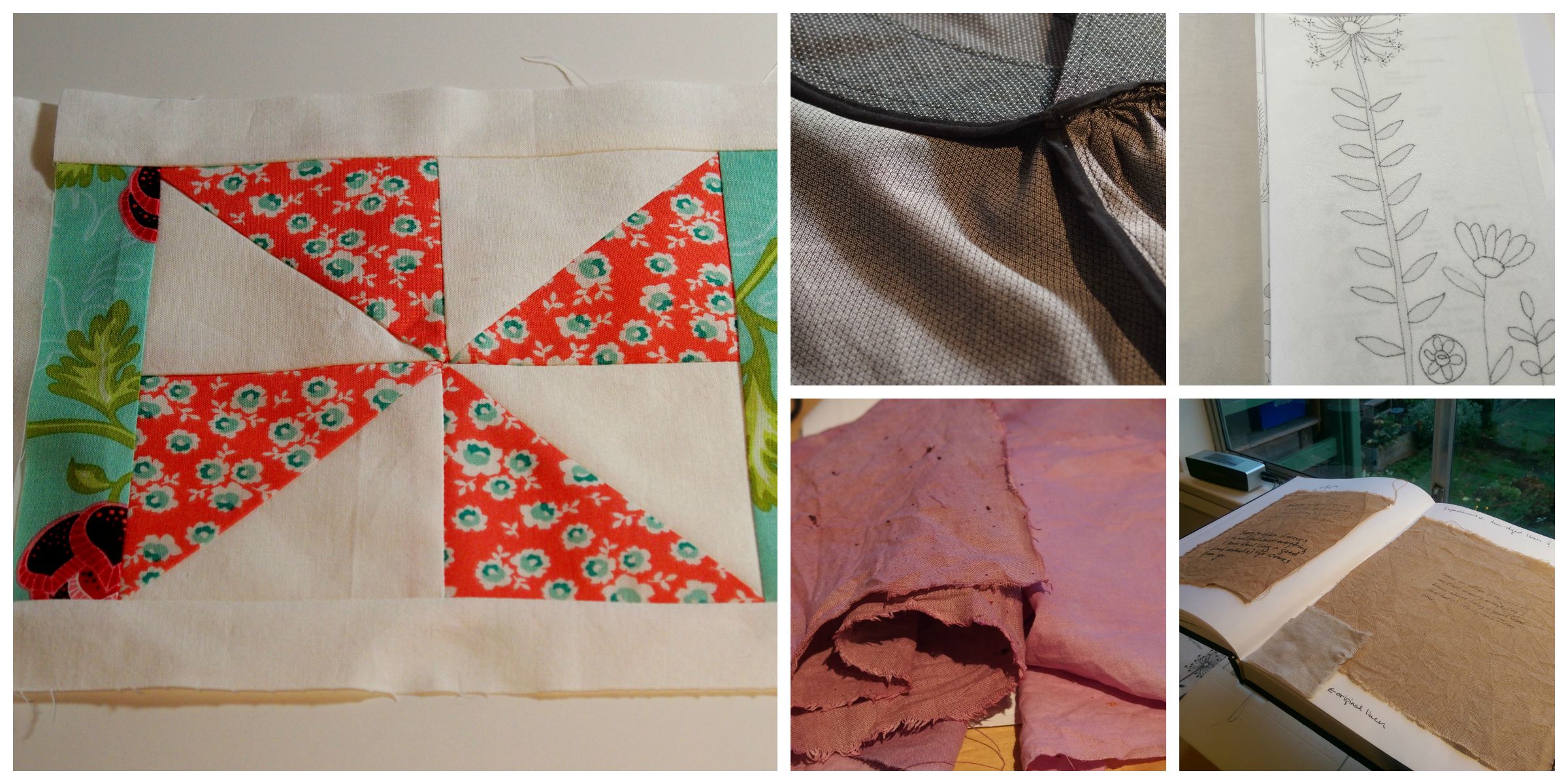
Brian left on Saturday morning for a 9-day hunting trip up North, which coincided with the start of my intensive Zen practice period, and so the house has been very – very – quiet. While I normally fill the empty spaces by listening to podcasts, music, and sometimes netflix while working in the kitchen or sewing room – I started out on the day that Brian left by turning on nothing at all in the early hours before I went to the Zen-do. This was repeated on the Sunday morning, when I rose at six to work in the sewing room before attending another day of sitting – watching the light rise outside in the silence of morning as I worked on the bits and pieces that have been catching my interest lately. The photos above represent my work of the weekend and last couple of days – prepping the embroidery piece, natural fabric dying with some textual experimenting, binding the seams on the Cappuccino dress after basting them by hand. I have done most of this work in silence.
Sometimes the story in my head tells me that I must multi-task, or without *entertainment* the process of making is otherwise boring. I don’t know where that story came from, but it is lodged there, and so I keep a stash of podcasts and audiobooks just for when I’m sewing. I do most of my knitting at night while watching netflix or on the bus to work. My making is rarely done without the influence of other activities, in other words, and I rarely stop to question that impulse.
But in the last few days of minimizing other distraction in the sewing room, I’ve noticed how much my work style changes when I am simply on my own, listening to the voice in my own head, instead of channeling someone else’s words, ideas, or sounds. Sometimes I sing to myself during the rote parts of making (I’m working on memorizing some songs for an upcoming show) – but otherwise I have allowed myself to simply be in the moment with whatever I am working on. What that seems to mean is that rather than staying in one place (sitting at the sewing machine, tracing out a pattern, etc) there is much more flow to my working style and I am inclined to work on something as long as it captures my interest and then seamlessly moving onto something else, and then back again. So I do a bit of rote work like tracing, then I get up and go to the kitchen and mix up a batch of whatever natural dye I am experimenting with and cut up cloth to go in it, then I jot down some notes for a letter I am writing (and hope to incorporate into some textile art), then I organize supplies for a project that is in-process, and then perhaps I trace a bit more of my embroidery pattern before finishing up. Each task takes as long as it takes, without any other task overlapping – the nature of hands-on work.
This is counter to what I think of as my normal work-style, where I pick one task, turn on a program of about the length of the task and then sit and listen/work for the time period I have allotted. There is rarely time for creativity in that process, and I don’t find myself inspired to pick up another thing or intersperse activities. I am simply sewing/knitting/stitching and listening – and my brain is too full to do much else (like allow an idea to float in and then make some notes about it – which would be two other brain tasks in addition to the two already going on). This is not to say that I am not creative, but I tend to think about projects when I am in other modes of life, without my hands on the tools, rather than letting intuition guide my next movement in the place of process-making.
There have been a rash of studies and articles that demonstrate that most of us can’t really multitask as much as we think we can, and that our brain is just rapidly switching between one thing and another, which gives us the idea that we are able to handle more than one thing at a time. This means that we are forever balancing one brain process against another, and while it doesn’t matter much when doing a rote task (like endless rows of stockinette stitch on number three needles), it’s not conducive to the process of having new thoughts and then being able to follow them up with an action. That is, it impedes our ability to move fully into a creative mode, even while we are in the act of making. This experiment of the last few days – of intentional silence – is a reminder of that for me anyway.
I am not saying that I am going to give up listening to podcasts and music in the sewing room – we all know how much rote work we must engage in that truly does become tedious. Hand-basting miles of bias tape to seams is definitely made better by watching a bit of television! But part of my practice focus right now is to spend more time being *just* creative, and that means more time in silence when I’m at work on some or another project. I have some deep creative welling going on at the moment, and I figure the least I can do to honour that (and myself) is to listen deeply to that process rather than another round of This American Life.
(Quotation in the title is Seneca, the famous Roman Stoic and statesperson – he meant this in the physical sense – the full quote is “To be everywhere is to be nowhere. People who spend their whole life travelling abroad end up having plenty of places where they can find hospitality but no real friendships.” – but I think it applies psychically as well.)


 Red Cedar