Red Cedar
More apocalypse, less angst
Are you planning a debt-free holiday?
Is it possible to get through the holiday season debt free? I’m wondering that as I project the expenses of hosting a new year’s day open house, travel to Vancouver Island, bringing hostess gifts to the friends who we visit, and paying for at least one holiday outing for the family (appropriately, a community theatrical reading of Scrooge)…… It adds up incrementally, even when you factor gifts out of the equation entirely (this is our second gift-free year).
Ever since I paid off my credit card and started tracking my expenses over on mint.com in August, I have discovered a whole new level of financial control. In the fall I worried I wouldn’t be able to afford decreasing my work week to four days, but instead the last several months has shown that it is not only possible, but the smaller paycheques haven’t caused much worry at all. I just have to think through my purchases more and live with the consequences when I don’t. Being on a primarily cash-only system – when the wallet is empty, it’s empty – and that means no more spending until payday (just like when I was young and made minimum wage!)
My mint.com numbers have been looking good, with overall debt and spending going down over the past four months, and I have finally phased out my expensive chequing account – not to mention a savings account that things would occasionally get charged to (paypal problems dammit) ending up in NSF fees. I have one last line of credit to pay off ($1600) which I will have the bulk of done by the end of this calendar year.
Given all that – I am determined not to let the credit card balloon over the next month, even if it means dipping into my meager savings account in order to pay cash for the things we want to do. I have also focused on making or bartering for the gifts I am giving my step-daughter, and we canned extra in the summer to give away over the holidays. Oh – and there’s the canned mincemeat and fruit cake which Brian has been working on – not to mention the potholders and fabric boxes I am making out of scraps that I want to use up!
In short, we are attempting to keep the costs as low as possible this year so that we can continue to work towards our financial goals – but I don’t believe that means we can’t enjoy ourselves. Indeed! I find it much more enjoyable to participate in the season if I’m not simultaneously worrying about the amount of debt being added to my credit card.
It’s obscene isn’t it? The spend, spend, spend during a season supposedly dedicated to charity and companionship. Fortunately it’s possible to turn around and it’s such a relief when we do!
Two show-offs.
This is the other reason that I wanted to de-link my blog from Facebook – does everyone in the world need to know that I’m showing off stuff that I make? These two items were finished a couple of weeks ago – I’m now onto potholders, placemats, and a crocheted hat/scarf set for Christmas presents which will make an appearance here as early as this weekend (I’m very pleased with this year’s potholders – they have chickens on them!)
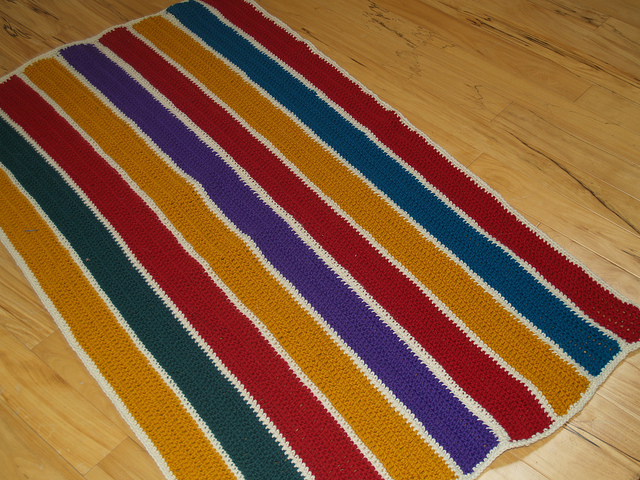
This here is a baby blanket that I made for some friends who are due in the new year. It’s my first crocheted blanket project – and went surprisingly quickly, though it is not without an error in the form of an uneven edge. Good thing babies don’t know anything about crochet! I am desparately in love with the colours here – circus-y and I’m hoping attractive to little baby eyes!
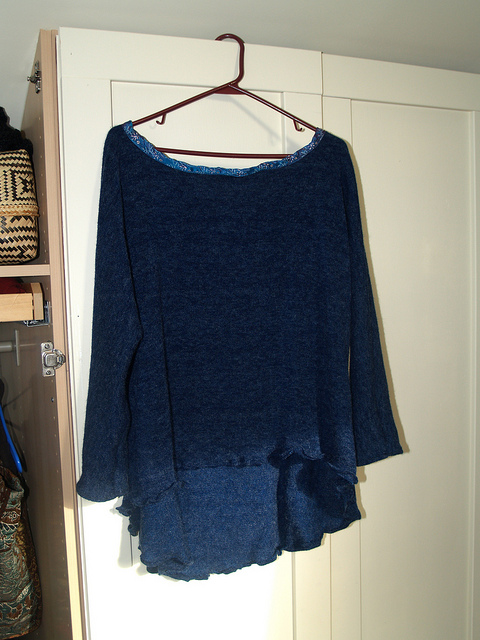
This sweater is a re-do of one I made a couple of months ago. I wanted to pare down the size and use a stretchier fabric, plus do something more interesting with the collar-line. I am quite pleased with how this turned out (I am even wearing it to work today), and am planning a third version in a wool/silk combination now that I have the pattern down. Wool fabric is very expensive, so I wnted to get it right first! A friend of mine has also asked for a copy of this, and I just received the wool blend fabric to make hers in the mail last night – so more simple sweaters are on the horizon! Good thing this takes no time to put together!
Un-syndicating
I have decided (for the second time in four years) to unsyndicate my blog from Networked Blogs which is what I use to publish my blog posts to my Facebook page. Why is that? Because I’ve noticed that in the last four months of having all my posts sent directly to Facebook, I have a great tendency to self-censor and omit the things that are actually going on for fear of worrying or offending people who might be on my Facebook feed. Many of those people, I’m sure, would forget all about this blog if it didn’t show up in the feed – wouldn’t bother to come here if it required actively subscribing to the blog – and so I am preferring to return to my smaller circle of readers. That is, those of you who visit without prompting, or who are subscribed to receive post notifications by email.
It just feels cozier that way to me – and it’s not even like I’ve got some crazy, private life that needs to be discussed here – but I want to get beyond worrying about people and go back to just talking to the circle who actually cares enough to show up.
So hell-ooooo! to those of you who do. I’m back to writing about my life in a more intimate way.
Kate Chopin awakening the body
The Awakening by Kate Chopin, published in 1899 was reviled and then ignored for decades after its release. Seen as “unexpected” from a writer of Chopin’s calibre, and controversial in that Chopin did not admonish or judge her main character’s actions – this book was censored and refused in many libraries. Although women’s rights were not a new concept – the suffrage movement was in full swing in America at the time of publication – male and female critics alike focused on the lack of morality in the novel, seemingly scandalized by the notion that women’s rights might include a refusal to rear children or stay in conventionally-prescribed marriages. And also, that it might include “adult sin” such as adultery.
One such representative reviewer said
In a civilized society the right of the individual to indulge all his caprices is, and must be, subject to many restrictive clauses, and it cannot for a moment be admitted that a woman who has willingly accepted the love and devotion of a man, even without an equal love on her part–who has become his wife and the mother of his children–has not incurred a moral obligation which peremptorily forbids her from wantonly severing her relations with him, and entering openly upon the independent existence of an unmarried woman.
The first time I read The Awakening, a couple of years ago, I found myself somewhat annoyed by the character of Edna Pontellier and felt that she represented a particular selfishness of middle-class existence during the late Victorian era. During this same period, unspeakable things were happening to working class people in the United States – only a few years later we have both the Triangle Shirtwaist fire in which dozens of women perished, and the publication of The Jungle by Upton Sinclair which documented the horrific conditions for men and women living in the slaughterhouse district of Chicago. Edna, by comparison lives a life in which all the material things are available to her, and even the basic household work is carried out by the underclass of racialized people in New Orleans. While Edna is very much concerned with her own oppressive existence, she perpetuates that existence on her Quadroon nanny and cook with scolding and angry behaviour, never quite making the parallel between her existence and anyone else. Such are the limitations of early, middle-class feminism.
Since then, I have read quite a few works on this theme – most notably Madame Bovary and Henrik Ibsen’s The Dollhouse and so tried to approach the work this time with understanding the context in which Kate Chopin wrote her novel. In particular, an interview with Charlotte Perkins Gilman in response to why she wrote the story The Yellow Wallpaper gave me some insight into how the stifilling of women’s ability to work – particularly intellectual and creative work – created a kind of frustration and borderline madness. Certainly the character in that short story is imprisoned by a husband who believes she needs rest for her nervous condition, so is Edna imprisoned by the restrictions of social conventions while her own interests are seen as incidental to what’s important in the family life. As Madame Reisz points out, to break from this conventionality – the artist must have tremendous courage – “The bird that would soar above the level plain of tradition and prejudice must have strong wings. It is a sad spectacle to see the weaklings bruised, exhausted, fluttering back to earth.”
The Awakening is a book rich in literary language – and some particularly rich themes are found in narrative messaging regarding the body and nature. Smoking, the creative arts, and the portrayal of children also offer us some avenues of analysis – but for now – I am just going to focus on the body as it prefigures the modern feminism of the 1960s and 70s.
In The Awakening the body underscores Edna’s position in her partnerships, in her society and in her own conflict.
From the very opening scene of the book, Edna’s body is viewed as a possession of the husband – her burned skin looked upon by him as “a valuable piece of property which has suffered some damage.” This is a none-to-subtle positioning of Edna as object, later echoed in Leonce’s fascination with his other material belongings in the home.
Another central focus on the body takes place as Edna and Adele Ratignolle are making their way to the beach. It has already been established that Adele is a mother-woman and Edna is not – but here we get a description of the women that contrasts the distinctions even more clearly. “The women were both of goodly height, Madame Ratignolle possessing the more feminine and matronly figure. The charm of Edna Pontellier’s physique stole insensibly upon you. The lines of her body were long, clean and symmetrical.” (Chapter 7) Following the rest of the paragraph we get the sense that Edna is somewhat androgynous physically, yet still attractive (unlike Madamoiselle Reisz who is described in the most unflattering physical terms).
Much is made of hunger and food in the book – a physical hunger mirrored by Edna’s emotional hunger – she is depicted as being ravenous in at least two instances (upon waking one the Caminada Cheniere, and upon leaving Alcee Arobin after Madame Hightower’s dinner) that are closely linked with her physical and emotional adultery.
Likewise, a central bodily symbol is clothing which is mentioned throughout the book. What Edna wears, what she is comfortable in (dining in a peignoir for example), and finally her act of standing naked on the beach “for the first time in her life… she stood naked in the open air, at the mercy of the sun, the breeze that beat upon her, and the waves that invited her. How strange and awful it seemed to stand naked under the sky! How delicious!” Prior to this she has a vision of a naked man, and the clothing of both men and women throughout the book is commented on as intrinsic to their characters.
I have appended some notes about the symbolic use of nature at the bottom of this article – for another literary look, but I want to leave this off with some reflection on the central conflict of Edna’s tale. This is expressed early on in Chapter 7 when Chopin reflects of Edna – “At a very early period she had apprehended instinctively the dual life – that outward existence which conforms, the inward life which questions”. This can also be understood as the schism between the soul’s yearning and the physical conventions to which we all adhere. A counter-point to this is found in the many musings about the artist and the artistic temperament which arise from the character of Mademoiselle Reisz. This character is probably as important to the narrative as Edna Pontellier herself, as Reisz demonstrates that another life is possible for women – if somewhat unpalatable (from Edna’s perspective certainly). While Edna does not want to be “owned” she also does not want to be “outside” as Mademoiselle Reisz for the most part is. As Mademoiselle herself comments “To be an artist includes much; one must possess many gifts – absolute gifts — which have not been acquired by one’s own effort. And moreover, to succeed, the artist must possess the courageous soul….. The brave soul. The soul which dares and defies.” (Chapter 21)
Ultimately Edna is not able to dare and defy, recognizing that she will be drawn back into her husband’s home if she cannot support herself physically or emotionally. Society and money hamper her from being able to resolve the conflict satisfactorily – and she finds even the struggle to do so exhausting – ultimately resulting in her final choices on the beach.
Notes on Nature
Nature is probably the most obvious source of symbol in The Awakening – birds, the sea, the beach, grasses and flowers, and domesticated plants all serve to reveal some aspect of Edna’s world and inner struggle.
Focusing here on the Sea – Edna’s source of emancipation (in learning to swim) and also the location of her suicide – the sea is described variously as — melting, sonorous, murmuring, loving, full of imperative entreaty, seductive, never ceasing, inviting, sensuous, enfolding the body in a soft close embrace, as speaking to the soul. The Sea also mimics the states of the characters – when Edna confides in Adele at the beach the sea is being whipped into a froth, when they all leave the dinner table for a late-night swim the sea is lazy and painted like a dream. When Edna is opened by music “her very passions themselves were aroused within her soul, swaying it, lashing it, as the waves daily beat upon her splendid body.” Water, of course has birth and death connotations which Chopin draws on throughout the novel.
Besides the sea, setting locations are key to Edna’s internal states – if the sea is the location of emancipation and release, the beach is a site of openness and frankness, the cottages and the city are sites of oppressive conventionality. The women are freer with each other on the beach, particularly when their children and husbands are elsewhere. Once they re-enter the city, only Madameoiselle Reisz remains an open confidant, as she lives outside of the bounds all the time.
Birds also figure prominently in the narrative – from the opening scene with the parrot and mockingbird, to the end with a bird flying overhead Edna on the beach – one wing broken. A particularly poignant passage is found in the advice Edna relays from Mademoiselle Reisz – “The bird that would soar above the level plain of tradition and prejudice must have strong wings. It is a sad spectacle to see the weaklings bruised, exhausted, fluttering back to earth.
Life Tidbits: School and home.
All my recent writing energy has gone into my final term paper and my presentation for tonight’s class – leaving me spent when it comes to blogging here. Sadly, I ended up writing two term papers – one which was discarded after several hours of attempting to rework it, and one which I banged out at the last minute because I wasn’t happy with the original (totally different topic too). That is the first time in my life I have ever discarded a nearly-finished paper! But I’m sure it was the right thing to do, as I was able to start fresh with a much more coherent thesis (basically stated as: The rise of reason in the last several hundred years has impacted the human relationship to nature, the body and the self.) In any case, I’m feeling intellectually spent and am sure glad that it’s the last class of term next Wednesday!
Brian is going away this weekend to visit a cousin, and I am staying behind in Vancouver to catch up on things – which means 3 whole days on my own to party! Or, really, to prep the living room and hallway for painting. Plus do some sewing. And maybe even clean out the fridge. Living it up alright!
On Monday I went and picked out the paint colours for our new living room – and I am pretty excited about them. York Harbor Yellow for the main walls, Caliente for the small hallway off the living room and Mistletoe for the kitchen (which will be painted in the new year). Our house gets almost zero sunlight in these areas, and yet for some reason the previous owners painted them all mid to dark shades which makes them really dim in the winter especially (photo here). I’m quite excited about spicing up our living room with a brighter colour, one that co-ordinates with the furniture we already own. After the painting, we’ll be putting up new curtains, cleaning our sofas, and rearranging some furniture which should give us a fresh living space for the new year. Lots of work in the next couple of weeks but I am eager to get started on it with my free weekend (Brian originally offered to do it all, but now I want to get started without him).
I’m also going to pick out some sheers for the window treatments and trim them in some co-ordinating colour – finally getting rid of the Ikea drapes we bought upon moving in almost three years ago. This is the living room we’ve wanted from the beginning – but in the flurry of moving we didn’t have the time or money to paint. Now that we’re a bit organized in other aspects of our life together this seems like as good a time as any for some minor redecorating.
I feel like such a recluse these days – give me a weekend and I just go domestic – but I’m truly in my place of contentment there. Which I suppose is what making a home with other people is about… creating that space of rest and peace. Given what goes on in the world, I am so grateful to have this small oasis to call my own.


