Red Cedar
More apocalypse, less angst
A few notes on Candide.
Since I believe I will be presenting on Candide for class (along with the Book of Job), I am going to confine myself here to some simple notes which will help trigger me when it comes to forming the presentation. Once I actually find out for sure if I’ll be presenting, a more formal look at this work will appear here.
Candide is a satire which tells the story of Candide and friends through a fast-paced, sometimes ridiculous series of events traversing the globe from old world to new and back again. Written in response to the philosophical doctrine of optimism (dubbed Panglossianism by Steven J. Gould), Voltaire uses the characters and their adventures to enter the discourse on the nature of human life and relationships. This is classic Enlightenment writing, arguing for reason over the superstition inherent in the “optimism” developed by Gottfried Wilhelm Liebniz who argued that “all is for the best because God is a benevolent entity.” This is expressed by Pangloss, the philosopher of the tale as,
It is demonstrable that things cannot be other than as they are: for, since everything is made to serve an end, everything is necessarily for the best of ends. Observe how noses were form to support spectacles, therefore we have spectacles. Legs are clearly devised for the wearing of breeches, therefore we wear breeches.
This doctrine of optimism is one of passivity, in which humans are simply to accept what happens as what is supposed to. Although this pattern of thought has receded in the wake of the Enlightenment, we can certainly see echoes of it today in new age thought as well as fundamentalist creationism – some streams of which encourage extreme passivity in the face of global injustice. Voltaire takes a position against this in Candide, ultimately transforming his characters through self-directed labour by the end of the tale.
In between the Edenic beginning of Candide’s life (in a castle, learning from Pangloss alongside the beautiful Cunegonde) and the end of the story where he finally resolves that a good life is one made by honest intention – Candide and his friends face many of the world’s horrors. There are beatings, lynchings, venereal diseases, shipwrecks, slave mutilations, natural disasters, cannibalistic acts, and the simple ugliness of time’s ravage – rapidly demonstrated as a refutation to the maxim that all is well. Even when Candide and his manservant Cacambo get to ElDorado (the famed and mythical city of gold in the new world) and are received as equals in opulence without having to work (the pebbles of ElDorado are rubies and emeralds, the street mud is gold dust) – they are quickly bored and so strike out again in an attempt to re-enter their hierarchical society at the top (this does not go as planned of course).
Several observations about human nature and the capacity for good (happy) living are made over the course of the story:
- People are (almost) never happy, and each person thinks he has a worse lot than anyone else.
- Simply giving people riches does not change their ability to live well, and ultimately doesn’t make them happier than they were before the riches.
- Idleness more than anything else provokes discontent.
- Honours and titles do not bring the comforts that we might imagine they do. There is hypocrisy in all quarters of ruling institutions, the church and the monarchy.
- It is possible even after a life of calamity to find peace and contentment.
- Contentment may be found in a community of family and friends labouring together to provide for existence.
- Attempting to explain life as part of a divine plan is fruitless and leads to passivity rather than action on one’s own behalf.
- An honest life rather than one of riches or honours is the most satisfying.
From my perspective, it’s hard not to agree with this philosophical stance on the meaningful life, but Voltaire’s jibes at the monarchy and the church throughout this and other works earned him many enemies in his lifetime. He we imprisoned, exiled, and ultimately banned from his home city of Paris in the course of his lifetime, though he did live into his eighties and was much revered by his followers. I have to say – having read Voltaire for the first time when I was eighteen – he is one of my favourite philosophers. Satire, irreverence and an unwavering commitment to telling the truth no matter how uncomfortable are all hallmarks of Voltaire. His novels Zadig and Candide are enjoyable reads, laden with the arguments of his day – making his philosophy digestable to the average reader. Most of what Voltaire is arguing today sounds a bit – “well, yeah,” because his ideas about the rights of the poor, his anti-slavery stance, and his notion of an honest life – not to mention his refutation of the “enlightened monarch” – are all ones that today have been adopted by western culture. But in his day, Voltaire was highly controversial and his ideas were being cast on highly contested ground.
Worth checking out – last year was the 250th anniversary of Candide and the New York Public Library put together an interactive online exhibit to celebrate. Check out the reader-annotated Candide wiki and more illustrations like the ones in the video above – developed for the purpose of a new printing of Candide.
Life (and Dostoevsky) – Not as simple as a sum.
(An adaptation of Notes from Underground for modern opera. This trailer sums up the key moments in the novella and is interesting from the perspective of modern adaptation.)
In our first week of class next semester we are to have read The Book of Job, Candide and Notes from Underground all of which may be read from a certain existential perspective – and all which give rise to the question of why? What is our purpose on this earth… and in the first two especially “Why do bad things happen to good people and how do we exist with the knowledge that they do?”. In Notes from the Underground I think we are faced with less of this question, and more of the first question – “What is our purpose, how do we articulate ourselves in the face of an uncaring god/society/bureaucracy/city?” And also, what is this human nature we are saddled with? What is nature versus construct?
In this short (110 pages) novella Dostoyevsky creates a truly detestable main character. This character is not repulsive because he is a murderer, a rapist, a tyrant or a thief – but somehow because he is none of those things. And nothing virtuous either. Here we have an unnamed character who believes himself trapped by his intellect and so confined away from other members of his society, when in reality it is his petty jealousies and desires which bind him to a succession of unsatisfactory encounters which leave him increasingly alienated and self-hating.
There are two parts to this novella – part one which reads as a rambling essay about the nature of man and society, and part two which recounts three experiences of the narrator some years past which he has come to ruminate on in his advanced years of forty (!) Both parts of Notes purport to be from the same diary, which I find a bit of an artificial construct – even as the intellectual themes of the “essay” carry through into the experiences of the narrator. There are no clues given as to why this memoir is being prepared, or who is being written to – while at the same time there is a sense throughout that the narrator wants *someone* to hear his thoughts. And perhaps that is the point. Alienated from everyone, penning the memoir contains the hope that perhaps someone will discover it, or that he will find the courage to share it and thus be freed from his “disease of excessive consciousness”.
In Part One we are treated to the narrator’s introduction to himself as not even a loathsome insect – he gives us some brief biographical details (he is a retired civil servant, lives in St. Petersburg) – but mostly focuses on his philosophy of the human condition in this part. We are treated to a bitter tone throughout – though the narrator has some germane reflections on the enlightenment notion that is man could only become enlightened – then! he could start acting in his true self-interest instead of being blinded by traditions and desires. Dostoyevsky’s character says:
When, to begin with, in the course of all these thousands of years has man ever acted in accordance with his own interests? What is one to do with the millions of facts that bear witness that man knowingly, that is, fully understanding his own interests, has left them in the background and rushed along a different path to take a risk, to try his lucky, without being in any way compelled to do it by anyone or anything, but just as though he deliberately refused to follow the appointed path, an obstinately, willfully, opened up a new, a difficult, and an utterly preposterous path, groping for it almost in the dark.
And later he asks of the reader, even if we could bring all human life down to the simplicity of a sum (2+2), understanding human nature from a deterministic standpoint – would we want to?
For who would want to desire according to a mathematical formula?… For what is man without desires, without free will, and without the power of choice but a stop in an organ pipe?…
For when one day desire comes completely to terms with reason we shall of course reason and not desire, for it is obviously quite impossible to desire nonsense while retaining our reason and in that way knowingly go against our reason and wish to harm ourselves. And when all desires and reasons can be actually calculated… something in the nature of a mathematical table may in good earnest be compiled so that all our desires will in effect arise in accordance with this table…. In short…. there would be nothing left for us to do: we should have to understand everything whether we wanted to or not.
And more
What does reason know? Reason only knows what is has succeeded in getting to know… whereas human nature acts as a whole, with everything that is in it, consciously, and unconsciously, and though it may commit all sorts of absurdities, it persists.
Interesting as this discourse is, I often wonder in novels which go on this way – why the author hasn’t simply written an essay to address what are obviously the intellectual debates of the day. For it is clear here that Dostoyevsky is making some kind of response to the philosophical debates of his day, though putting that response in the mouth of a character who turns out to be pretty unlikable and bitter.
I have to wonder how we are supposed to relate to this main character in Notes, particularly as we move into the second part which is more “memoir” than philosophy. In this section we see the character’s interactions with 1) a bullying captain who the narrator eventually walks into on the street in an attempt to become equals (the captain doesn’t notice him) 2) some former classmates with whom the narrator insinuates himself at dinner in order to prove something about his intellect (in which he fails miserably, acting like a boor and drinking too much and then insulting everyone) and 3) with the prostitute Lisa who he encounters after his fateful dinner and ultimately acts horrendously towards in the days which follow. As I mention above, he doesn’t become a killer or rapist, because he is unable to free himself from his inaction, instead engaging in a kind of insidious insulting game – using his intellect as a bludgeon against comradeship, intimacy and ultimately love. Near the end he says of love “Even in my most secret dreams I could not imagine love except as a struggle, and always embarked on it with hatred and ended it with moral subjugation.” This statement seems to be true of all his human relationships – that every encounter is about obtaining power and thus he is disagreeable to most of the people in his life.
Our narrator seems capable of one kind of self-reflection, but not another. While he is able to understand in hindsight his problematic behaviour, he seems powerless to transform it in future actions, and unwilling to let go of a problematic identity in order to be truly free. For all this narrator’s talk of being free (he discourses on this at length to Lisa who he claims is much less free than him because she is engaged in the labour of selling her body), he is just as unable as her to move on with his life. Through his story of a prostitute whose coffin he has seen taken up on the street the day before, we see that the fears he projects on Lisa are his own – that he shall leave nothing behind but derision and the ignorance of the people around him laughing at his demise. And perhaps this too is a clue as to the reason for the Notes – he is focused in the first part of some type of potential physical illness, but we can see throughout that it is truly a psychic/emotional illness which is likely to kill him before he is of advanced age.
Ultimately I am left with the question of how we are meant to relate to this character – for as reprehensible as he might be, he is not without some insight into the human condition. We sympathize with him only as one who is immobilized by his desires and his inability to deal with them maturely and appropriately. As the title suggests, our narrator feels hopelessly separated from the above ground world – the world of adults who take on responsibilities, learn social niceties, and keep up appearances. While the narrator feels this above ground world is somewhat fraudulent and thus postulates superiority, he also yearns to be accepted into it. While he goes on at length about his romanticism, he also refers to his own status several times as “insect” – belying both the fantasy and the fear that dwell within. Is this character just an extreme of something which exists within each of us? Do we all feel the tension of individual versus society on some level and is that the main commentary here? For such a short work, I am left with the need to re-read in order to examine Dostoyevsky’s clues as to the answers…..
As the video trailer at the beginning of this post attests – the questions at the heart of Notes still resonate 170 years after its publication. There is an online lecture here which I am moving onto read next – which promises to offer more insight into the text.
Incredible frosty foggy morning.
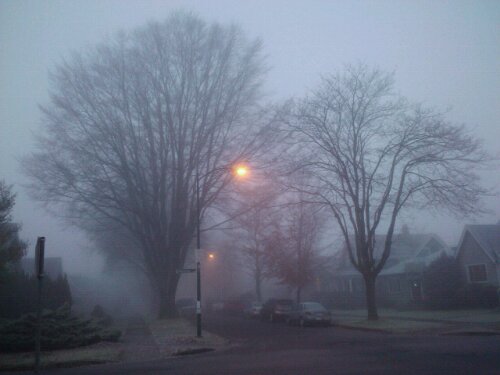
Love the big trees spindly in the fog. Taken on my way to work.
Lyrics: Gun Street Girl
Sometimes I share poetry here, but today I am sharing a song that occasionally echoes in my mind – so perfect are the lyrics, so wistful the tune. A lifetime ago when I was eighteen, I laid on the floor of my big rented house with my best friend Julia and listened to the Tom Waits’ album Raindogs over and over on the record player. It seemed at the time that my life was that record in all its tragic beauty – a feeling one holds dearly when we aren’t sure if the path we’re on is one of our own choosing. If you know this song, you’ll hear it as you read the lyrics, and if you don’t know this song? Go find this album and it will change your life.
Gun Street Girl
Stick around to tell us all the tale
He fell in love with a Gun Street girl and
Now he’s dancing in the Birmingham jail
Dancing in the Birmingham jailTook a 100 dollars off a Slaughterhouse Joe
Bought a bran’ new Michigan 20 gauge
Got all liquored up on that roadhouse corn,
Blew a hole in the hood of a yellow corvette
Blew a hole in the hood of a yellow corvette
Bought a second hand Nova from a Cuban Chinese
Dyed his hair in the bathroom of a Texaco
With a pawnshop radio, quarter past 4
Well he left Waukegan at the slammin’ of the door
He left Waukegan at the slammin’ of the door
I said, John, John he’s long gone
Gone to Indiana
Ain’t never coming home
I said John, John he’s long gone
Gone to Indiana
Ain’t never coming home
Sitting in a sycamore in St. John’s Wood
Soakin’ day old bread in kerosene
He was blue as a robin’s egg brown as a hog
Stayin’ out of circulation till the dogs get tired
Stayin’ out of circulation till the dogs get tired
Shadow fixed the toilet with an old trombone
He never got up in the morning on a Saturday
Sittin’ by the Erie with a bull whipped dog
Tellin’ everyone he saw
They went thatta way
Tellin’ everyone he saw
They went thatta way
Now the rain’s like gravel on an old tin roof
And the Burlington Northern’s pullin’ out of the world
With a head full of bourbon and a dream in the straw
And a Gun Street Girl was the cause of it all
A Gun Street girl was the cause of it all
Riding in the shadow by the St. Joe Ridge
He heard the click clack tappin’ of a blind man’s cane
Pullin’ into Baker on a New Year’s Eve
With one eye on the pistol and the other on the door
With one eye on the pistol and the other on the door
Miss Charlotte took her satchel down to King Fish Row
And she smuggled in a bran’ new pair of alligator shoes
With her fireman’s raincoat and her long yellow hair, well
They tied her to a tree with a skinny millionaire
They tied her to a tree with a skinny millionaire
I said, John, John he’s long gone
Gone to Indiana
Ain’t never coming home
I said John, John he’s long gone
Gone to Indiana
Ain’t never coming home
Bangin’ on a table with an old tin cup
Sing I’ll never kiss a Gun Street Girl again
I’ll never kiss a Gun Street Girl again
I said, John, John he’s long gone
Gone to Indiana
Ain’t never coming home
I said John, John he’s long gone
Gone to Indiana
Ain’t never coming home
Aristotle and the demise of philosophy
The other night, after drinking a little too much wine, Brian and I got onto a conversation about philosophers. Yup. Because we’re just that crazy when we drink a few drinks together. We talk about changes to academic paradigms and get all crazy and shit.
Anyhow. I’m engaged in what are essentially philosophic studies at the moment, and it’s occurred to me that while there is this whole category of people we call philosophers historically, we are rare to name someone a philosopher in our current social/academic context. Like pretty much never. Even in the case of people like Slavoj Zizek, or Francis Fukuyama – two theorists who traverse across academic disciplines in an attempt to knit dominant cultural ideas into greater theories. See – just there – I called them theorists. But I just as well could have used the terms sociologist or political scientist. Or I could identify them by sub-discipline – film studies, postmodernism, cultural studies, liberal democracy. You get the idea. Starting in the 1800s, we essentially dropped the term philosopher in exchange for the more specific descriptors of academic field or political persuasion and in doing so, downgraded the philosophic pursuit. Worker-ized it, really. For these specified terms came straight out of the university labour system which has seen a vast transformation over the past century.
While I don’t want to go down that road at the moment, I put all this out there by way of discussing Aristotle – whose Politics – I have been reading this past week. Aristotle is undoubtedly one of philosophy’s greatest grandfathers, someone we are to regard in high esteem because of his expansive mind and early attempts at systematic political study which have influenced western political thought for the past 2500 years. Of course, political forms weren’t the only thing which Aristotle wrote about – for in his day an intellectual (philosopher) traversed the subjects of his world in attempts at theoretical examination and possible. This, of course runs counter to the modern mode of academic specialization (a process of running the mind into a corner rather than allowing it to range across disciplines). We recognize in Aristotle a philosopher of the first rate because of this versatility of mind, even though some of his conclusions are illogical and unfounded — but still, we valorize the attempt at inquiry as what is important. In particular, Aristotle operating outside of a formalized education system (such as we have 2500 years later, and such as he argues for at the end of the Politics) had a blank slate with which to begin working – something that presents a scope both terrifying and liberating for those of us raised up within the confines of industrial education.
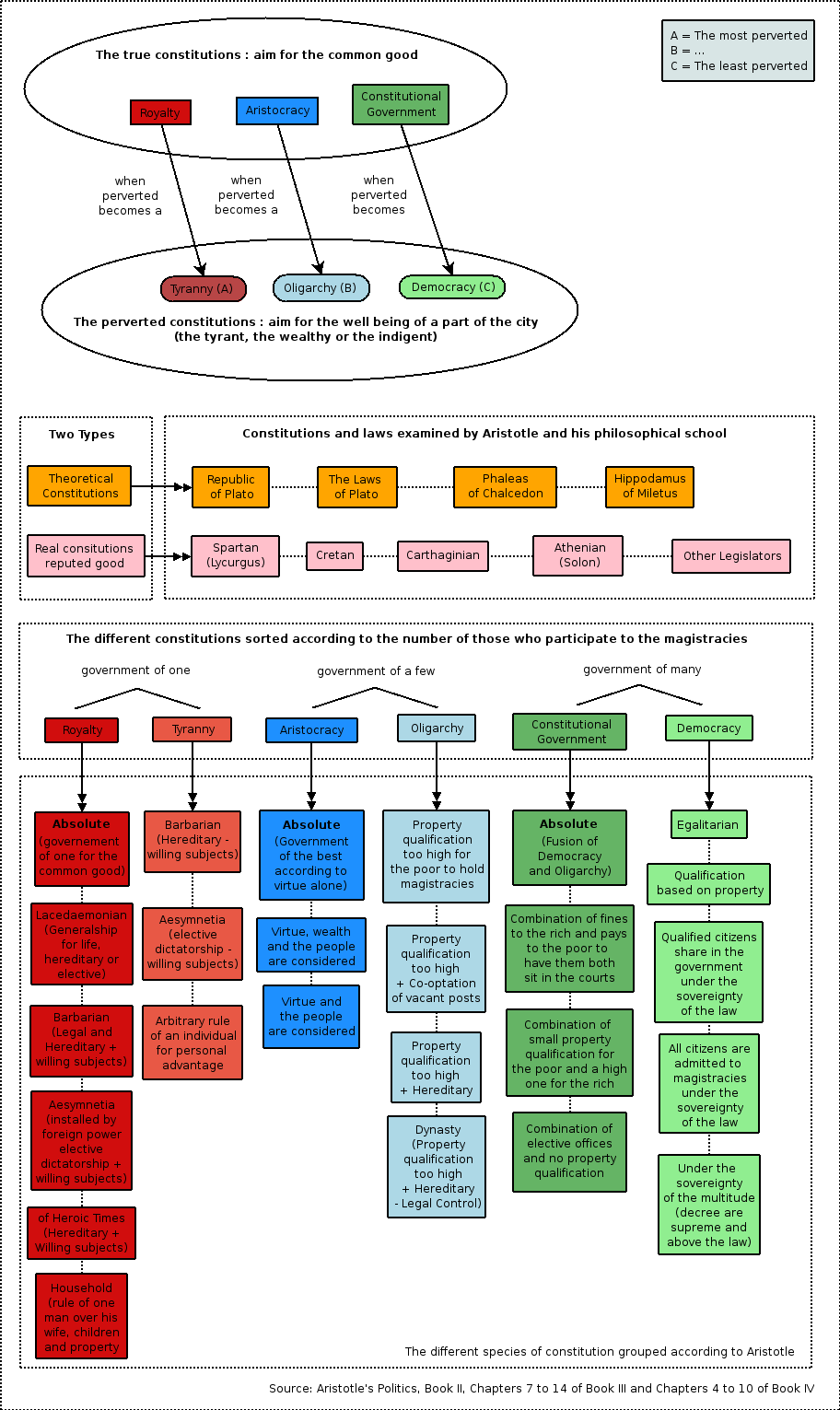
Politics is pretty much what it sounds like – an attempt at systematically understanding various political forms, their “perverted” forms and the best forms of political organization given a variety of factors. Aristotle studies across the cities of Greece to observe why various forms have arisen and the pros and cons of them, and spends at least some part of his work refuting Plato’s Republic (which calls for a communitarian style of living including the sharing of women and children across society). If this particular line of inquiry strikes you as interesting, I’ve included a chart that I downloaded from wikipedia below which lays out the various forms of government, their perversions and the various characteristics of each. To go over all that in this reflection would constitute a blog post beyond today’s scope.
More generally what I want to comment on is the faulty foundation of Aristotle’s study – the “natural” state of affairs on which he rests his study. In this conception of natural order, there are three dominances including master-slave, man-woman and man-child – each justified by a somewhat smug “obviously” with little actual argument. Also obvious to Aristotle is the fact that the “good life” to which all cities (the polis) strive is only open to those who do not labour physically or manually (mechanics, labourers and farmers are all excluded from the good life because the good life requires lots of leisure in which to pursue avenues of virtue). And further, all societies need rulers and there are natural forms of government that arise due to this need (monarchy, oligarchy, democracy).
The problem with this starting place is that rather than being an open look at the political possibilities for society, Aristotle confines himself to what is and thus consigns the majority of his society to subjugation. Even in a constitutional government arrangement, the vast majority of people in a city would not have the right to citizenship (mechanics and labourers), or even if they were citizens wouldn’t have the right to vote or hold office (women). Because Aristotle characterizes this as “natural”, he believes reason is on his side as he works his way through the question of what form of political government, never recognizing outloud how his own biases and blinders might be influencing his approach. According to Aristotle, for example, a most dangerous approach to politics is democracy (the perverted form of constitutional government) for democracy is rule by the poor and might result in property being redistributed and equalized if it were allowed to grow in Greek cities.
On the other hand, the examination that Aristotle takes in Books 2-4 provide a window into the various conditions under which people were living, and the under which people would revolt against their government structures. In Book 5, there is a thorough examination of what creates contempt between a people and their rulers and Aristotle, above all, preaches for benevolent governance no matter what form it takes. In his view, a large middle class is the optimal social composition, and checks on unlimited wealth as well as the degradations of poverty must be enforced in order to ensure than neither of the extreme classes are left to their own devices of accumulation or starvation. Property should be held privately, for example, but with laws stipulating limits on sale or purchase, and with no one inheriting more than one piece of property in a bequeathment. In this way, there should be enough property to go around for all citizens (this whole argument is undermined by the fact that citizens make up the minority of people living in a given city).
In short? Aristotle is searching, in his own time and perspective, for an answer to a question. Like all philosophers he is stumbling a bit because of his context, and wrapping something up in the guise of nature is as cheap appeal to reason as there ever was. But it’s what we expect of philosophers, and the echoes of Aristotle may be found in Machiavelli’s The Prince, in Fukuyama’s Origins of Political Order, and in countless other texts from across the span of intellect (these two come to mind because I’ve just read them, not because of any other links).
Despite missteps, we recognize Aristotle as a philosopher because he searches for the *truth*, because he believes there is a truth to be found. This is something our contemporary theorists have moved away from – relativism having sunk its teeth into the privilege of Euro-centric academia – but it goes some distance to explaining why we have stopped regarding the intellectuals of our time as philosophers. And this lack of regard all round is part of the anti-intellectual current which runs through our modern North American politic. Instead, thinkers are determined as mere researchers, or insulted for being removed by “ivory tower” status – rather than being accepted as a necessary part to understanding and transforming the world in which we live.
While we can’t compare the life and times of Aristotle with those of modern philosophers – the contextual distance is too vast – we can examine the need to return philosophy to a place of status and to embrace the ability of all people to engage in philosophical discourse. Of course there is a problem with definining absolute truths (the end of history as both Aristotle and Fukuyama both posited they were living in as regards political forms), but we also shouldn’t discount the steps towards greater intellect and understanding. We shouldn’t continue to marginalize the development of human thought.
(Click to get a properly formatted graphic of Aristotle’s political forms)