Red Cedar
More apocalypse, less angst
Mersault’s meaning.
I shook off my sweat, and the clinging veil of light. I knew I’d shattered the balance of the day, the spacious calm of this beach on which I had been happy. But I fired four shots more into the inert body, on which they left no visible trace. And each successive shot was another loud, fateful rap on the door of my undoing.
The Stranger by Albert Camus is one of those books that made the rounds in high school, was a part of my 80s pop culture referencing (“Killing an Arab” by The Cure ring a bell?) and is only 100 pages long. Yet somehow I have only now come to read it – this brief and beautiful work. Though frequently classified as an existentialist work, Camus himself denied that label, preferring the philosophy of absurdism which maintains that efforts to find meaning in human life are absurd (and will fail) because certainty is impossible. Accordingly there are three possible actions to be taken in response to this lack of ability to know the meaning of life
- Suicide (which Camus rejected)
- Transcendant belief (as per Kierkegaard) or
- Acceptance of the absurd and a continuation of life with this knowledge – this was Camus’ approach.
As much as The Stranger (also translated at The Outsider) explores this third approach to the absurdity of life, the main character (Mersault) somehow misses this third option, instead opting for a form of suicide through the senseless murder of “the Arab” (which removes him from sensory pleasures and ultimately gives the state leave to execute him).
To some degree I am with Camus on this one, the ultimate meaning of life is unknowable – but in order to continue without descending into a kind of self-absorbed individualism, or nihilism we are responsible for finding meaning in interaction and experience. And in fact, recent studies show that individuals find their greatest happiness in relationships, in volunteering or caring for others, in spiritual engagement, in project-oriented goals, and in pursuing goals that are greater than the self. While we shouldn’t conflate the pursuit of happiness with the meaning of life, the field of positive psychology is establishing that a large part of the “good life” (particularly once core material needs are met) is found in the ability to find meaning in our day-to-day activities and relationships.
This is essentially the stuff that Mersault seems unable to do – while he recognizes the aburdity or “pointlessness” of it all – he is unable to find meaning in his relationships, in goals, in religion, and thus is utterly disconnected from his society (a stranger, an outsider – the prosecutor in the murder trial accuses him of having no place among the normal moral mentality of humanity).
Of his mother’s death he says: “It occurred to me that somehow I’d got through another Sunday, that Mother now was buried, and tomorrow I’d be going back to work as usual. Really, nothing in my life had changed.”
Of his lover: “A moment later she asked me if I really loved her. I said that sort of question had no meaning, really; but I supposed I didn’t.”
Of work ambition: “I answered that one never changed his way of life; one life was as good as another, and my present one suited me quite well….. As a student I’d had plenty of ambition of the kind he meant. But, when I had to drop my studies, I very soon realized all that was pretty futile.”
Of the murder: “”And just then it crossed my mind that one might fire, or not fire — and it would come to absolutely the same thing.”
In each of these statements is the recognition that there either is a grand design and thus Mersault is powerless to it, or there is no grand design and thus none of what he does has much consequence. He is candid with the court system and himself that he does not feel much emotion for anything, doesn’t have time for emotion – and at one point says of his trial “the prospect of witnessing a trial rather interested me, I’d never had occasion to attend one before” – in effect casting himself as an observer on his own life.
But as unaffected as he seems about these matters, he does not seem to recognize that he does place great meaning (and derive great pleasure from) his sensory experiences, particularly in nature. It is in these passages that we locate the emotional resonance of Mersault – that which is truly important to him:
“Only one incident stands out; toward the end, while my counsel rambled on, I heard the tin trumpet of an ice-cream vendor in the street, a small, shrill sound cutting across the flow of words. And then a rush of memories went through my mind — memories of a life which was mine no longer and had once provided me with the surest, humblest pleasures: warm smells of summer, my favorite streets, the sky at evening, Marie’s dresses and her laugh. The futility of what was happening here seemed to take me by the throat, I felt like vomiting, and I had only one idea: to get it over, to go back to my cell, and sleep…. and sleep.”
In this passage, he is overwhelmed by the sensory memories to the degree that he must put a stop to them through sleep – something that he engages in with increasing frequency after his incarceration (sometimes sleeping 16-18 hours per day). As much as Mersault maintains that nothing matters, that nothing changes either way, that nothing has much impact in the long run – it is after his imprisonment that he is (to some degree) awakened to the fact that there are things that matter, at least in the sensory immediate:
“Still, there was one thing in those early days that was really irksome: my habit of thinking like a free man. For instance, I would suddenly be seized with a desire to go down to the beach for a swim. And merely to have imagined the sound of ripples at my feet, the smooth feel of the water on my body as I struck out, and the wonderful sensation of relief it gave brought home still more cruelly the narrowness of my cell.”
We might interpret the act of killing the Arab on the beach is an act of nihilism, which Camus does not approve of. Ultimately this senseless act removes Mersault from his only meaning (sensory experience), plunging him into a state of sensory deprivation (a dark prison cell) – and thus removing the only location in which he finds meaning. And although he ultimately comes to accept his death as a meaningless but good death (particularly if crowds came out to watch it), one doesn’t believe that this is the right answer to the “absurdity” of the human condition. It is certainly *an* answer, but there are too many cracks in the facade of Mersault for us to see him as totally unaffected. His sensory reminiscences allow for the recognition that at least on some level he has experienced a glimmer of personal meeting in life, despite his protestations.
And in case you don’t know it – here is The Cure’s 1978 video for “Killing an Arab”:
How had I failed to recognize that nothing was more important than an execution; that, viewed from one angle it’s the only thing that can ever genuinely interest a man?
Silk/Wool Beanie and Scarf
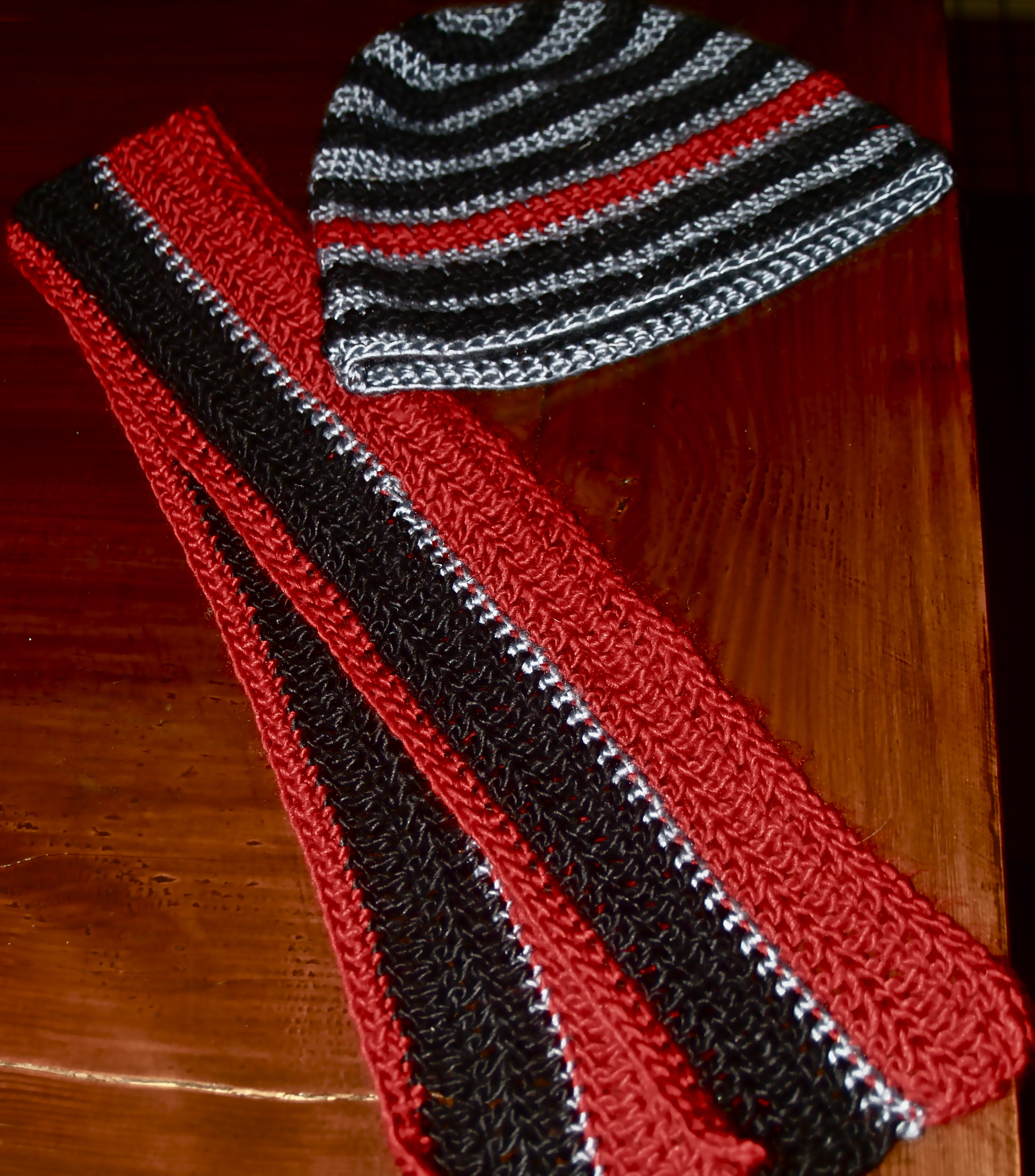
One of these days I am going to figure out how to photograph my stuff better…. These look much nicer (not so bright, and not so shiny) in real life. Finished this evening to be put in the mail to a friend tomorrow. A return on a favour she did for me early this fall and also because she rocks. Like the last toque and scarf set I made – this is Mulberry Wool/Silk blend and it’s not only super-soft but really warm. Which is good because this set is going to Ottawa where it gets real cold.
The festive branch

Despite the sickness and the harriedness of this last week, we managed to get our house decorated for Christmas (plus, I got the second curtain hemmed properly while on one of my sick days, so our living room is technically “done”). We don’t do a Christmas tree because 1) it’s horrifically wasteful, 2) trees are messy, and 3) we don’t have any room in our tiny house to put one up. Instead, I have instituted the tradition of the “festive branch” which entails branches in a vase which get decorated with only the prettiest, most delicate glass ornaments. Twiggy branches just don’t hold up anything heavier than blown glass, so I’ve been collecting nicer ornaments for just this purpose in the last few years. (Before I met Brian who came with a kid, I had never decorated my home for Christmas – but now it’s something I enjoy doing as long as it doesn’t get out of hand.)
I made several other decorations this year which I will feature here as well, but for now you get a picture of this year’s festive branch(es). Below is a photo of my favourite ornament which I bought the first year Brian and I were dating at the Bay for less than $5. I still think she’s the best, and I’d love to find more like her:

The Machiavel?
Not being a student of the stage, I only recently became acquainted with the concept of the “Machiavel” in Elizabethan theatre. This (according to the best defnition I’ve found) is “primarily a person who puts his own personal survival and power above any traditional moral restraint. He is a person who believes that the assertion of his individual desires is more important than observing any traditional ways of dealing with people and who is prepared to do whatever it takes to achieve his personal desires. He is, thus, a self-interested individualist with no traditional scruples about communal responsibilities and morality. The Machiavel is thus commonly an inherent source of social disorder.” (Ian Johnston, VIU) Makes sense that the character-type named after Machiavelli would be those whose power-seeking (and maintaining ends) justifies all sorts of means… ultimately drivers of the plot from one point to the next.
Interesting too that there is rarely just *one* Machiavel in a given work – the villain without a worthy match is rather boring – and so rarely does Shakespeare depict good actually winning out over evil. Rather it is the operative with the most cunning who often comes out on top – independent of their moral weight – even as we may sympathize more with the characters who fall. King Lear and Cordelia in King Lear being our example from last term. In this term’s Shakespeare Antony and Cleopatra it is difficult to distinguish a character with any particular morality, but the Machiavels are everywhere. Both our title characters, plus the character of Octavius to varying degrees share these characteristics. Antony least, Cleopatra moreso, Octavius the most. Guess who wins in the end? But ultimately it doesn’t matter because we aren’t sure how we feel about any of them throughout the play – so Shakespeare paints a picture of even the most ardent star-crossed lovers as being willing to throw each other under the bus if the power stakes are significant enough.
Despite what is supposed to be a deep and abiding love, both Antony and Cleopatra make arrangements in opposition to the other’s interests throughout the play – Antony by marrying the sister of Ceasar to seal his bond, Cleopatra by making promises to Octavius which emasculate Antony’s military prowess in order to save her sovereign Egypt from submission to Rome. And yet, we are left to wonder whether or not these characters ultimately believed they could play off Octavius to ultimately end up with each other *and* all the power.
Hard to believe in Antony who is the weakest manipulator of the three – his greatest downfall is his desire for Cleopatra and a certain arrogance that he can do what he likes, no matter what is being alleged, or what his wife Fulvia (who dies near the start of the play) is doing in his absence. He is irresponsible in his wants and the marriage to Octavia is not his own plot for dominance, but one that is suggested to him, and which he picks up on the merits of. He is not the master of his own fate, and his judgement is questioned by many throughout the play because it is obvious that even in his final anger with Cleopatra (after she militarily betrays him) that he cannot imagine living without her. Ultimately Antony is manipulated by Octavius and his friends, as well as his lover Cleopatra – so we might choose his side of things if he wasn’t so weak and if he didn’t show his own propensity towards morally questionable behaviour. (Not to mention his pitiful death scene where he can’t get anyone to kill him, so botches his own suicide).
Cleopatra is a villain with a bit more going on. Reigning monarch of Egypt she loves Antony only so much as she can control his actions and is furious when he betrays her by marrying Octavia. One wonders if its this first break between Antony and Cleopatra which sets the stage for her military betrayals later in the play…. that she ultimately doesn’t trust Antony enough to risk it all for him. Twice she betrays him militarily in order to save her own sovereignty, and close to the end of the play we find her entreating Octavius (falsely, it turns out) to allow her to maintain her sovereignty as ruler. While Antony kills himself over the lost love of Cleopatra (she arranges for him to think she is dead), Cleopatra kills herself over the loss of her power and the fear that Octavius will parade her through the streets as a prize of war, a fate she cannot bear to envision. Cleopatra can not live without herself, her self-image as a noble and powerful woman, and is required by her dignity to take her life which she does in a pseudo-erotic manner, followed by her maidservants who adore her.
And Octavius? He has it all by the end of the play – acheiving through force, manipulation and broken promises – but its with a hollow ring that he closes the play with the lines:
Take up her bed;
And bear her women from the monument:
She shall be buried by her Antony:
No grave upon the earth shall clip in it
A pair so famous. High events as these
Strike those that make them; and their story is
No less in pity than his glory which
Brought them to be lamented. Our army shall
In solemn show attend this funeral;
And then to Rome. Come, Dolabella, see
High order in this great solemnity.
Now soverign ruler of Rome, Octavius must still kneel before the strong personalities of Antony and Cleopatra, as well as their passionate love for one another. Not only were their lives notable, he says, but their deaths are the kind which make legends (who has ever forgotten that Cleopatra died from the bite of an asp, likely self-inflicted?). Tragic though their deaths are, they make the life of Octavius even moreso as he must live in the shadow of these events which he set in motion through his own struggle to acquire power.
Despite her glaring faults (the dishonesty, the vanity) – I find Cleopatra to be the most sympathetic of the characters – if only because she forces the male rules around her to accept her presence as *one of them* despite her gender. Frequently throughout the play we are treated to the perception of Cleopatra as a temptress, a witch, a mesmerizer – not to be trusted. And during battle scenes, her presence as commander of her forces is questioned because she does not belong in this most masculine of spheres. Even her self-inflected death is an act of self-empowerment as she cheats Octavius out of the victory of her debasement. ” Bravest at the last|She levell’d at our purposes, and, being royal|Took her own way.” Only Cleopatra has any real dignity at the end of the play, though Octavius honours Antony, we can’t quite get the image of him staggering around after stabbing himself out of our minds.
Some other areas of inquiry I am interested in exploring further with this work include:
- the destructive nature of desire
- the false “reason” which drives the acquisition of power
- feminine seduction/bewitchment/power/sexuality
A little updating.
I have been home sick since about Sunday, give or take a couple small errands, and so I am updating my blog from bed this morning. Finishing off my coffee before I shuffle into the bath and then get on with whatever household chores I can do before I get tired again. Colds! Such a small illness, such a large effect on overall energy. But I am on the mend, so I expect to be back to work tomorrow (I actually thought I would be back today, but I’m still too exhausted and snuffly). So far this week I’ve missed three meetings (2 union, 1 work), a union xmas party and today’s work luncheon for Christmas. But whatev. I used to push myself into everything despite illness, but last autumn I had a major health problem brought on by doing that and it took months to fight. (Lung infection which I had for two months while traveling the province on bargaining business – probably one of the most miserable periods of my life).
In any case, I did manage to finish a small sewing project yesterday: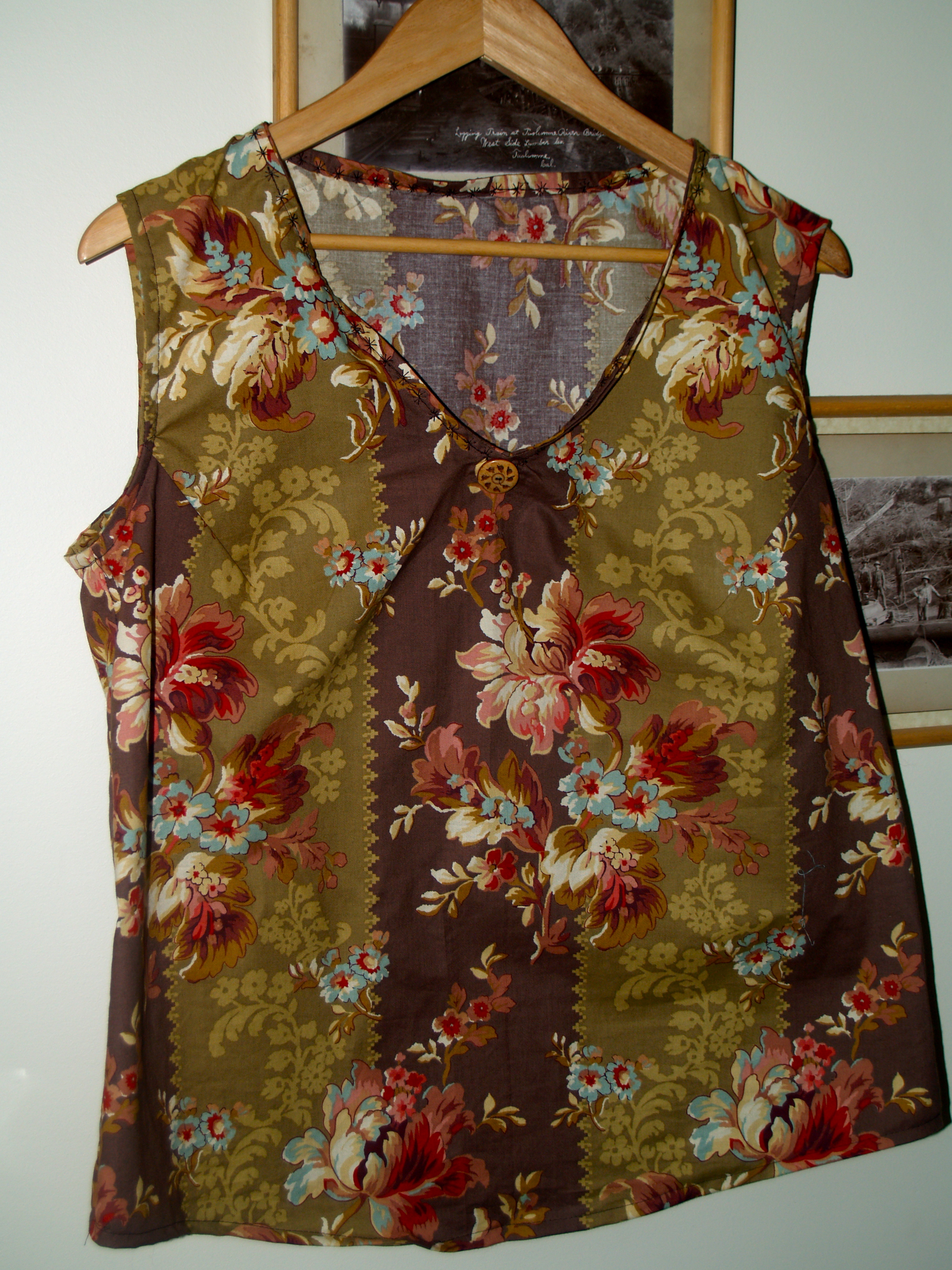
A perfectly-fitting tank top which I started on the weekend. Really, it was a short project, but it took me feeling a bit better to finish it. I wasn’t sure how this fabric would work as a top, but it looks great on and I do so love this wall-papery design…. hopefully I can put it to use under a cardigan until the weather gets warmer.
Tonight we are decorating for Christmas which means that I have some cutting out and finishing of handmade ornaments to do today. Perfect since I don’t want to move too much. Plus we put together a gingerbread house structure last night so it will be ready to decorate tonight as well. This year, as always, I am so glad that we don’t do a Christmas tree. It seems like enough work to get lights and decorations happening without also lugging five-seven feet of greenery into the house as well.
So I’m off to bath and shuffle and drink tea while I work my way slowly through the house and its many little chores – with naps in between of course, and possibly some more reading for my January classes. I finished Antony and Cleopatra yesterday and have begun Edmund Burke’s A Philosophical Enquiry – good times.


 Red Cedar