Red Cedar
More apocalypse, less angst
Red pinstripes and spring!
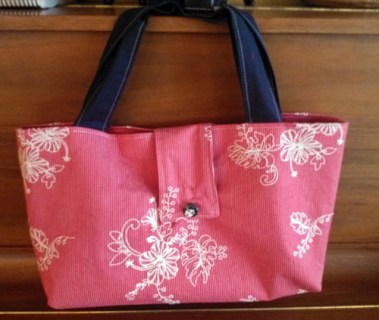
A new bag for spring finished last night!When I saw this fabric at DressSew two weeks ago, I knew I had to make something from it – it’s the right weight for anything that you might use denim in….. but I wasn’t sure about making a whole skirt out of it.You can’t tell from the photo, but the flowers are machine embroidered, not printed.
Bag details: Cotton/Poly blend med-weight, interfaced for structure, snap closure on front, self-designed: 1 metre each of exterior fabric and lining fabric totaling $15.
I think my girly-button is a bit small for the size of the bag so I may try to replace it with something else – but otherwise I’ve got a new bag for picnics and beaches. And a shout-out to Vancouver sewists: DressSew has tons of cute fabric in at the moment.
And….. catching up.
Tonight is my last class, and I’ve been so buried in my paper every available minute the last couple of days that I haven’t been to write here. Now that I’m finished my term paper, “In the Absence of a Creator: A reflection on the modern monster” (an examination of monstrosity in literature in the context of existentialism and a social transition from religion to secular humanism), I can breathe a bit easier. I still have a few journal entries to post before the end of next week, but am feeling otherwise done. Which means that by tomorrow I will have completed my first year of grad school. (Yay me!)
I am clearly starving to read something other than my assigned list, for even as I worked through my paper, I have read two novels and half a short story collection since last Thursday. This is a ridiculous pace even for me, but it’s more fun to read when you don’t have to write about it afterwards! For the record those books are Disgrace by Coetzee, The Book of Illusions by Paul Auster, and Stay Awake by Dan Chaon. I just got the Chaon book out of the library yesterday, but I find his short stories so compelling I can’t put them down. Next on the list is Ali Smith’s There but for the which I also got out of the library – it’s bumping 1Q84 down the queue because I own that one and it doesn’t have a time schedule to be read on.
I’m also looking forward to more gardening and sewing time in the upcoming weeks. Over the weekend I managed to put a lot of seeds and starts into the back garden, and potted up some sweet peas, dahlias and even veggies for spots of colour in the seating areas. I think the next project is going to have be a continuation of our front yard, since I’ve now decided what my next plant purchases for that area will be (two Japanese skimmia and one Witch Hazel tree). I am also mid-way through two tote-bags for a fundraiser – which is reminding me how much I enjoy simple household sewing.
It occurs to me that even though I only took one class per semester, school has taken up a lot of time these past eight months. As much as I have enjoyed being so preoccupied with intellectual pursuits, the balance in my life demands a few months off to just play a bit too. With spring in the air (I could smell it this morning, flowering things must be at their critical mass when the air scent changes) I am amped for a summer of undisciplined pursuits of all kinds!
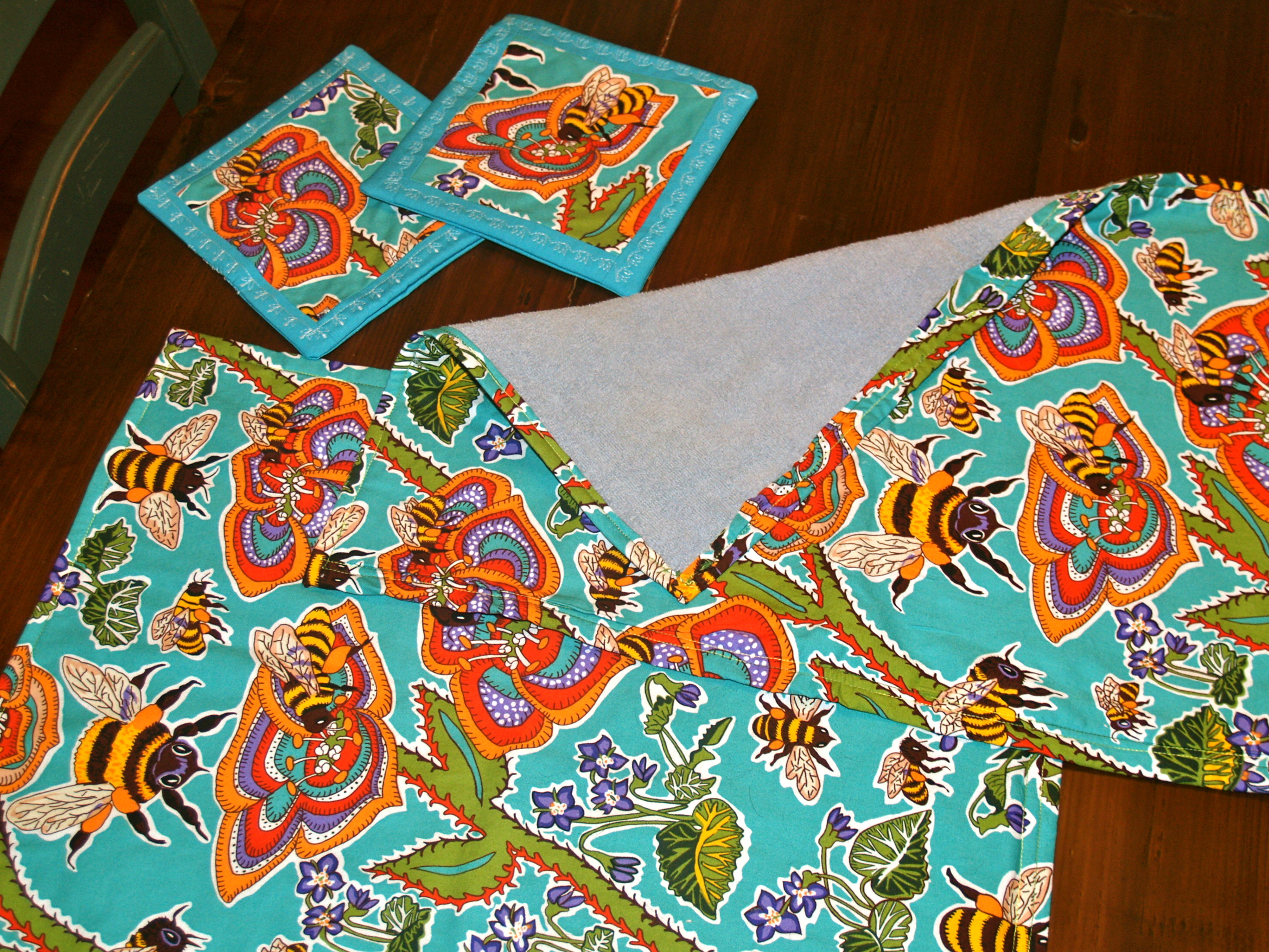
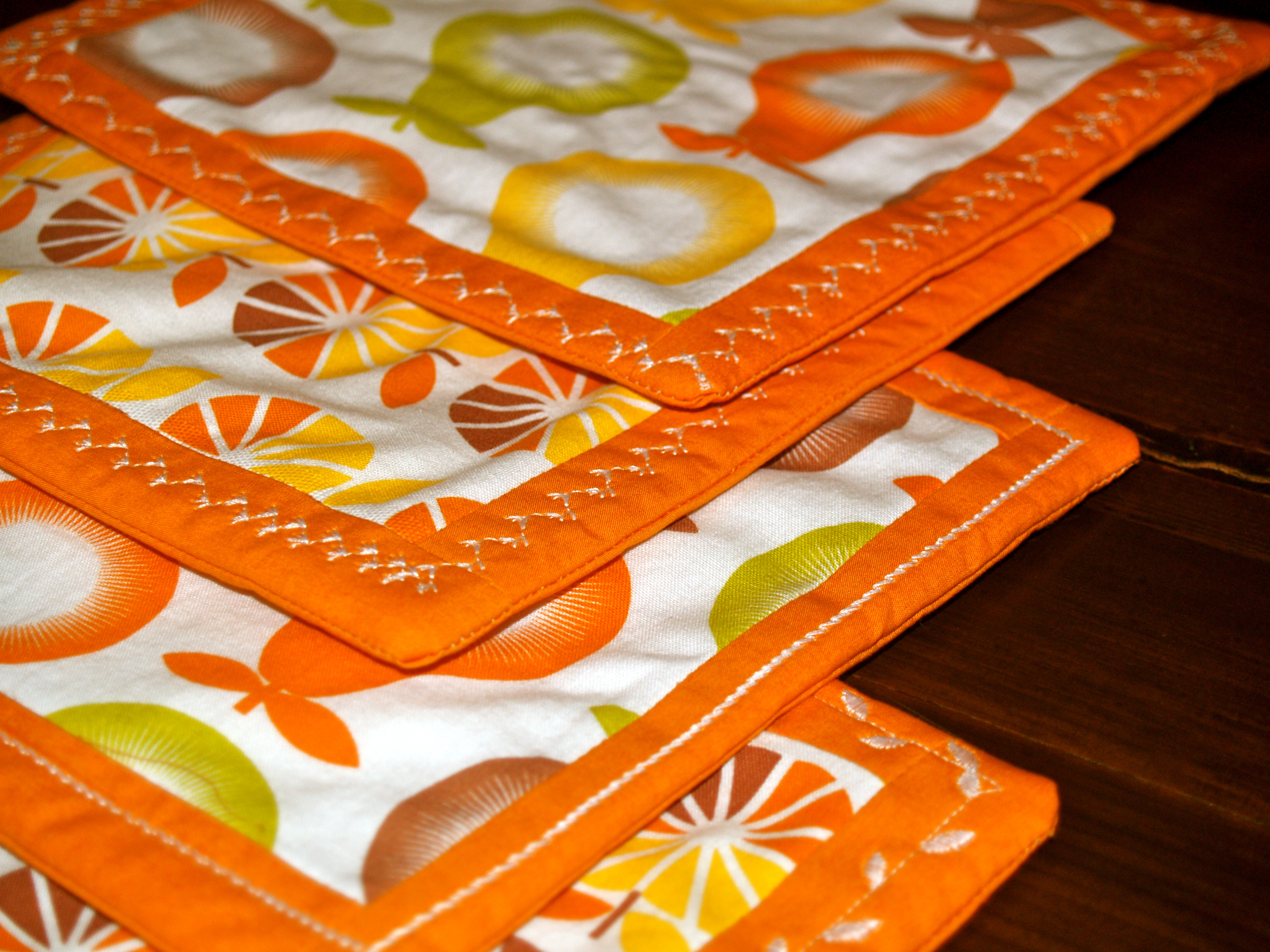
New spring kitchen linens!
It’s been ages since I’ve finished any sewing projects – mostly because of school, but also because my sewing machine was running a bit rough. Now that school is almost done for the semester, and I had my sewing machine tuned up last week – I have no excuse!
Starting out simply, I recycled some towels that were on the way to nowheresville and used them to back up some bright quilting fabric to make ultra-absorbent dishtowels. And then I added a few straightforward potholders to the mix and voila! New spring linens for the kitchen with a minimum of work and money. This is some slap-dash sewing, but so satisfying to get a project knocked off in under two hours!


Book Notes: Le Père Goriot
“Holding this book in your hand, sinking back in your soft armchair, you will say to yourself: perhaps it will amuse me. And after you have read this story of great misfortunes, you will no doubt dine well, blaming the author for your own insensitivity, accusing him of wild exaggeration and flights of fancy. But rest assured: this tragedy is not a fiction. All is true.”
Le Père Goriot, Honoré de Balzac
- Part of La Comédie humaine – the scientific novel work in which Balzac completed 90 novels which set out to examine in detail the human condition. The scientific approach being one of keen observation, and an attempt to set down the stories without authorial judgement on his characters. Written in 1819, set in Paris during the Bourbon Restoration.
- Somewhat of a King Lear – Old Goriot is an elderly man with two daughters who he has set up financially, yet who shun him emotionally right up to his death. I would not try to draw this analogy too closely, except to note that both touch on themes of inter-generational tension, inheritance, responsibility, filial love, insanity and the justice/injustice of death.
- We see the tale mainly through the eyes of Eugène de Rastignac, a man from a bourgeois, yet impoverished family. In the course of the novel he abandons his law studies in order to climb the French social ladder – and is almost willing to anything to put himself in comfortable circumstances. I say almost willing because in the end he chooses subjection to love over financial position by becoming the lover to a wealthy woman (who is prepared to keep him) rather than the husband to another woman who has come into wealth.
- Critique of middle-class morality (and lack of). It seems as though everyone has a lover and this is quite open. Gambling, debt, falsity feature strongly in the lives of the upper class.
- Vautrin (Cheat-death) the third central character after Goriot and Rastignac. Seen as scheming and Machiavellian in his dealings with Rastignac especially – still it is interesting to see how the boarding house members band together against his accuser. The sense that among any social group there is cohesion against the state or outsiders.
- This book lacks redemption for any of its characters. A gripping portrait of Parisian society – in the wake of broken/stirred-up social traditions, the individual takes on a selfish identity. This is particularly true among the rich, whereas the poor still rely on each other and thus act in a more unified way even in the most basic social interaction.
“However gross a man may be, the minute he expresses a strong and genuine affection, some inner secretion alters his features, animates his gestures, and colors his voice. The stupidest man will often, under the stress of passion, achieve heights of eloquence, in thought if not in language, and seem to move in some luminous sphere. Goriot’s voice and gesture had at this moment the power of communication that characterizes the great actor. Are not our finer feelings the poems of the human will?”
Book Notes: Disgrace
‘How humiliating,’ he says finally. ‘Such high hopes, and to end like this.’
‘Yes, I agree, it is humiliating. But perhaps that is a good point to start from again. Perhaps that is what I must learn to accept. To start at ground level. With nothing…No cards, no weapons, no property, no rights, no dignity.’
‘Like a dog.’
‘Yes, like a dog.’
An exchange between David Lurie and his daughter Lucy near the end of Disgrace. J.M. Coetzee
- J.M Coetzee’s 2nd Booker-prize winning novel. 220 pages of compelling reading with a deceptively simple surface.
- A story of personal disgrace (professor engages in lurid behaviour with a student which includes borderline stalking and a borderline rape – it is not named rape in the book, nor does the girl name it so, which in itself is part of the denial which lies at the heart of the book) – rooted in racial disgrace in post-apartheid South Africa.
- Characters wrestle with aging, death, desire, aloneness, responsibility (or lack thereof), and the ability to make reparations to others. Gender and generational relations are also powerful themes. Also, relationships with animals.
- Lucy, the twenty-something daughter is the first of the post-apartheid adult generation – attempts to make reparations through the body which can be read as somewhat naive. Coetzee himself clearly made decisions in his own life – by moving out of SA to Australia – that the Lucy character is confronted with. How much do we internalize the history of our countries? By staying on, do we make it right?
- Book was criticized for portraying Blacks as wanting to humiliate Whites who stayed on – but I wouldn’t read it this way – the characters of David and Lucy subject themselves willingly to their own “disgrace” (and by this I do not mean that Lucy subjects herself to her own rape, but she has agency in her choices afterwards). What I read in this narrative is the difficulty of building new relationships in the wake of the social shift. Roles are not reversed, and yet new demands are made on all characters that they are unsure of how to meet.
- What redeems David Lurie, if he is at all redeemed, is women his own age and his ability to seek counsel from them in meaningful ways. In addition, he has minor revelations about the nature of power and neglect through working at the animal hospital.
- I say the book is deceptively simple because it is a quick read at 200 compelling pages – but it is deeply layered and could be re-read from a number of different angles.


 Red Cedar