Red Cedar
More apocalypse, less angst
Post #2069: Knitting on the edge of the Salish Sea.

I’m sure everyone reading this knows that today is election day in Canada – and it’s important! By tomorrow morning we’re either going to have a new government or a constitutional crisis on our hands – and either way it looks like voter turnout is high. (In case you haven’t been following along, Canadians really, really don’t like the current government, but we’ve been having some trouble getting our shit together to vote them out).
But since all of us Canadians are on the edge of our seats and will be until sometime tonight – let’s not talk about that. Instead, I want to talk about another Canadian thing that I’ve been learning about recently – and that thing is Coast Salish style knitting. That hat above is an example of the knitting technique which produces something that many of us on the west coast grew up with – the so-called “Indian Sweater” also known as Cowichan knitting even though it doesn’t particularly originate with the Cowichan band (one group of Coast Salish people). As the style was practiced by many people along the BC coast, it is most rightfully known as Coast Salish style because that’s inclusive to all the peoples who practiced it (and doesn’t reduce all native people to a single band, which they are not).
Anyhow. I grew up on Vancouver Island in the seventies and eighties – during which time pretty much every household had a toque or a sweater in this style. Made of bulky wool, in a base of three shades (black, white, grey) – I can’t say I thought about them too much. Like any colonial legacy, Coast Salish knitting was just part of what was, not noticeable even though a very rich history and tradition surrounded these items.
For a full history of this style of knitting, I recommend that you pick up Sylvia Olsen’s book Working with Wool: A Coast Salish legacy and the Cowichan Sweater from your local library – which is the only account that I know of and full of fabulous historic documents and photographs.
Anyhow. I have been learning to knit (since June of this year) and one of the things I love about learning a totally new craft is that it doesn’t matter if I’m bad at at it. That is, I’ll try everything knowing that it’s probably going to have some problems, because everything new has problems – this is a liberating thing! So at the end of September, I signed myself up for the Fringe and Friends Knit Along which I thought looked pretty straight forward. I mean, I hadn’t done colourwork before – but still, how hard could it be to knit a Cowichan-style vest?
The answer to that, of course, is mixed. No, it’s not particularly hard, but if you don’t know the technique for trapping floats *and* you knit continental – well – there just aren’t a lot of people out there who can show you how. Also (as I learned on Friday) true Coast Salish knitting requires that you trap the floats with every stitch, creating a backside to the fabric that is pebbled and where no strands are carried without being trapped – and there are no videos online that show that (but there will be soon). So I started out on the vest, trying at first to do a gauge swatch and trap the floats – and pretty much immediately got stuck. I just could not see it from the Fair Isle You Tube videos. Also, I was working with bulky yarn and big needles – something I found much harder than I thought I would – so rather than powering through, I set the whole thing aside and figured I’d get back to it next year.
Cue: Perfectly timed workshop.
Early last week I noted on Ravelry that Sylvia Olsen was coming to Vancouver to teach some Coast Salish knitting workshop *and* one of them happened to be on Friday night when I had nothing else planned. So I signed up (how could I not – that was stupidly fortuitous) and went over to Wet Coast Wools to learn about this knitting form that was so dominant in the place where I grew up. Sylvia got us started with the knitting project, and while we were doing the unstranded grey brim of the hat, told some of the story of her history with Coast Salish knitting, and the colonial relationship that it developed out of. So we learned both the style and some of the history of what is Canada’s *only* indigenous knitting practice (by which I mean something that emerged from Canada in a singular fashion, Coast Salish knitting is the fusion of European-brought knitting and Coast Salish weaving traditions).
While I can’t say that I trapped my floats perfectly – I think I’m only averaging every other one here:

 I did start to get the hang of the technique and by the end of the class I had started the colourwork and was on the way to my hat. Saturday allowed me lots of knitting time and fueled by my desire to practice I powered through to a finish!
Not only that, I wore it out of the house on Sunday when I went to pick up chickens from our friends who raise meat-birds in the interior, and everyone in that little hunting/farming crew of ours were very impressed. It’s not hideous! But nor is it perfect.
Yesterday I pulled out the KAL project again and since we were having a lazy Sunday after errands, watching TV and eating moose meat tacos for dinner (such an easy thing now that we have a freezer full of the stuff) – I got lots of knitting time in to start off the project. Again, this has some issues – the bottom band cable got screwed up and I was well into the project before I noticed, and it’s hard to get even stockinette on large needles with bulky yarn – but it’s really just another piece on which to practice Coast Salish knitting techniques so that I can prep myself for a really large project like a sweater for Brian.
This vest requires that I knit and purl (it’s knitted flat) which mean that part of yesterday’s practice was figuring out how to trap the floats on the purl side – which I think I’ve got down now that I’m partway up the back panel of the vest.

Election watching at the bar tonight means that I’m not going to get anything done on this today – but I’m finding the colourwork process addictive – and I’m hoping that this panel will be finished by the end of this week (I’ve got a ferry ride to the island on Friday and one home on Sunday – that’s several hours right there!), plus Brian is out of town for a few days….. Not to get too carried away, but I could have this vest done before the end of October if I dedicate myself to it (and abandon my other sweater project for a couple of weeks)….
If you are interested in this style of knitting, or want to know more about Sylvia Olsen’s workshops, books, and stories – please check her out at her blog – she told us in class that she will be posting some technique videos to YouTube in the next couple of weeks – which I am looking forward to. In-person workshops are great, but videos really help to reinforce the learning.
As a final note, I want to acknowledge that the Coast Salish knitting techniques come out of a brutal colonial relationship which my people were a part of perpetuating in the interior of British Columbia (as homesteaders in Secwepemc territory), and which I perpetuate as a white person living on unceded native land. This does not erase the fact that I am from this land, and that Coast Salish knitting has a strong resonance for me and my family because is is such a place-based form of handwork – and so I learn it in respect of the people who have always lived here, and in the hopes that we can change future relationships through acknowledgement, reparations, and mutual governance of this place where we live.
Post #2068: Counting down the days
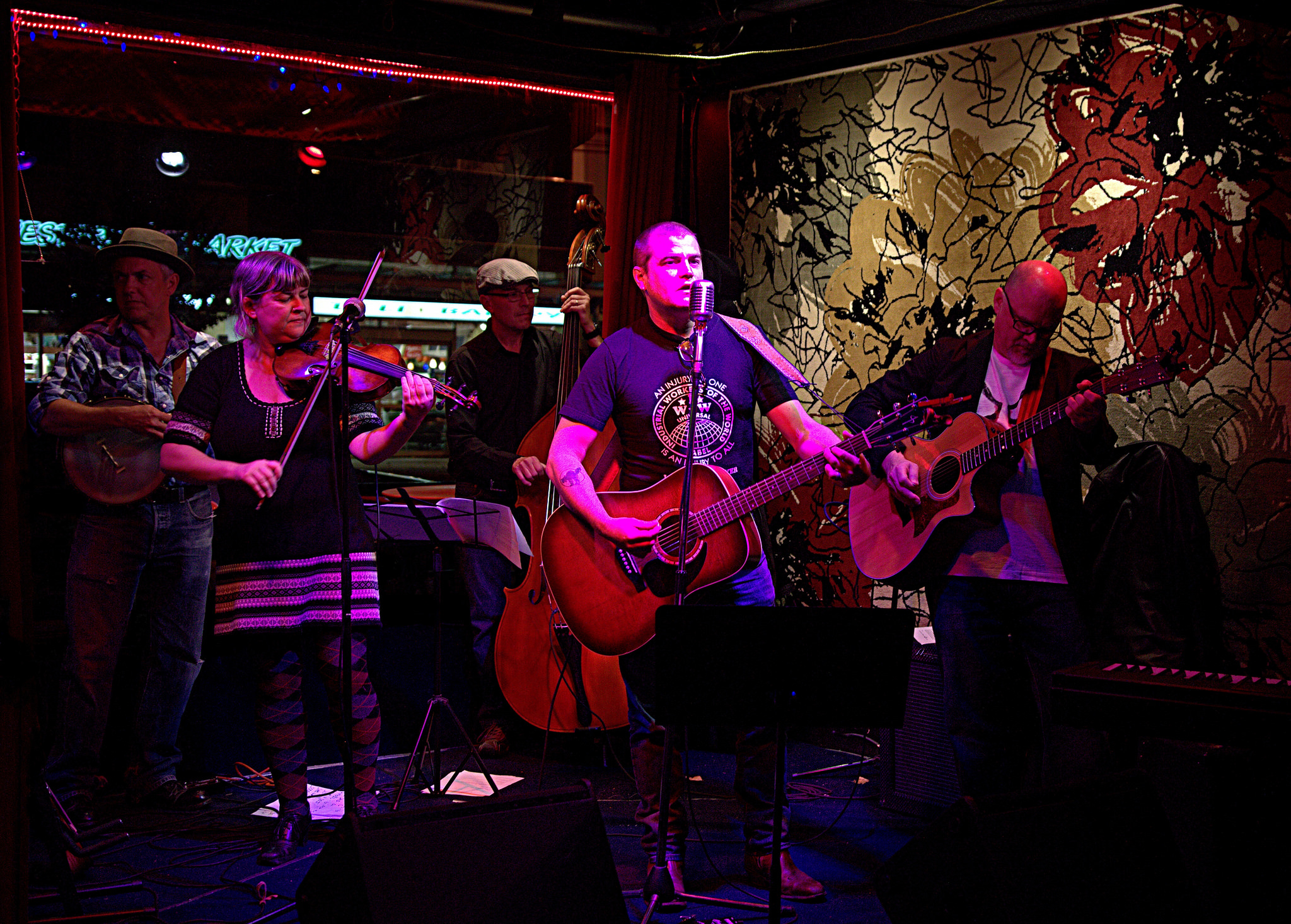
(Photo by Jonathan Moogk – My band Lone Crow Jubilee playing last Saturday night)
I haven’t much to say today except that we are three days away from the Candian federal election on Monday and I have read every single constitutional scenario for a minority government outcome on the Internet. We have had minority governments before, not that long ago, but this is a bit different because of the intense unpopularity of the current Conservative government. I’m curious to see how it all goes down, and am hoping ferociously that we will be all done with Tories after next week.
Either way, I’ll be crying on election night. I pretty much always do.
Post #2067: A small realization after morning coffee

Sometimes I find myself spun by anxiety. Am I good enough? Fun enough? Doing the right thing? Am I a good enough partner or friend? Do I live my life in the right way?
Today I am feeling that. Like I am not any good, even though I can look at my life with an objective eye and see that yes, I have made and been granted a very good life, full of brilliant people and material comfort – and that my own self and choices must have something to do with that. But anxiety isn’t objective, it just comes and goes, no matter how much I try to control for the factors which trigger it.
But then I also remember that no matter how I feel about these things – I just am. Am here. Am me. Am an expression of the life of this planet. And the feelings that bounce around inside are both real and unreal, can be set down and picked up again – and are hollow in the context of my knees touching the meditation mat, my butt perched on the bench as I let the space around me grow larger than my feeling. This moment, I think, this moment, with every out-breath I enumerate each second in which I am alive and just being. Alive and no one. Alive and everything.
Post #2066: In which I realize I will always want to be learning.

Last week, I crossed the stage and officially (in front of an audience) received my Master in Liberal Studies. So I am done with that – after four years of night classes and the occasional weekend seminar – I now have a degree to hang on my office wall, and if I choose, I can put more letters after my name (but I would never do that because in my work environment it’s considered pretentious unless one has a PhD and that PhD is job-related). Bill Nye the Science Guy also got a degree at my ceremony – and honorary doctorate in Science – which turned the event into a bit of a celebrity watch fest. I’m not sure the purpose of giving honorary degrees to people who already have several (he has six), and have no connection to the institution at all – but I suppose there is some bit of politics in it that I don’t understand.
In any case, I am 42 and have just finished my second university degree – and I have to admit that watching the doctoral students cross the stage, I was a bit jealous of their red robes and floppy caps – envious of their accomplishment and their new titles of Dr. Though I never felt this way during my undergrad, or while working on my master’s, I was suddenly taken with the idea of doing a PhD.
Fortunately, that idea was fleeting, when I realized two days later that not only am I already enrolled in more study, but that I would like any additional learning beyond that to be really much more hands on and applied.
For one thing, I’ve been accepted for precepts study in my Zen tradition – a process that will take a year or more to complete. And for another thing, I am really very drawn to textile and art techniques, and am already hungry for time in which to pursue those interests. Another formal degree is always a possibility I suppose, but for the next two (or more) years, I have other things to do with my educational time. In addition to the precepts study which starts next month, I’ve enrolled in an eight-week beginner weaving course for January – and Maiwa has so many amazing textile courses that I would love to fit into my life.
What this does highlight for me – the thinking about the PhD and all – is that I am quite happy with the idea that I will always be learning, enrolled in some form of education, and following my interests in both formal and informal ways. A degree is just one way of expressing educational attainment – and not the most appropriate one for what I want to learn and where I am right now. The desire to learn, however, has an ongoing place in my life – and I am so glad to set the master’s program aside and move onto a new course of study!
Post #2065: The sewing room tour (finally finished)
After a flurry of posting about the sewing room reno in early September, I’ve been a bit quiet on the subject in anticipation of the two final pieces of furniture that were on their way to helping me finish the job. This past weekend, both were installed, and so I’m ready to show off the sewing room I’ve been working on since August.
In case you forgot, the sewing room was shared with the TV and guest quarters and used to look like this:

Besides the fact that my sewing stuff was crammed into a shared space, I had also collected a ton of fabric from thrift and seconds sales, none of which I was ever going to use (it was bought so randomly), which resulted in a stash overflow of epic proportions. A big part of the job at the outset was de-stashing the fabric, with a little yarn thrown into the mix. We also got rid of the gross/ancient futon couch, the table my sewing machine was on, and moved the TV to another room.
 This really left me with only a large wooden shelf from the original room furnishings – an item my father and I made together about thirteen years ago – and that has always been wonderfully useful in my life.
This I organized with uniform boxes, five to a shelf, all labelled with their contents. Likewise, patterns got organized according to type in magazine files. Some other odds and sods ended up on these shelves as well, which is to be expected, not everything can be categorized! Having used this system now for the past month – it’s incredibly easy to both find things when I want to use them, and to put them away. Seems elementary I know, but being well-organized makes it so much easier to stay well organized.
Next up is the sewing table, which we put together on the weekend (it was on order at Sears for a month). I picked the Sauder table because it is designed for both sewing, and storing a sewing machine (right depth, right height), plus has some built-in storage, and folds into a cabinet. It may be that I never put my sewing machine underneath in the long run because I like to have it out and available. But if I ever do get a serger, it’s got a place to live.

Being able to keep my workspace tidy is really important (given the mess it was before all the time), so the extra cupboard on this is a bonus.
Of course, the one thing I haven’t had for years (since I lived in a 1/2 duplex all by myself on the Sunshine Coast) is a cutting table positioned at the right height. And so, I bought an Ikea Bekant table to do the job. It’s sturdy and a decent size – and I find myself using it as an all-purpose standing table for all sorts of things – sorting through patterns, hand sewing, choosing fabrics and threads under the super bright work light. It’s been really great having this set up. Underneath you can see baskets – one for unfinished projects, and one for scraps from works in progress. The UFOs in the one basket are very old, and some decisions will have to be made soon. The plastic drawers house some quilting projects in progress.

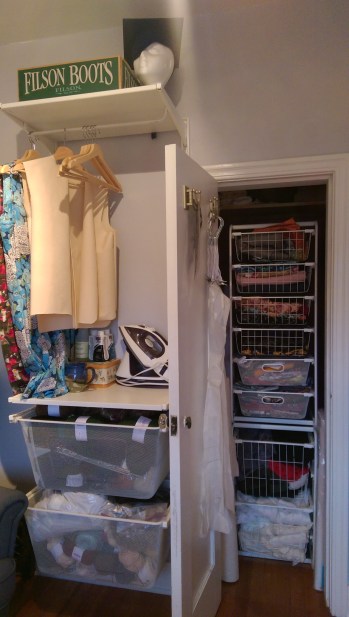 And then we come to two pieces of storage hardware the I purchased from the Algot line at Ikea. Algot is a series of mix and match pieces that make in-closet and hanging storage solutions – very easy to hang and put together. I wanted to be able to store all the fabric, yarn, and garments-in-progress neatly, and visibly (for easy access). My self-imposed rule now, is – no new fabric or yarn unless there is room in the bins for it. I have made my storage space finite and obvious to help curb my hoarding tendencies. Right here you can see that there are several garments worth of fabric, and at least four sweaters worth plus a bunch of other yarn. That’ll keep me going for awhile. One of the first things I did after the sewing room was mostly set up, was make the Woodland Stroll Cape out of wool that’s been in my stash for three years – this is a trend I tend to continue as I look at my oldest fabrics first.
One of the other final pieces, picked up last week, is this most-desired chair – which my mother bought me as a graduation gift. You see, I don’t always like to sit at the sewing table or stand at the work table – when I am knitting intensively or stitching, or even ripping out stitches on a dress gone awry – I like to have a comfy place to sit. Beside that you can see the technology center which features the printer/scanner, my tote full of camera bits (which I apparently didn’t tidy for the photo), a bin for paper, and the notebooks I pull out to write and sketch in. On top, you can see a doll made by my mother – my favourite of the many she has created.

Ultimately, it’s the little details that thrill me when I discover their utility or aesthetic value: I installed a full-length mirror so I don’t have to run up to the bedroom to try on garments, I framed some dresses that my mom made when I was a little girl as memento artwork, I hung kitchen organizers to keep all the small bits close at hand, and got all the thread out of a shoebox and onto an organizer so it’s easy to pick from. I also installed new overhead and task lighting, and a new roller blind to help keep the light in when working at night.

Of course, this wasn’t my labour alone. My husband painted from top to bottom, helped me install the shelving, and put the sewing table together. He’s also just been super supportive of turning this into my space now that we have a little extra room in the house – and that is *huge* to me.


 Red Cedar