Red Cedar
More apocalypse, less angst
Post #3054: Life at low tide

I was a having a perfect little romantic walk along the beach at low tide yesterday afternoon, when we passed a neighbour with her reactive dog barely under control. Not a minute later, and that dog shot up the beach and jumped on our beautiful old dog, biting her and then running off again. We scurried up the beach together to get away because I was afraid the attacking dog would come back at us, so riled up it was, but we managed to get up to the road and home without further event. That’s when I realized that Charlotte was bleeding – only a little – but still, it made everything seem much worse. Fortunately I have many supporters on the Internet and even some on my little island – and with friendly online hand-holding and some firm instructions about cleaning the wound from my neighbour – I got everything cleaned up and still managed to get in the studio for a couple of hours last night.
Two realizations I had as a result of this:
- At another time in my life, this incident would have sent me into paroxysms of anxiety and trauma. I would have felt isolated and scared (with Brian away), and sat inside those feelings quite willfully (not intentionally, but refusal to let go of a feeling is a powerful addiction). Yesterday, I got home with fairly little anxiety – some worry, but of a normal level – asked people in my community for help, got it, and then went on with things. I think that change comes from a variety of places, including aging, but I would pinpoint my daily meditation practice as the thing which has most helped me get less reactive over the last few years. One of my teachers told me early on that it wasn’t that meditating would change your immediate emotional reactions, but it definitely impacted how long you held onto the feelings afterwards – this came back to me last night when I realized that I quite effortlessly dropped the negative feelings once the attack had ended.
- Like any abrupt or traumatic event, I am reminded that no matter what moment we are currently having, it can change in a nanosecond, and without warning. Which is why we can never get too smug about where we are, or how things are for us. It’s just luck that something hasn’t occurred to take it away yet (or luck that we were born into it in the first place) – nothing to be proud of, nothing to take for granted.
The dog and I are both fine this morning, she’s a bit more tired than normal but pretty much seems to be herself. I expect she’s sore from being jumped on, but the site where she bled doesn’t seem to be causing her any real pain, even when I run my hand over it. I’ll just keep it clean today with alcohol and watch for infection at this point.
My plan for today was to get back to blogging with a Dillardesque reflection on low tides and what they bring (birds! seaweeds! interesting rock formations normally under water!) but instead, it’s something else. It’s the real thing – the fact that life everywhere is changing at each moment, and if you don’t pay attention you miss so much of the unfolding, each second that is about to change the course of your life entirely.
Post #3053: Restoration, self and loom.

Is it ironic that I took a mental health day on mental health awareness day? Because that’s what I did yesterday – I took a day off work to deal with my anxiety, imposter syndrome, and the general antipathy that I am feeling towards both my work and my co-workers at the moment. I won’t go into why I’m feeling stressed about workplace issues – because we’ve all been there and the specifics matter much less than the fact of having to sell our labour to survive in the first place.
Anyhow. I spent my day off as follows: morning meditation, long walk on the beach, studio time, 2-hour yoga class, errands, awesome healthy dinner, and more studio time. Pretty great, eh? Well yes, but the work anxiety plagued me all day and I periodically checked in on my email as a result. Turns out, I am missed when I’m not around and today I have double the number of items to follow up on. Which is why I get paid what I get paid, the buck so often stops with me.
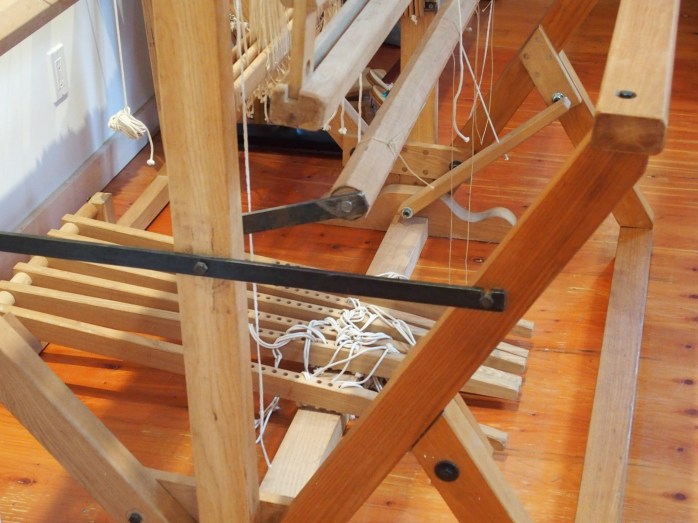
My studio time yesterday was spent mostly on the loom. On Tuesday I was at a furniture restoration place to drop off a chair, and I picked up the miracle product: Howard’s Feed N Wax which is a wipe-on, wipe-off beeswax product that smells like oranges – and I could hardly wait to take it to the wood of my 44-year old loom. I’ve got the breast beam and the castle done and you can see here the difference between the waxed (right) and unwaxed (left) parts:
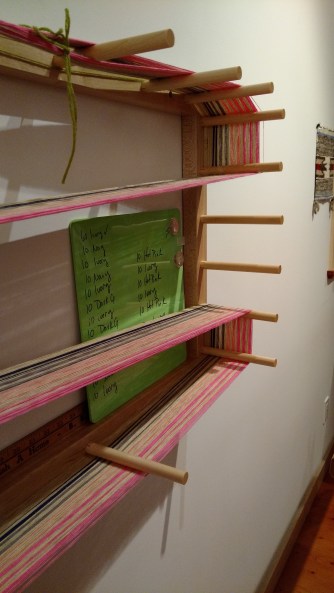
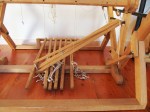
Even more striking are the shaft bars that I polished and strung with new texsolv heddles (you can see them in the foreground hanging in front of the old bars and string heddles behind):

 As I’m working on the loom, I’ve got the distinct impression that it was built sturdily but in its many decades of being moved around (the former owner moved it across the country and back 3 times), it hasn’t been put back together quite right and so there are some places that need tightening, and I might end up putting a screw or two in to straighten things up. This is one of the benefits of cleaning and waxing the whole thing at the outset – it’s giving me a real chance to look at each part carefully. I’m glad it’s taken me over a year to get to this job, for I didn’t know enough when I bought the loom, and would have done a half-assed job of fixing it up had I just brought it home and got started.
In the evening, I started winding another warp, getting about 2/3rds of the way through it (and finishing the colour stripes which are the time consuming part). This is for my hubble-photo inspired tea towels which will be of a very plain weave – and will be woven on Little-J (my small loom). I have to admit that the more I weave on the small loom, the less I like it – it’s a table loom with treadle conversion and thus very light weight and wobbly – not to mention clacky (loud). I expect that the countermarch, when ready to go, will make a much more satisfying weaving experience – but I’m glad I’ve had the small one to work with in the meantime. I’ve learned a lot in the last few months, and Little-J was a lot less overwhelming to get started with.
I forsee that the Little J will get sold in the future, as I narrow down my needs and options. I now realize that it’s too small for most things I want to do (20 inches), but weaving on the 45-inch countermarch is going to be a bit of a reality check on what width of fabric I really want to make and my talent at shuttle throwing!
This weekend I’ve got to focus on making bags for an event next weekend, so I’m not sure if I’ll get my loom threaded for the tea towels – but I sure hope so – because there’s something nice about always having a weaving project set up and ready to go. Bit by bit, I’ve got myself a weaving studio happening here — not to mention a great beach to take walks on when I need a reality check….. now, if I could only ditch the work thing.
Post #3052: Recognizing the countermarch!

I have to confess something here and now:
When I bought my floor loom last February I had no idea what I was buying. I mean, I thought I did, but really I didn’t.
For months now, I have been circling this loom and trying to figure it out. I’ve moved it twice but never gotten it set up to weave on – partly because I want to replace all the cordage, but also because I just wasn’t *getting it*. I thought it was a standard jack loom because that’s all I really knew about, and I reasoned that it looked so different from other looms because it was hand built in Nova Scotia in 1973 (by a draft dodger and his wife) which made it unique. I figured that I had the treadles on upside down which is why they did not hang properly – I thought once I replaced the cords and tied it up, I’d get a warp on no problem and it would all fall into place….
It turns out that all of that was wrong.
Since November when I started weaving again after getting the J-made up and running, I’ve been consumed by weaving websites and discussion forums and books. It was while perusing some forum a couple of weeks ago that I found a picture of what looked almost identical to my loom…… The Glimakra Standard – and it was upon poking around some more that I realized that my loom is not a jack loom at all — but a countermarch!
While jack and countermarch looms have many things in common, they do not operate in the same way when it comes to tying them up. The weaving process is the same, but the set up process is not. No wonder I was confounded!
Now that I know what I have, I’m feeling a lot more confident about getting it up and running over the next few months. It is a beautiful piece of work, this loom – likely made of maple, with hand-forged metal fittings — a good cleaning will bring it right back again, not to mention replacing all the old string heddles and the clothesline cord before even attempting to warp and balance it for weaving on. Countermarch looms are supposed to have easy treadling and be fairly quiet – once you stop swearing while attempting to tie them up that is! So I’m eager to compare it to the little loom I’ve been working on for the last few months.
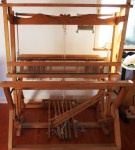
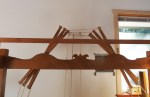
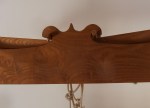
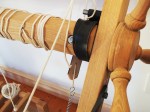
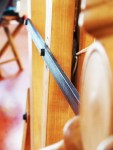
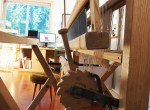
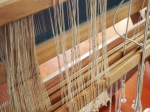
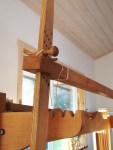
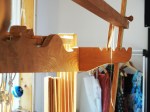
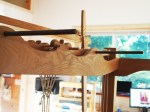
I’ve taken a bunch of photographs and created a gallery of the details here because one thing I’ve found is that there are not tons of countermarch resources on the Internet, and my pictures might help someone else ID their loom later on. Bit by bit, I’m going to figure this one out!


#3051: A miniature rant

I have unfollowed an awful lot of people on FB lately. And not because they are right wing, you know? But because they are ludicrously angry about every single thing. I can’t take it anymore – I really can’t. I want to engage politically but I am beyond done with the non-stop infighting, macho posturing and angry lecturing. So I’m disengaging with that – using social media to be social – and taking my politics back to the world at large as I prepare to run for president of my union local next month and work on local community projects. My time is not well spent being talked down to or shouted at.
Fact is, each one of us has only so much energy and so much influence. It’s important to direct that wisely.
Post #3050: Meditating the morning of….

I’m not going to say what it’s the morning of, because we all know, and many of us are unhappy about it, and the world seems inching closer to the edge as a result of what will happen later today.
And yet.
And yet when I rose this morning I got on my knees to meditate in the dark dawn of 6 am. I took refuge there in the stillness, the cushion supporting me, the trees of my island breathing in and out alongside me.
Towards the end of my sitting this quote bounced up into my mind:
Acceptance does not mean fatalism. It does not mean capitulation to some slaughtering predestination. Those who follow Tao do not believe in being helpless. They believe in acting within the framework of circumstance…. Acceptance is a dynamic act. It should not signal inertness, stagnation, or inactivity. One should simply ascertain what the situation requires and then implement what one thinks is best. As long as one’s deeds are in accord with the time and one leaves no sloppy traces, then the action is correct. Deng-Ming Dao
I take refuge for exactly this reason – so I can get up and face the world as it is, while still holding faith in the capacity for compassion, renewal, sanity. This is the only practice that stops me from becoming paralyzed by the grief held inward like a breath that can’t be properly expelled, decaying and stale.
I will not watch the news today – acceptance does not also mean that one must stare at the train wreck. I will knit a silly pink hat and plan to join in the collective of women around the globe tomorrow. Knitting, meditating, chanting, and changing. This is my world. The one I accept. The I take refuge in and from. Breathe in. Breathe out.


 Red Cedar
