Red Cedar
More apocalypse, less angst
Post #3094: Things in perspective
A co-worker died last Wednesday in a work-related car accident. It was one of those freak accidents in which the thing most at fault was the icy roads and bad timing. But somehow, that makes it worse – a reminder that life can conclude in a catastrophic second. When everything is otherwise normal and you don’t even see it coming, and there is no one to blame because the condition of this life is that it one day ends.
We like it better when we can blame something for a death – a drunk driver, smoking, untreated diabetes – and so on. As though divining all the possible reasons for death, we might avoid them entirely ourselves. But the death of anyone we care about is a warning, one that we secretly hope is not applicable to ourselves.
This is perspective, a death always is. And because it was work-related, it’s put some work-related issues into focus for me – things I’ve been feeling muddy about for the past few months.
I don’t want to write too much about my first world problems in my first world job…. But the essence of my work thoughts have been in the vein of meaningful work, right livelihood, and whether I can work another ten years in my current position (without going bonkers) in order to achieve my retirement pension.
I think this is mainly life-stage related, not specific to me or my work – as I’ve seen many people ask these same questions of themselves in their forties. This is also a period in which many professionals in jobs like mine (government) decide to quit and become consultants. Sadly – a correlated trend is people in their fifties coming back to government to get five more years into their pension so they can one day retire. After twenty years of watching people come and go and come again – I am mostly convinced that switching workplaces is not the answer to the work mid-life crisis (though I still have many days where I fantasize quitting).
I suspect that people leave work because, like me, after twenty years of doing something one has become an expert. In many fields once you’ve attained a certain status, there are not a lot of higher achievement levels, and thus work becomes a bit boring. In bureaucratic fields like mine, creativity is rare and something we must constantly fight to express in our work – and after a while of that, a bitterness or exhaustion starts to seep in. In the past two years I’ve found myself increasingly saying “just tell me what to do and I’ll do it,” with a kind of despair over the lost autonomy in my work.
But where my interest in professional work flags, I have another whole work life as the president of my union local. In this work life, I run the show (to some extent), am required for creative problem-solving, negotiation, counsel to my co-workers, and maintaining good work relationships at all levels of the organization. I manage a budget, lead my organization in good governance, and sometimes even get to advance social justice objectives in the cases I represent before management. In short, I have a role that is unique in my organization, and autonomous while still having obligations and responsibilities.
This is an obvious contrast to my official employment, but as I’ve said to many people over the years, it’s probably being a shop steward that has kept me in this particular workplace more than anything (well, and the people I work with are awesome).
My issues of the past year are about how I balance these two spheres – or in fact, stop thinking of them as two and realize that they are both part of the same workplace coin. Since becoming local president, I have at times seen them in opposition to each other – and instead of working to re-balance the load to other co-workers or union reps, I have tended towards holding in the work, as if to prove that it is possible to do two full-time jobs by myself. This has caused a bit of a problem in terms of work stress, but it has also created a resentment towards my career-work that is artificial.
The reason this has come up in relation to Ann’s death last week is because I always knew her to be a woman who brought a lot of herself to work, and found a great deal of meaning in serving her workplace as an administrative officer and a shop steward, not to mention as a social justice activist and advocate for the unemployed in her community. Although I did not know her closely, it seemed to me when we did work together that as much as she had a life away from work, the people she worked with and for were of significant meaning in her life – and her unionism was part of the same cloth as her dedication to work. What I have seen since her death is that her work, and work-related service as a union steward – are cast together as an honourable whole by those who knew her. That these two things are not observed upon as distinct from one another, but as parts of the same livelihood which extends beyond how we make our living, and into how we live our lives.
In short, the big takeaway from the last couple of weeks is thus: Looking for meaningful work is a mistake if we do not learn to find meaning in whatever work we do.
And meaning, in my job, is right in front of me in both of my roles – as is interest, demand, and novelty – if I just tilt my perspective slightly and find ways of giving myself the time to properly do and enjoy my job. That means better work/life hygiene – more separation between work time and downtime; sharing work with my union reps and my co-workers instead of hoarding it all; and meditation every day (it really helps me keep perspective which is what this post is all about).
So, no – I did not interpret my co-worker’s death as an “you only live once” reminder and immediately quit my job. Instead, I responded to what arose in me – a need to engage with my co-workers, ask questions about what was needed, and go back to work to support people in my union role. This event has been a sharp reminder of what matters though, and a big part of that is how we approach what’s right in front of us each day.
Post.#3093: Road trip to the other side of the Island.

In more than ten years of being together, Brian and I have never celebrated Valentine’s Day. We don’t believe in Hallmark holidays for one thing, but also, my birthday happens the week before and we’ve already done a dinner thing, or an overnight thing for that. Valentine’s just seems like one more thing to spend money on.
But when I told Brian last week that I was taking some time off work, effective immediately, he suggested that we take a couple of days of holiday on the other side of Vancouver Island. And thus, yesterday we arrived in Tofino coinciding with Valentine’s Day.
Tofino has changed a lot since I was a kid. For one thing, there are several resorts on Long Beach, all with beautiful big lounges that look out onto the ocean. Although these resorts are out of our price range – the lounges at happy hour are not – so last night we went out and had (the pictured) fancy cocktails in the Long Beach Lodge “Great Room” and watched the sunset with all the other romantical couples. Two $6 “champagne” cocktails later and I was happy to retire to our B&B on Jensen Bay (the inlet side of Tofino).
This morning we woke up to this sunrise over Meares Island before stumbling up the trail to a little hot tub nestled in the trees:

It’s a pretty spectacular spot all around. Plus the weather is taking a break from the storms of the past few weeks. As far as I’m concerned that’s great news for this trip, but according to someone here – tourists at this time of year hate the good weather because they are here to “storm watch”. Apparently that’s something the big resorts promote as a winter pastime to get people over here.
We’ve got dinner planned for the best restaurant in town tonight – The Wolf in the Fog – almost impossible to get a reservation at but highly recommended. I’m hoping it lives up to its reputation. But even if it doesn’t, a couple of days among the big trees of the west coast feels like a good break for the brain and a little recuperation of heart time for Brian and I. Despite the fact I don’t do Valentine’s day, a renewal of time together is always well spent.
Post #3092: Another Blackwood cardigan

Last night, I went up to the studio with no real plan in mind. I’m still exhausted from my work meltdown and it’s hard to get excited about things at the moment. Fortunately, I had a project on the dressform that only needed a couple of pieces cut and sewn to finish, and Voila! Another version of the Blackwood Cardigan, this one fitting perfectly with a couple small adjustments to the width on the front band.
When we get back from Tofino, I will have to decide what to tackle next: a pair of pants? One of my unfinished jackets? Or recurring a pattern based on a muslin I just made (that didn’t work out). I find it’s best going into the studio not knowing what I am going to work on, and just let my energy level and interest direct me. Too much forcing myself to finish projects and I just end up resenting the whole exercise.
Post 3091: Birthday dumplings

Last week I turned 45, and one thing that happened was my friend Aaron came to visit me all the way from New York where he lives. I picked him up at the Nanaimo airport first thing on the morning of my birthday and we got a coffee and then went to Man Lee (the Asian grocery) before coming back to Gabriola.
Since moving here, Brian and I have felt the absence of good Asian cuisine. We are lucky that there are a couple of good restaurants on our island, but it’s just not possible to get good Chinese food here or anywhere close by. In Vancouver – good noodles are served in almost every mall kiosk and you can choose restaurants by very specific region – so that’s been a bit of an adjustment (ie: we were spoiled by delicious and inexpensive food from around the world).
As I’ve posted elsewhere (and perhaps here) – this has forced us to really up our cooking game, and I’ve been seeking out good cookbooks to aid us in not only learning to make specific dishes, but learning about different cuisines as a whole. One of the books which has been instrumental so far is Fuschia Dunlop’s Every Grain of Rice. So far, I have cooked about half the recipes in that book – and I plan to make the other half over the next few months – because every single one is a winner, and I’ve learned so much about cooking techniques by following them.
So, for my birthday I decided that the best way Aaron and I could spend our afternoon was in preparing a feast of recipes I’ve never made before. This included Sichuanese Wontons in Chilli Oil Sauce, Bok Choi with assorted dried fungus (her recipe calls for fresh shiitake, but I wanted a dish with snow and black fungus so I improvised), and Steamed Chicken with Chinese Sausage and Shiitake Mushrooms (wrapped in lotus leaves).
I have to admit that I’ve always been a bit daunted by dumplings – the making of them that is. But with a friend to help, we figured it out and ended up with so many perfect bites! This meal was also my first time steaming food in lotus leaves – which I did using the Instant pot.
I would say that this was the best meal I’ve made from Dunlop’s book – but I’m really not sure – as I’ve made so many great combinations of dishes in the last few months. One thing I know for sure, is that these are restaurant-grade meals – as good as anything I’ve eaten in Vancouver over the years – aided by ingredients that are local and fresh from the island where I live.
Post #3090: In which I catch my breath
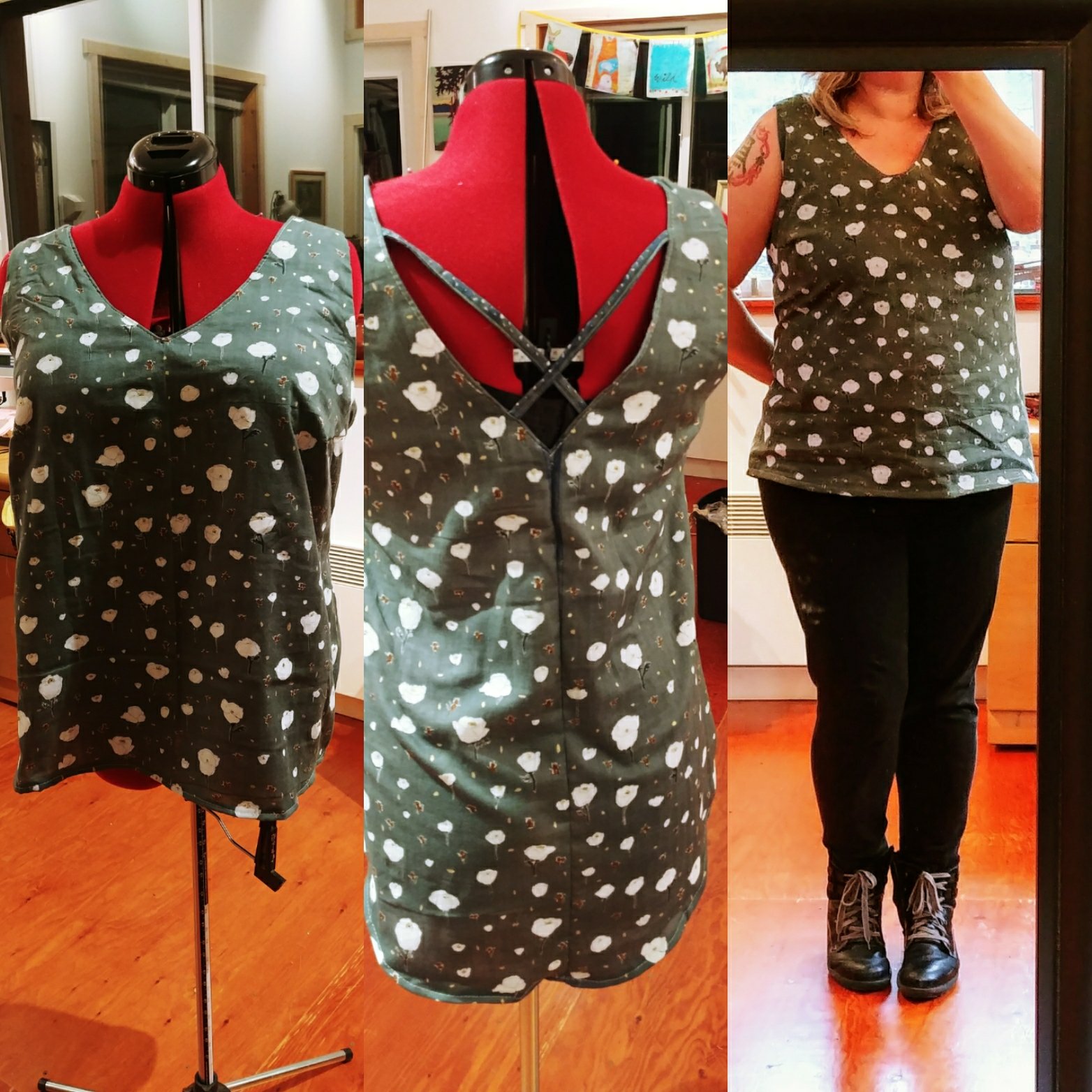
Last weekend I finished a new top, pictured above. It’s the Cashmerette Webster top/dress – which I made a muslin of back in early December to see if I would like it better as a dress or a top. Top won – and I made this version out of some stash fabric (Nani Iro double-gauze) that I have been waiting to use for two and a half years! Since making this top, I’ve worn it five times – a clear indicator that I will need to make another top from this pattern.
I’ve got many things cut out at the moment, or ready to be, and I’ve just salvaged two unfinished jackets from the sewing basket where things to go die. If I get myself in the right mode, I will have some new clothes for spring.
At the moment, I’ve got a few days off work – taken in a bit of a fit last week, when I reached the end of a high-pressure project (and ongoing overtime for months), and my brain kind of broke, snapped or whatever. One might call it a nervous breakdown – but given that I seem to be returning to myself rather quickly, I’m going to settle with extreme burnout as a better description. I’ve got until Monday off, and if I’m still feeling foggy, then I’ll take a few more days. At this point the emotional upheaval (crying) has tapered off and I’m just feeling very slow. Not depressed – just as though my brain has come to a bit of a crawl.
I’m taking things easy and trying to figure out what steps I can take to better protect myself, my boundaries, and free time in the future so that I can get the necessary time out that I need to function. Part of the issue is that I have not taken a total break from work and union responsibilities in a year – even when I take time off I check email and often end up working – and while I thought I could get away with that, I realize now that I can’t. Also, I should always schedule a week off in February because I always need one. And I don’t need to hoard work – it is entirely possible to share my workload better with my team.
Anyhow – I’ve returned to zazen after a week without (what a mistake, I always drop it when I most need it), and am focused on going in – in order to get out of this state I’m in. There is nowhere else to go right now I’m afraid – it’s all me, or nothing. Or it’s nothing and all me. Because zen.
So I’m here, and sewing – fixing up this blog to reflect the focus of it a bit better – and packing up for an overnight to Tofino tomorrow. I’m sure I’ll have more things to say on all of these topics shortly.


 Red Cedar