Red Cedar
More apocalypse, less angst
Post # 3101: Small tasks in awakening
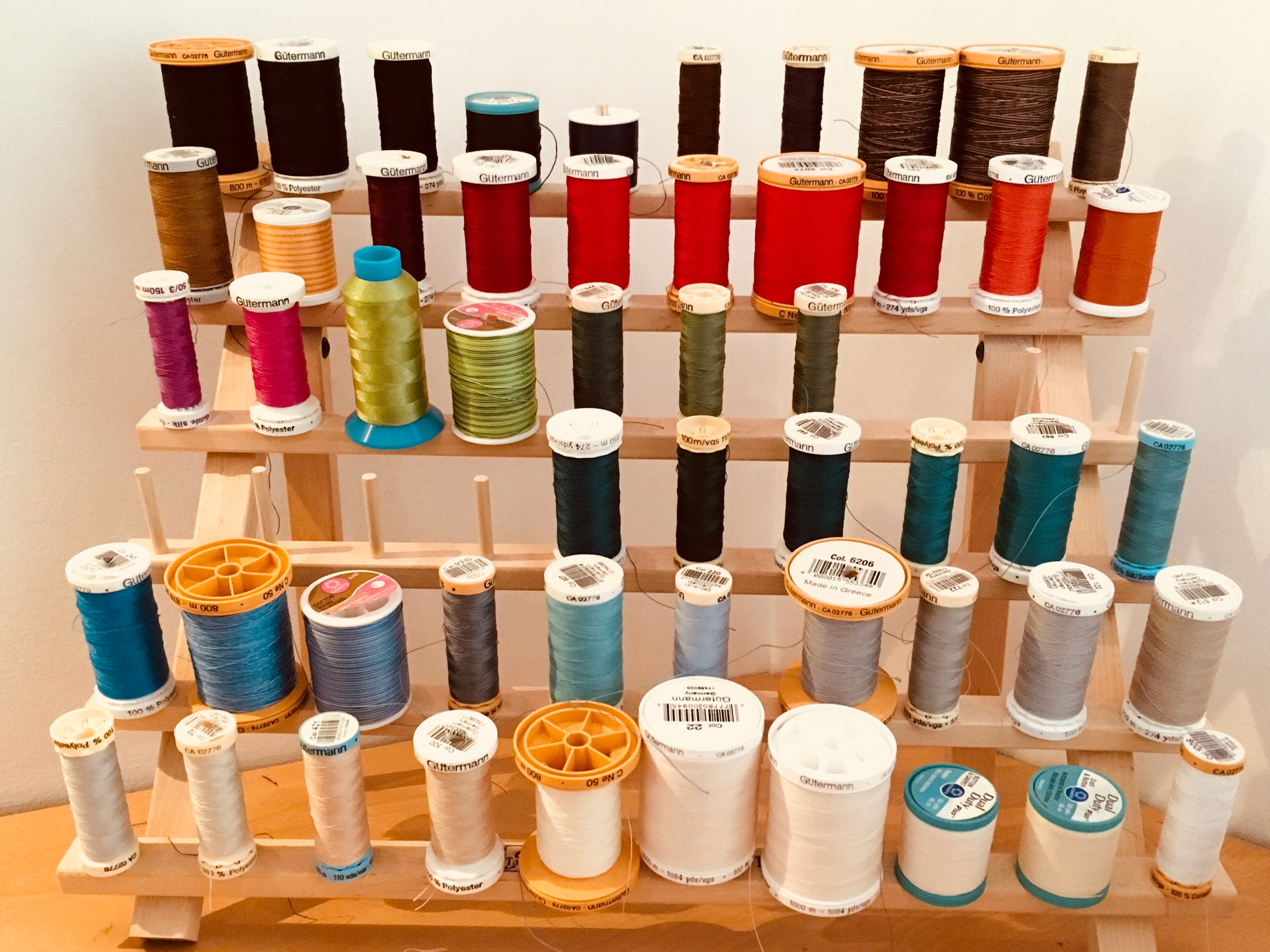
I sorted my thread spools this morning and threw out the near-empty ones, arranging the remainder by colour in the spool rack. It was a very satisfying small project, particularly because I look at them all the time; they sit right beside my computer monitor at my work desk.
This week I plan to focus on small tasks like this. Tidying up a corner of the yard or two, emptying out the boxes I moved out of my old office, renewing my car insurance, cutting out a new pattern on some muslin fabric. It feels like we’re just creeping out of the end of winter weather, and I think small, completed tasks will help pull me along in that.
Seasonal birds have returned to my yard, daylight savings will bring longer evenings, and we are only fifteen days away from the official start of spring. Oh, my soul. It’s time to wake up!
Post #3103: The spa robe
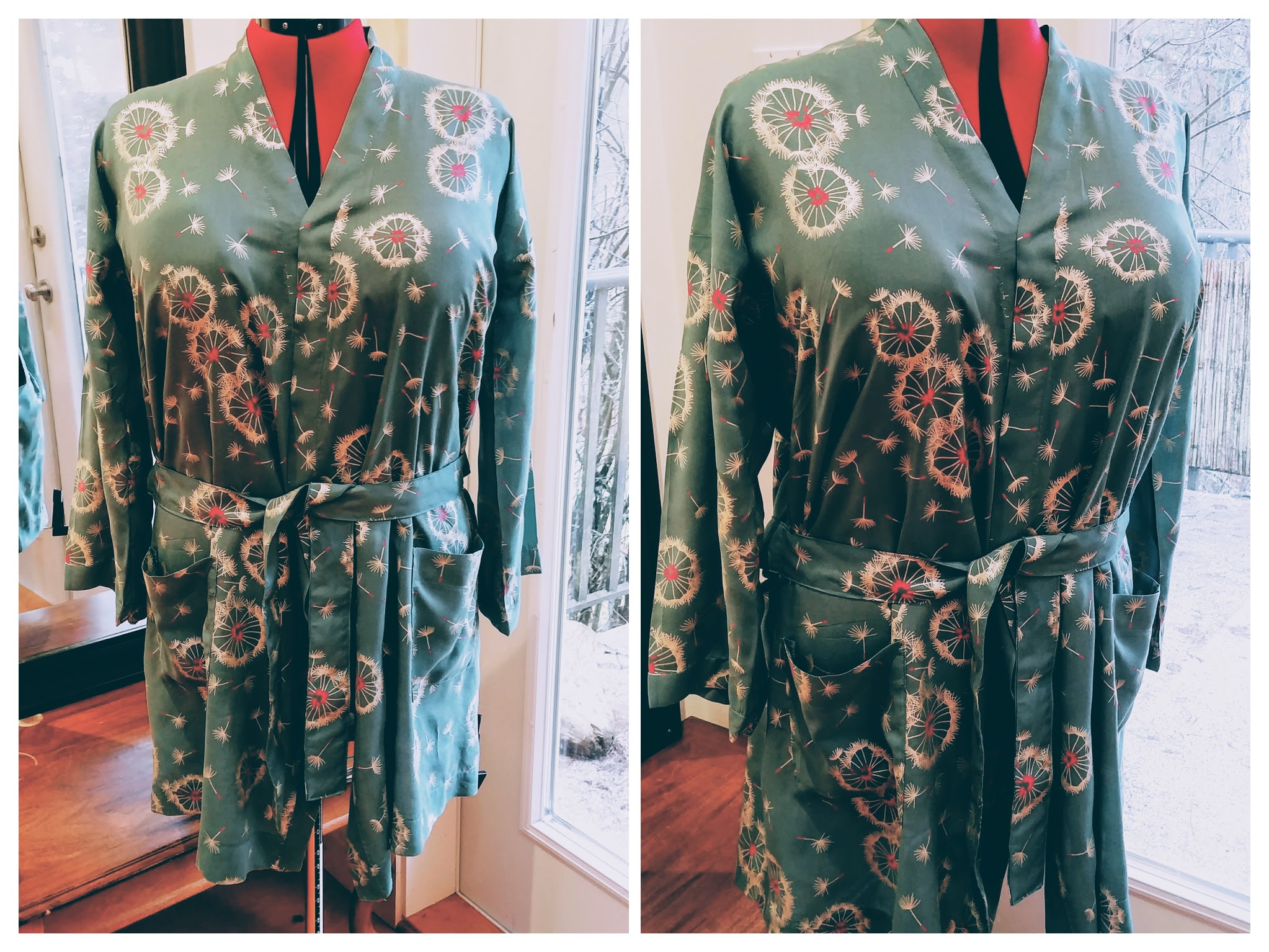
Voila! I present to you my new hot tub cover up!

This is the final, and largest make from the fabric mailing I received from Sew Haley Jane ten days ago. Between the cloth wrappers and this robe, only a half metre of rayon is going into my stash, and all other items from the box (including most of the matching thread) have been used up.
The fabric is Art Gallery Fabrics rayon – Tiny Dancer metallic. Though you can’t see in the photos, the dandelion heads are a silvery colour that pop quite nicely. For a pattern I chose the Purl Soho Robe which I had in my pattern stash already – it’s more of a formula for making a robe than a pattern, which suited me fine – particularly as it focuses on getting nice finishes.
Rayon isn’t a fabric I have sewn with much, as I don’t tend towards blouse-weight materials in my dresses or tops – and as much as I love this print, I couldn’t really imagine myself clothed in it. However! Since the hot tub went in and we use it pretty much every day, I’ve been noting the need for a cover up to take me from house to tub and back again.

Because a robe doesn’t have a ton of fitting issues, this make allowed me to focus on finishing techniques: french seams, measuring hems and bindings properly, and hand stitching. The front and sleeve bindings are both attached with blind stitches – something I’ve always been unsure about, but following the instructions, I got a nice finish and the stitches are imperceptible on the front of the robe.
As I was working on attaching the waist tie, I realized that something I’ve always hated about all robes I’ve owned is the fact that somehow, a single waist closure is supposed to do the trick. As anyone with a bustline knows – this only works on straight bodies – and most of us end up cinching the waist ever tighter in hopes of magically closing the gap up top. To rectify this long-standing annoyance, I’ve put a snap up top to hold it closed, and frankly, I will likely often wear this without the tie:

This was a totally engrossing project over several days – I took it one step at a time without rushing any of them. The only thing I might have done differently is make this a tad longer, as I shortened the original measurements a bit too much. On the other hand, this isn’t a robe for warmth, and it covers up nicely. Now that I’ve done this pattern once, I have in mind to do a heavy linen version for Brian (his robe is looking pretty shabby and men’s robes are almost always too long for his height). I’ve ordered some fabric samples to see what might work best.
All in all, I am very satisfied with the garment, and plan to use it later this afternoon when the rain subsides and Brian returns from the city. Around here, hot tub time is quality time!
Post #3102: Project before power outage
Yesterday was a blustery, cold day here on the island – but that didn’t stop me from going into Nanaimo to protest the Phoenix pay system, blight to the federal workforce!
While I was there, I also stopped by my old office to pick up my things as I was kicked out of it a couple months ago for someone who doesn’t have the option to work from home. Since changing my reporting relationships a couple of years ago, I haven’t really had a work “home” in BC – and as a result have become entirely telework based over the past six months. I turned my pass key in yesterday and that was it, I’m officially an itinerant worker.
Now I have a bunch of boxes in my car that I am determined to ruthlessly sort through because I am 100% sure that most of that stuff is not at all necessary and can go to thrift or garbage.
When I got home from my travels I spent a bit of time in my studio – and decided to get the five fat quarters that came with the Sew Haley Jane mailing out of the way. I’d been looking at quilt patterns to use them in – but honestly, as much as I love the colours, I couldn’t see them in my home. So instead, I cut them, finished the edges and added some ribbon – and voila! Wrapping cloths:
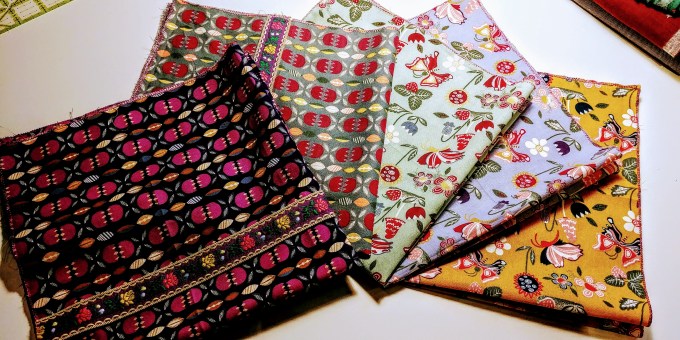
For a number of years now I have used cloth scraps and remnants instead of wrapping paper for gifts – much less wasteful and the fabric is easily reusable. Also, a nicely finished cloth wrapper becomes part of the gift!
These ones are 18 x 18, finished with a tight zig-zag stitch along the edges. A small but satisfying project that can wrap an average sized book, an 8 x 8 box, or a grapefruit sized round object.
I’m glad I went in the studio in the afternoon instead of waiting until after dinner because not long after I got these done, the power went out!
We’re still out as I write this – so whatever happened was no small event (I understand that some kind of surge blew two transformers) – and my battery powered devices are dwindling. Fingers crossed we get it back before noon!
Post #3100: Cabin changes
I have not written about our cabin at Link Lake in ages! Mostly because I haven’t been there since October – but also because there have been changes afoot in our ownership structure that have taken a few months to sort out. We’re right on the cusp of that sorting though (documents are being signed shortly) so I feel like I can talk about it now.

Our cabin in the interior of BC was bought as a piece of bare land five years ago with three partners involved in the purchase Brian/Me, Leung and Dave. We hired a builder to do the initial construction, with a plan to do or hire out the finishing work ourselves (in our case, finishing involves putting in a well and septic – so it’s a bit more involved). The cabin is not finished, but is in a totally usable state – we’ve got a woodstove, electricity, and wifi – and is well insulated for winter use. This last summer we put up railings so the deck wasn’t such a death trap – and bit by bit we’ve been doing the small work.
Bigger work hasn’t been happening though – and we’ve been a bit stalled, owing to the fact our land-partner Dave became disenchanted with the project a couple of years ago for a number of reasons (building codes, not the type of build he had originally envisioned, more money than he originally planned on spending etc). Since that time, we’ve been trying to sell his share in the cabin and bring on another partner, and because we no longer had three partners to put in $, large scale projects like a well got put on hold.
While jointly owning a recreation property is awesome on a number of fronts, it should come as no surprise that it’s a challenge to sell a share in a property like this. Selling to a stranger is out, but we don’t have a lot of friends who can come up with a large enough chunk of cash to buy in (even though it’s a steal for recreation property within 4 hours of Vancouver) — and of the friends who had money and were interested, two different couples came up to try it out for a weekend on their own and decided that it wasn’t for them after all.
We didn’t cast the net wide – preferring to let people come to us organically and vetting interest as it arose. We didn’t want to rush anything, nor did we have to. Our partnership agreement is pretty clear that the person who wants out has to do the selling of their share, and since Dave wasn’t pushing it, we didn’t have a hurry to find someone — which it turns out was very lucky because the perfect new land partner materialized this fall in the form of our friend Lisa!
Back in October, Brian and I were at the cabin with Leung, and our friend Lisa came up to visit for a weekend – while she and I were walking the dogs down near the bird sanctuary on Osprey Lake I was recounting to her the challenges of needing to sell the share so we could move on with well-drilling and drywall, and she said… “you know, I’ve been meaning to ask you about what’s going on with Dave’s share.” And from then on we started talking about the possibility of her buying in. This fall, Lisa and her partner spent a couple of weekends at the cabin alone to “try it on” and they were hooked.
We are now days away from finalizing the paperwork and getting the cash transfer happening – we have a last-man-standing agreement, and a land ownership document that need notarizing, and then money will go to Dave and Lisa will be our new land-partner! She’s a natural fit for the property – having come up several times for work parties and hang outs – she loves the interior and the outdoors, is into rustic cabin life (though like us, she would appreciate running water), and her partner is also interested in doing more hunting and fishing in the area. Plus, she’s awesome and funny and smart and progressive – all good qualities in people you want to spend lots of time with. (Also – if we count life-partners (who are not all co-owners), there are now four women to two men involved in the Link Lake cabin!)
We’re planning a work party with our new owner in May, and the well-drill for this summer. New energy is definitely spurring us on to getting the cabin to a more finished state – it’s really such a phenomenal spot – looking at photos this morning made me all achey to return there this spring. I also came across some early pictures of when Brian, Leung and I first went to look at the property in May of 2013:

Just a little reminder of how far we’ve come in five years, and with a new land partner, how much farther we can go!
Post #3099: Almost a post-iversary

Do you see that number in the title of my blog post? That means I am one post away from 4000 posts since starting this blog back in 2004. Fourteen years of blogging as red-cedar.
I think May is the actual anniversary date, but 4000 posts is a bit of a milestone is it not?
Unfortunately, my very first posts are not here anymore because I originally was blogging on another platform (maybe livejournal) and then moved to wordpress – but I do remember that I started this blog in order to document the environmental apocalypse, and make political commentaries (thus the tag line – more apocalypse, less angst).
While I am still internally documenting said apocalypse and making the odd commentary – this blog has been about so much more than that over the years, and has become an enduring chronicle of my life events. Partnerships, politics, moving, grad school, making, cooking, urban homesteading, marriage, hiking and other adventures – so many photographs and stories are contained in these posts.
I’ve never kept a consistent paper diary or a scrapbook – so other than my daytimers, this is the only place with much of a record of my past selves. Though I rarely look back, the fact that I can gives me quite a bit of pleasure (though I acknowledge having just looked at my first post on this platform, I find my posts about making stuff much more interesting than my earlier political commentaries).
I don’t know what post #4000 is going to be yet. A piece of clothing I am working on? Some reflection on my weekend meditation retreat? I’ll have to see when I get there tomorrow – but now that I’ve marked the occasion I won’t bring it up again!


