Red Cedar
More apocalypse, less angst
Post #3132: Blogging the Brumby

I finished my first fall wardrobe I had him last Friday. The Brumby skirt! This pattern has three options for length at an option for pockets or no pockets. I went for the midi length skirt, and of course, pockets!
The skirt didn’t turn out quite as long as I had wanted owing to a cutting mistake or two along the way. I have visions of midcalf length skirts and tall boots at the moment, this gets me close.

The pattern was very easy to follow and I made this up in a linen-cotton blend from Blackbird fabrics which I bought earlier this summer and fell in love with. One thing I will say about the pattern is that there is no ease. I chose to make the size 18 which turned out to be almost too small because I expected a little bit of ease in the waistband that didn’t exist. I saved the day by narrowing the back seam, and now I have a perfect, just right fit.
I would recommend this pattern for a beginnerish sewist who isn’t afraid to put in a zipper. I installed an invisible zipper by hand which was different than instructed. I figured it wouldn’t matter much since I don’t tuck things into my waistband and so the zipper isn’t a visible design feature for me.
I’ve now worn this twice, and feel like it’s a good choice for my year round wardrobe. Pretty soon I’ll be wearing it with tights for colder weather but can also imagine this in the summer with a t-shirt. Love the oversized pockets!
Post #3131: This week in making
I went into Vancouver yesterday for the funeral of a co-worker who I’ve known for over twenty years. She would have been fifty this month, but has had breast cancer now for several years – and after a long hiatus in which it was believed she was in full remission – it came back with some ferocity and she succumbed last week. Because she was one of those big personalities and touched a lot of lives the funeral was well attended and I saw a lot of work people there, some retired, who I haven’t seen in a long time. That was a nice aspect of an otherwise sad day. The service itself was pretty heavy on the “come to jesus” talk, since she belonged to an evangelical church. That part I could have done without. Towards the end of the sermon the preacher literally said that only those who had accepted Jesus would one day see A. again – and the rest of us should think about whether we were ready to open ourselves to the Lord right at that moment. It seemed like a kind of bereavement blackmail to me – but I suppose that’s how recruiting churches work.
I’ve been trying to get back to the studio after a month of hosting and travelling and generally not being interested in being inside – but it’s so far been a bit of a struggle and part of that is clearing project backlog from earlier in the summer. In the last couple of weeks I have finished up a few things.
First – there are many bags:


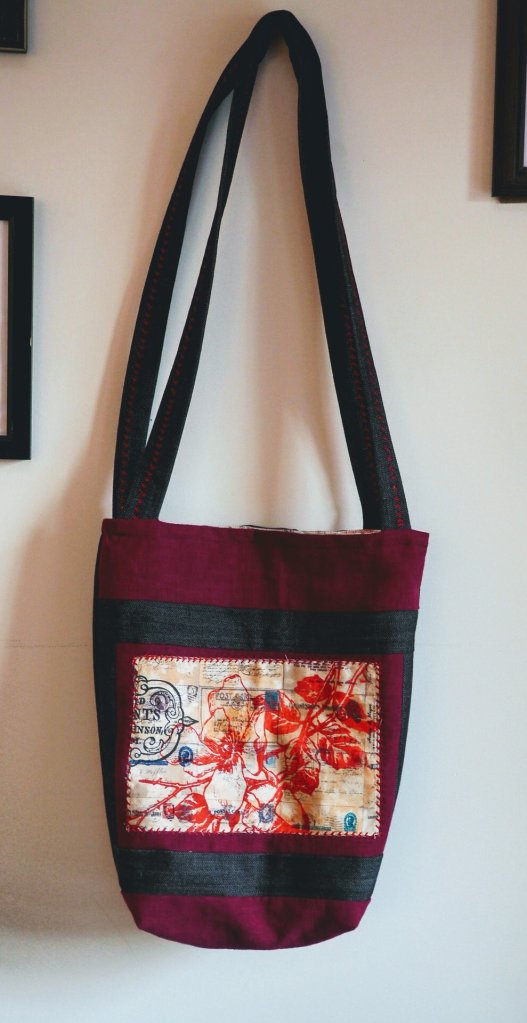
Inside of the gift bag – I feel like inline zip pockets are a major leveling up in bag making:

I also finished some major piecing work on the quilt I started in June with all thirty-six log cabin squares done and put together. I plan to piece the border as well, which will take a bit – but this represents a major part of the construction:

I plan to have this one professionally quilted so I expect this won’t be finished until after Christmas because long-arm quilters are usually fully booked from Sept to December.
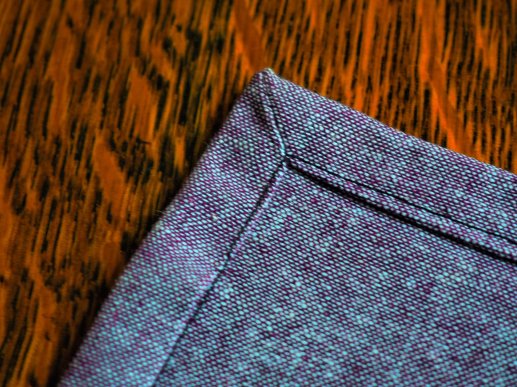
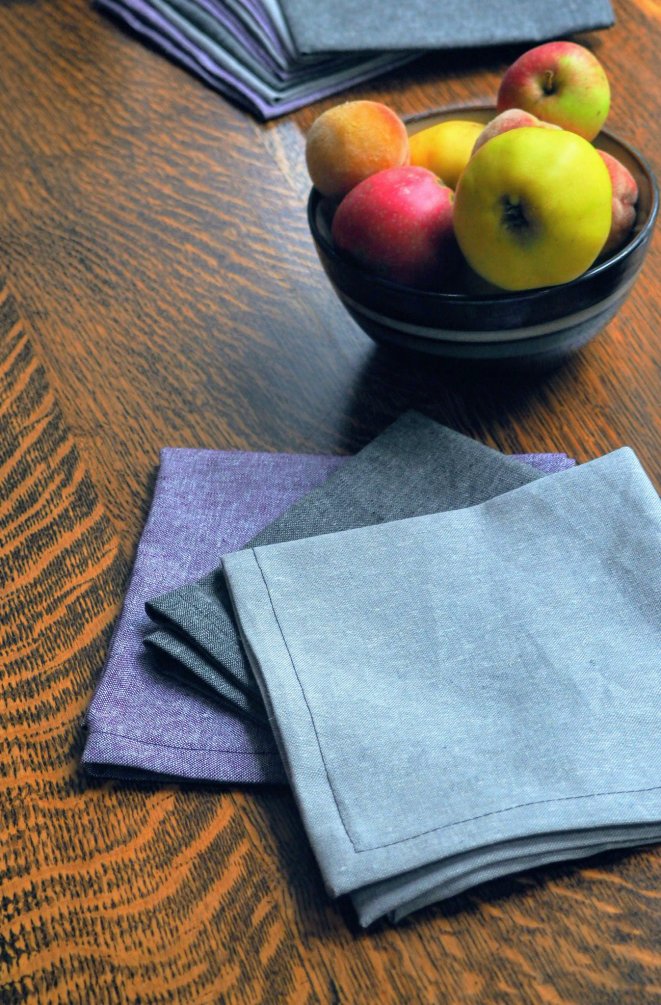
And finally, I learned to properly miter a corner this week and finished a set of eleven everyday linen napkins for our table:
Now that all of those projects are out of the way I’m ready to return to garment sewing. I have some very 1970s dreams at the moment – of mid-calf skirts and wide flood-length pants with tall boots. That stuff feels a bit too fashion-y for Gabriola – but it’s what I am planning on anyway. I’ve also promised Brian a new work bag since he wore the last one I made him right out (it had holes in it and I made him throw it away). I’m planning on something a bit advanced with lots of zippers and D-rings for that so stay tuned!
Post #3130: We are all disappearing

After I turned forty, I started to become invisible. At forty-five, this process has become undeniable – as a woman past a certain age, I have to make an effort to be seen.
There are some definite advantages to this. On a trip to New York last summer, the border agent did not even look at me, let alone ask a single question. I travelled through airports without anyone trying to make eye contact or buy me a drink. On another occasion in the gym a few months ago, I felt self-conscious about lifting weights in the same space as some eighteen year old boys – until I realized that they couldn’t see me at all and I could pretty much have stripped naked and done push-ups in front of them without the slightest tremor to shake their adolescent narcissism.
More generally, how I dress, and the length of time between haircuts goes unnoticed by pretty much everyone; and it probably goes without saying that I can now be friends with men without tension. This is partly age, and partly the fact I am solidly and happily married, ie: safe. Also, people have stopped asking me when I’m going to have children.
On the other hand, wait staff in restaurants treat middle-aged women on their own terribly. This means to be not only ignored, but in some cases I have been refused an available table and deposited in the corner at the bar, even though I am short and hate sitting at the bar more than anything. I know from working in restaurants when I was young that there is a perception that middle-aged women don’t tip and thus are subject to worse services as a result (this, you might note, is a self-fulfilling prophecy). After a certain age, women’s health complaints are simply chalked up to either being fat, or lacking the right hormones. And unless we aggressively pursue our careers, we are more likely to stall out at this point, senior in our knowledge but no longer sought for new projects in the way our male colleagues of the same age are.
I am told by male friends that they too undergo this process in part, but it seems to happen about a decade later. I wonder how much this is connected to pheromones broadcasting our fertility/virility – as the forties are when most women start to edge around menopause, while men don’t enter andropausal states until their mid to late fifties.
If this is the case, I expect I will be pretty much transparent by the time I reach fifty-three, as that is when I predict my menopausal transition will have ended. I know that I am just at the beginning of a process, one designed to show women how un-needed we are once we can no longer produce children.
***************************************************************
After I turned forty, I noticed something else started to happen – which is that I suddenly became visible to women much older than me. (My hair has been almost completely grey since around that time, and since that transition I am often placed as older.) While I was working on my Master’s degree, it seemed that the older women around suddenly took me and my life experiences seriously when I talked, and they more readily shared their stories with me.
At the time I told Brian, “It’s as though a door has swung open, and there’s a party going on that no one told me about.” I noticed, in contrast to one of my classmates who is a decade younger, I had entered into a different phase of community with older women, that she was still outside of.
While I am perceived as “young” in the community where I now live (the average age is 58 on Gabriola), I am no longer seen as having no life experience, and I notice when I go to volunteer in the community, there is an easiness in talking with women in their seventies and eighties that never existed in my younger life. They tell me about their children who have died, the sudden arthritis that challenges their independence, the husbands who no longer exist, the careers they once had.
Is it because I listen differently now? I’m sure that’s at least a part of it. I don’t feel the need to be somewhere else most of the time, and I see that my future lies in these stories – they are guideposts to survival when the unspeakable things of life happen (as they surely will). But I also think that my grey hair is the flag of a ship which has changed course towards another shore.
******************************************************************************
We laugh at women who make themselves up extravagantly in their forties to attract younger men (such are the constant jokes about “cougars”). Ha ha. But the onset of invisibility reminds us that there is only death at the end; the start of this process terminates with complete and utter disappearance.
Perhaps forty is too early to begin this contemplation and this sexual acting out is a form of denial – not unlike the trope of the man in his mid-fifties who purchases a ridiculous sports car and younger wife. I’ve served these men in fancy places where I once worked – and they live up to all the obnoxiousness of their stereotype. We think he’s pretty funny too – but we can’t put our finger on quite exactly why it makes us cringe to see it.
**************************************************************************
Our little boats bob along this journey, one that has no straight course in the wide open sea. As one aspect of our life becomes unavailable, another becomes possible, but only if we re-set our sights, and let loose some of our sails. Or to put it another way, hurtling towards an external and public mid-life crisis is not the only way to deal with the disregard for middle aged and older people.
Perhaps my growing invisibility gives me permission to turn inward, focus less on the fertile youth I am leaving behind, and take my place in the community of older women to which I increasingly belong. Perhaps this is what it means to become lighter and lighter, letting go of the layers until we are nothing at all.
Post #3129: A knock and a walk

Lives are so layered – when I think back over my forty-five years of life on the planet, I feel like a whole different person lived my teenage years, my twenties, and even some of my thirties.
And that is okay, that is just how it is – I don’t feel un-integrated as a person, but that each of those whole/separate selves is a part of of the greater me.
Sometimes though, the past comes knocking and the former self is jarred back into existence. Just a little bit. This morning the eco-radical me from past days did just that in the form of a text message from an old friend.
That, plus the hints of autumn in the air have me feeling deeply nostalgic for a time when I was out in the woods a lot more than I am these days.
It’s a good thing that the present me had the sense and ability to move out of the city a couple of years ago. A forest walk awaits me when my working day is done!
Post #3128: Taking myself seriously

The problem is, I don’t take myself seriously. Not as a writer, not as a maker, not even as a union president. It’s bizarre really – at the age of 45 to be so sure that no one wants to listen to me – contrary to all available evidence. Someone suggested to me recently that this is the patriarchy in action, and I think that’s right. I never hear men around me ask the question of whether their work has worth. They just seem to *know* that it does.
I’m not sure I want that feeling exactly – I think too many men think the world wants their work when it doesn’t and I don’t want to be like that. On the other hand it would be nice to do just about anything without having to plumb the depths of my psyche first. While I don’t want to lose a sense of humour about myself (not that kind of serious), I do want to make way for going to the next level, and stop talking myself out of everything before it happens.
I am setting new goals for the fall because September seems to demand it. There is here a writing, a making, and a work goal – each acting on a specific intention that I have been exploring in the past couple of weeks:
- Allow 3-6 hours per week for reading and writing practice
- Start working towards some kind of textile show and sale instead of getting rid of things the minute they are finished
- Make meetings happen – stop asking for permission to have them
My spiritual goal remains the same as always – keep showing up, no matter what happens.


 Red Cedar