Red Cedar
More apocalypse, less angst
Summer Sewing: Tank Top
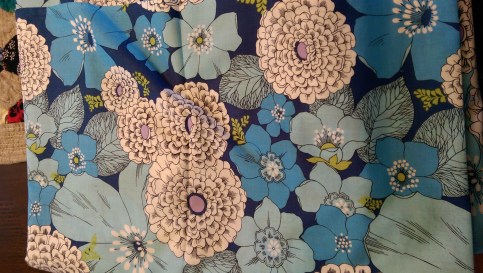
 This is the first of the summer sewing projects completed yesterday – a tank top made out of a flowy synthetic fabric (does not wrinkle!) This is a very straightforward pattern (2 pieces, two bust darts, bias finish on the neck and armholes) – and I decided to go the extra step and complete it with french seams.
When I first started sewing, I often chose patterns that promised “complete in an hour” and then cursed myself for taking longer than that. Now that I’ve been sewing garments for a few years I can’t imagine finishing something properly in an hour, even something as simple as this tank top.
It’s not that I’m even that fussy when it comes to finishes, but a garment really does wear better when the seams are neatly done (hidden is preferable) and the bias strips are sewn with care. I spend a lot more time pinning than I used to, and have eased up on my lead-food sewing pedal speed. I have also learned to take breaks at natural places in the garment construction so that I don’t end up “rushing to finish” when I’m tired or frustrated.
I think I’ve got enough of this fabric to additionally make a simple skirt – the pattern I plan to use for that is the simplest pattern I know (my very first skirt!) – a very basic construction with elastic waist and no pockets. Like the tank top I will finish it with french seams which will elevate its construction just that little bit.
I’ve got two skirts and a tunic planned for this month and I also just received this gorgeous piece of cotton lawn in the mail that I want to turn immediately into a sleeveless dress – summer sewing season is upon us!
Alchemy in jars
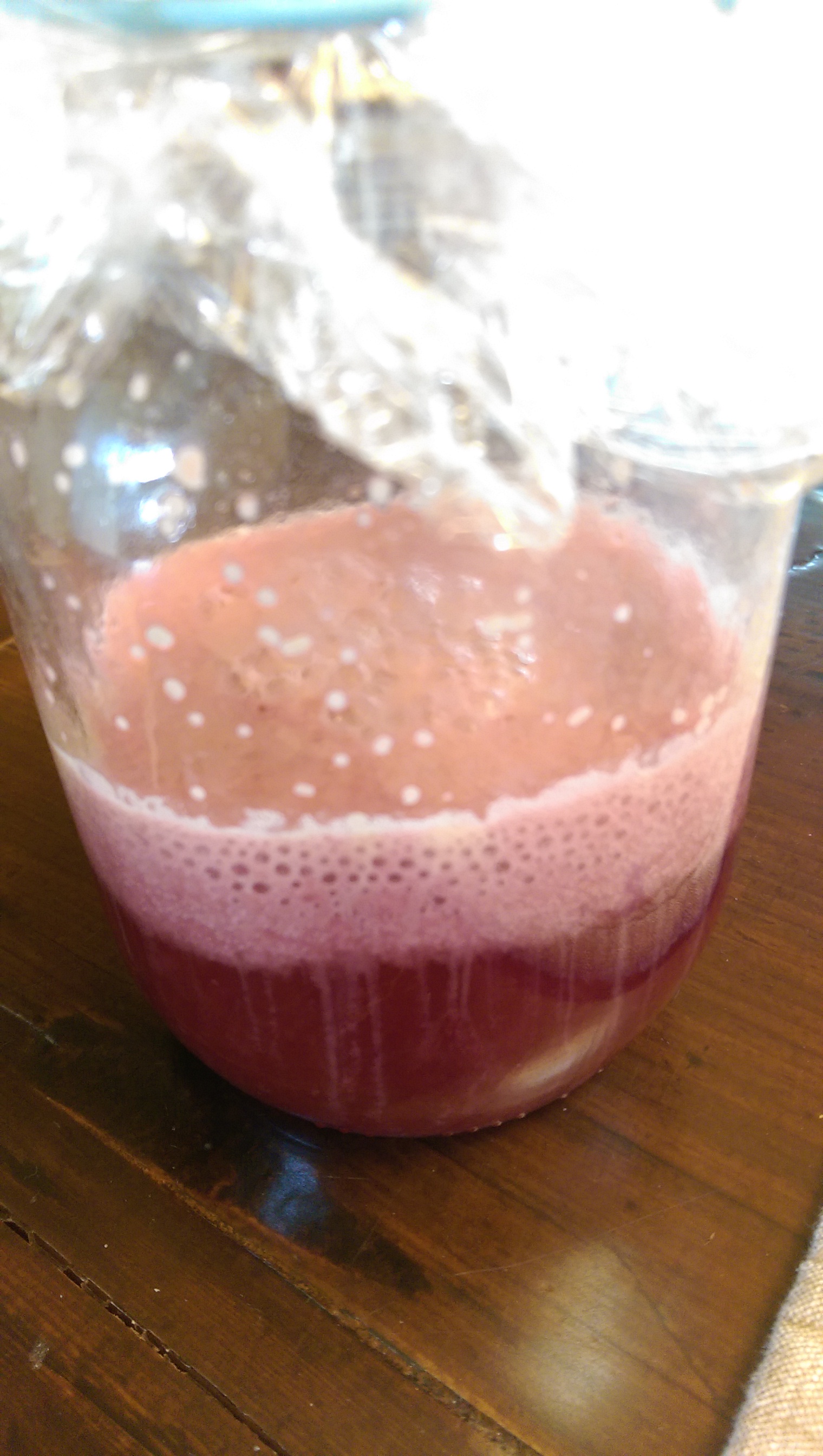
This post rightfully belongs to Tuesday, but I’ve been a bit preoccupied with work things, social things and other things – and so it’s now Thursday and I’m finally getting around to posting on phase two of the Blueberry-Pomegranate Wine which I completed on Monday afternoon – that is the activation of the yeast (one packet of red wine, dissolve in one cup of the wine-juice and let stand until it froths), and the addition of said yeast to the primary along with 2 teaspoons of acid blend, 1 teaspoon of yeast nutrient, 1/2 a teaspoon of pectic enzyme and the same again of tannin. My airlock is currently bubbling away which means my ferment is happy and active. I expect by Monday it will have died down and be ready for the secondary. Initial hydrometer reading is 1.020 which you might note is much lower than the initial mead reading of two weeks ago. I’m thinking that after this batch of wine goes into the secondary, I am going to try a second batch of mead – but a dry mead this time to compare to the fruity version I’ve got going already.
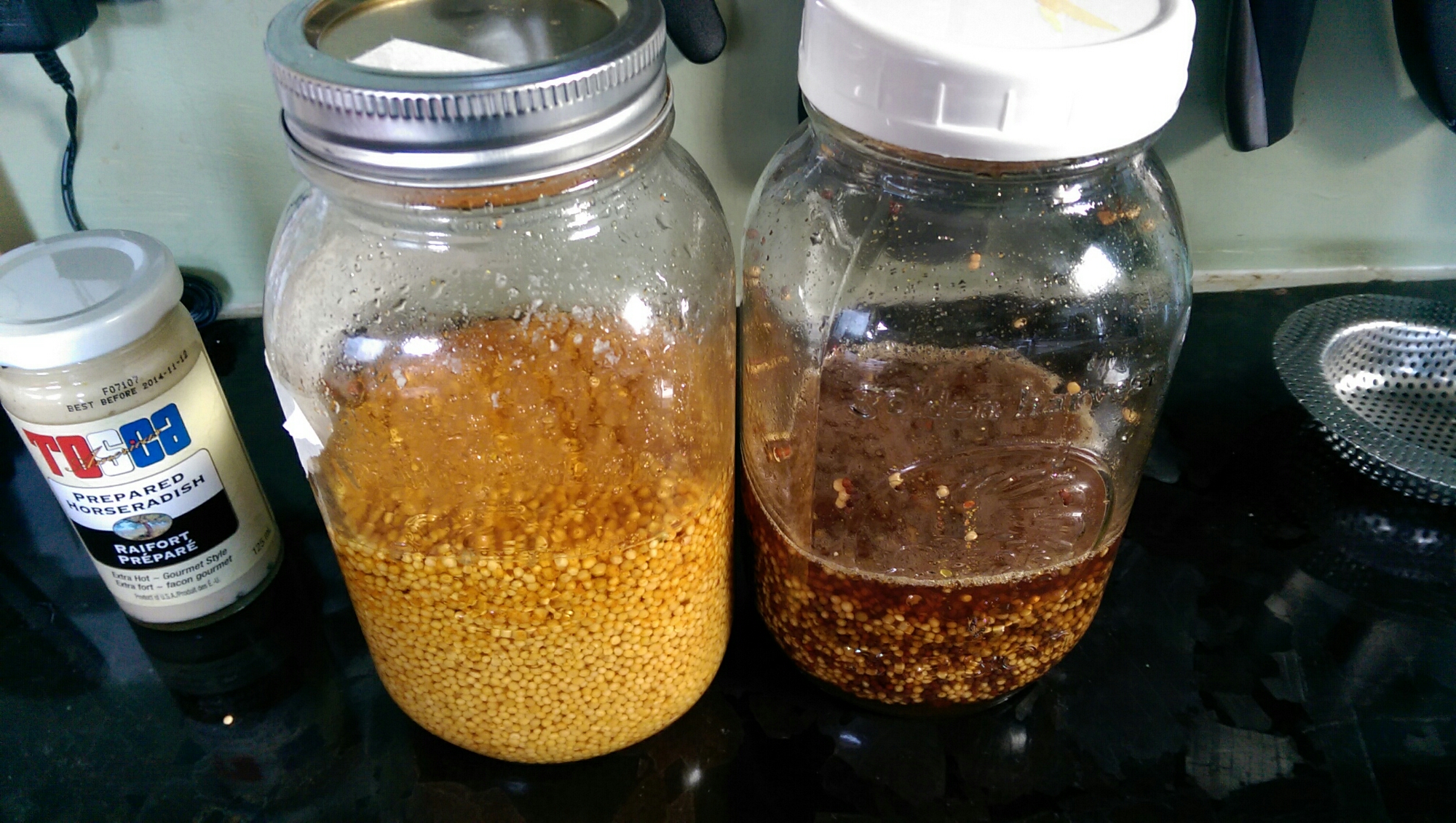
Also on Monday night, I started two batches of mustard seed soaking which I will grind up into a paste tonight when I get home. I’m trying two different recipes below – a basic yellow mustard with horseradish added for kick, and a beer mustard which uses both yellow and brown mustard seeds.
The Rhubarb Ketchup Recipe
Since I first discovered it two years ago, Rhubarb Ketchup has pretty much become a staple condiment in our house. It works as both a ketchup and a sauce for meats and involves two ingredients I always have lots of in the spring: rhubarb and canned tomatoes (from the previous year’s canning). So really, this combination is a bit of a no-brainer

My alterations to the recipe that I originally poached off the Internet are typical ones for me – the addition of apple cider vinegar and a couple cloves of garlic – to punch up the taste a little bit:
Ingredients:
4 cups of rhubarb cut into one-inch pieces
1 large yellow onion, chopped into one-inch pieces
4 garlic cloves, diced
3 cups of canned tomatoes (with juice)
1 cup apple cider vinegar
1/2 cup white sugar
1/2 cup brown sugar
1 tablespoon salt
1 good shake of cinnamon
1 tablespoon of pickling spice tied in cheesecloth
Throw all that together in a pot and it will look like this:
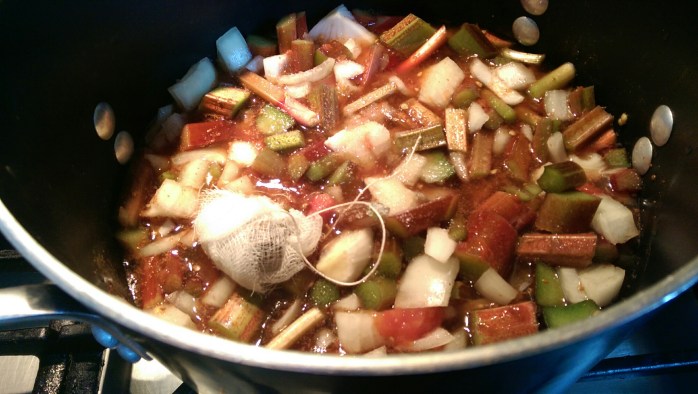
Bring the mixture to a boil and the put it on simmer for an hour to two hours (I like to cook it down a fair bit). Once the consistency is where you like it, remove the pickling spices and blend with an immersion blender. As you can see, this doesn’t have the colour of Heintz – no dyes or chemicals in this pot of awesome sauce:
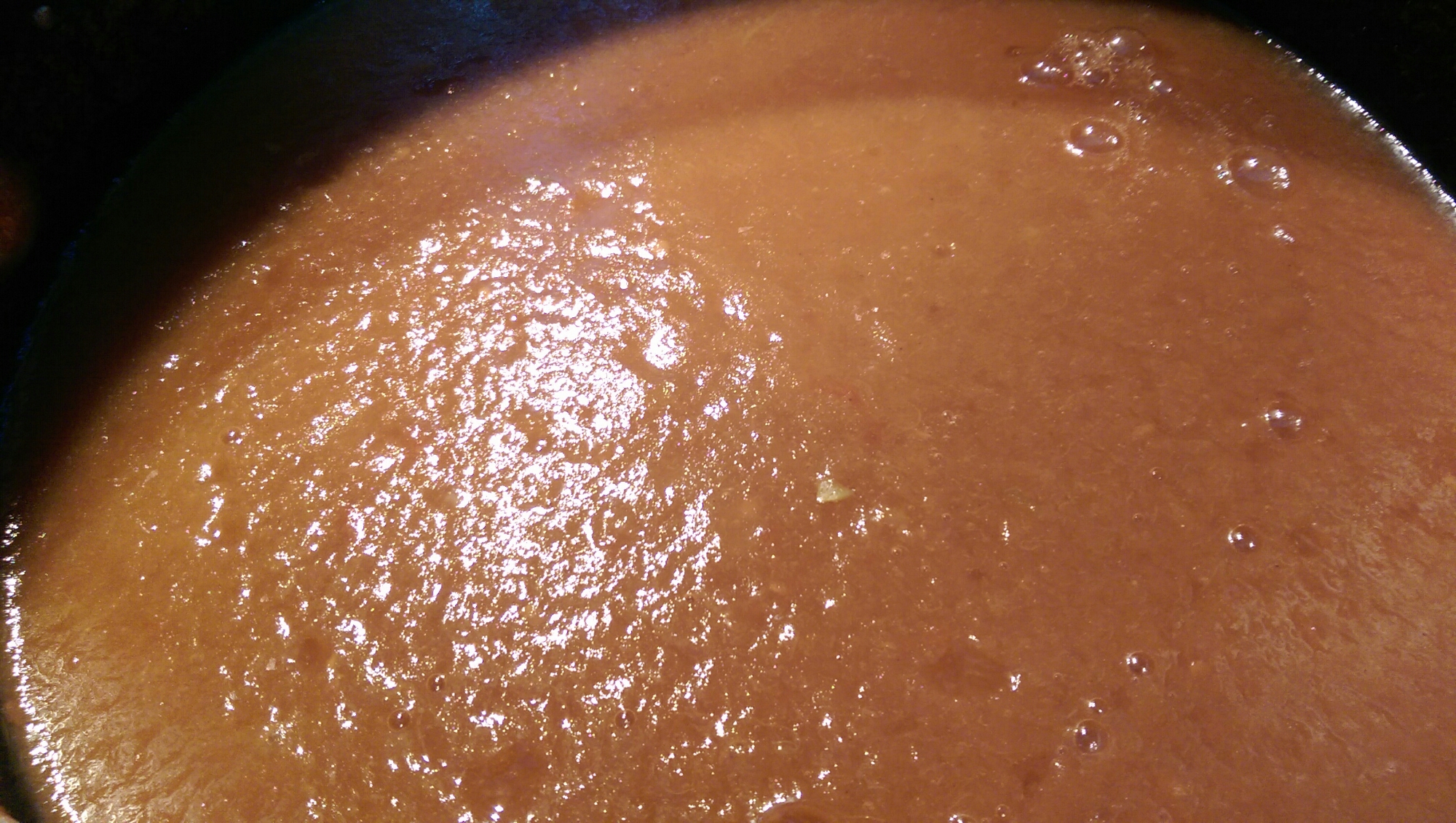
Process in a boiling water canner for 20 minutes and you’re done. Makes four pints and the recipe is easily (and safely) doubled.
Another day, another brew.

This afternoon has been a putter-around-the-house-until band practice kinda space – particularly as 1) I drank a little too much at our bbq last night and 2) It’s raining outside.
The first rhubarb ketchup of the season is simmering away on the stove as I write this, and I’m plotting two kinds of mustard to start soaking after I get this post up – I am definitely feeling the start of a new food season upon us as I pulled the last of the blueberries from 2013 our of the freezer and weighed them for the Blueberry-Pomegranate Wine I have been thinking about for the last couple of weeks. Again, this recipe comes from True Brews and makes a one gallon batch. According to the book, this comes out the most like red wine of any of the fruit wines so I’m curious about that.
Before I go any further I want to point out the picture up top – which is the blueberry-lavender mead I posted about earlier this week. As you can see from today’s picture, the mead has clarified a lot, and there is now quite a bit of sediment at the bottom of the jug. If I age this beyond 1 month, I will siphon it again before letting it sit – purpose being to clarify the liquid as much as possible with each racking.
Anyhow – today’s recipe calls for 3 pounds of blueberries, 2 cups of pomegranate juice, 5 & 2/3rd cups of sugar and 12 cups of water to start out (plus a Campden tablet).
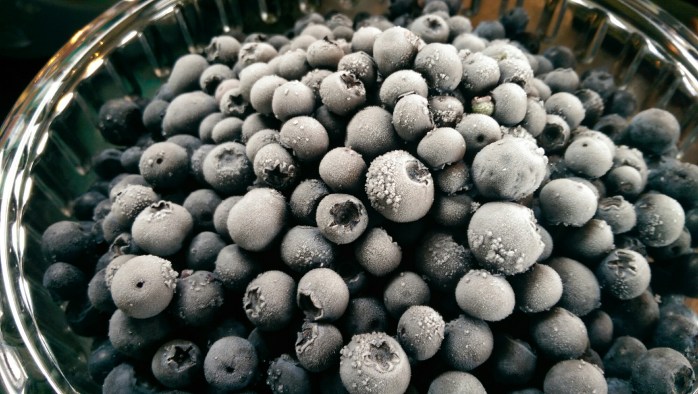
I started with the blueberries frozen and weighed them on the kitchen scale. I have read elsewhere that using frozen blueberries in liquor-making is optimal because the freezing and then thawing of fruit brings out its sweetness – think ice wine. I’m not sure if this is true, but I’m pretty sure that using frozen fruit can’t hurt the process in any way.

I thought I had several mesh bags to secure the fruit in, but it turns out – I had none – so I wrapped my blueberries up in cheesecloth instead (note to self – buy more cheesecloth and mesh bags). I keep quite a bit of fabric in the kitchen these days for just such eventualities.
 Pomegranate juice isn’t something that I normally buy – it’s rather expensive ($9 for a bottle) and a bit tart for everyday drinking. I just grabbed the stuff from Donald’s market that was not blended with other fruits. There was no way that I was going to purchase enough pomegranates to make my own pure juice – I figured this was the next best thing.
The process for making the wine is very straightforward: After sterilizing all the tools you are about to use, combine the sugar and water on the stove and bring to a simmer. Don’t boil it, you are essentially just heating it until the sugar dissolves. Once the sugar is combined, take the pot off the heat and let the mixture cool down to room temperature.
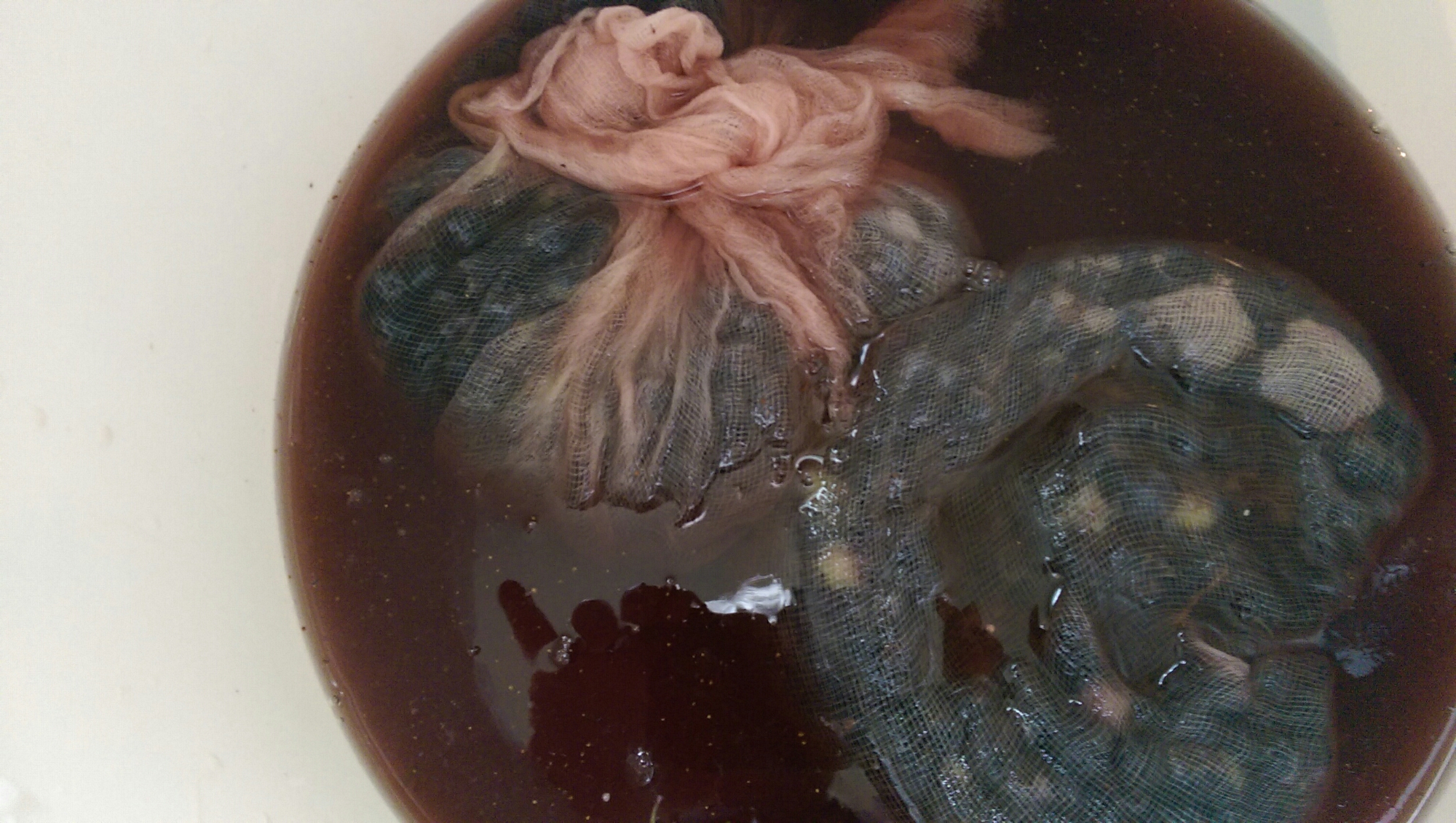
Combine the sugar-water and pomegranate juice in the primary and then add the bag(s) of fruit. Using clean hands or a sterilized potato masher, get as much juice out of the fruit as possible . Once everything is mixed together, crush a campden tablet and snap on the lid with an airlock. (You can take your original hydrometer reading before putting the lid on, but I forgot so I will take mine tomorrow when I add the yeast).
And that’s it! For about $10 in ingredients I have another 3 bottles of wine on the way.
Starting a new stitch.
 The first hand work I ever undertook (besides my failure of a Grade Six sewing class) was cross-stitching. At the time I was the least crafty person I could imagine (seriously – I didn’t have a decorative bone in my body) – and yet for some reason I found myself drawn to a book called Celtic Cross Stitch at the SFU Bookstore and bought it. This became my first self-taught visual practice, one which has resurfaced intermittently over the years – in both small and large (tapestry-style) formats. (The last thing I finished was this pillow which languished for years in my UFO pile). I do tend towards sewing and crochet these days – but mostly only because my eyesight isn’t so great for small work anymore.
Recently I’ve been inspired by some folks on an online forum who do all manner of hand work – including cross stitch – and so I shopped around the Internet and found myself a kit for a table-runner (Christmas themed – this is my annual contribution to household decorating). This central star marks the start of it and I have to admit I’m a bit excited about it. I’ve never used a kit before – and they are a tad expensive for what you actually get – but there is a tremendous convenience in pre-cut thread and fabric that matches the pattern requirements.
I’ll share as I go – one more project to add to the rotation (I’ve got two crochet projects, three quilt projects and one dress on the go at the moment as well) – which pretty much ensures I’ve got most of the 2014 making schedule ironed out 🙂


