Red Cedar
More apocalypse, less angst
Post 3074: Airport meditations
I am thirty minutes into a 4-hour layover in the Vancouver airport before flying out to Toronto. Long story short, when I checked in this morning, my original flight plan was all screwed up due to a delayed flight – but I was attended to by an Air Canada employee who was really great, and patient with me and booked me on an even better flight than I originally had.
Some things came into focus as a result of that moment – you know how they sometimes do… and since I haven’t sat meditation for the last two days – my airport practice for the next 3 and a half hours is focused on generosity, and I’m using the sound of the occasional cart-bell as a reminder (each time I hear the ding of the airport cart, I stop and take a breath and refocus my intention).
Thus far I’ve had some really nice interactions as a result.
Post 3073: Sketchy sketching
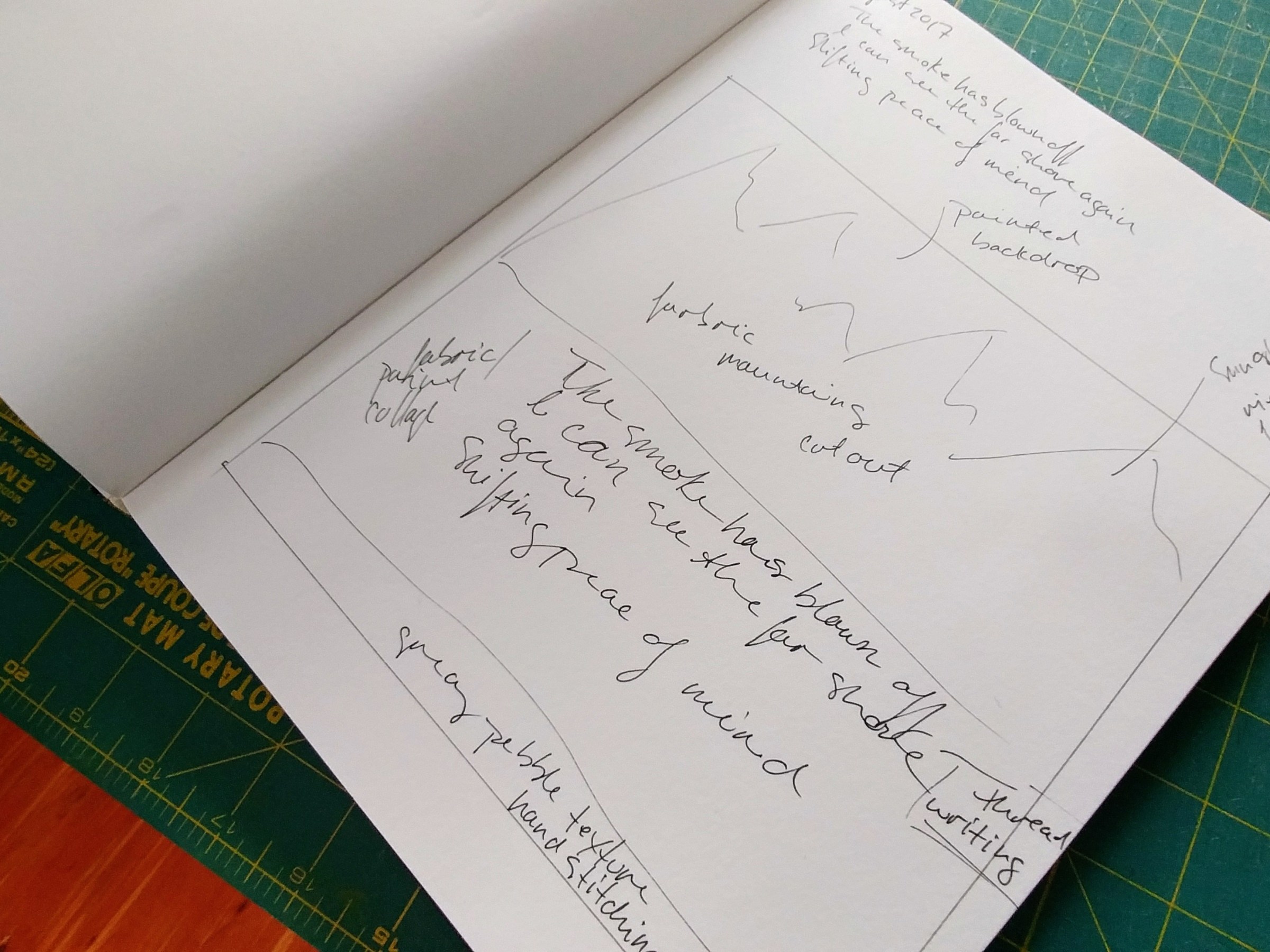
The smoke on the BC coast cleared this weekend. After two weeks of nicotine-coloured light and a smoke ceiling emanating from the interior fires – we can see blue sky with normal clouds passing over again, and we even had a bit of rain on the weekend which brought some cooler temperatures with it.
And that was all it took for the lethargy I’ve been feeling in this latter half of summer to shrug right off. I’ve heard that the smoke has put everyone into a state of low-level carbon monoxide poisoning – much worse if you are in the interior, but not good wherever the smoke has lingered – and I’m pretty sure that Brian and I have both been feeling that effect. Tired, sore throats, burning eyes, lots of napping – low interest in things.
But as of Friday, both of us were back in our studios working on our projects – he’s just getting ready to go into final mixing on his first solo album – and I divided my time between weaving, sewing, and sketching some new ideas into the textile notebook.
As a teenager hanging out with visually-artistic friends, I was always jealous of the sketchbooks filled with colourful images and bits and texture and paint. My notebooks were of the word-filled type, with the occasional doodle that I quickly inked over because they weren’t any good – those being the days of adolescence when I believed that everyone was paying attention to what I did or didn’t do well (oh! the freedom of realizing that almost no one cares about what I do at all).
Though I have filled many notebooks with writing, I have never been the type of person to create a scrapbook or even collect much in the way of ephemera to put in such a thing – though a couple of years ago I started gluing fabric practices into a large bound book I had bought for the purpose. Since 2015, many of my experiments – stitching, painting fabric, weaving – have made their way into this book. Mostly it serves the purpose of a visual reference for things I might like to return to or incorporate into later work – but more recently I find myself putting full-on sketches – in ink and fabric down on these pages.
Besides the fact I’ve had a bit of time and space this week, I think what has been making this type of “idea work” possible for me is that I have just stopped caring about how sketchy the sketches are. As you can see from the photo above, my sketch from this morning is more like scribbles than anything. It’s the idea I had while driving back from dropping Brian at the ferry – and I wanted to make sure I got it down quickly so that I didn’t lose it for later. Besides drafting this out in five minutes, I took another ten to generate two fabric swatches treated with watercolor paint which will get attached to the page when they are dry. From there, I will blow up a photo and create a sketch of the mountain range across from me, I will practice some thread writing, and then I might create a whole textile “sketch” as well. From that textile sketch, I might create a more finished work, or maybe not. One of the sketches I completed a few months ago is now hanging in my house and is commented on by visitors pretty often:

While there is plenty about this piece that I would change, working a sketch through to “finished” taught me a lot about the processes I was using and would like to use in the future.
It seems to me that the sketchier my initial sketches are – the easier it is to get the ideas out somewhere that I can reference them later. Otherwise, I just plain forget, which seems a shame when I don’t have that many good ideas to begin with.
I am hopeful that this recent increase in putting ideas to paper will result in more original work as life space permits. While I have long realized that I need more chances to get into the studio fresh in the morning for original work – I recently came to the understanding that all the work I do in the evenings – the sewing and weaving and pattern following – is practice for the times that I am inspired. That time of “rote” making is all skills-development so when I am struck by some new expression, I don’t have to learn all the practical elements to bring it together. I see that now, as more of my ideas are easily transmitted to textile – in the past I had no idea how to make my thoughts tangible even thought I had lots of good ones (which went unsketched!)
A few years ago I came across this passage by Ira Glass which has continually resonated with me. It’s all practice! Really. It’s all getting the ideas out until we find the thing that makes the special thing happen. I’m still finding the special thing – but I know I am much closer now than I was ten years ago:
“Nobody tells this to people who are beginners, I wish someone told me. All of us who do creative work, we get into it because we have good taste. But there is this gap. For the first couple years you make stuff, it’s just not that good. It’s trying to be good, it has potential, but it’s not. But your taste, the thing that got you into the game, is still killer. And your taste is why your work disappoints you. A lot of people never get past this phase, they quit. Most people I know who do interesting, creative work went through years of this. We know our work doesn’t have this special thing that we want it to have. We all go through this. And if you are just starting out or you are still in this phase, you gotta know its normal and the most important thing you can do is do a lot of work. Put yourself on a deadline so that every week you will finish one story. It is only by going through a volume of work that you will close that gap, and your work will be as good as your ambitions. And I took longer to figure out how to do this than anyone I’ve ever met. It’s gonna take awhile. It’s normal to take awhile. You’ve just gotta fight your way through.” ~Ira Glass
Post #3072: The warping of Big-A

So! Eighteen months after purchasing the big, mysterious, countermarch loom (now nicknamed Big-A in contrast to my small loom Little-J) – I have a warp on and am weaving!
I started sleying the reed before I went on holiday at the beginning of July, and then when I got home in the middle of the month I threaded the heddles and wound on. Since then I have been slowly weaving in a basic hopsack pattern in order to learn about my loom and to get the feel of throwing the shuttle before getting too complicated with the treadling.
For this test warp, I used the yarn that came with the loom (the seller threw in a bag of brightly coloured handspun wool with no stretch – perfect for weaving). It’s a chunky yarn, heavier than worsted weight, which I offset with some skeins of Briggs and Little Heritage in black to create some colour separation. The weft is also black B&L as you can see in the photo below. The intended outcome of this is a blanket which will be created by cutting the weave in half and joining it in the middle for about 54 inches of width. I expect that lengthwise it will work out the same to create a square lap blanket. To be honest, I didn’t work the project out in too much detail because just getting a warp on was the goal, and I was improvising with the yarn on hand.
Now that I have this loom in operation – I am starting to assess it. Countermarch looms are known for being quiet – which is definitely the case with this one (jack looms have a clack and rattle to them). These looms are also known for being overwhelming or difficult to tie up – which I didn’t really find at all. Time-consuming yes, but I have read so much about these looms in the last year that when I climbed underneath to tie up the treadles, I had a good sense of what I needed to do. On the “negative” side – the homemade brake is not holding so well – the belt that the former owner rigged it with broke, so I grabbed another old leather belt that I had on hand – but it is not cinching the warp beam tightly enough to hold it. As a quick fix, I filled a milk jug with water to create enough weight to hold the warp beam back. I can live with that for now – but if I keep this loom into the future, I will probably purchase a proper brake band kit for it.
There is no question that 45 inches is probably all the loom I can handle – as I can barely reach from one side of Big-A to the other. I’ve got 27 inches on right now which I can manage with no problem. I expect that my comfortable maximum weaving width is somewhere around 35 inches. And because it requires a minimum of 2 yards (if not 2 and a half) to warp, this is definitely not a loom for small samples. On the other hand, there is a lot of control in the overhead beater, which makes for a more even and appropriate weave structure overall. We’ll see what it’s like with 8/2 cotton on it – something I plan to do in short order to get a feel for how different weights and fibres weave on this loom. At the moment, I only have a 10-dent reed – so I’ll have to invest in others if I am going to play with different weights in the future. I will also need to purchase some additional heddles at some juncture.
Throughout the restoration and set up of this loom, I have spent a lot of time kicking myself for the purchase of something so complicated as a new weaver. It seemed to me that I spent *so* much money and time setting it up – wouldn’t it have been better had I just bought something new, with less headaches? Maybe. On the other hand, I have learned far more about loom technology than I would have otherwise. As well, this loom will end up costing me less than a fifth of what new one would cost. So far I am into this loom for about $875: $500 for the initial purchase plus $100 to have it moved, $250 in heddles and texsolv cord and $25 for the restoration wax. More heddles and a brake kit will total an additional $400. Rounding up, this loom will cost $1300 when the restoration is fully done (and I didn’t have to spend that $ all at once). A new loom of identical width/type/shaft #s and similar quality starts at $4700 US (almost $6000 cdn plus taxes!) That’s money that I just don’t have.
So yeah. I’m feeling pretty proud of myself now that I have Big-A up and running and am actually making a *thing* on it. I look forward to many more such experiments in the near future.

Post #3071: Tis the season to put down some pickles….
 Summer has been full of things thus far, and so has work – leaving me little extra-curricular time for posting on my blog. But I think I’m going to return to writing about food since we are in the season of bounty and the preserving instinct has once again kicked in (not to mention cooking! but more in the next post on that).
We’ve just wrapped up our long weekend open house (with camping in the yard) – which started on Friday and ended around noon yesterday – and as at the end of every party, we were left with a glut of a few things. At every one of our gatherings we supply the main food items for breakfast and dinners (with grazing foods for lunch) – but we usually ask that people bring a few other things to share – particularly those that get expensive. This year those requests were for coffee and limes (for drinks). Our friends are generous when we ask – the result being that whatever we desire we get times ten. Last year was cheese, and we never did eat it all before it went bad.
With coffee — it’s not such a problem — it keeps in the freezer and we drink it every morning so we’ll go through it happily. Limes – on the other hand — need to get used.
And so as exhausted as I was yesterday, I managed to rouse myself from the couch to deal with some of the leftover foods. The pictures in this post represent some serious good eating in our future as I am in the process of:
- Lime pickle using this recipe
- Lacto-fermented dill-green beans (3 tbsp to 4 cups of water for the brine ratio)
- Salt-preserved eggs from the book Asian Pickles by Karen Solomon – these are salt cured with star anise, in the shell and raw for five weeks – which flavours them for addition to fried rice and other dishes.
As we were preparing for our weekend, I also managed to put my hands on some meyer lemons (first ones I have seen in over a year) and now have three jars of salt-curing lemons in my cupboard as well.
In the kitchen today, Brian is making tomato sauce out of 30 pounds of roma tomatoes that we bought through okanaganfruit.ca – this being the first year in our relationship that we couldn’t make the timing work to be in the interior to buy late-season offerings (I have a trip to Toronto at the end of August when would normally go). I also have 20 pounds of cherries that need pitting before going on the dehydrator – so I expect when my working day is done I’ll be sitting outside on the deck and taking care of that.
As always – I have more plans in the wings as I am expanding my cooking repertoire and new flavours, sauces, and pickles are on the menu. Still need to track down a few ingredients at the asian markets when I am back in Vancouver this fall – but looking forward to some new dishes and techniques to bring to the table.
Post #3070: Coming to terms with time

I haven’t posted here for a while but I’m on holidays so I’ve got a bit of time, more time than I’m used to these days. And it has occurred to me, with all this time off, that I’m not really good at taking a break. Here I am at the cabin, without a lot to do, and I find myself agitated instead of relaxed. And I don’t mean a little bit agitated. I mean the kind of agitated where I’m having trouble sleeping and I can’t sit still even though I don’t have anything to do. When I do sit down for a few minutes I feel guilty about sitting without getting up and doing things that I feel a bit paralyzed from it. Which I suppose is how I get so much done in a day normally, and what I’m valued for.
But here’s the thing, my meditation path is something I’ve been thinking about a lot lately. I often find myself giving instruction and advice about how just sitting can save our lives, I really believe this to be true. But at the same time I can’t just sit. I am doing all the time. Even when I am meditating, and I am sitting for an hour a day here, I am doing something. I am meditating. I track my meditations in an app, I work to increase the length of my sit, I practice with techniques I hope will change my life. I am vigorous in my study even as I recognize this is the antithesis of the zen path.Which is not to say that Zen equals doing nothing but it does require that one occasionally step back and allow things to rise without acting on them.
These days my life is all about acting on things. I became the president of my union local in February, my current job is demanding and people rely on me every day for advice, I am often at home on Gabriola alone and so I have to make sure that everything is running smoothly without Brian’s help.
While I definitely feel that in some ways moving to the island has freed up more time and space, it has also has created the sense that I must always respond and prove I’m available even though I’m no longer in the city. For the first time ever in my working life I gave coworkers my private email case there is an emergency while I am away, and just days into my holiday I have already received three emails to it. What that does do is make sure I don’t check my work email but I don’t take it as a great sign that I’m holding on so tightly to my sense of self importance. I’ve always poked fun at the people who could not put down their BlackBerries at night, but I recently became one of those people.
This vacation at the cabin is illuminating that fact, and I’m aware that I have more than another decade of working life to go and if I keep up the delusion of being all things to all people I am going to burn out before I get to retirement. So it’s something to think about, to let go of, so I can find days where doing nothing is ok.


 Red Cedar