Red Cedar
More apocalypse, less angst
Post #3098: My first monthly sewing box

I vowed that I wasn’t going to fall for a monthly curated box, and for the last few years I held strong! But recently my will crumbled and last week I received my first curated sewing box from #sewhaleyjane.
The issue I’ve had with the monthly knitting or sewing boxes, is not the cost or the commitment – many of them let you drop in and drop out without signing on for a year (yarn clubs of the past always made you sign on for a whole year which is a lot of $) – but that you might not like or know what to do with the fabric/yarn that you receive! On the other hand, there is the excitement of receiving a package, and the challenge of working with materials you might not otherwise pick for yourself. And since we all make a lot of things for others – no fabric or yarn ever needs go unused, as long as it is of the quality we want to work with.
So, to test out whether I could use up a monthly fabric mailing, I signed up for the luxury Sew Haley Jane box – which is pricey with shipping to Canada – but I chose it because aesthetically, her previous box mailouts attracted me. Also, it’s shipped out of the UK, and I wanted to get out of the North American market a bit. (If there was a monthly curated box from Finland or Japan I could get in on, I would!)
I received my February box last week and you can see most of it pictured above. What I didn’t capture was the Lottie Blouse pattern that came with it. Cute, but not at all my style.
The main fabric (teal with dandelion seed heads in silver) came in a quantity sufficient for a dress or tunic, but since its a bit bright for my everyday wear, I have deployed it to become a bath or hot tub cover-up. Right now, that is half-sewn and should be finished later this week.
I have a mind to turn the five fat quarters into zip pouches for gifting later in the year, but I might also just hem them into reusable wrapping cloths or save them for later.
The kit also came with glass headed pins ( which I needed more of) and coordinating thread (to be all used on my robe). The only thing I don’t know how to use is the metre of fancy trim ribbon…. So that’s gone straight into stash.
So far, not bad! I will try this subscription for awhile and see how I do. Right now feels like a good time to try this approach as I am sewing a lot and looking for inspiration as I replace my ready-made wardrobe with hand makes bit by bit.
If I find myself truly unable to use box items or accruing more stash instead of clothing, then I will unsubscribe. The last thing I need are more bins full of fabric!
Post #3097: The Cephalopod Dress

It’s a new dress kind of day!

I am going to straight up tell you that I am in love with this make. As usual, my photos aren’t the best but don’t let that fool you – this is one fabulous dress!
Print is Cotton + Steel Mystery Food Smoke, Cotton Jersey Knit. I bought it from Thread Count Fabrics back in the fall and it’s been waiting to be turned into a dress ever since.
I originally thought I would use the Turner Dress pattern by Cashmerette for this. I’ve been in love with her patterns recently – as she knows how curves work – and so I decided to try it out. Good thing I decided to make a muslin first!
Using some black jersey I discovered two things about myself – apparently I have a long torso ratio-wise which explains why things that are supposed to sit just above the waistline almost never do, but also, I don’t like dresses that divide at the waistline or just above. When I think back on all my favourite dress makes, to a number, they are all either derivatives of the Coco dress (for knits) or have princess seaming (for wovens). Somehow I’ve been making dresses all these years and never noticed that preference.
But still, Cashmerette came to the rescue because the one thing I’ve never liked about the Coco dress by Tilly and the Buttons is the neckline. It’s way too high for my bust shelf (and makes me look blockier than I’d like). On the other hand – the Concord Shirt by Cashmerette has a neckline that I really like – so I traced one neckline over the other and altered the Coco pattern that I’ve been using and altering for the past couple of years.
Now, despite what I said yesterday about sewing not being simple – the Coco dress really is pretty easy once you are comfortable sewing with knits. Four pieces – a front, back and sleeves with a hemmed neck and sleeves instead of bias binding. I don’t have an overlock – I just zig zag stitch on my regular machine for knits and it works fine (though I sure like the idea of those professional finishes).
I really love this dress more than I thought I would. Although I loved the print, I wasn’t sure about wearing it – but it works for me. And paired with black tights and a cardigan – it’s like cozy pajamas that I can wear to work!
Post #3096: The way I used to sew

 Besides cutting out a million things this week (seriously, I cut out three new projects yesterday) – I have pulled this collar-less, lined coat out of my unfinished objects basket. I can’t remember when I started this project, but I hazard to guess it was about three years ago, possibly even four.
It’s hard to tell from this photo, but the fabric is a jacquard with velvety green flowers that capture the light (as in this photo, the sun is shining on the bottom part of the coat). Eventually the sleeves will be properly set-in (they have issues as the moment) and then I will assemble the emerald-green lining and facings. At this point I’m not sure if I will do a button or clasp closure on the front – partly owing to the fact that I did not do a full bust adjustment, and also have gained a bit of weight in the interim. Depends what allows it to close once the lining is in.
Which brings me to something that has become apparent since I pulled this out for finishing: my sewing has really changed and improved over the past few years. Here are a few things I no longer do:
- Cut up tissue paper patterns. Tracing a pattern off the sheet used to seem like a colossal waste of time to me – and as speed was one of my initial sewing objectives – I always went straight at the pattern. Problem is, if I cut the wrong size, there was no going back – also – tissue paper is problematic when it comes to pattern alteration which brings me to another thing I no longer do…..
- Cut straight from the pattern. I have finally come to terms with the fact that all patterns need alteration, and except for a few patterns for simple knits like t-shirts I always take my pattern cut from swedish tracing paper, and cut and re-tape it in the right proportions for me before setting it to fabric.
- Leave seams unfinished because it’s going to be lined anyways. On a woven finishing is essential even if the seams won’t show! The fabric on this coat is seriously unraveling at the edges just from sitting in a sewing basket. Finishing with a zigzag stitch will stop that right away.
- Cut/sew imprecisely. Okay, I still do this to some degree – but I can tell from the pieces on this coat that a few years ago I was pretty approximate with the steadiness of both my cutting and sewing.
And although I still cheap out on interfacing much of the time, I see how the cheap, iron-in interfacing on this garment is wimpy and a total mistake. I’m going to go with it this time – but future long-wear garments will be a better class of interfacing.
Although a main message of the blogging/making world is “sewing is fun and easy” – I’m going to call bullshit on that. Sewing is complicated, and requires lots of small, separate skills that need honing for consistent success. This is not to say that it’s impossible to learn, or never fun – I love being challenged – but I fell for a certain amount of this rhetoric when I started learning to sew garments, and I couldn’t figure out why I was met with failure more often than success.
Looking at this garment, and the instructions for the pattern, I can see why that was – it’s not at all simple! And there are so many things you have to know before you can even follow a basic pattern.
Also, because I was not fashion oriented before I started sewing (and still am not), I had no clear idea about what kinds of fabrics and patterns would suit me, and I made many things that taught me about sewing but never made it out of the house because they sat wrong on the bust line, or the fabric was itchy (always line wool crepe people!), or the colour was just *wrong*.
In other words, some steep learning curves. I was listening to a podcast by the Clothes Making Mavens last night in which Barbara Emodi from Sewing on the Edge talked about exactly this problem – to even follow a basic pattern from the Big 4 pattern manufacturers, a whole lot of knowledge is pre-supposed, even in those garments aimed at beginner sewists. (And honestly, it felt so good to hear that expressed. It wasn’t/isn’t just me!)
All that said, it is only in failing that we learn to succeed, and looking at this coat I can see how much my basic technique has improved, not to mention my ability to spot a garment that works for me and know why that is (another garment – that could have never been flattering on me – came out of the unfinished pile and went straight in the bin). If I can get the sleeves to sit right at the shoulder, then I’m onto the lining and that gets me to finished pretty quickly (fingers crossed). I suspect though that I will procrastinate a bit more and make a couple more things that I *know* will go into rotation immediately.
Post # 3095: The problem with pants

Pants are a scary thing to sew – am I right?
Although I have tackled many garments in my short sewing life – I have only made one pair of pants (a cropped version), and even then I hated them until I gained weight and they fit me properly in the ass. But all the fitting issues that make pants difficult to sew, makes them equally hard to buy in a good fit.
Through sewing my own garments, I have realized that I have a long torso from underbust to waist, a narrower back than front, and a very short waist to crotch ratio. I had never really noticed any of these things before – but now I see that pretty much every pair of ready-to-wear pants I own has a crotch line that falls lower than it should. I guess I’ve never noticed because that’s just how pants have always fit – but now that I’m getting ready to tackle the dreaded pants problem – I’m starting to notice how these measurements work.
My problem is, I’m not really sure where to start. I cut out and altered Vogue pattern V8499 on Sunday, which looks like exactly the type of pant I want to wear, but I fin
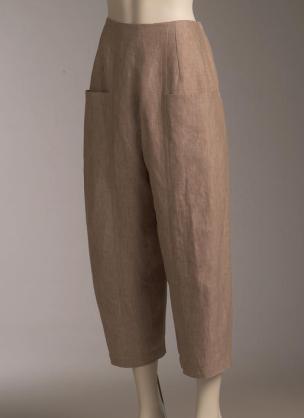
d myself immediately flummoxed by the instructions which involve very complicated (to me) top stitching and pockets. Should I stop and find a simpler pattern? Or baste together the main pant pieces to see whether the fit is even worth it before investing the time in fancying them up?
I have another pants pattern that is simpler and that I have made before (the one and only pant project). It definitely needs some alteration, but I think it’s more straightforward. It calls for lightweight denim and I only have medium weight. I wonder if that’s okay?
And then there is the whole problem of zippers and buttonholes. I pretty much redesign every dress to be a pull-on just so I can avoid setting in a zipper or sewing a hook and eye – which does not bode well for paints-making which often involves two types of closure!
It all seems very complicated to me. So much so that yesterday as I was sorting out the pants patterns, I found myself pulling the very simple Coco tunic pattern off the rack and recutting the neckline in anticipation of making a new dress instead. Never have I found myself wanting to sew so many other things than pants!
But diverge though I may, I am committed to getting pants right this year. Cropped pants in particular, and then maybe leggings. I do love a good fitting pair of pants, but so often they are all kinds of wrong.
And so the experiments begin.
Post #3094: Things in perspective

A co-worker died last Wednesday in a work-related car accident. It was one of those freak accidents in which the thing most at fault was the icy roads and bad timing. But somehow, that makes it worse – a reminder that life can conclude in a catastrophic second. When everything is otherwise normal and you don’t even see it coming, and there is no one to blame because the condition of this life is that it one day ends.
We like it better when we can blame something for a death – a drunk driver, smoking, untreated diabetes – and so on. As though divining all the possible reasons for death, we might avoid them entirely ourselves. But the death of anyone we care about is a warning, one that we secretly hope is not applicable to ourselves.
This is perspective, a death always is. And because it was work-related, it’s put some work-related issues into focus for me – things I’ve been feeling muddy about for the past few months.
I don’t want to write too much about my first world problems in my first world job…. But the essence of my work thoughts have been in the vein of meaningful work, right livelihood, and whether I can work another ten years in my current position (without going bonkers) in order to achieve my retirement pension.
I think this is mainly life-stage related, not specific to me or my work – as I’ve seen many people ask these same questions of themselves in their forties. This is also a period in which many professionals in jobs like mine (government) decide to quit and become consultants. Sadly – a correlated trend is people in their fifties coming back to government to get five more years into their pension so they can one day retire. After twenty years of watching people come and go and come again – I am mostly convinced that switching workplaces is not the answer to the work mid-life crisis (though I still have many days where I fantasize quitting).
I suspect that people leave work because, like me, after twenty years of doing something one has become an expert. In many fields once you’ve attained a certain status, there are not a lot of higher achievement levels, and thus work becomes a bit boring. In bureaucratic fields like mine, creativity is rare and something we must constantly fight to express in our work – and after a while of that, a bitterness or exhaustion starts to seep in. In the past two years I’ve found myself increasingly saying “just tell me what to do and I’ll do it,” with a kind of despair over the lost autonomy in my work.
But where my interest in professional work flags, I have another whole work life as the president of my union local. In this work life, I run the show (to some extent), am required for creative problem-solving, negotiation, counsel to my co-workers, and maintaining good work relationships at all levels of the organization. I manage a budget, lead my organization in good governance, and sometimes even get to advance social justice objectives in the cases I represent before management. In short, I have a role that is unique in my organization, and autonomous while still having obligations and responsibilities.
This is an obvious contrast to my official employment, but as I’ve said to many people over the years, it’s probably being a shop steward that has kept me in this particular workplace more than anything (well, and the people I work with are awesome).
My issues of the past year are about how I balance these two spheres – or in fact, stop thinking of them as two and realize that they are both part of the same workplace coin. Since becoming local president, I have at times seen them in opposition to each other – and instead of working to re-balance the load to other co-workers or union reps, I have tended towards holding in the work, as if to prove that it is possible to do two full-time jobs by myself. This has caused a bit of a problem in terms of work stress, but it has also created a resentment towards my career-work that is artificial.
The reason this has come up in relation to Ann’s death last week is because I always knew her to be a woman who brought a lot of herself to work, and found a great deal of meaning in serving her workplace as an administrative officer and a shop steward, not to mention as a social justice activist and advocate for the unemployed in her community. Although I did not know her closely, it seemed to me when we did work together that as much as she had a life away from work, the people she worked with and for were of significant meaning in her life – and her unionism was part of the same cloth as her dedication to work. What I have seen since her death is that her work, and work-related service as a union steward – are cast together as an honourable whole by those who knew her. That these two things are not observed upon as distinct from one another, but as parts of the same livelihood which extends beyond how we make our living, and into how we live our lives.
In short, the big takeaway from the last couple of weeks is thus: Looking for meaningful work is a mistake if we do not learn to find meaning in whatever work we do.
And meaning, in my job, is right in front of me in both of my roles – as is interest, demand, and novelty – if I just tilt my perspective slightly and find ways of giving myself the time to properly do and enjoy my job. That means better work/life hygiene – more separation between work time and downtime; sharing work with my union reps and my co-workers instead of hoarding it all; and meditation every day (it really helps me keep perspective which is what this post is all about).
So, no – I did not interpret my co-worker’s death as an “you only live once” reminder and immediately quit my job. Instead, I responded to what arose in me – a need to engage with my co-workers, ask questions about what was needed, and go back to work to support people in my union role. This event has been a sharp reminder of what matters though, and a big part of that is how we approach what’s right in front of us each day.


 Red Cedar