Red Cedar
More apocalypse, less angst
Post # 3120: Getting organized for sewing (using Trello)

I use the online organization tool Trello a lot with my work team these days. We are distributed across the country, and so we need a shared workspace for leave and work planning that we are allowed to access from our network. Of course we can’t use it to share protected documents, as it is not a particularly secure workspace and has social components that potentially could be exploited – but as far as it goes, Trello works well for a visual planning and calendaring tool and I’ve grown quite attached to doing all my work planning in it.
So of course, when I decided the other day to take a run at organizing my pattern stash (and eventually, fabric stash), and also creating a staging ground for planning garments – it was a no brainer that this was the tool I chose to use. I thought this was pretty original until I did a google search and saw that at least two other sewing bloggers have written about using Trello this way – of course!
I’ve tried to organize stash in the past using Zoho – which is a decent online database creator. Unfortunately I never found it convenient enough to actually go back and page through it for ideas. It also wasn’t aesthetically nice to work with – and a bit of a drag to figure out. Lately, I’ve been keeping links to patterns I want to try (but don’t necessarily own yet) in Google Keep – which isn’t at all visual and was getting a bit messy.
I wanted this round of organization to have the following features:
- searchable
- ability to delineate between patterns I want to try and patterns I own
- visual – able to attach photos
- included planning tools and ability to share patterns/materials between projects
While I know from my work in information architecture that everyone has their own way to organize information that seems logical – I determined that the best way for me to organize is by garment type: Tops, Outerwear, Pants, Statement pieces – and so on. Plus I’ve made a list for Fabric stash, Textile art ideas, and Completed projects. I want to use this less as a showcase for what I’ve done, and more as a quick tool for noting ideas, materials, and pattern matches.
I’m pretty sure this is going to keep getting added to as I work with it longer:

Within each of these sections organization happens within “lists” and “cards”.
As my main interest in using Trello is for organizing my next projects, and capturing patterns I am interested in pursuing I have started a list on each board for possible patterns (labeled Possibles). That list contains a card for each pattern I am currently interested in and if I own the pattern already, I label it with a green tag.
Other lists on the board will be used to plan my next project(s). In the example below I have created a list for a lightweight summer blouse. Into that list I have copied a fabric “card” from my fabric stash board, plus three pattern cards from my list of possibles because I’m not sure exactly what I want to make yet. If I wanted, I could create another board for Notions stash and copy in any notions that I own that are suitable for the project.

Once I have decided and made the project, I would eliminate the cards that did not get used (the patterns I didn’t choose for example) and then file that list under the Completed projects board.
To effectively use these boards I will need to:
- catalogue my stash
- use it for note taking and ideas – particular in the textile art section where I hope to record thoughts and materials as they come to me
Features that I also intend to use include the checklists and due dates in each project . If you put due dates on items or tasks within an item, the calendar function in Trello allows you to see the dates for all your projects laid out alongside each other. For production or commission sewing – this is a real bonus.
Of course this is just one way to organize patterns/projects/stash in Trello; there are other blog posts out there which share different organizing schemas. I think the way to proceed in setting up Trello as your sewing organization center is to determine your main goal and design from there. My main goal is *not* stash organization. It *is* a place to organize ideas and plan. This makes my organizing principles different than someone who wants to track all the patterns or fabric they own.
Trello is available via your web browser, and there are also apps for Android and iPad. I use all three – and they all have pretty much the same functionality, though I do think that the iPad makes it easiest to add patterns directly from their weblink to your Trello account and boards.
For other posts on the subject of Trello organization for sewing, check out:
Post #3119: Another five days of Me Made May 2018
Yesterday was day 15 of Me Made May and I am still on a roll with the self-sewn items:

There are some repeats from the last couple of weeks – but the cephalopod and roses dresses are were originals, as is the Amy Butler bag that I made years ago and carried my work clothes over to the city with me yesterday. That bag represents the first pattern I ever sewed from, and the first time I ever used interfacing – a precursor to the garment making I started doing shortly afterwards (about eight years ago).
This next seven days is going be a greater challenge for a few reasons:
- Although I got a tripod to better take photos of myself this month, I promptly dropped and broke my camera so I am stuck with mirror selfies.
- I do not have a full length mirror in the condo or the cabin I am going to on the weekend.
- My husband (love him!) takes worse photos of me than I take of myself in the mirror.
- I will be at our bush cabin from Thursday and so not wearing all my cute things.
So we’ll see how successful I am at getting photos over the next little bit. The fact that I have photographed myself 15 days in a row is somewhat remarkable and the process has made me a lot more relaxed about how my selfies look. I do plan to purchase another camera before the end of the month (Olympus is having a sale on the model I want until May 31) – so I look forward to setting up more professional photos in the future.
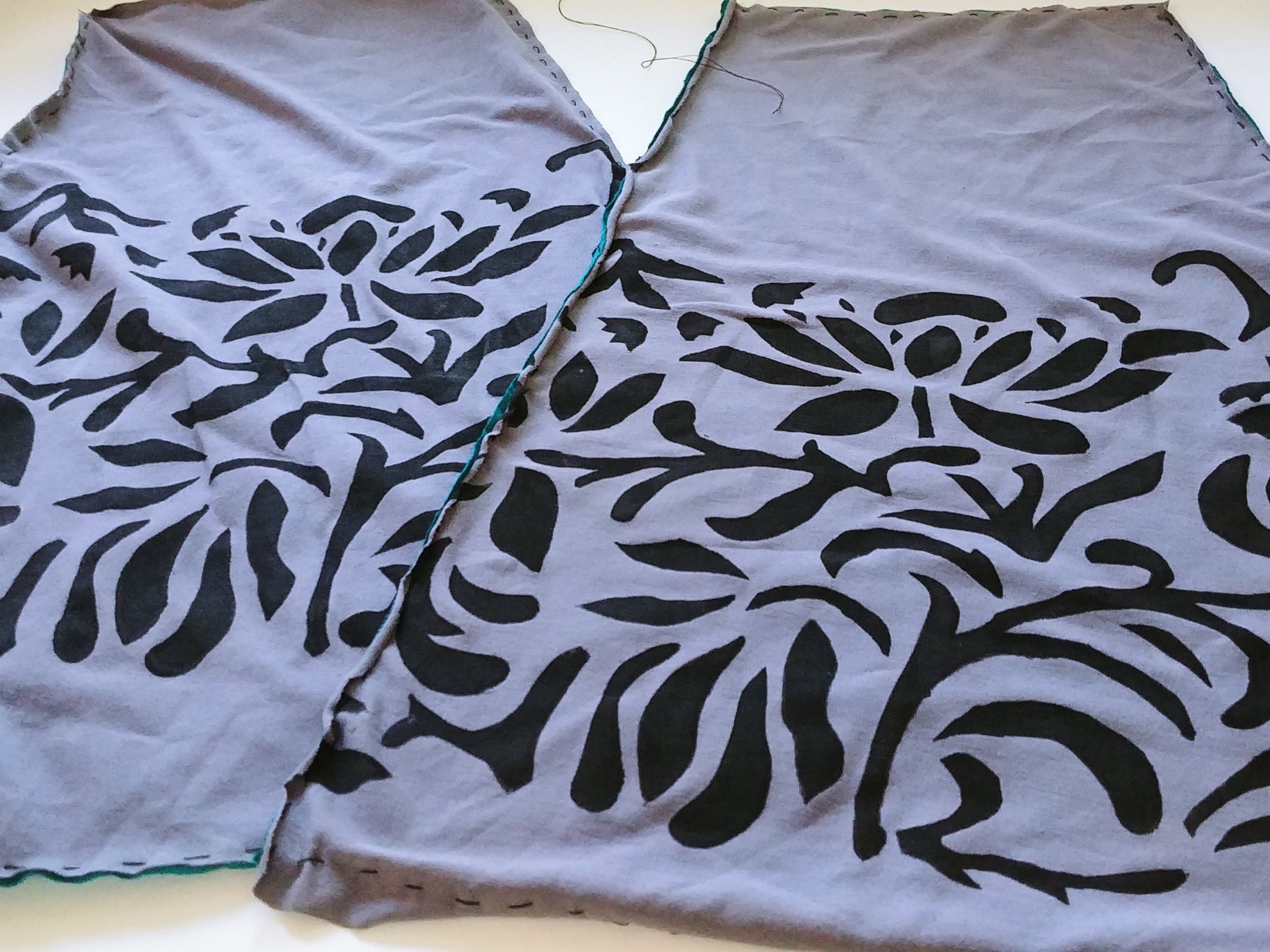
Up there in the banner image is my next significant project which I organized this past weekend – the Alabama Chanin swing skirt – which I have stencil printed and will start embellishing sometime next week. This is a four panel skirt and I printed on each of them, then basted them to a backing layer – next step will be to stitch around all the shape edges, then cut out the interiors -which is a bit of a process if my test-samples are anything to go by.
As I’m away from home and studio at the moment, there won’t be any sewing progress this week – and since I am trying to only sew from stash at the moment I don’t even think I’ll get a visit to Vancouver fabric stores while I am here. On the other hand, I’ve got three items cut out at home, and more projects planned in my mind for summer wear – and if this heat wave keeps up it will be end of sewing season for me anyway.
Post #3118: Zen chic
If you go and type “zen chic” into a search engine right now, one thing you will notice is that none of the links that come up have anything to do with Zen Buddhism. Not so here! I promise that this post has an actual relationship to Zen *and* stylish (?) clothing.
This little project has been underway for a couple of months – owing to the amount of time it took me to knit the poncho – but I am pleased to say that after four or five years of Zen practice, I have finally gotten around to making my first dedicated meditation clothing – which will only be worn for retreats and no other purpose:

This in no way comprises “traditional” wear, such as samue (plain cloth jacket and pants) or lay robes. Instead, it is what I consider essential for a meditation retreat – a jersey-knit dress with 3/4 length sleeves (to be worn with full length black leggings), and an easy-to-pull on poncho knit in DK-weight wool for travelling between the meditation hall and the dining hall. This garb is comfortable, modest, and most important – stretchy – which is a must for long sessions of sitting and bowing (in full prostration several times a day). Also – it’s black. Dark, neutral colours on retreat are a Zen thing meant to help minimize visual distraction.
Because I have a lot of black in my regular wardrobe, I usually just grab things on my way to retreat – but too often the items I want to pack are in the laundry, or a little worn out from regular wear. My hope is to make a small capsule wardrobe that will last a long time and remain clean in between practice sessions. Three outfits are enough to carry through a 7-day retreat as we don’t exactly sweat or get dirty in the meditation hall – and by layering, I can wear the same items in different seasons. That’s my plan at the moment – starting with two items.
I am very much in love with this poncho pattern – having made it twice now (the first time in an amazing rust-red, completely unsuitable for meditation retreat). it is essentially just a large stockinette rectangle, mattress stitched at one long edge to create the shoulder and neck. If you are interested in the specs for the Easy Folded Poncho, the pattern is available for sale on Ravelry. The dress is simply one more version of the Coco Dress with a modified neckline hidden beneath the top layer in this photo.
I haven’t decided yet if I am going to make more of the same or go for a samue or other traditional outfit as a bit of a challenge. To be decided.
And on a totally different tack – I changed my instagram handle yesterday to reflect the name of my creative practice studio – so if you are so inclined and weren’t already following me – please go to Instagram and follow @birdsongtextiles. No big changes coming to the content posted there as it is pretty much all textile-related already!
Post #3117: A sunny Monday

I just had such a great weekend.
Brian is working on songs for a new album (to be recorded in the fall), and a couple of musician friends came up to workshop the material with us. In between many hours of playing and arranging music we also ate great food, had our first evening fire of the season, had a few too many drinks, went to the local spring fair, and had a picnic of deli foods at the most beautiful point on the island. The weather has definitely taken a turn towards summer and I am returning to my work desk replenished in vitamin D, and creative fellowship.
I’ve got a pile of work on my plate this morning so more writing will have to wait until later, but in the meantime I have determined that the best way to post Me Made May outfits is to do five days at a time. Here are the first five days of the challenge:

Left to right: my self-makes are top (Cashmerette Webster) and pants (Emerson crop pants), skirt (self drafted) and top (Cashmerette Concord), skirt and sewn infinity scarf (self drafted), dress (modified Coco by Tilly and the Buttons), pants (Emerson crop pants).
One thing this challenge is already helping me with is determining what clothes have seen better days and no longer suit or fit me. Take the blue top in the above photo – if you look *very* closely you can see that the spandex in the fabric is breaking and so there are puckers that look none too good. That shirt is now relegated to yard work wear only and one of the reasons that I am trying to avoid plastic in fabrics I purchase from here on out – this shirt is less than a year old and has never seen the dryer!
I note that a few people have started following here lately – likely due to my activity in the sewing community. I have finally updated my About page to give a little more info about myself. If you are interested in a bit of backstory, please check it out!
Post #3116: Why bother with hand-finished hems?

It was not so long ago that I believed a garment could be finished without any hand sewing. I mean, that’s what machines are for – and why would I want to delay wearing a garment by taking the extra time to deploy stitches by hand to an item? I really felt that these kinds of finishes (including hand-basting underlining) belonged in couture dress making and not in my everyday wardrobe.
But lately, I’ve found myself finishing nearly every garment by hand – hems and sleeves in particular – to get “invisible” finishes instead of simply running the garment through the machine with a visible line of stitching left to show.
Beyond the barely visible stitches, hand finishing also gives much greater control over how fabrics go together. As in this photo, where I am attaching self-made bias tape to the bottom of my most recent top:
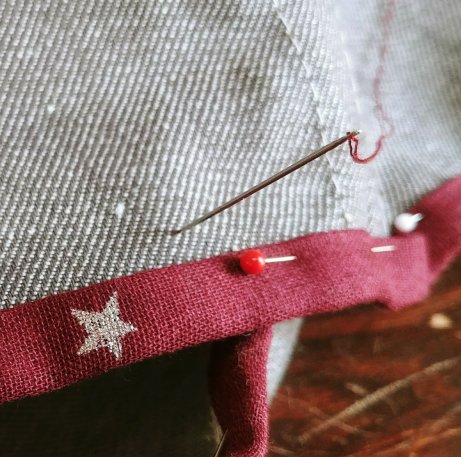
Of course bias tape can be sewn on with a machine, but in my experience it’s a challenge to line everything up so that top and bottom layers are caught evenly. Hand sewing allows me to line it up as I go, resulting in a much tidier finish than I have gotten in past attempts to finish a hem this way. I mean – it’s a no-brainer right? Taking time with each stitch allows me to control the needle and the fabric for a more professional look.
A lot of us have fears about hand stitching – right? But now that I’ve been tackling hems this way more often, I have definitely gotten quicker and better at it. And really – no one can see the backside anyways!
It also just slows me down enough to help me with the bad habit of pushing to finish after a long evening of sewing. This is always when the mistakes get made. When I decide I will hand hem, I just get myself to raw edges and then set the work aside, knowing I will give myself the space to sit out in the garden (now that the weather is warmer) or beside Brian on the couch while we are watching a show – and find a nice end to each make. Far preferable than the rushed and frenzied “get-it-done-beforebed” finish. I suppose it goes along with my tendency overall to take a bit more time with my makes these days. I don’t need a thousand things – just a few really well-made things.


 Red Cedar