Red Cedar
More apocalypse, less angst
Post #3117: A sunny Monday

I just had such a great weekend.
Brian is working on songs for a new album (to be recorded in the fall), and a couple of musician friends came up to workshop the material with us. In between many hours of playing and arranging music we also ate great food, had our first evening fire of the season, had a few too many drinks, went to the local spring fair, and had a picnic of deli foods at the most beautiful point on the island. The weather has definitely taken a turn towards summer and I am returning to my work desk replenished in vitamin D, and creative fellowship.
I’ve got a pile of work on my plate this morning so more writing will have to wait until later, but in the meantime I have determined that the best way to post Me Made May outfits is to do five days at a time. Here are the first five days of the challenge:

Left to right: my self-makes are top (Cashmerette Webster) and pants (Emerson crop pants), skirt (self drafted) and top (Cashmerette Concord), skirt and sewn infinity scarf (self drafted), dress (modified Coco by Tilly and the Buttons), pants (Emerson crop pants).
One thing this challenge is already helping me with is determining what clothes have seen better days and no longer suit or fit me. Take the blue top in the above photo – if you look *very* closely you can see that the spandex in the fabric is breaking and so there are puckers that look none too good. That shirt is now relegated to yard work wear only and one of the reasons that I am trying to avoid plastic in fabrics I purchase from here on out – this shirt is less than a year old and has never seen the dryer!
I note that a few people have started following here lately – likely due to my activity in the sewing community. I have finally updated my About page to give a little more info about myself. If you are interested in a bit of backstory, please check it out!
Post #3116: Why bother with hand-finished hems?

It was not so long ago that I believed a garment could be finished without any hand sewing. I mean, that’s what machines are for – and why would I want to delay wearing a garment by taking the extra time to deploy stitches by hand to an item? I really felt that these kinds of finishes (including hand-basting underlining) belonged in couture dress making and not in my everyday wardrobe.
But lately, I’ve found myself finishing nearly every garment by hand – hems and sleeves in particular – to get “invisible” finishes instead of simply running the garment through the machine with a visible line of stitching left to show.
Beyond the barely visible stitches, hand finishing also gives much greater control over how fabrics go together. As in this photo, where I am attaching self-made bias tape to the bottom of my most recent top:
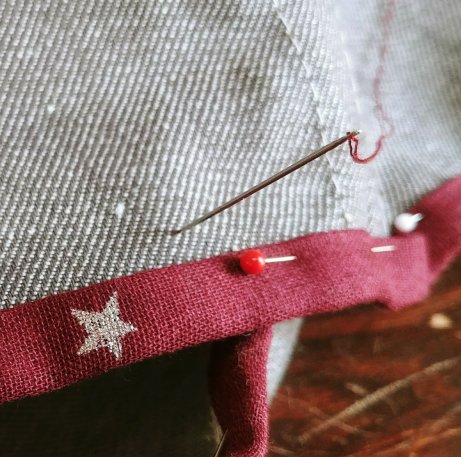
Of course bias tape can be sewn on with a machine, but in my experience it’s a challenge to line everything up so that top and bottom layers are caught evenly. Hand sewing allows me to line it up as I go, resulting in a much tidier finish than I have gotten in past attempts to finish a hem this way. I mean – it’s a no-brainer right? Taking time with each stitch allows me to control the needle and the fabric for a more professional look.
A lot of us have fears about hand stitching – right? But now that I’ve been tackling hems this way more often, I have definitely gotten quicker and better at it. And really – no one can see the backside anyways!
It also just slows me down enough to help me with the bad habit of pushing to finish after a long evening of sewing. This is always when the mistakes get made. When I decide I will hand hem, I just get myself to raw edges and then set the work aside, knowing I will give myself the space to sit out in the garden (now that the weather is warmer) or beside Brian on the couch while we are watching a show – and find a nice end to each make. Far preferable than the rushed and frenzied “get-it-done-beforebed” finish. I suppose it goes along with my tendency overall to take a bit more time with my makes these days. I don’t need a thousand things – just a few really well-made things.
Post #3115: Me Made May begins!

It is day two of Me Made May – and I am wearing the spring dress I made a couple of months ago:

I don’t plan to post a selfie every day this month but I might do round-ups once a week, or at the end of the month as I have pledged to wear at least one me-made item per day. I just got a tripod for my camera (my old one fell apart some time ago) so I am also going to use this month as an opportunity to get some better shots, particularly outdoors. Photographing myself well is something I would like to get better at – and a tripod is key to that process as it means I can use my real camera which takes *much* better photos than my phone.
So, as a recap – this month in addition to wearing me-mades I am planning to:
- sew to fill wardrobe gaps
- sew from fabric in my stash
- continue to finish the unfinished items kicking around my studio
I am also going to clean out my drawers again and remove anything that isn’t getting worn. I have done this already this year, but I still feel that I have many items that I do not enjoy or want to wear – mostly because they are ill-fitting. There are only so many things I can save for “one day when I lose weight/get in shape” and even though I am working out consistently these days (more on that in a future post), I know that even if I do get more toned – it doesn’t mean my body will go back into the same form it was before when those clothes fit. Bodies are weird like that – always changing shape and texture.
When you sew for yourself, there is no hiding from your shape! But unexpectedly, I’ve grown to like my body more not less as a result. I think it has something to do with the fact I am forced to look at myself more often in the mirror and in photographs – and you just get used to what you see over time. For many years, I would never look in mirrors at all because I hated what I saw; that kind of avoidance just builds on itself and creates as much of the body-hating dynamic as anything else going on.
I just became aware of a challenge that took place earlier this year called “sewing makes you love yourself“. I’ve been thinking about that for the last few days and realizing how much that is the case for me – as much as shopping for ready-to-wear-clothing makes me hate myself, the converse is also true – which just speaks volumes to the subjectivity around our bodies. During this month of May I might try to write a bit more on these themes, as I focus on wearing and making more of my wardrobe for the summer.
Happy May!
Post #3114: Going for the log cabin after all

I’ve taken the plunge and started cutting a new quilt.
As I mentioned in my last post, I’ve had my interest in 19th century quilts piqued recently – and I think that I finally (maybe) have the skills and patience to pull off a heavily pieced quilt – so I’m going for it. Log cabin blocks here I come!
At the moment I am deep in the throes of cutting “logs” for the log cabin block:

The paper bags are there to divide the sizes and the dark/light fabrics from each other. As I’m not exactly sure how many finished log cabin blocks I’ll end up with, and would like the fabric to come along randomly, not in groups – I’m cutting all my fabric at the outset. This approach also allows me to chain piece one side at a time – which is a big time saver.
At first I was going to do a “modern” version of this – using Kona solids in jewel-toned colours, against a palette of neutrals. This would necessitate ordering more fabric which I am trying not to do, and result in a very stark set of blocks. But then I remembered that I had some Moda fabrics in my stash perfect for a 19th century quilt – print collections that I’ve been saving for a long time because I love them so much. These would be the French General Josephine and Atelier lines:
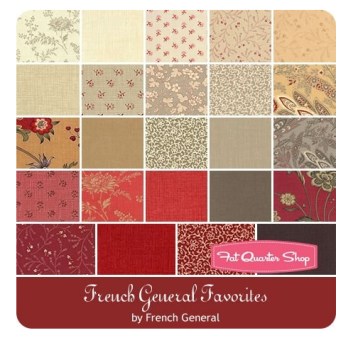
These fabrics are some of my all-time favourites, and thus have remained untouched for a long time (I have been fearful of ruining them with the wrong project). Something about the colourways and antique-inspired prints move me deeply every time I contemplate them. Taking them out this time was no different and I really had to talk myself into washing and preparing the fabric for use – but once I had it out of the dryer I started cutting the 1.5 inch strips in earnest.
I have about a third of the strips cut into logs now and I plan to power through this week and get it all done so I can reclaim my work table for other things. Once I start the chain piecing, I can start and stop by size – so once I get one side done and pressed, I can take it off the sewing machine for another project – and so on. This organization allows me to continue sewing summer garments (and have a friend in for some sewing coaching) in between bouts of chain piecing. With thirteen pieces per block, I don’t expect these to go together quickly – but I have reoriented my ironing station for maximum efficiency in this process.
I first learned to piece and quilt thirteen years ago, by taking a class at Carola’s Quilt Shop in Gibsons in which we made a potholder (which is a miniature quilt after all). Back then I didn’t believe I could ever get precise with my cutting and sewing; I had just bought a machine and preferred my projects to incorporate large squares and a fair degree of randomness.
The key thing I took away from that class (and for which I am forever grateful) was how to use a quilting ruler and a rotary cutter properly. As I take blade to fabric this time around, I notice that in fact I have gotten a lot more precise over the years – and am now at a stage where I can (probably) pull off a thirteen piece block 64 times with some precision. Part of that is the development of my skills, but also because I have discarded the notion of getting projects done quickly – something that used to be important to me.
I’m quite excited about this project – which will answer my desire for a 19th-century-inspired quilt in my life. Not exactly sure where in the house it will get used yet – but I know from experience that once a quilt is made, it always finds its place somewhere.
Post #3113: A small and scrappy make
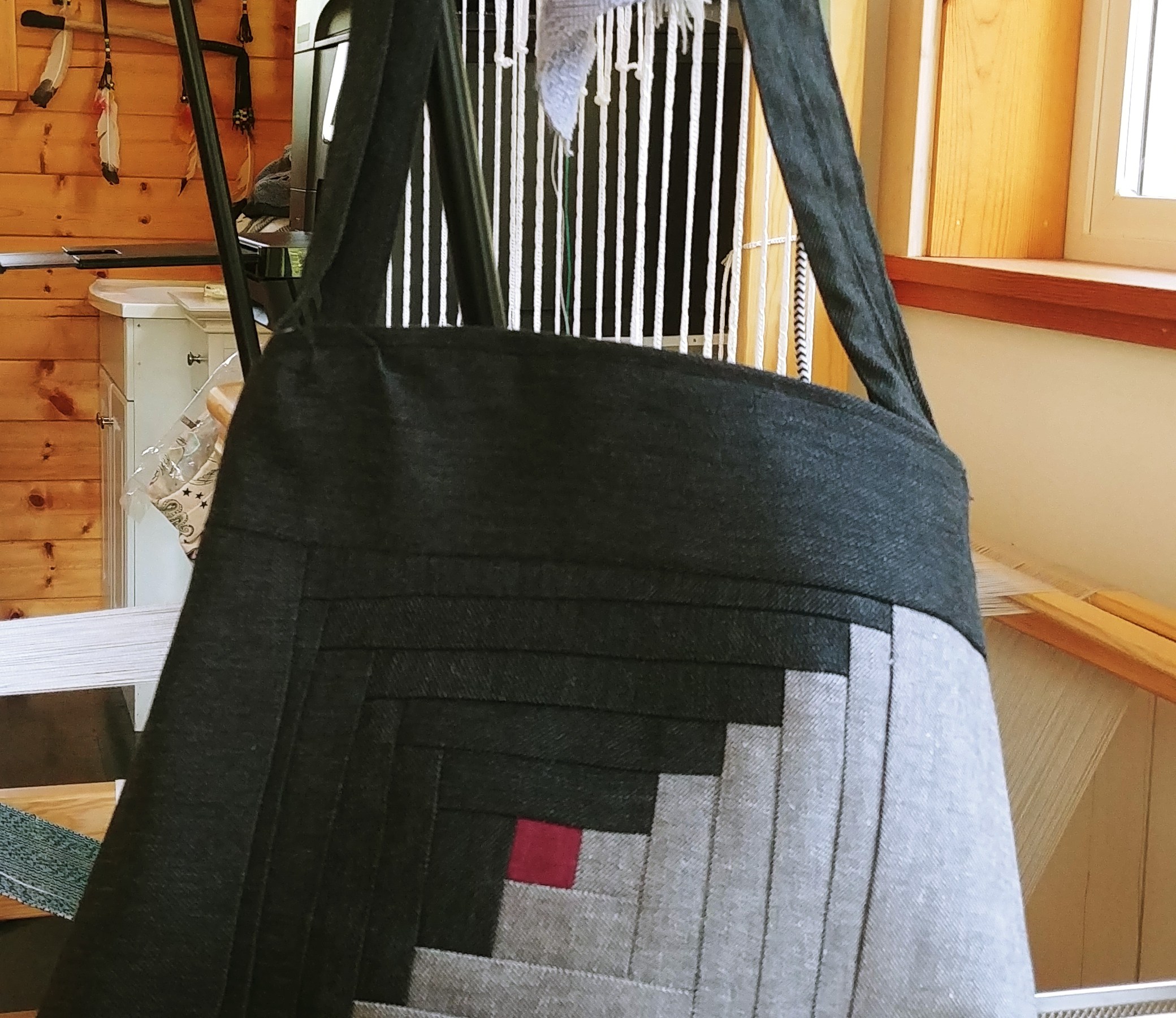
Since watching the mini-series version of Alias Grace on Netflix a couple of weeks ago, I’ve been thinking a lot about classic quilt blocks. There’s quite a bit of quilt-talk in that story and the period-accurate quilts featured on the show are extraordinarily beautiful.
I’ve been wanting to make a new full sized quilt for awhile, but I’m still deciding what style and materials I want to use. A queen-sized quilt is a big undertaking so you really have to love what you start with – there is no half-hearted quilting!
As part of this exploration I pieced together a log cabin block from some garment scraps the other night as an experiment to see if I might have the patience to do a whole log cabin quilt (answer: probably). Log cabin is such an interesting block because it can be laid out in so many different ways to some really stunning effects.
With just one log-cabin block made out of scrappy twill and linen (and a tiny center of double gauze) – I was totally in love with the finished product. Instead of setting it to the side I added some interfacing and extra fabric and turned it into a small bag just big enough for my iPad, wallet, and phone (there is a phone pocket on the back side).
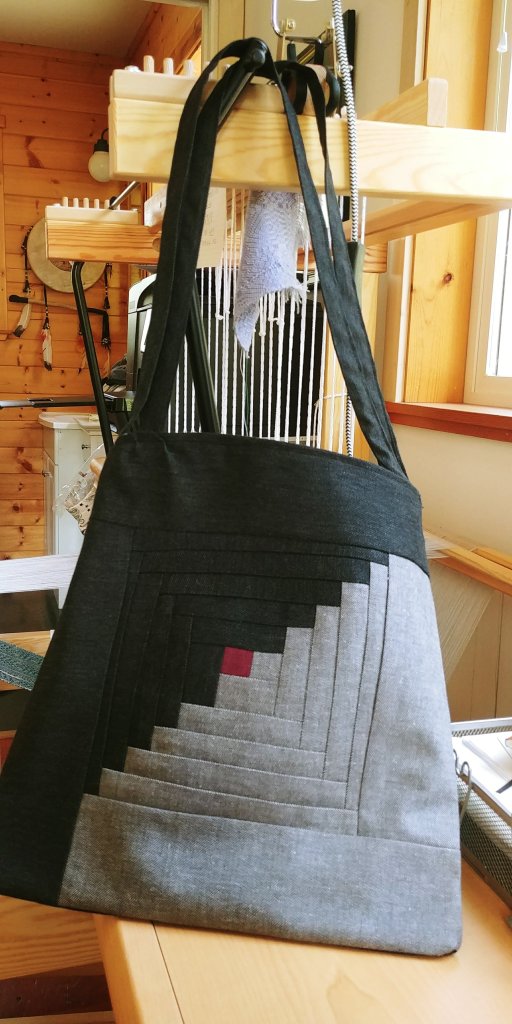
This was a quick project and used up a bunch of scraps which is satisfying on both counts. It’s not at all original (turning a quilt block into a bag), but by using these heavier bottom-weight fabrics in neutral colours, this bag doesn’t feel “scrappy” at all to me. I love patchwork – but I don’t necessarily want to wear it on my person – you know?
Of course it’s fully lined, and has a cel phone pocket on the back for easy access. I’m kicking myself now that I didn’t put magnetic snaps into the lining because I feel like that would be a perfect final touch – but I might sew a heavy duty snap in instead for securing the closure. I’m not sure if I really need it though so I’ll use the bag a bit first before I decide.


 Red Cedar