Red Cedar
More apocalypse, less angst
Post #3170: Zen ocean
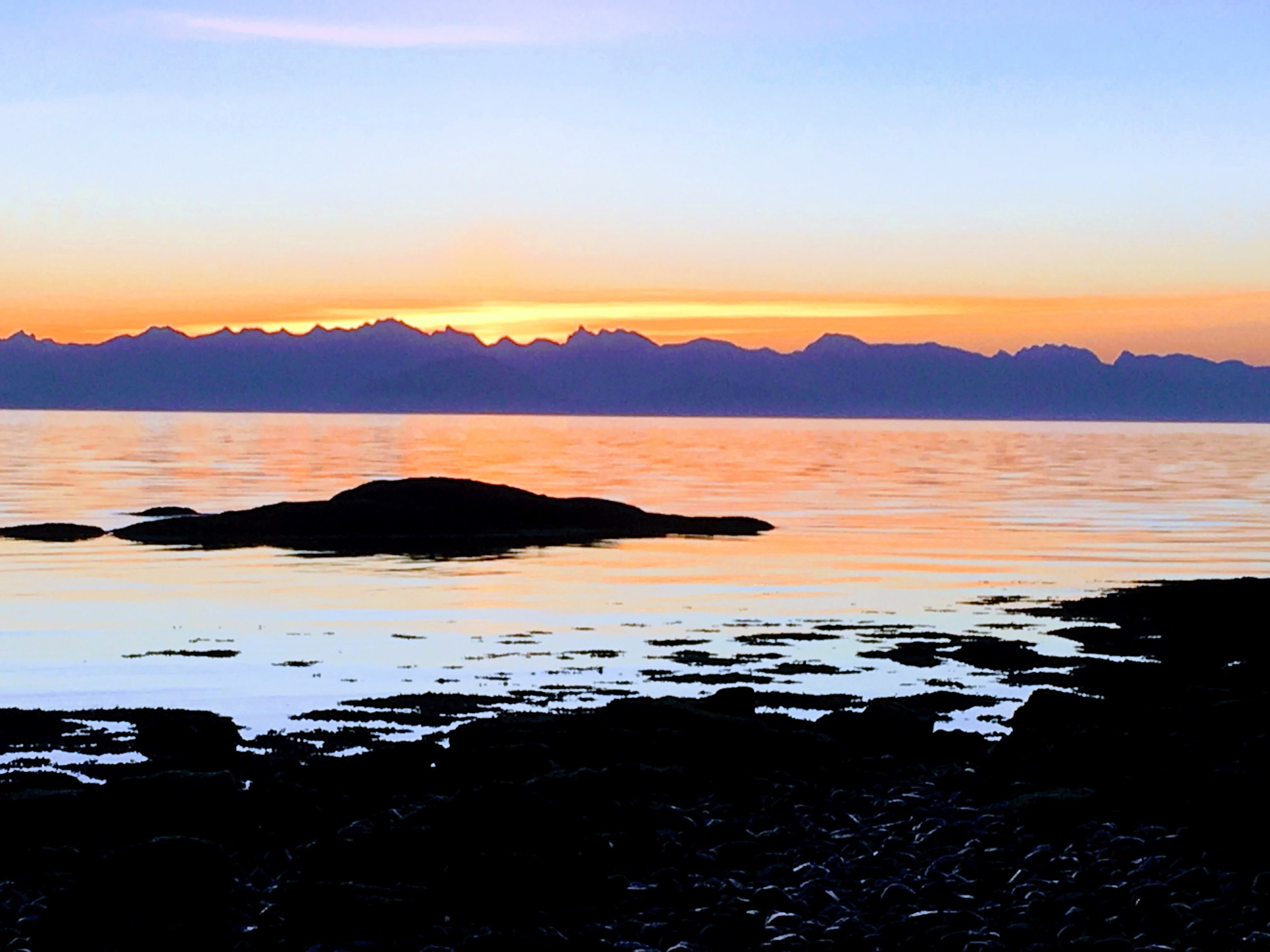
I’ve been night swimming the last few nights, encouraged by warm days and high tides later at night. 9:30 on Sunday, 10:30 Monday. The bioluminescence is blooming, so waiting until full darkness brings a magical quality to swimming that we only get a brief period of each year. It’s hard to describe the visuals of swimming in phosphorescence, I’ve tried before and the best description I came up with was that it’s like swimming in stars, shooting stars. The arms and legs stir up the sparks and light outlines the body, moving outward from it in a cloud of light that goes down into the inky sea. I’m at a loss for words to describe it really. It’s simply part of the magic of summertime.
I can’t remember the last time I went into the ocean at night, but I think it might be as far back as when I lived on the Sunshine Coast, fourteen years ago. Living in Gibsons, I sometimes went down to Secret Beach on warm nights to swim in the glowing waves, but then I moved back to the city and dropped the practice. I didn’t live near ocean swimming in the city, nor did I ever feel the urge to go into the water in the crowded neighbourhoods where the beaches exist. Too busy. Too dirty. Chip wrappers and dog poo in the sand don’t invite feelings of communion with the water.
Now on the other side of the strait, I walk across the road from my house to swim within visual distance from the last place I practiced night swimming. At low tide, the bay empties right out past the rocky reef leaving only a rocky/muddy flat, but at high tide it fills up as much as five metres. I follow a sandy shoal in, stepping around the rocks and submerging myself as soon as I can, swimming out to just shy of the reef. I don’t like to get too close, risk an accidental scrape against the barnacles.
Tides, like bioluminescence, remain one of the great mysteries to me. I understand these phenomena scientifically, and yet I still can’t wrap my mind around them really. The fact that at one time of day this bay is a shallow pool, and at another, the water is 10 feet or more deep is not something I can compute in any rational part of my brain.
I am an avid watcher of tides. There are beaches not far from me where mid-tide swimming is possible, but quite honestly I’m spoiled by a beach at my doorstep and so I wait, 3.7 metres allowing swimming out beyond where my feet touch the bottom. At 4.0, the pool is full and at 4.5, only the top of one part of the reef is visible and seems very far out at sea. Such is the illusion that the water creates. Walking 100 feet on land is not the same as swimming out 100 feet in the water. There is an element of danger, the unknown, even though I recognize this bay is also a muddy flat in another life.
The weather hasn’t been overly hot and the nights are temperate, not muggy, but still the water and the air aren’t far apart in temperature once the sun goes down. Full sunset right now is about 9:30 making evening swims possible until quite late as long as the tides co-operate. To see bioluminescence though the night sky has to be full dark, closer to 10:30 and it’s best to swim away from any adjacent light sources including moonlight.
On Monday I went swimming with my friend Kyla in a sliver of the moon’s glow, but the because ocean glows deep with the movement of our feet, the light was visible even with the moon above. We went after the bar, after the open mic, to a beach that is known for this phenomena, sitting on the sandy shore as the light disappeared from the horizon. We got a little chilled, throwing rocks into the water looking for evidence that it was time to go in. Once we saw the confetti-like sparkles rippling outward, we stripped off our clothes and waded through a shallow seaweed before plunging ourselves into the inky sea. We exclaimed at the brilliance of each stroke, at the way our kicking feet below us created a milky way underneath. The luminescent organisms grew more numerous the farther we swam out, the dark sky also full of stars on the cloudless night.
I’m not sure there is anything more magical than swimming naked in a silvery glowing ocean, underneath the Perseid meteor shower. We paddled around for awhile out there, exclaiming as though we were teenagers on LSD all over again, floating on our backs to look at the stars, until Kyla felt a fish nibble her arm and we decided that it was time to go a bit closer in. We went onto the beach for a moment, before swimming back out for another few minutes “to make sure we really saw what we saw.”
On the beach, my clothes went back on full of sand as I scrambled to get dry in the darkness and we turned the seat heaters on in my car on the drive home to bring up our body temperatures, now chilled after half an hour in cold water. As always, the ocean left me stoned. Swimming in the dark has a disorienting effect, bobbling between dark sky and sea, moving without a horizon to fix on and a sense that that the ocean goes down forever, right to the core of the earth. When you climb out from that, it is hard to fix oneself in space again and for the first minute or so of driving my car, I wondered if I really should be doing that.
Back at the house I showered and rubbed oil in my skin, went to bed, dreamed of floating in a bottomless ocean with only the light of tiny creatures and the stars to guide me home.
Post #3169: Another weekend party come and gone

The August long weekend is the date of our annual party at Birdsong. We start on the Friday afternoon and the last guests usually clear out by noon on the Monday. In between there is always lots of food, drink, chatter, and music with friends old and new coming together on our little patch of Gabriola compound.
This year we decided to combine a house concert/community dinner with the party and ended up feeding about 65 people on the Saturday night, and I think we saw about 80 people in total over the course of the weekend, with 30 of those folks staying at our place in tents and in the house. We don’t hire anyone to help, so yes, it’s a ton of work but our friends share the DIY spirit and many people pitch in over the course of the weekend to help with food prep, dishes, kid wrangling, and tidy up so that by day two the party takes on a really self-sustaining vibe.
This was our fourth year doing it (we started the first summer we moved here) and for me it was the sweetest one so far. We did a lot of food prep in advance, freezing meat skewers, pulled pork, and vegetarian chili that all came out ready to cook or be reheated. This year I also organized a few activities that were well received – Saturday morning yoga in the park, disco happy hour in the afternoon (blender drinks, ABBA!), and an artist talk on Sunday by the creator of a piece we are hosting for a few weeks. Although the days remained free flowing, these scheduled activities gave everyone drop-in points if they were interested in having them. They also gave me timing points that helped organize the work we needed to do each day.
Throwing a three day party is a bit of a thing, but the length of time people have together really helps open up deeper conversations and relationships than is possible in a few hours over drinks in someone’s living room. As hard as I worked, there were so many moments in which other people took over and I could just relax and enjoy the companionship of good people and music. I made some surprisingly tender connections with a couple of people, had a rousing singalong of Bony M’s Rasputin with my former bandmate Jon, and got to drop into a truly delicious yoga practice on a bluff above the sea.
On the last night of the party I went down to the ocean at high tide with some friends and we swam out while watching the last light of the day disappear on the horizon. I haven’t swum at night for a long time, and I forgot the pleasure of feeling adrift, looking up at the lit houses on the bank above while floating on my back in the bottomless water. I felt stoned when I came out, heavy with the pleasure of a massage as I padded up the trail, now faint in the after light. It wasn’t quite the end of the weekend for me, but it stands out as a moment in which I felt the deepest of gratitude for the companionship of friends and of nature, full of all the possibilities of a well lived life.
Most years I get to the end of the party and tell Brian that I’m not sure if I ever want to do it again. This year on Monday morning we sat up in bed drinking our coffee and talking about what we could do next year to make things even better. Too exhausted for any new ideas, we gave up in the moment and simply focused on what the days had meant for us: a chance to connect people to one another, to do service for our community, and to participate in a different vision of the world if only temporarily. Full up, we are, with the gift of being able to bring people together in this way.
Post #3168: One-sentence reviews for the first half of 2019

Reads and reactions in brief since January 1st, 2019.
How to be Alone – Lane Moore
Essays. Lane Moore is youngish, funny, and figuring out her life. These essays are part of her process.
This House is Haunted – John Boyne
Novel. Forgettable. In other words, I read this in January and can’t remember anything about it.
How to be a Person in the World – Heather Havrilesky
Letters. Havrilesky is Ask Polly and this is a selection of her responses to people who write in asking for help. Compassionate and wise, with lots of tidbits to take away for those of us reading along.
Practical Magic – Alice Hoffman
Novel. Classic chick lit about the witches among us and their deeds committed in the name of love and escape. A quick read, fluffy.
and also sharks – Jessica Westhead
Short stories. Loved these. Quirky and poignant. Would read these over and over.
Things Not to Do – Jessica Westhead
Short stories. Did not enjoy this collection as much as the first, but still found these tales compelling. Dark, funny, a little unsettling.
Ladder to the Sky – John Boyne
Novel. Loved this somewhat implausible novel about deception (and murder) in the life of an aspiring novelist on his way to greatness. I wondered if Boyne based this on someone in the literary world. It feels like good gossip.
Changemakers – Mary Wilson and Faye Weller
Non-fiction. A book by Gabriolans about how to make changes in our own backyards, using examples from around the Gulf Islands. Includes a handbook for community organizers in the back.
You Think it, I’ll Say it – Curtis Sittenfield
Short stories. Satirizing modern life, Sittenfield sets up her characters through their own expectations. Enjoyed this and would read more of her.
The Manual for Cleaning Women – Lucia Berlin
Short stories. If Berlin were a man, she would be as famous as Raymond Carver. Working class stories about the difficult lives, addictions, and marriages of women.
The Quick & the Dead – Joy Williams
Novel. Williams is a brilliant writer of short fiction, but she is no novelist. I read this aloud to Brian and while some parts of it are well crafted and funny, it does not hang together as a novel.
Advice for Future Corpses and the People Who Love Them – Sallie Tisdale
Non-fiction. A how-to manual for people dealing with death that contains all the practicalities told by a no-nonsense Zen Buddhist and nurse. Pick it up if you are dealing with this in your life.
The Heart’s Invisible Furies – John Boyne
Novel. This book has one of the best first lines I’ve ever read. Beyond that it’s an excellent read about growing up adopted and gay in Ireland in a time when neither fact could be spoken about. This novel has a lot of heart, even though the main character is at times frustratingly obtuse.
The Overstory – Richard Powers
Novel. Smart, historical, gutting. Everything about this book spoke to me and I sobbed my way through the whole middle third of it.
Deception – Denis Mina
Novel. A page-turning whodunit. A husband goes searching for answers when his wife is convicted of murder, diarizing his findings, which slowly reveal the crumbling core at the centre of his life.
The Magic Toyshop – Angela Carter
Novel. A fairytale involving orphaned children, sinister relatives, charmed toys, and incest. Classic Angela Carter.
On Writing – Stephen King
Non-fiction. Part memoir, part craft. King’s work from twenty years ago blends his own life experiences with advice for new writers. More useful and inspirational than any other book on writing I’ve picked up.
The Art of Memoir – Mary Karr
Non-fiction, craft. Although I write about my life, I’m not a memoirist which this book helped me define. If you write memoir, this is probably the book for you.
The Rise and Fall of Great Powers – Tim Rachman
Novel. An interesting tale comprised of three stories woven together about the life of Tooly, raised in mysterious circumstances and travelling back to the closest thing she has to origins in order to understand where she came from.
The Silence of the Girls – Pat Barker
Novel. I was disappointed by this re-telling of part of the Illiad through the eyes of Briseis, a young royal taken as a slave in the war for Troy. The charcaters were flat and most of the story is told through banal internal commentary.
Sex Object – Jessica Valenti
Essays. Intimate, outraged, and full of truth. Enjoyed Valenti’s style of recounting the indignities of female life without getting bogged down or self-pitying.
Mr. Essay Writer Guy – Dinty W. Moore
Essays. Witty and short, these essays are a great example of how one can write about pretty much anything.
To Show and To Tell – Phillip Lopate
Non-fiction, craft. Lopate has a lot to tell us but he comes across as somewhat pompous making this a difficult read.
Lyrical and Critical Essays – Albert Camus
Non-fiction. Classic existentialist argument, interesting sketches of places, brilliant observations on the end of the world post WW2. I haven’t finished this collection yet, still dipping in with great pleasure.
How Will Capitalism End? – Wolfgang Streeck
Non-fiction. Reading this brought back my youth spent in socialist study groups (a good thing in my opinion). Streeck is a classic Marxist and he applies his analysis to the times we are living in to great effect. Clear writing which gets at the heart of these problematic times.
The True Secret of Writing – Natalie Goldberg
Non-fiction, craft. A how-to on running writing retreats and writing exercises. Interesting if you want to create a retreat for yourself or others.
Outline – Rachel Cusk
Novel. Not a conventional narrative, Cusk tells rather than shows for most of the story which is crafted as the internal dialogue of the main character. I plan to read the two others in this triology, though I’m still not sure how I felt about this one.
This Close to Happy – Daphne Merkin
Non-fiction. Merkin’s book on depression, her own experiences, and how it is treated in this culture is some of the truest I have ever read.
Before I Wake – Robert Wiersma
Novel. A highly readable, quasi religious tale about tragedy and the miracles it can bring forward.
The Writing Life – Annie Dillard
Non-fiction. Annie Dillard’s famous extended essay in which she writes, “How we spend our days, is of course how we spend our lives.” A beautiful meditation.
The Ten-year Nap – Meg Wolitzer
Novel. A novel about the impact on women’s lives when they choose to stay home to raise their children. An enjoyable read set in NYC.
Against Everything – Mark Greif
Non-fiction. Incisive essays about modern society. I took this out of the library and had to read it fast, now I want to read it again. In particular, Greif’s essays on music (Radiohead, Punk Rock) really stood out.
Bad Feminist – Roxanne Gay
Non-fiction. Essays about living in the world as a black woman, about privilege and education, about representation in popular culture. I feel like I’ve heard Gay interviewed too often for any of this to feel fresh, but she’s a great writer.
Motherhood – Sheila Heti
Hybrid. I went to a party and all the women in their mid-thirties were talking about this book. It made me glad that I’m past my childbearing time. So did this book.
The Farm – Joanne Ramos
Novel. A story about making babies for money, for the very rich in fact, and the classism and racism that go with that. A page-turner, I really enjoyed the concept and writing of this debut novel.
Confessions of a Recovering Environmentalist – Paul Kingsnorth
Non-fiction. Essays about the modern crisis in our environment and in the environmental movement. Kingsnorth writes all the things I think (but more articulately, so reading his work is like having a conversation with a known friend – something I appreciate, but it also gets a bit boring after awhile.
Post # 3167: An increase in reading

I’ve started reading again lately. Not that I ever really stopped entirely, but I’ve been lazy about it these past few years. I could blame it on the screens, or on my busy work life, but really I’ve just fallen out of the habit. The problem with that in our culture of attention-deficit, is that once you’ve stopped reading, it becomes hard to start again because the brain has to be retrained to focus for long enough to finish a whole chapter, and then a whole book.
From an early age, reading was my preferred activity, and I can’t remember a time in my life where I didn’t have something on the go. I have not had cable TV in most of my adult life, and before the advent of Netflix and other like services, that meant if I wasn’t out socializing, then I was home reading a book or a magazine (loved magazines and journals). Before the advent of smart phones, whenever I had to wait in a queue or take the bus, I carried a book with me to pass the time. There is no doubt the encroachment of electronic services on my life has pushed the printed word to the margins. My brain seems to think it is so much more rewarding to check Facebook on my phone or crash out in front of a Netflix show than it is to immerse myself in the world and words of an author.
A couple of months ago I read Stephen King’s On Writing which has been kicking around my shelves for awhile. Part memoir, part instruction, it’s full of excellent insight and advice. In it King says “If you don’t have time to read, you don’t have the time (or tools) to write.” He also advises that aspiring writers should get rid of their TV. His book was written in the very early days of Internet, how much harder this instruction becomes if we think “get rid of all screens”.
I really took the advice about making time to read to heart, realizing that at the most intellectually productive times of my life (last seen during my Master’s degree) I was reading from a wide variety of materials simultaneously and at great volume. Not only that, but it is by other writers I am so often inspired in both content and style. While I do not write “from” the work of others (responding to or borrowing from), I carry all those other words around with me, not to mention a sense of how I (don’t) want to write when I come to work on a new piece.
And so I’ve been reading with ferocity lately, turning the TV on less and taking a book with me wherever I go. My house is littered with reading in progress, and I’ve re-subscribed to literary journals and magazines (oh! how I’ve missed you!) It’s been a few weeks and I seem to have turned my brain around: I increasingly seek out a book rather than my phone or the television when I want to unwind. Right now I’m engrossed in The Farm by Joanne Ramos. Sheila Heti’s Motherhood made me want to go back and read Doris Lessing’s The Golden Notebook, and the latest issue of the Paris Review is sitting beside my keyboard, waiting for a moment when I can crack it open and read the Lydia Davis essay.
In A Writing Life Annie Dillard says, “if you ask a twenty-one year old poet whose poetry he likes, he might say, unblushing, ‘Nobody’s.’ In his youth he has not yet understood that poets like poetry, and novelists like novels; he himself likes only the role, the thought of himself in a hat.”
A renewed focus on writing should increase our attention to reading. I feel a deep sense of relief about it, turning the pages as I curl up on the couch or ride the ferry to Nanaimo, as though getting off the screen and back to the inner worlds of books is what I’ve been craving all along.
Post #3166: Not perfect
I’m heading out for a four-day meditation retreat tomorrow and I am not ready at all. By that I don’t mean packing my bags, that only takes me a few minutes, it’s just that I’m not really in a kneeling-and-staring-at-the-wall-for-hours frame of mind right now. My meditation practice in the last three weeks has taken a backseat to work and writing – and I have a bit of guilt around seeing my teachers for that reason too.
But I’ve paid, I’ve agreed to my practice position (head tea server), and what’s more, I’m on the hook to give someone a ride from the ferry to the retreat centre so there is really no backing out on this one. And I wouldn’t want to anyways – after all, when we come to meditation practice, we come from wherever we are at that moment. It can’t really be any other way.
A musician friend of mine staying at the house this week says that to be perfect, to reach enlightenment is not truly human. That to be human is to be full of flaws and contradictions. And I think that’s right. I don’t believe in perfection, but I do think that striving for it is one hundred percent who we are as a species. It’s what gives us drive to improve things for ourselves and others. It’s also what leads us to some of our worst behaviours. The notion of perfectability can be twisted in so many different directions, and they aren’t all altruistic.
So that’s not what I go to meditation retreat for. Though I believe the psychological state that looks like “enlightenment” is attainable, I don’t think it’s anything mystical that one gains and then holds onto. Then again – what do I know? I’m not enlightened! What I do know is that sitting in meditation for hours, or days at a time, silently letting go of thoughts and cultivating an inner quiet, allows for openings and understandings that might not otherwise be there in our busy, noisy lives. I’ve certainly had experiences – often post retreat – that suggest meditation has the power to unlock some pretty deep stuff in us, and some of it’s pretty instructive to doing just a little bit better in this world. Which is why I do this thing in the first place: each time is a totally different experience of the practice, and each time I come away with a little bit more of something — not perfection — but a little bit more of myself in the world.
Which is why showing up, exactly as I am — unprepared and exhausted and a little bit resistant to practice at the moment — is so important. Because I’ll only find out what I’m going to learn this time when I do. And besides, it’s beautiful up there in the mountains, even if I do spend most of my time looking at the floor.


 Red Cedar