Red Cedar
More apocalypse, less angst
Post #3161: More practice on the big loom
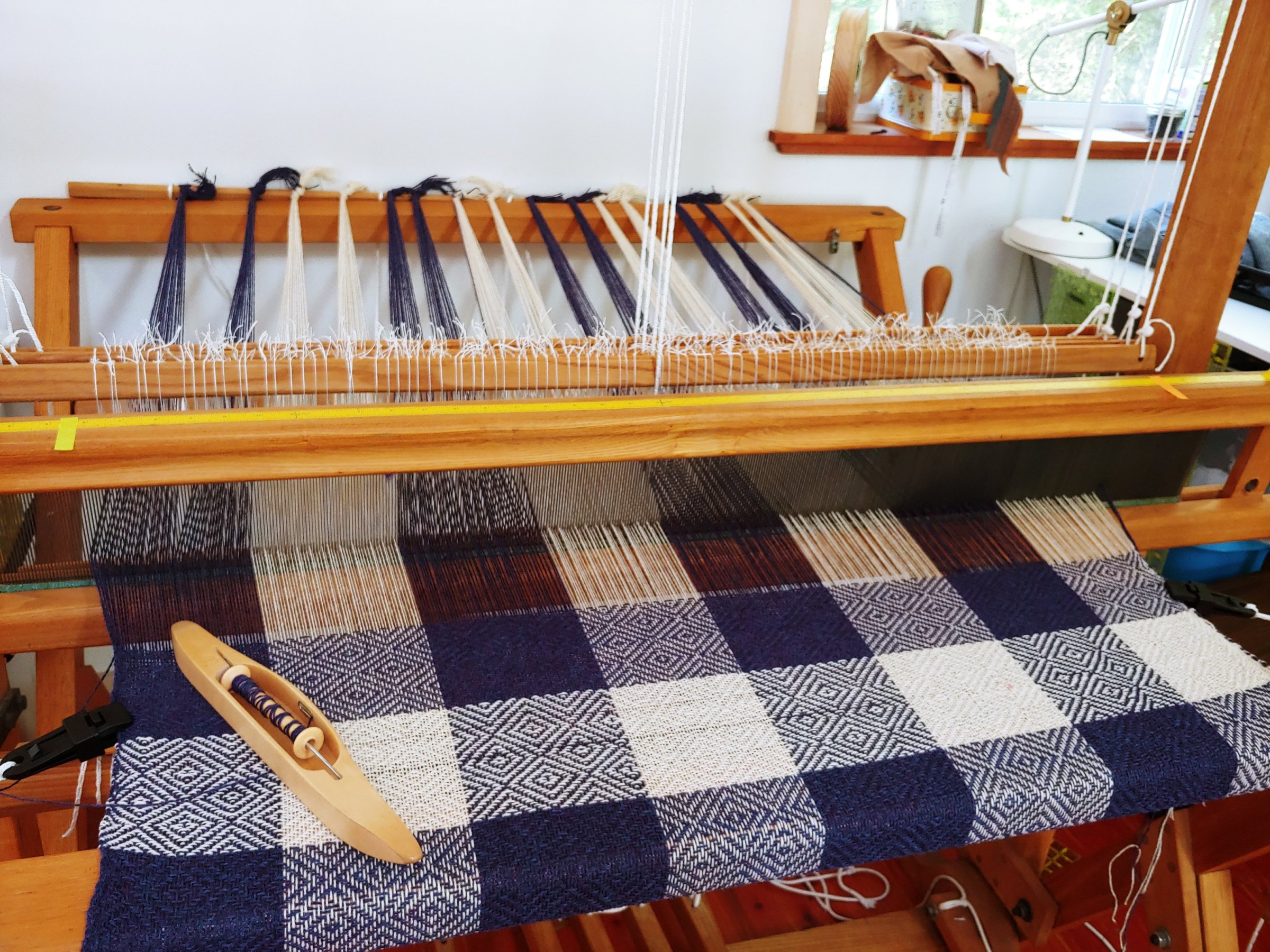
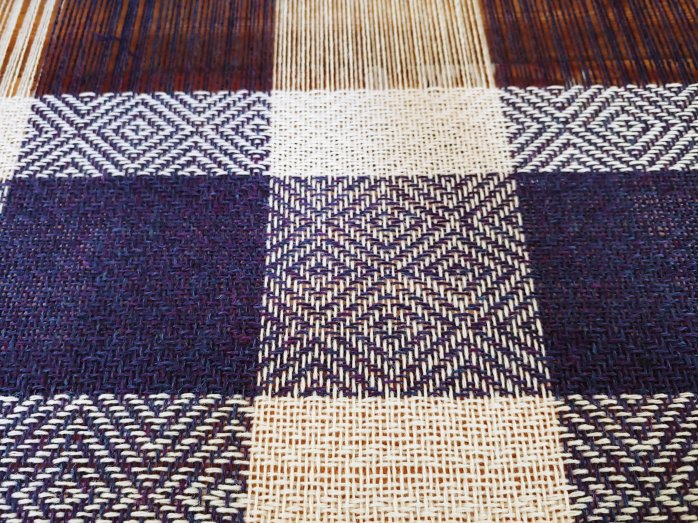
As much as I’ve written about my big loom, I’ve only warped it three times. The first time was a blanket experiment with free yarn when I still had the belt brake on the loom. The second time was an attempt at back to front warping a tea towel loom which failed miserably and got scrapped. The third time was this past weekend when I put a warp on for a blanket and I’m now weaving off quite nicely.
But I didn’t get here easily. For one thing, my loom has no brake on it at the moment and I’m tensioning the warp with weights hung off the crank handle. This has resulted in many little accidents along the way with weights crashing loudly to the floor, and when this project is done I am resolved to either fashioning a new friction brake, or figuring out the best way to hang weights from the back beam a la Tien Chu’s method.
Also, I made a bunch of mistakes in the process because I haven’t warped this loom very many times and there are some adjustments that have to be made before putting tension on. At the outset I forgot one of these, though I did manage to walk it back and fix it part-way in.
Now that I have made all the adjustments, including retying all the treadles, it’s weaving along very nicely and this blanket will be done in no time.
I have another sample ready for the Julia which will likely not go on this week as I’m about to leave my home and studio for a few days of city time – I plan to get a shawl sample on, and also think of another project to put on the big loom so I can keep getting experience warping it until it is comfortable for me to do.
There is a part of me that would rather get a different large loom, as this one is so idiosyncratic! However, there is a larger part of me that doesn’t want to spend between $2000 and $5000 at the moment – so I’m resigned to getting good with what I’ve got at hand!
Post #3160: Another month, another mailing
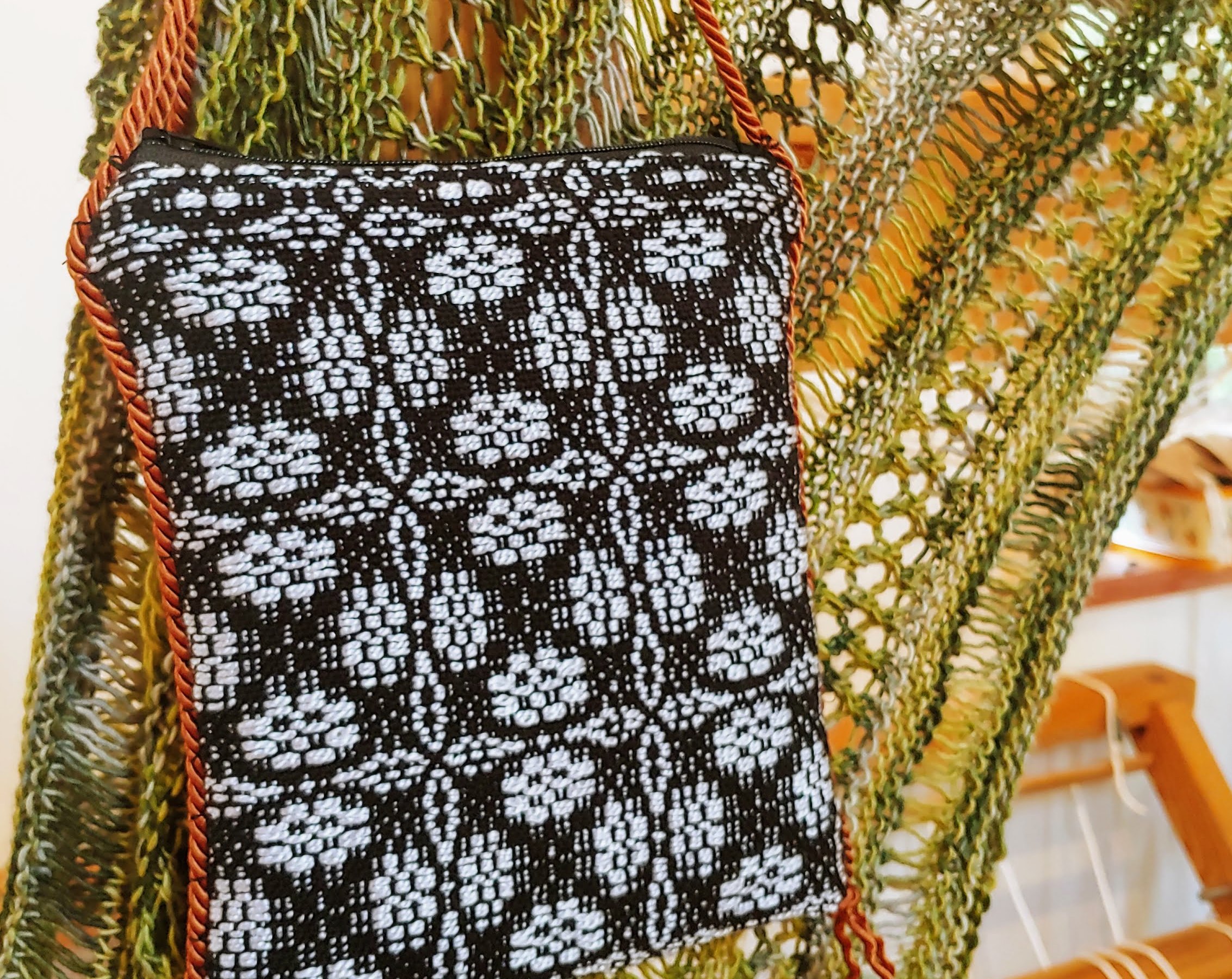
Issue number 4 of Comfort for the Apocalypse, my monthly mailing, went out this morning and it featured this woven purse and an essay about connecting to our past and future through craft. Also, a fantastic rhubarb recipe.
If you enjoy this blog, I encourage you to subscribe to my Comfort for the Apocalypse project because it’s where I’m doing my serious writing at the moment. I also ask that you share it with others because I would like to build my readership far and wide.
Post #3159: Tie-ups and tackling the big loom
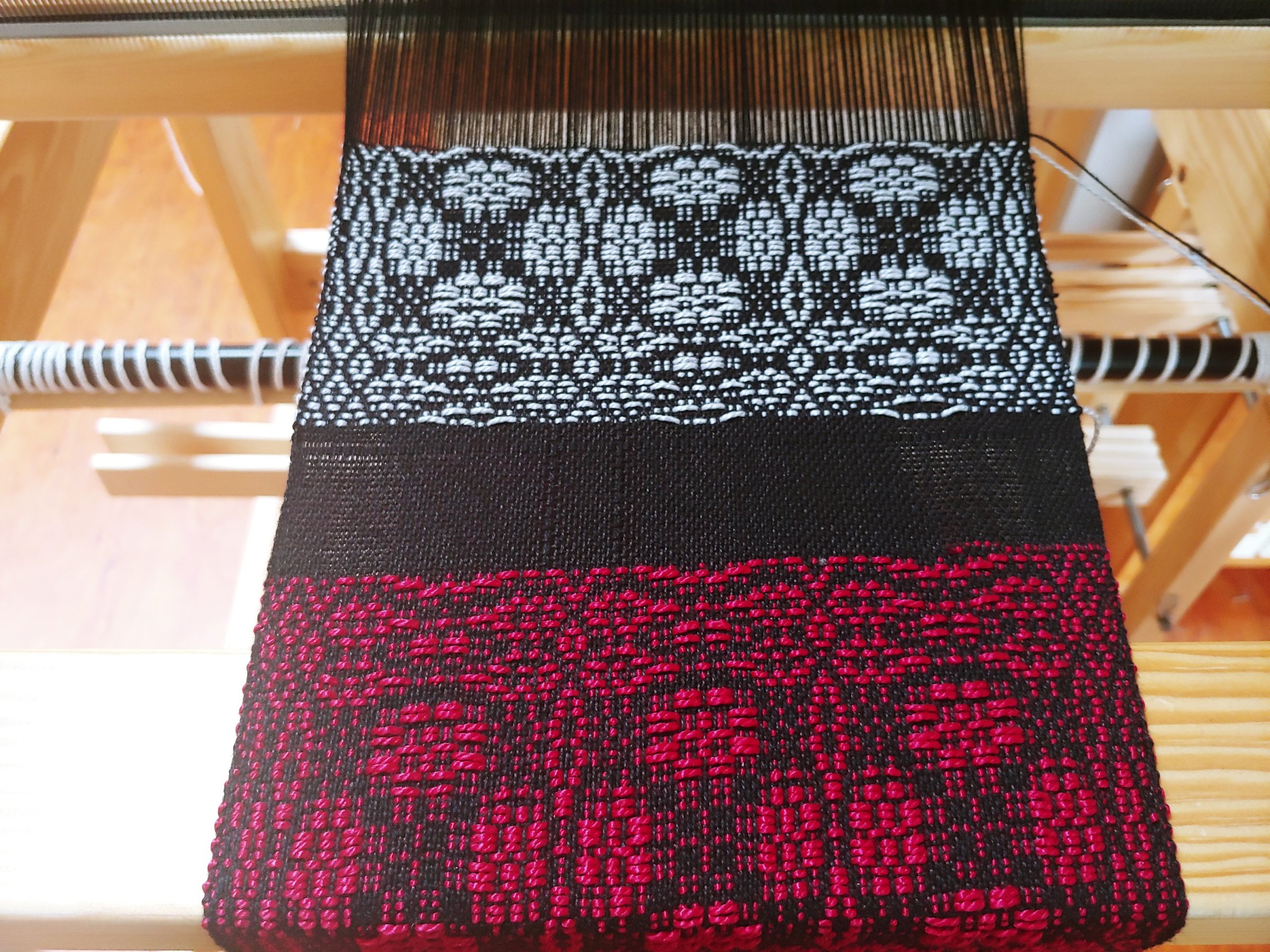
Last week was one of weaving and getting ready for weekend guests. Twenty-three for a sit-down dinner on Friday, and a couple of friends from the city until Sunday. You can see up above what I’ve been working on – it’s a sample of an overshot pattern from Handwoven magazine. I’ve now worked the pattern in three different fibres for the weft – and I have enough silver and copper to make a small zip bag as well. That’s three pieces of cloth for my sample book, and enough fabric to make a small thing!
This is overshot, a weave structure I have long been fascinated with but thought would be a bit complicated to weave as it requires two shuttles. Since the whole purpose of sampling is to learn new things, I decided to start with something that really caught my eye and have really felt rewarded by my choice. While it has taken me a bit to really get in a rhythm, I am finally there and confident that if I did warp the loom to make a scarf, I’d get into the flow and be able to get it done without getting bogged down. While it’s tempting to do that, I’m going to be moving onto my next sample shortly in preparation for making a wool blanket.
The friend that was visiting this weekend brought his new partner along – a ceramicist with an interest in knitting and fibre arts. As I was showing her the studio I uncovered the big loom (which sadly, I most often use to hang other projects on). After they left I fixed some cordage on the back I’d been meaning to replace and then left it uncovered. I’ve got a warp that I chained ages ago and I’m going to put it on now to practice warping that loom since it’s been ages – and then once I’ve woven that off, I plan to weave a 36-inch wide blanket out of cotton weft and wool warp.
I have a bit of a love-hate relationship with the big loom because on the one hand I sense its tremendous potential, while on the other it doesn’t have a working brake (I’m using weights instead) and I find it a bit daunting to approach due to its size. As with the rest of my sampling practice, I am going to approach this loom in a few different ways and discover how to make it work best for me. This will involve re-doing the treadle tie-up.
And speaking of treadle tie-ups, I just redid the tie-up on the Julia loom and employed the Vavstauga method and wow – that is a game-changer. Note: I did not buy their kit only because shipping to Canada the last time I checked was a tad expensive – but I would highly recommend this tie-up on any countermarch that can be fitted for it.
I’m back to being weaving obsessed – though I still have many spring sewing plans I plan to take to the machine in the next few weeks which is making me feel pressed for time to work on all the projects!
Post #3158: Making samples
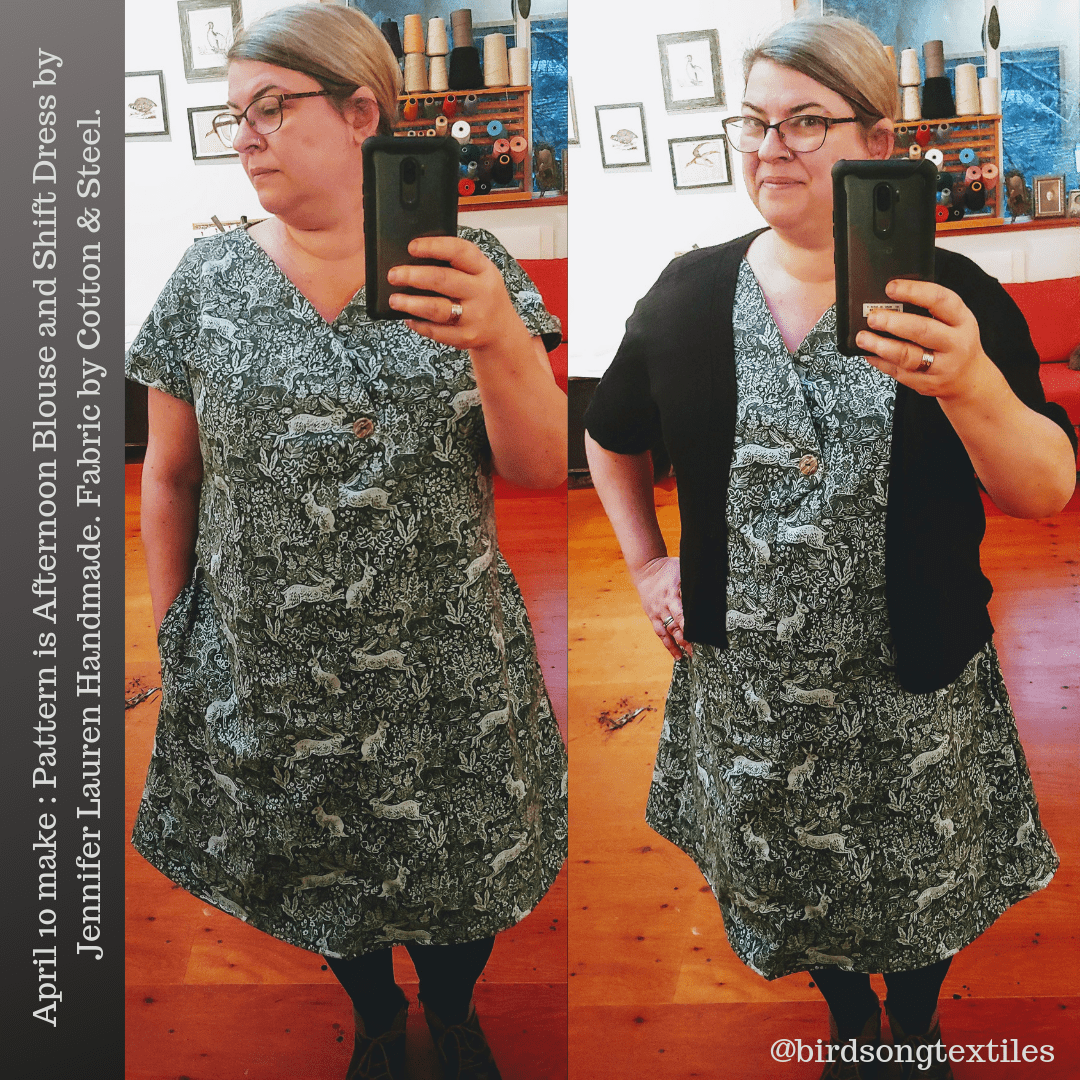
(A photo of my latest make – a new shift dress for spring).
I’ve always been averse to making samples on the loom. So much work to thread, wind-up and tie on the whole thing without having “something” to show for it at the end. But I’ve realized this week that if I want to improve both my technique and my understanding of fabric, I should *only* be weaving samples. Although I learned the basics of weaving three years ago, I have simply not woven enough to become proficient at it – and I believe part of the reason for that is my tendency for project-based thinking as opposed to a mindful approach to developing technique.
Sewing lends itself to project-based thinking and ever since I started to sew I’ve had an eye towards “useful” objects – quilts, household items, bags and clothing. There is nothing more satisfying to me than finishing a dress or pair of pants on the machine and then immediately putting them on or into my drawer for circulation. The very first garment I ever made (a woven skirt with an elastic waist) I wore to work the very next day! While that hasn’t been true for every garment I’ve made – some never do get worn because of mistakes in fitting or fabric choice – my skills have improved with each make, and it’s unusual now to end up with something I can’t wear.
But with weaving it’s a whole different story. While it’s true that I will use even the most error-ridden piece of cloth that I weave – simply warping project after project isn’t helping me improve my understanding of my loom or my fabric production. There’s a few reasons for this I think:
- putting long warps on (for multiple tea towels or a long scarf for example) means that it takes forever to weave them off
- because I make errors repeatedly in weaving, I lose interest in my long warps and then they sit for months at a time before I finish or take them off the loom
- this means that I’m only getting 3 or 4 warps on my loom in a year, which doesn’t help me perfect the warping process
- limited warps don’t allow for a diversity of projects to help build my skill and knowledge repertoire
When I leaf through weaving magazines or books, I see so many things that I want to make, but rather than sampling a pattern, colour choice, or treadle pattern to see how it works – I have a tendency to put the whole project on at once whether or not I have the skill level to execute the finished look. This has lead to disappointment on a number of fronts.
The currently weaving project on my loom is underway (about halfway woven) and I believe I’ll have it off the loom by early next week. It’s a plainweave rug (of dubious quality since I haven’t woven in months) which I put it on in order to get weaving again. Once that comes off I’m going to set up all 8 shafts on my loom again and go through my books and magazines and pick one sample at a time and get it on and off the loom. I have lots of material to sample with – and I’ve recently figured out a better tie up method for my Julia countermarch – so really, no excuses.
I was listening to an interview with Tien Chu the other day in which she expressed the need to reject the idea that some people are born with creative eye or creative talent. Instead, she says, it’s all about practice. We practice combining colours and we improve our ability to understand how it works. We practice how to weave and we make more consistent cloth. We practice weave patterns and textures and we become more able to design our own projects.
In my younger life (pre-thirty) I believed that I did not have visual creative talents – when really, I did not have exposure to the tools and techniques that would interest me enough to develop them further. Looking back now, I feel so lucky to have stumbled on a book of Celtic cross stitch designs in my mid-twenties, a door that opened unexpectedly and has lead me twenty years later to a textile studio in which to practice, practice, practice.
So practice I will – by sampling. Let’s see if that helps improve things by this time next year!
Post #3157: Loom talk
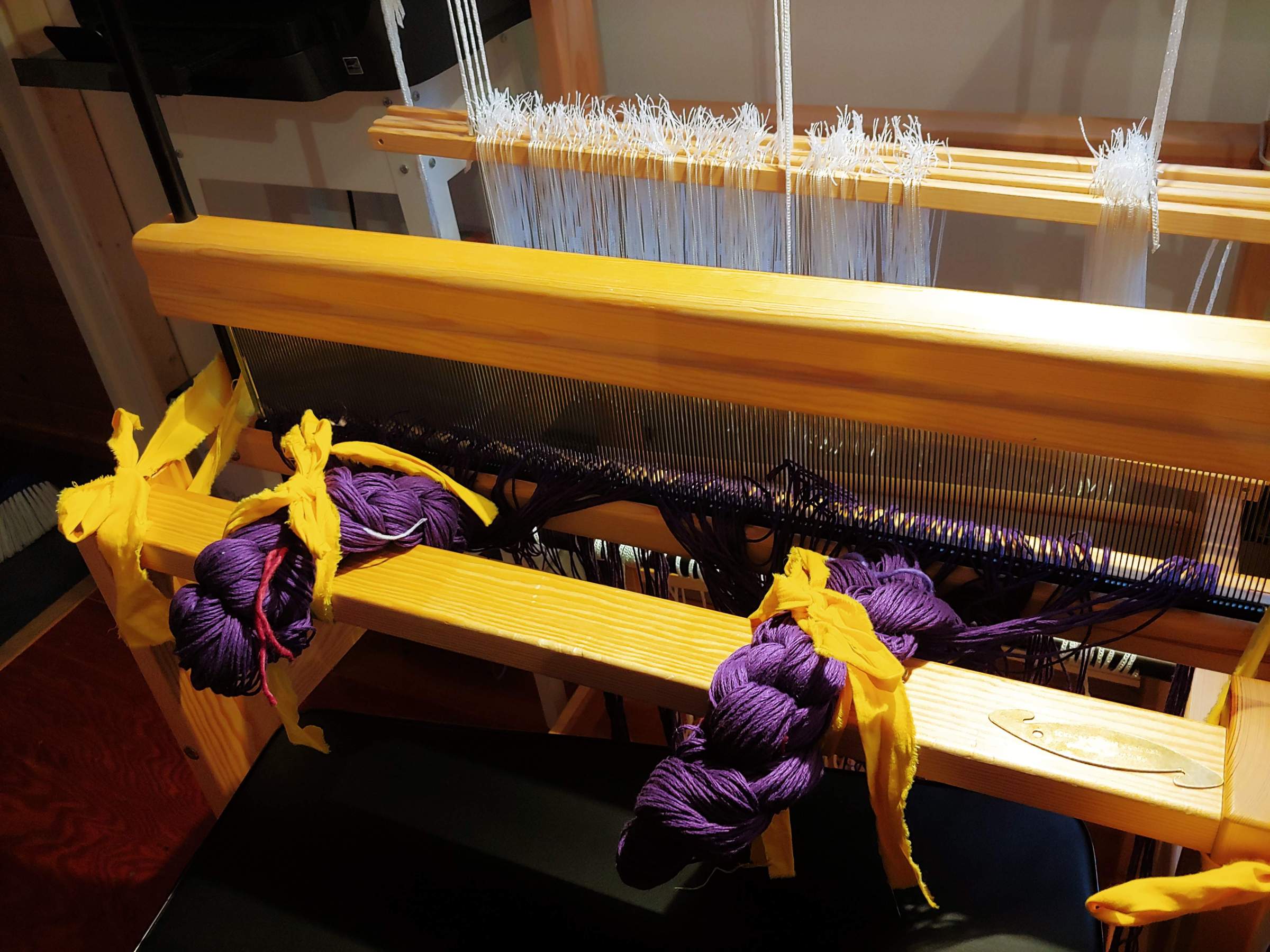
I started warping my loom for the first time in ages yesterday. Problem is, I decided to use a warping technique I’m not overly familiar with and I made a mistake right out of the gate. Fortunately, my warp chains are salvageable and I’m able to warp front to back which is the way I know best. Though I keep wanting to nail back to front, no matter which way I’ve tried, it doesn’t come easily to me. I think I might just be one of those weavers with a very strong preference.
I’m just hoping that while dealing with my mistake I didn’t get my warp chains too out of order. At least it’s a rug warp, and not delicate if and when I have to work through a tangle.
I haven’t put anything on the loom in several months because it’s seemed like so much work, and honestly, weaving is something I’m not very good at. While my sewing has improved to the degree where I’m happy with my skill level, the same is not true with weaving. I have a throwing technique that abrades my warps and breaks them, and my selvedges are wobbly. And while I know that these things are just a matter of practice, getting a warp on only to have finished pieces come out so-so is a bit of a downer.
So I’ve got to adjust my expectations, step back to see that sewing is something I’ve done for sixteen years now, and weaving not so much.
My plan is to get this warp on by the weekend so I can start weaving again. I’m also inclined to get a warp on my big loom soon since I have only warped it once since restoring it. I’m a bit afraid of it to be honest, and I have thoughts about getting rid of it in favour of an easier-to-warp jack loom. I think I need to work with it more before making that decision.


