Red Cedar
More apocalypse, less angst
Intuitive gardening.

I have to admit – for all my researching and garden planning – when it comes right down to it, I’m an intuitive gardener. Which essentially means that no matter what the planting charts and guides say, I don’t do anything outdoors until it “feels right”.
Last year, warmer weather in February and early March encouraged me outside to plant my early radishes, fava beans, lettuces at their scheduled time – it literally felt to me as though the earth was ready to receive my seeds when I put my hands into it, and thus I gardened earlier than many people suggested I should. What that meant was that when May and June turned out to be dismally cloudy, my plants already had a head start and for the most part flourished despite the wet late spring. I did lose several cucumber plants because I kept attempting to put them out despite the weather forecasts – but overall, my plants that were established in the slightly sunnier early spring had a head start on all those plants that weren’t seeded until May – and I know that made a huge difference in yield.
This year – it’s an entirely different story. With no mild air to herald spring around the corner just yet, I have been hesitant to even start my peas outside even though March is supposedly their planting time. Same goes for Favas (my fall crop froze over the winter) and radishes which I would usually be putting in right now. It’s just been too cold, and the earth here – while thawed – is close to freezing. Additionally, we’ve had torrential rains and windstorms recently that would knock the growth of any struggling veggie back. So despite the planting guides and my ready-to-go plans – I’ve been hanging back and working on turning the beds in between downpours.
(I’ve also got this season’s planting grid worked out, my seeds organized, and some of my starts sprouting on the windowsill.)
I know I’m not the only one out there who “feels” for things rather than following the “rules” – and yet this discussion of intuition never comes up in the gardening books I’ve been reviewing. As though it’s just about this many weeks before or after frost and then *go get your seeds in* rather than checking it against what you sense is actually going on weather-pattern wise. I suppose to some degree that’s stuff that comes after a few years of gardening, and so the how-tos just aren’t going to cover it. Also, I think the authors don’t want to overwhelm people by encouraging too much right at the beginning.
In any case, my spidey-sense this year has said – “just wait a little longer” and I’m glad I listened to it. It certainly saved losses during that late-February snowstorm, and my pea shoots weren’t drowned in the monsoon last night. I’m waiting now on true spring to get at it…. not the one on the calendar, but the one in my bones.
Which food and when? Slow-carbing.

Over the weekend, I read The 4-Hour Body: An Uncommon Guide to Rapid Fat-Loss, Incredible Sex, and Becoming Superhuman by Tim Ferris – a library reservation that came through this week with good timing, as I’ve been thinking a lot about diet and exercise lately. Since starting my fitness/health class at the YWCA in January, I’ve lost almost ten pounds and got myself back into a quasi-routine at the gym. I’m not going six days a week (my goal), but I am thinking forward to activity on most days which is better than where I was in the fall (doing nothing, blaming my schedule for impeding me from the gym when it wasn’t).
Now, I won’t say that this whole book is a worthwhile read – each section featuring various “life hacks” that Tim Ferris has experimented with in his own life – but there was certainly enough interesting information in there to encourage a little of my own personal experimentation. In particular, I noted that both my trainer and Tim Ferris recommend a similar type of lower-carb eating (not no carb) which he calls “slow-carb” and my trainer would call “eating for my type”. Not only does it look very similar to the GI-eating (glycemic index) recommended for diabetics, it tends towards focusing on whole foods clean-eating which is preferable to me on a number of levels.
The five basic rules of “slow-carbing” are thus:
Rule 1: Avoid “white” carbohydrates (or anything that can be white). Use legumes in replacement of grains.
Rule 2: Eat the same few meals over and over again.
Rule 3: Don’t drink calories.
Rule 4: Don’t eat fruit.
Rule 5: Take one day off per week and go nuts.
Except I’m not very good at following rules, and I also don’t totally agree with some of Ferris’s suppositions so I’m altering them like so:
Rule 1: Same as above – with the addition of a possible 1 serving of whole grain (like barley) per day instead of the legumes he prescribes.
Rule 2: To rule 2 I say, no way. Eating the same few meals over and over again would be unhealthy because one wouldn’t get the food diversity required for optimal health. This rule has nothing to do with losing weight and everything to do with being a limited cook (which Ferris admits to – eating out as much as two meals per day).
Rule 3: This has been my mantra for a long time – I’m a water drinker because it’s just so much healthier than juice or soda. Ferris does say that a glass of red wine or two a night won’t impede fat loss – which provides for those of us who like a drink now and then.
Rule 4: My trainer also says not to eat fruit and that’s a major bummer even though I don’t eat much to start with. On the other hand, local eating pretty much proscribes fruit in the winter since there’s very little local available right now.
Rule 5: I like the idea of one day a week I can eat anything, though Ferris seems to go overboard on the gross and fatty which I think really promotes screwed up values when it comes to eating. For people with bingeing behaviours, this is not a particularly good idea.
Ferris’s approach is definitely not for everyone – but I like his approach that each thing we try is simply another experiment on what works for our particular body. I’ve decided to follow this for a few weeks and see where it leads me – as an experiment or a “cleanse” to my system. Since January, I have been really paying attention to my simple-carb intake – and I know that has definitely helped. Since type-2 diabetes runs in my family, I also know that low-GI eating is of an increasing necessity as I age (if I want to stave that particular ailment off as long as possible). So let’s see what happens shall we? I’ll report back in a week or two if I make it that long…. I’m already missing bread!
One more note on the book: the 15-minute orgasm section? Really. Damned. Weird.
Scrappity-scrappity

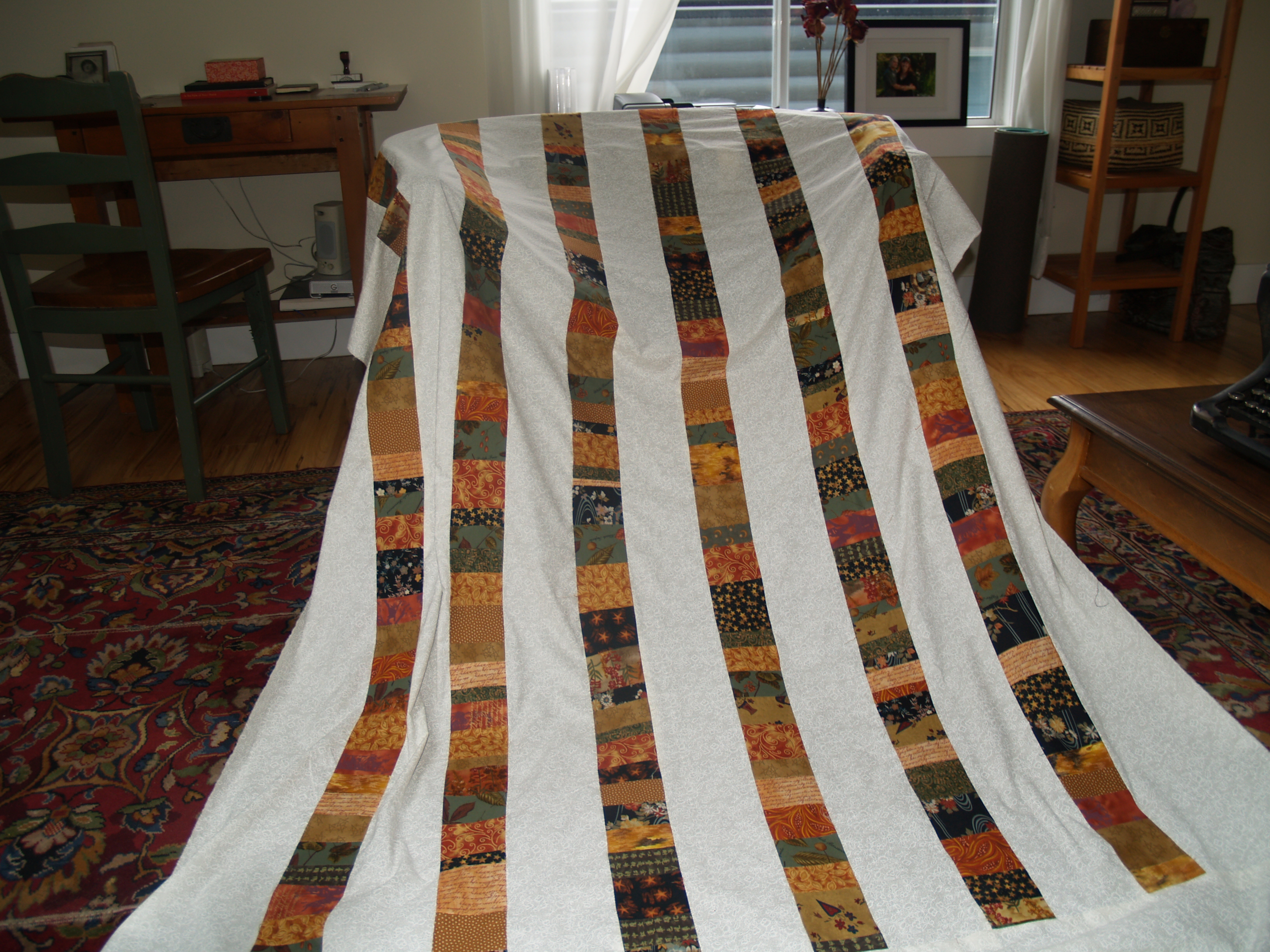
Don’t have much to say today because it’s a running around kindof day – so here are some pictures of a quilt top I finished last night. A double-sized made from scraps from other projects (except the white sashing). Now I’ve got to baste and quilt the damned thing!
How earthquakes are about taxes.
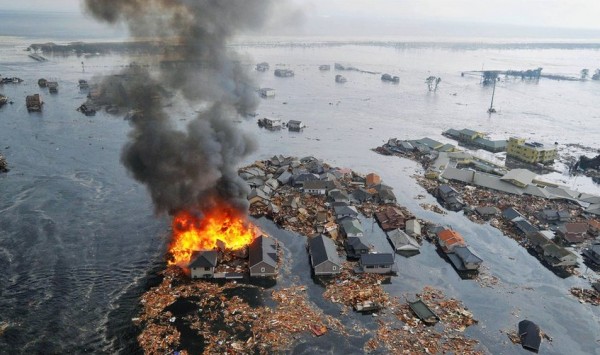 Having grown up in the “Ring of Fire“, I have to admit that the recent spate of earthquakes (in the last two years or so) has got me a bit nervous. This morning’s images in particular – floating fire, buildings disappearing into whirlpools, cars floating down highways – make the possibilities of my city all the more real. Living on a fault line, with natural gas to our homes, on a petulant coast – there is only so much being prepared for an earthquake (by stockpiling food and water) is going to do if the gas lines rupture and the oceans heave. In fact, I’m finding myself a bit annoyed with the admonishments on Facebook this morning to “be prepared” as though the devastation rocking northern Japan has something to do with people’s lack of readiness rather than nature’s most powerful work in living memory.
But that’s human nature isn’t it? To pretend we can exert control over that which is uncontrollable and unpredictable. To refuse the reality that some things happen to people for which they are *not* to blame. It allows us to set ourselves up as the survivor in both practical and moral terms – it gives us some small measure of internal peace to think that *we* won’t be like *them* because of our own individual responses.
What I think will be instructive when the damage from the largest earthquake to hit Japan in recorded history, will be to look at how collective preparedness makes for an entirely different landcape in that country as opposed to the devastating earthquake in Haiti last year. Already it is apparent that the seismic upgrading of much of Japan in the past two decades has meant that this massive event is not having the impact that it otherwise would have in cities like Tokyo where building shook from the coastal tremors, but otherwise have not sustained damage. Whereas the Haiti earthquake killed hundreds of thousands, the earthquake we are watching today is estimated to kill hundreds (though that number is entirely up in the air at the moment). And where it took the Haiti government days to pull together a functional respose, the Japanese Prime Minister was ordering the military into affected areas within hours of the initial shocks.
Thus – the difference between an earthquake in a wealthy country and one in a poor country. Not to mention the difference between a country that has invested tax dollars in preparedness for such an event, and one that has been repeatedly robbed of its natural treasures without any security put back into national infrastructure. There’s a very good blog-article on the New Yorker site this morning discussing just this – that earthquakes are a political-economic event as much as they are a natural event.
On the BC coast, the battle for seismic upgrading of our schools and public institutions has long been on the agenda, fought for by concerned parents and communities – and while many schools and public buildings have undergone upgrading – progress is slower than a lot of people would like. Because they are expensive. Because they use up tax dollars that the province is busy giving back to corporations instead of using to secure our communities in the event of the worst sort of natural event. Of course, this upgrade-deferral can only really go on as long as there is no disaster here, and as long as no one thinks about it too much when an event happens overseas.
Now, I’m all for personal preparedness and I’ve got a basement full of food and water in case of any number of potential disasters that could befall us….. but it’s curious to me during times like this how many of us believe we can control our fates individually while failing to demand the collective action to lessen impacts overall. That collective action is tax-based – both in preparing our roads and buildings and in supporting our emergency services who will come out in full force should the worst occur. And that’s something worth remembering now – as we go into a period of provincial and municipal elections – we have to ask ourselves what kindof an earthquake experience we want to have here at home – as we extend our support and sympathy to those abroad.
In the Bookshed: Backyard Bounty
 Backyard Bounty
Linda Gilkeson
New Society, 2011
Often when I’m reviewing gardening books these days, I am called to reflect on just how completely off-base I was in my early gardening attempts in the mid-nineties. For example, when Linda Gilkeson writes about double-digging and deep digging, “they have serious disadvantages, not the least of which is that they are a daunting amount of work…… In our cool climate, any kind of deep cultivation buries the community of topsoil microorganisms down where it is cool…. it doesn’t make sense to set them back this way,” – I shudder to remember how I cajoled a passel of friends into a weekend of roto-tilling and then double-digging a whole East Van backyard in an effort to establish my first kitchen garden. Then again, back in the mid-nineties, I didn’t have a proper gardening library and it was nearly impossible to find good books on edible gardens that were focused on our bio-region.
Fortunately, veggie growing is in again and there are far better beginner references now than I had access to during my first garden adventures. Backyard Bounty: The Complete Guide to Year-Round Organic Gardening in the Pacific Northwest is one such book – an all-around how-to for the first-time gardener, and a handy reference for those with dirtier (more experienced) hands. With sections detailing garden planning, soil preparation, organic fertilizing and composing, seedlings, winter gardening, pest management, and a year-round garden calendar – Gilkeson aims to provide everything one needs to know in order to produce at least some food out of the garden year-round. As a Master Gardener, she works to banish the guilt many new gardeners feel about not following the “ideal” composting techniques and soil recipes – allowing that each of us develop our own styles and shortcuts in making our gardens produce.
Particularly useful to me is the A-Z vegetables and fruits directories in the back of the book…. which I know I will be referencing this summer when something or other isn’t working the way I’d like it to, or when I’m looking at a different storage technique for a particularly abundant crop of something. I have other books with A-Z references, but none specific to my growing climate – and really, there are big differences to how we do things in different parts of the country. A decent resource section and index round-out this book, making it easy to find what you’re looking for while skipping the stuff you already know. If you’re looking for a single decent reference for your Pacific Northwest garden – I would definitely recommend this latest offering from New Society Publishers.


