Red Cedar
More apocalypse, less angst
Hastings-Sunrise garden tour success!
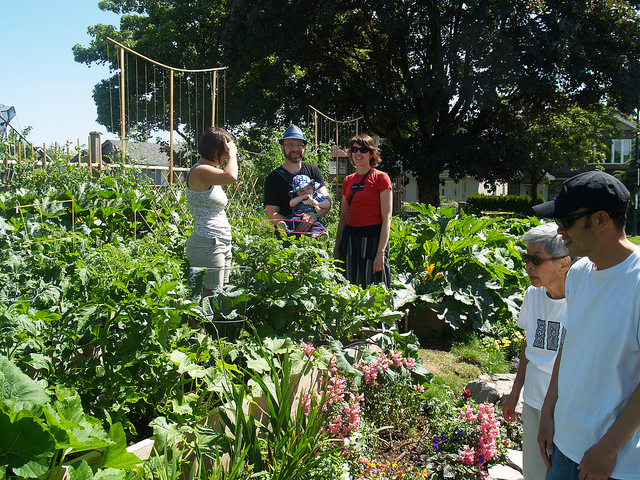 It’s been awhile since I’ve posted here, summer in the garden being what it is, and the fact that I was totally wrapped up in organizing the Summer of Sustainability Garden Tour which took place on July23rd.
Despite my gnawing misgivings leading up to the event (what if no one shows up? what about the weather? maybe I should just give back the grant so someone else can use the money) – I can happily say I was wrong and our neighbourhood rocks! See here for more photos on Flickr.
Three workshops went off without a hitch, our master-gardener was in fine form answering questions all day, and we gave away hundreds of free seed packs as well as four gardening books (in the raffle). At final count, we believe that 120-150 people participated in the event – most people going to an average of four houses, and each house getting between 20 and 30 people visiting. Which is pretty good number for a word-of-mouth event like this one.
In the end, all of our participating households said they were glad to be a part of this and it gave them a chance to meet people from their neighbourhood. For my part, I met lots of people who I hope to hang out with again (we’ve already got a dinner invite out of the deal – yay neighbours!)
I will be putting together a report for the grant wrap-up event in the fall, which I will surely post here and elsewhere, but for now I just wanted to say – PHEW! I am so glad that’s over and proud of how it went.
For all the people who want it to happen again? Let me know and next year we’ll do it with a community committee 🙂 – cause that is a hell of a lot of work for one person.
Trailer life.
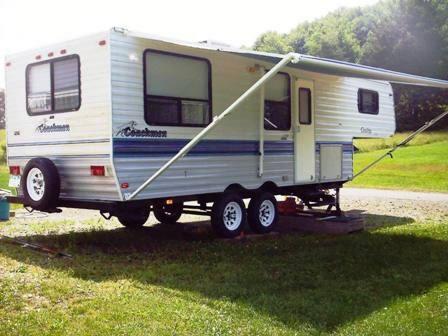 Goshbless’em my parents have bought me a trailer. A 5th wheel camper-type thing, but intended to be stationary on the back of their property for when B. and I come to visit – like our very own summer cabin in the woods (trailer-park style). My dad is working on the hook-ups this week – septic, water, electric – and I’m looking forward to seeing it later this month when I’m visiting after my upcoming union convention. (The photo accompanying this post is just illustrative).
When my mom first brought up the idea a month ago (a friend offered it for a good price) – it seemed like a good one to me. Space in their home is at a premimum, and now that I travel with husband, teenager and (sometimes) dog – there isn’t always room without resorting to sleeping in the decrepit camper out back. This solution is several steps up from the camper without breaking the bank – and provides a fully operating bathroom and kitchen plus a full-sized bed. (Not to mention a couch, tv, microwave, etc. It’s fully kitted out.)
But much more important – this trailer is a huge symbolic gift by which my parents are demonstrating that there is a place for me on the family 5 acres. And that they want my family to feel welcome to spend time there. Which is an “oh, duh, of course” on one hand, but given some pretty screwed up family dynamics in the last couple of years – well, let’s just say I have had a lot of strong emotions with regards to my family of origin this year. I wouldn’t characterize this as a peace offering, so much as my parents making some assertions about what they want for the whole family – including my little Vancouver offshoot of it.***
So that’s a big deal, and I’m really gratified by my mom’s suggestion of it, and the fact my dad apparently had to do a lot of work to situate it properly (this involved knocking over a rotting shed and cutting down some trees leaning precariously over the site). I’m sure it’s been more of a hassle than they intended, but now B. and I have our very own lovenest trailer to stay in when we come to Victoria. With my new three-day weekends and our posh crashpad, I’m hoping to spend an increasing amount of time on the island – which means more help as my parents get older, and more time spent with good friends too! Funny how a little fifth-wheel makes that all the more possible….
(***This is in no way to imply that my parents have been anything but good to me – but without going into too much detail – you know how family dynamics can just be hard sometimes right?)
Goat Lake Panorama
 This is where I ate lunch on Thursday. It is now Saturday and I am back in the city, reconnecting to machines and household duties. I am planning a travelogue post on Cathedral Lakes Provincial Park shortly, but before I can get to that I must can some twenty pounds of apricots purchased on our trip home.
Stories of civilization
 * Supplementary Reading: Memories and Visions of Paradise by Richard Heinberg
It’s been years since I’ve read any of the bible, and I had really forgotten how the Book of Genesis really does pack in most of the key stories of the Old Testament. (There’s a great summary of its key events here).
But for all that, at its core Genesis is a single story of longing for the “Golden Age” of humanity – ie: Eden. Far from unique to the Bible, this desire shows up throughout the history of literature and philosophy – belying a dominant theme in human consciousness – as well as some possible clues about our relationship to life pre-civilization.
For many years I have ascribed to (what I thought was) my own personal theory that Genesis is really the story of human transition from hunter-gatherer to agricultural society and finally civilization.That the “fall” of man is really about the descent from a time of truly living in accordance with “God’s will” or nature, into the manufactured sin of co-creation and trying to bend that nature to the will of man.
Hence, when Adam and Eve are cast out of the garden for having knowledge – of their nakedness (for one) which represents their clear demarkation from the life of the wild animals with whom they lived – man is cursed to eat plants of the soil that will only come from his hard labour rather than eat easily from the trees and bushes of the garden. God condemns Adam above all animals to have to work the land in order to feed himself – become a farmer. From this event onward there is great wickedness and war, which God tries to cleanse with the flood, but even afterward he has to do a lot more smiting in order to encourage man to clean up his act. All that aside, there isn’t a lot of good going on post-Eden. Cities are built and they are wicked, tribes of people keep getting sent out to establish settlements across the land – so much so that God commands them to mark themselves with circumcision (a practice the demarcates the transition from clan living to tribal life), the primary goal of most people seems to be to have as many children as possible in order to establish greater settlements and so wives are swapped and brothers are forced to impregnate their sisters-in-law, and so on. The end of Genesis in particular really ramps up the whole human misery quotient by demonstrating through Joseph that the only real way to survive (beyond believing in God) is to get in good with nasty rulers, become a profiteer on the people’s misery (selling food during a famine), and enslave whole communities (Goshen).
Ending with the death of Joseph at 110 years, Genesis is a portrait of people in distress at being forced out of a previously abundant life. And if we look at the timing of the whole affair? The first cities in the Sumerian region (which is close to where Eden is thought to have referenced) were established around the time that the fall of man is documented as a historic fact in the Bible. Interesting, no?
As part of my supplemental reading, I found the supplemental reference – Memories and Visions of Paradise – which was first in print in the late eighties. Turns out that my hunter-gatherer transition theory has been thought of before and by people much more in touch with the archeological evidence than me. The following long passage sums up the core argument – and I would really like to find more writing on this subject if it exists out there because so far this is the best I’ve found:
“Recently, however, the Genesis passage describing the four rivers of Eden has inspired another round of speculation and research. In 1980, following a decade of fieldwork in Saudi Arabia, archaeologist Juris Zarins of Southwest Missouri State University decided to apply himself to the old problem of locating the original Garden [of Eden]. Zarins began with the textual account, and he then familiarized himself with the geology and hydrology of the Near East and the language patterns of its ancient inhabitants. But his crucial clue was to come from space-age technology: satellite survey images show that the Tigris and Euphrates were once met by two other rivers, one of which is now dammed, the other a dry bed. Moreover, the valley where the rivers met was once rich in bdellium, an aromatic gum resin, and in gold, which was still being mined there until the 1950s. As we saw earlier, both of these substances are mentioned in Genesis. On the basis of this new evidence, Zarins concluded that Eden was a relatively small area south of the spot where the four rivers met, a region now covered by the top of the Persian Gulf.
Paleontologists agree that around 5000-6000 B.C., southern Mesopotamia was a forager’s dream. While the region had previously been aris, there was now abundant rainfall and diverse plant and animal life. Agriculture had been developed at least two millennia earlier and settlements were appearing in the valley. As the climate changed and people began to migrate into the region, competition must have arisen between farmers and gatherer-hunters for the fertile land. Zarins theorized that the Eden myth originated in that era of competition and change. “The whole Garden of Eden story… could be seen to represent the point of view of the hunter-gatherers.”
“It was the result of the tension between the two groups, the collision of two ways of life. Adam and Eve were heirs to natural bounty. They had everything they needed. But they sinned and were expelled. How did they sin? By challenging God’s very omnipotence. In so doing they represented the agriculturalists, the upstarts who insisted on taking matters into their own hands, relying upon their knowledge and their own skills rather than his bounty.”
In the Eden story we find Adam and Eve naked and unashamed, eating the fruits of the trees. It requires little stretching or twisting of the story to read this as a description of the lives of primitive foragers. After all, it was only after the Fall that God sent Adam forth to till the ground. The author of the passage seems to be telling us that human beings were innocent and happy as long as they simply lived off the bounty of Nature. Once they began to eat the fruit of the Tree of Knowledge of Good and Evil — once they began to bend the cycles of Nature to their own presumed benefit — their innocence was lost. It was only then that the symbolic original couple realized their nakedness and were cast out of the garden.”
From Memories and Visions of Paradise, Richard Heinberg 165-66
There is so much more that can be written on this theme, but for an introduction to the argument I will leave off here. I’m sure to say much more on this at some near-future point.
Life catching up.
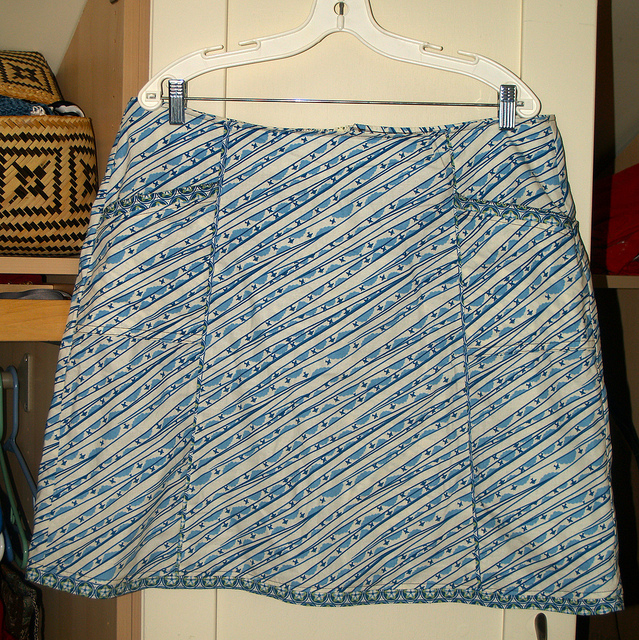 Ah. After tomorrow I am on a week of holidays – garden tour, brunch on Sunday, then five days of camping before a long-weekend visit of the in-laws. That’s lots isn’t it? I’m hoping to get some sewing in there when we get back from Cathedral Lakes… after a dress disaster this week, I’m a bit behind on my one garment per week goal. This picture here is last week’s skirt which I sewed in one hurried evening…. But I really would like to get to work on the cherry print halter dress I’ve been plotting for weeks. As soon as the pattern arrives in the mail I’ll be making muslin out of a bedsheet, just to ensure the pattern fit is right before cutting into the costly fabric I just bought to make it!
I also ordered some of this Wrenly Voile for a dress and this WildField to make another Sorbetto top out of. After that I’m switching to fall and winter clothes only as I’m feeling the need to get some woolen skirts and jumpers into the mix. I also have a fall quilt stashed in my cupboard which needs finishing, plus some xmas projects that need a bit of a boost. I am really hoping that my extra day off per week in the fall will help me get some of this done!
Speaking of which, I’m thinking of taking advantage of the three-paycheque month coming up in August (I get those twice a year, very exciting) and using the extra cash to fill the kitchen larder full for the better part of a year. That means, all our canned veggies and fruits, a freezer-order of meat from the local butcher, all the dried legumes for a year, cooking oil, vinegars, sugars and flours – which would leave us only having to purchase our fresh veggies and dairy weekly. I’m thinking that might really cut down on the food bill, and help me reconcile the smaller paycheques without feeling it as much.
We are already prodigious canners in the late summer – which really does keep costs down on stuff like canned tomatoes, condiments, bbq sauce, tomato sauce etc. – so this is really just going the next full step to an annual purchasing system of legumes and other non-perishables and a semi-annual purchase of meat and fish. I’m going to track it all using mint.com as my budgeting tool and see where we end up with grocery spending by September 1st of 2012.
In other news I’m just doing a lot of reading for my university program which starts in September – but even so I still feel behind…. My goal is to get all the course texts read before the start of the course so that I can focus during the semester on deeper reading and getting something out of the discussions rather than scrambling to keep up. We’ll see how much I get read before September 7th!


 Red Cedar