Red Cedar
More apocalypse, less angst
Love is Reckless – Rumi
I will be writing about Rumi tomorrow as part of my course writings, but in the interim I am sharing the poem I was meditating on this afternoon. An antidote to the grey day – shone in the afternoon light of divine love.
Love is Reckless
Love is reckless; not reason.
Reason seeks a profit.
Love comes on strong, consuming herself, unabashed.
Yet, in the midst of suffering,
Love proceeds like a millstone,
hard-surfaced and straightforward.
Having died to self-interest
she risks everything and asks for nothing.
Love gambles away every gift God bestows.
Without cause God gave us being;
without cause, give it back again.
Gambling yourself away is beyond any religion
Religion seeks grace and favour,
but those who gamble these are are God’s favourites,
for they neither put God to the test
nor knock at the door of gain and loss.
New York City – Days Two & Three
I’m going to laundry-list here because I haven’t had any blogging time in the last two action-packed days, but it seems like I should keep some record of this New York trip so that I can remember stuff later to write more about. I have some definite thoughts about Occupy Wall Street which I will save for another post.
I have just posted a fresh (brief) set of photos to Flickr of the last two days, but they don’t tell the story very well so here is what we have been doing:
Day Two – Brian’s brother came along with us for the day and together we took the subway downtown to:
- Visit the Metropolitan Museum of Art where we took particular notice of the Greek antiquities and an African sculpture exhibition before taking a couple of tours. Mica and I went on the Fashion in Art tour and Brian went on a tour of the Lehman brothers collection which the rest of us checked out afterwards. I think the next time I come to this city I will just plant to visit the Met every day for two hours in order to see everything properly – I really don’t do the rushed museum tour.
- From there we went to Union Square where Mica shopped for clothes (two cute dresses and a winter jacket).
- Poked around the 18 miles of books at Strand books.
- Then we went for dinner in the East Village at a French restaurant which was pretty good and had a lovely atmosphere.
Day Three – My friend Aaron happened to be working in town at the same time we were out here so we made plans to hang out for the day which we started at:
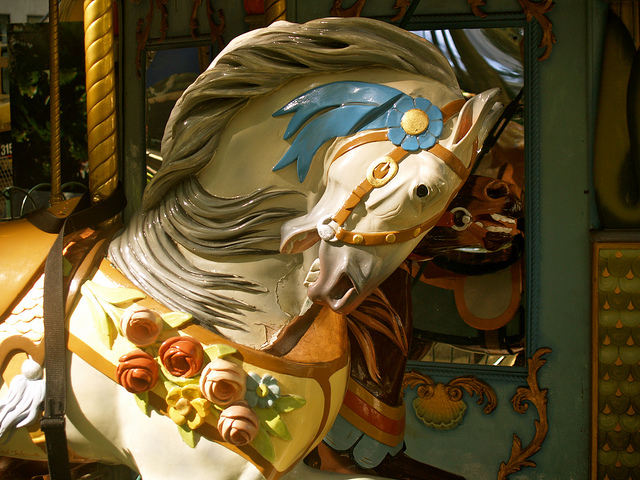
- Bryant Park – a beautiful urban spot with free wi-fi, a children’s reading room/lending library, a carousel and lots of seating (not to mention a public washroom with an attendant). This is what an urban park should look like – functional and welcoming.
- We walked over to Grand Central Station for the picture-value and then,
- Hopped on a subway down to Wall Street where we took photos of Occupy Wall Street and briefly chatted with a few folks. Sadly, I’m not inspired and have come to believe this is more of a Facebook phenomenon than anything – more on that in a follow-up post.
- From there we went back uptown to stand in line at the Shake Shack in Madison Square Park. Friends told us this was worth it – and they weren’t kidding. The line was an hour long, but that was definitely the best shake I have ever had in my life (made from frozen custard – heavenly) and the burger was in the top five for sure.
- After recovering from our food coma we went over to Greenwich Village and strolled around for a bit, but it was so packed that Aaron suggested we go up to an area that Mica might want to shop and we
- Took the subway to Herald Street (where Macy’s and other big shops are). Aaron and I drank coffee and caught up while Brian took Mica shopping.
- From there we took the train over to the Lower East Side in time for dinner and found a bistro where we could sit on the sidewalk and have drinks as the day turned into night.
Today is Thanksgiving and we are staying in Queens and making dinner with Brian’s brother and sister-in-law and some other folks who are joining us to eat later. A very nice break from the twelve-hour-days of running around we’ve been doing. Tomorrow is our last day here and I’m sure that will be another marathon of things we must do.
New York City – Day One
 So I’ve got to admit – this whole family holiday thing is a new, strange deal for me. Not that this trip to NYC is the first one or anything, but it is certainly the most destination-y one so far. You see, prior to actually being part of a family unit, all my travels have been taken up by activism, and hanging out. Which means that the New York I got to know ten years ago is a blur of lower east-side housing co-ops, activist gathering spaces and bars. Ditto DC. Ditto Seattle. Ditto pretty much every major city I’ve been to. Because I go to hang out with friends and that means I’m with people who know their cities and they wouldn’t be bothered to show me the tourist things right? Right.
This has its own cachet, of course, because you get to pretend that you aren’t just another tourist. But it also means that you never do the stuff that you might secretly want to do. Like ride bikes in Central Park or whatever. The family trip is another matter entirely, because if you don’t do the things everyone else does, your kid will think the whole episode is a major fail. And that’s great for me, because it’s forced me out of my “I’m too cool” box and we have a whole tourist itinerary for our five days in NYC.
For example today we:
- Started out towards the High Line and along the way stumbled onto Left Bank Books which has a small but incredible selection of first and signed edition literary editions (lots of beats, and lot of contemporaries too) and a very friendly clerk. He gave us a copy of “Reading Hot Spots” – a tourist map of NYC with bookstore and library destinations marked on it. Awesome!
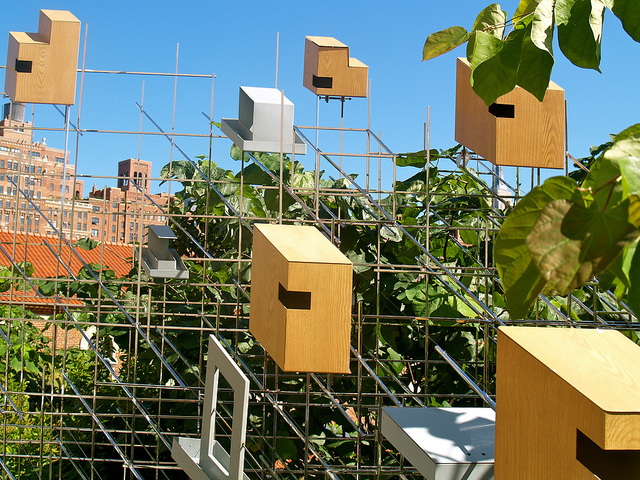
- Strolled the High Line which has been constructed since my last trip here and is a work in progress. This is definitely one of the coolest parks/urban spaces I have seen – the reuse of an old train line which ran over the city into an elevated park. All native planted, and with some location-specific art and seating that is worth a look at for examples of what decent integrated design looks like. (As I type this I note that there has been a quiet proposal to turn the old Port Mann bridge into a park. From what I saw today – totally! Do it! Not only will locals love it but it will be a major tourism focal point.)
- Dropped down from the High Line mid-way to stroll the Chelsea Market and have lunch. Also a redesigned space – a former biscuit factory which was launched in the 1890s – it now features market shops, restaurants, artisan clothiers and other odds and ends.
- From there we walked the rest of the High Line and then took the subway up to Central Park where we rented sketchy bikes for cheap off a crew of Jamaican hustlers (not the official bike rental place that’s for sure) and rode the entire perimeter of the park (about 10 km), stopping off at park highlights and watching a brief acrobatics show along the way. Then we ate ice cream before heading back to Queens to get groceries for dinner.
All in all? A great day full of stuff – though my feet are a tad sore now from all the walking and biking and standing on the subway we did. And for tomorrow we’ve got a whole new set of plans to make.
Check out all my photos from today (well the decent ones anyhow) at my Flickr collection.
One Long Struggle – Part Two
As I head out to New York City – land of Occupy Wall Street among many other historic struggles – I am reflecting on Lucretius and the Epicureans a bit further. One question that was posed in our Saturday discussion/lecture was “Are we approaching or even in a crisis of the public sphere world akin to Brotteaux’s Paris which might make an epicurean style of living an attractive alternative?.”
The Epicureans believed that beyond simplifying their desires, living outside of their society in the fellowship of others seeking the same path was the only way to contentment. What, says Lucretius, is the point of seeking honours and political offices when these only present the illusion of accomplishment?
“And Sisyphus exists in life, right here before our eyes:
The man consumed with seeking the accoutrements of office
From the people, who always comes back sad and beaten. To be driven
To seek power – an illusion after all – which is never given,
And undergo endless hard toil in striving for it still,
This is the act of struggling to shove a stone uphill,
Which, at the very peak, only goes bounding down again,
Seeking, quick as it can, the level field of the campaign.”
Indeed, what is the point of engagement in a world in profound crisis? To think we can effect change on systems so large and out of control seems ludicrous, while at the same time living within them is cause for continual discontent. Why not disengage entirely?
A tempting thought, and one which thousands of people in the last 2000 years have attempted through various pioneer, back-to-the-land, environmental, and religious movements. (And one so apparently threatening to the social order that in many instances this self-removal from society has brought the worst kind of repression and violence against its adherents.) At the very least, we remove ourselves from being contributors to the grasping nature of the world – the selfishness, the fear-mongering, the grasping for material goods beyond our actual needs – where is the harm in that?
As an activist, this is not the first time I’ve turned my thoughts towards such dreams – but as always I find myself questioning the base premise: that the point of life is simple contentment of the self. Or to put it another way – the purpose of life is happiness – something I’ve never been sold on as a philosophical starting point. Instead I recognize suffering as essential to self-knowledge, realize that we have a duty of care to others outside of our immediate sphere of self-interest, and believe there is a moral imperative to act *when* we can effect change.
To simply cultivate a rich inner life apart from the world to which we are born seems at turns
- necessary – in order to free ourselves of the want and fear which drive our most base actions and disatisfactions, and
- irresponsible – it by necessity excludes anyone who is not of pure mind and intellect, not to mention removes critically-engaged actors from a society which needs them.
And when I think about what would be implied in separating from all of our society – including our family who was not “enlightened” enough to follow in our communal footsteps – it also seems deeply cruel and a fundamental disavowal of those to whom we owe our lives (and often our sense of purpose in the form of our children).
None of this is to promote heedless engagement in the pursuit of political or social ends for as Lucretius points out, “Life is but one long labour in the dark,” and thus we can never know all the effect of or reasons for our actions. Nor do I believe that tradition or family loyalty must keep us chained to the yokes of superstition or material drives. So often, our adherence to social conventions, political convictions and so-called familial obligations, blinds us to the fact that our very energy is being spent in the most pointless of ways – and that really is a waste when it does not one jot lengthen our life, or shorten the period we are dead (to paraphrase On the Nature of Things).
Perhaps it is just that in this time of my life I am looking for more measured approaches than “all or nothing” – and look towards the philosophy of Mencius in pursuing right action or even Socrates’ pursuit of higher knowledge while still performing social obligations – for examples to live by. For Mencius, everything has a right order which supports everything else: a strong individual supports a strong family supports a strong village supports a strong state supports a strong individual and so on. Benevolence, humility, moderation, compassion and self-reflection are encouraged among everyone from the monarchs down to the people – and leadership is seen to be extended through ensuring that all who one is responsible for is provided. While his advice is directed to the rulers of the Warring Period in China, it is possible to cast much of his approach over everyday actions and obligations and to cultivate the inner reflection emphasized in order to find our Way through despair and difficulty. (Taoism has always been very attractive to me in this orientation).
(In the Greco-Roman tradition, I find myself more drawn to the Stoics’ approach to life which was both ascetic and social and pursued a self-sufficiency that did not seek external reward for validation.)
But since this is just a blog-post and not a term paper (which I should be working on next), I don’t want to go too far down the road of comparative philosophy. To my opening pretext – my trip to New York – I have to reflect that even as I question the efficacy of the protest at Occupy Wall Street, I strongly believe in the moral imperative which drives the occupiers of Liberty Plaza. Rather than retreating in the face of a seemingly impossible wall (of greed, corruption, cronyism, and the cruelty of a monolithic system that exercises little benevolence or compassion), they (and others around North America) are choosing instead to form a society internal to the heartlessness which surround them and are attempting the greatest possible inclusion inside that circle. It is not even possible to see how the folks who have taken their cause to the streets of NYC could live the Epicurean ideal even if they wanted to – most of them landless, broke, in debt, and living in a country which does not just let people wander off and live apart in the wilderness. And so what perhaps seemed a plausible response to injustice and crisis in the time of Epicurus or even Botteaux (during the French Revolution) is unrealistic in the panopticon of industrial life where every spare mile has been claimed for the machine.
While I can’t help but agree with Lucretius that the pursuit of powerful offices is useless and only leads to dissatisfaction, I can’t see that the crisis of this society is going to be helped by those most aggrieved of it just disappearing off to a garden of self-reflection – nor do those individuals even have that choice (America’s handful of communes can only hold so many people after all).
Bowl of Roses – Rilke
(This is the poem I read this morning as I work my way through The Essential Rilke one piece at a time. I was tempted to pair it with an photograph of roses – but I think the imagery here is striking I wanted to leave it to paint its own visions. This poem is properly read outloud – it demands life off the page – so find a quiet place and read it to yourself or someone else.)
Bowl of Roses
by Rainer Maria Rilke
You saw angry ones flare, saw two boys
clump themselves together into a something
that was pure hate, thrashing in the dirt
like an animal set upon by bees;
actors, piled up exaggerators,
careening horses crashed to the ground,
their gaze thrown away, baring their teeth
as if the skull peeled itself out through the mouth.
But now you know how these things are forgotten:
for here before you stands a bowl full of roses,
which is unforgettable and filled up
with ultimate instances
of being and bowing down,
of offering themselves, of being unable to give, of standing there
almost as part of us: ultimates for us too.
Noiseless life, opening without end,
filling space without taking any away
from the space the other things in it diminish,
almost without an outline, like something omitted,
and pure inwardness, with so much curious softness,
shining into itself, right up to the rim:
is anything as known to us as this?
And this: that a feeling arises
because petals are being touched by petals?
And this: that one opens itself, like a lid,
and beneath lies nothing but eyelids,
all closed, as if tenfold sleep
had to dampen down an inner power to see.
And, above all, this: that through the petals
light has to pass. Slowly they filter out from a
thousand skies the drop of darkness
in whose fiery glow the jumbled bundle
of stamens becomes aroused and rears up.
And what activity, look, in the roses:
gestures with angles of deflection so small
one wouldn’t see them if not for
infinite space where their rays can diverge.
See this white one, blissfully opened,
standing among its huge spreading petals
like a Venus standing in her shell;
and how this one, the blushing one, turns,
as if confused, toward the cooler one,
and how the cooler one, impassive, draws back,
and the cold one stands tightly wrapped in itself
among these opened ones, that shed everything.
And what they shed, how it can be
at once light and heavy. a cloak. a burden,
a wing, and a mask, it all depends,
and how they shed it: as before a lover.
Is there anything they can’t be: wasn’t this yellow one
that lies here hollow and open the rind
of a fruit of which the same yellow,
more intense, more orange-red, was the juice?
And this one, could opening have been too much for it,
because, exposed to air, its nameless pink
has picked up the bitter aftertaste of lilac?
And isn’t this batiste one a dress, with
the chemise still inside it, still soft
and breath-warm, both flung off together
in morning shade at the bathing pool in the woods?
And this one here, opalescent porcelain,
fragile, a shallow china cup
filled with little lighted butterflies,
and this one, containing nothing but itself.
And aren’t they all doing the same: only containing themselves,
if to contain oneself means: to transform the world outside
and wind and rain and patience of spring
and guilt and restlessness and disguised fate
and darkness of earth at evening
all the way to the errancy, flight, and coming on of clouds
all the way to the vague influence of the distant stars
into a handful of inwardness.
Now it lies free of cares in the open roses.


 Red Cedar