Red Cedar
More apocalypse, less angst
In the garden October

This was my garden last week, third week of Octorber, as I got a significant amount done on putting the garden to bed for the winter. I have planted two plum trees, mulched the blueberries, and put in a series of bulbs that will come up in the spring including: Chionodoxa Pink Giant, Narcissus Cool Flame, Hyacinth Pink Pearl, Allium Ostrowskianum as well as a black and pink tulip mix. Each year my goal is to get more permanent flowers into the back yard through the use of bulbs and perennials. Eventually we will beat back the grape hyacinth which was the only thing growing back here when we moved in (can you believe it? three summers and the yard is a totally different beast).
I have also started digging up the dahlia tubers, with that project to finish this weekend – and have planted half my garlic. I am also going to attempt to keep my hanging fuschia alive from this year to next by moving it into our little studio and putting it into dormancy. Apparently this is easy, as is taking new fuschia cuttings in the spring which would save us the $80 we spent this year on hanging baskets next year!
We’ve got a ton of leaves out front now, and are investing in a leaf-vaccum and shredder which will make for some easy mulching of these back boxes as the fall turns into winter. You can see from these photos that some of our beds are still in need of a top-up to be truly ready for next spring – and the leaves will be a big help on that front. With the rains coming in this week, I suspect it will be awhile before I can get a picture of our backyard that I love as much as this one – with the fall colour in and everything still green. The mud-days are coming, followed by the frozen-days…. and I’ve still got so much to do before that happens! (See all of last week’s garden photos on flickr.
Lions and foxes – lessons in power
I’m having a hard time finding an entry point into the material for this week’s class – King Lear and The Prince. Both works deeply embedded in our political/historical culture and thus difficult to unpack in the space of 500-1000 words. My own digestion of the material is just too fresh for any meaningful depth of discovery, and in the case of King Lear I found it a real struggle to get it down in the first place. More on that later, as today’s reading journal entry is focused on The Prince – a guidebook to seizing and maintaining power, written in early 16th century Florence.
Though some have posited that this may have been satire rather than advice, I have a difficult time believing that – particularly as the Machiavelli had spent some time being tortured in prison for an alleged role in a plot to overthrow the Medici family – and any word taken the wrong way would have surely been used painfully against him. At the same time, some of Machiavelli’s prescriptions in The Prince seem over the top in their amoral inference that the door is certainly open to understand the book as a satirical critique of power if one should choose to do so.
It is better to be feared than loved if you cannot be both. But you must avoid being hated.
So, taking the book at face value – Machiavellis famous for saying things like the above. And also things like:
Men should either be caressed or crushed, for if the injuires are slight they can always gain revenge, but they cannot if they are heavy.
Really, the book is packed with handy tips like these which cover everything from how to take power, the necessity of destroying bloodlines of former rules, the requirement for civic rather than mercenary armies, the types of fortifications and arms one should need for maintaining power, and the requirement for chucking morality out the window should the need to hold onto power supercede it. Oh – and don’t bother looking for your rewards in heaven, being a good prince pretty much necessitates behaviour which will send you straight to hell. A very straightforward, no-bullshit approach to power if you ask me, even as I cringe at the self-interested autocracy of it all. And the prose is direct, not flowery or euphemistic, a clear communication from one who fancies himself an insider-strategist to those who actually hold the levers of power.
In this way, Machiavelli may be our first evidence of the political strategist as we understand that role in modern politics. The Prince is, after all, an attempt to get to the heart of the leadership question during a time of emergence for the modern state in Italy. This was not a friendly or fanciful context, but one in which torture was used routinely – one where the church had all but abandoned any pretences to morality under Pope Alexander VI (the “Borgia” pope who sought to feather the nests of his children through use of the Papal armies and his own political strategies). Although Machiavelli may seem cynical in the writing of this, he is not promoting so much as reflecting on the way the maintenance of power really works, as opposed to how it “ought” to work morally or ethically.
The perfect leader in Machiavelli’s opinion, is one who can balance reason and passion, playing the strengths of each – the astuteness of the fox alongside the ferocity of the lion – in order to alternately smoothtalk and create fear among the public. It is not enough to simply ride in and take what one wants without endangering the whole enterprise. A good prince may not be virtuous in his actions, but he must always be seen to be virtuous. A good prince must not be afraid to inflict cruelty, but if he does so it should be in the very beginning of his taking power so people can eventually forget that cruelty. It’s all a bit of a Jedi mind-trick really, but when one thinks of the success of the “100 days” plans of most conservative governments as of late, the effectiveness of the strategy is clear. (By “100 days” I mean the strategy by which a government comes to power and enacts its most regressive cuts and legislation in the first hundred days as part of the new “mandate” from the public. Closer to elections, governments become a lot more giving – this is all in keeping with Machiavelli’s edicts for holding onto power).
What justifies this all? The end of course – as usual, holding up the means by which one gets there. But then the question is, what are the ends? Are the most important ends sought by the individual prince? the political party? on behalf of the people? This is where the real deception comes in, because even Machiavelli seems to believe that the ends are based in the needs of the people being met, as opposed to the needs of the individual ruler in meeting his own bloodlust or addiction to political rulership. As in modern politics where the needs of the public are continually held up as the motive, when in fact they become the driver for the real motive – concentration of wealth and power in the hands of the few.
And therein lies my issue with reading Machiavelli’s words as satire. While it may *seem* over the top – what in his words is not the truth of how rulers do rule successfully? North American political parties may seem a long way removed from Florence during the Rennaissance, but no fewer political conspiracies and intrigues abound today, and while the direct murder of an opponent may be verboten (here and now) – to slaughter someone’s character through lies and innuendo is seen as perfectly fair game. Power is not a game for the ethical, then or now. And if the tone of the work is sometimes detestable, does that not simply reflect a desire on the part of Machiavelli to shock his reader into careful consideration of what he has to say?
These are my initial thoughts on The Prince – which I appreciated for the lucidity of thought, much more than the world prescribed by those thoughts. The question I am left with is one of the human capacity to see and act on power differently than what is laid out in this handbook – for we aren’t even one step removed from the cynical approach to ruling than the Florentine monarchs of the 16th century were.
Autumn sewing
I’ve been a bit lazy here about writing in the past few days, so I’m kicking off with a couple of pictures of new articles of clothing that I have sewn over the weekend.

First up is the dress that I completed yesterday – using a pattern from a magazine that someone sent me in a patternswap and some stretchy synthetic that I picked up at Fabricland on the weekend. This dress had set-in sleeves which I haven’t encountered before and *really* don’t like, but otherwise was easy to put together. Because I was using a knit fabric, I should have cut it two sizes smaller than I did, so there was some resewing and cutting that took place in order to fit it properly in the end. An easy-to-wear dress with fall cardigans!

And second – I completed this skirt, using a pattern from the 2010 issue of Stitch magazine. The fabric is a remnant home decor piece that I bought at an estate sale for $2, the denim was taken from a larger piece thrifted from Value Village last week (I have another denim skirt project coming). Total cost with zipper? $4 – and it makes for a funky, bright skirt that has a good weight for winter.
I’ve got a denim skirt in the works, as well as fabric for another skirt that B. picked out at Fabricland. Those will be the next two projects methinks – with another tunic thrown in for good measure.
Revealing possibility.
 Near the end of the 14th century, a young woman of thirty experienced a near-fatal illness – one she had prayed for over some time in order that she might know the suffering of Christ. In fact, she had wished for death so that she could truly understand all the agony and suffering that Christ had experienced in order to take in all the love of the world – but as it was, a near-fatal illness would do (it turned out). That illness, before it broke, became a revelatory vision to Julian of Norwich (as she would later be known) in which she witnessed the bleeding of the crucifix and received direct communion with Jesus and with God (the Revelations of Divine Love which she called them later). In this way she knew the suffering of Christ, and also became aware of God’s desire for people – and that their sin was a necessary step to choosing contrition and thus coming back to God in the course of their struggles.
The Revelations of Divine Love raises many questions – particularly to the modern (skeptical reader) who might be inclined to argue against revelatory experience – dismissing it instead as the effects of brain chemistry imbalance or some type of hallucenogenic effect brought on by poisoning. Which is certainly one way to read it – ergot poisoning being a favourite “cause” of the Salem Witch Trials as proposed by 1970s historian Linnda Caporael (a theory which has since been debunked). But we can also choose to simply read Julian’s vision as a true, revelatory experience, even if we aren’t sure what or who the “revealer” is.
In response to a discussion on that topic in last night’s class – one of my classmates posted the following Sam Harris video on the lunacy of miracles (like crosses that bleed and people raised from the dead):
And I can’t say I disagree that organizing one’s life around some things that people might or might not have seen two thousand years ago seems a bit strange to me. But then again, I think that Sam Harris entirely misses the point (as do all the smug atheists) of religion, which is less about whether Christ rose from the cross or God parted the Red Sea, and more about agreeing to a collective moral compass. From the perspective of human rights and the year 2011, I might disagree with some parts of that morality, but it doesn’t change the fact that religion exists with us to serve an essential purpose.
In any event, the point I wanted to get to with all this is that whether or not we believe in a divine being – revelatory experiences happen to all sorts of people from all faith and cultural backgrounds, and which might also be experienced by atheists who allow for that possibility. I say “allow for that possibility” because I believe that, like Julian of Norwich, one must be open to the experience for it to happen at all. A mind inflexible on the subject is unlikely to bend in such a way as to refute what it knows to be true.
I find it also curious that not only must a “visionary” be primed or opened, but that revelatory experience also comes from the visionary’s own cultural/religious/atheistic background. Thus, a Christian sees Christ bleed on the cross, a Hindu sees a deeper vision of Krishna, an atheist experiences the sense of “channeling the world’s suffering” – all in the name of something greater than the individual, all with the sense that some other aspect of the world (whatever it is behind the curtain) is being revealed. In the case of Julian it was a message of profound love, forgiveness, and a feminizing of the church.
To which the skeptics would argue that this in itself is proof that revelatory experience is nothing other than invention – for why would the Christian not come out of a trance with a greater knowledge of Krishna – if each of these experiences is a true one? And why does suffering take the form most politically palatable to each of the visionaries?
All this says to me is that the person having the experience is as much of a participant in the shaping of it (from their own background and history) as whatever external force/energy/intelligence has come to bear on them. If there is an external force. For perhaps revelation is actually an entirely internal process – does it cease to matter then? We can simply chalk it up as “crazy” and move on, right?
I don’t think it’s so easy to move in that direction either, because then I wonder what knowledge the deep psyche is offering up and what many springs which feed it have offered. By that I mean the collective around us – the crying, laughing, yelling humanity which infuses every part of us, which our brains are continually working to sort out – reading, attempting to understand the other. If this deep, internal well is the source of our visions, are the revealings about our world any less divine? If we channel suffering from all that has been poured into us and find a deeper compassion as a result of that moment of psychic “crisis” (as Julian did with her message of a loving God), is it any less important?
I am refusing to commit here, walking around the issue – because it doesn’t matter very much to me where revelatory experience comes from. The fact is that it does arrive in many people’s lives quite unexpectedly, and while some people choose to talk about it and proselytize based on it, the majority of people who have mystic experiences do not for fear of being considered crazy, or because they believe the message they received was only meant for them. What I definitely think is true is that the experience itself can only ever be truly understood by the person who has the experience. Writing about it, talking about it – these can never transmit the moment of suffering/fear/comfort/love/anger that a person might feel – for it is truly something ouside of ordinary experience.
The thing I’m most wary of in a discussion of works like this is the pitfall of cynical atheism (a la Christopher Hitchens) which sneers at spiritual needs and felt experiences of people rather than just accepting them on some level as part of the human diaspora. This does not mean that I agree with sitting back and allowing someone’s revelatory experience on evolution or abortion dictate public policy, but I do want to live in a world where each person is allowed the dignity of their believe and practice no matter what it is (and as long as it doesn’t interfere with the same in others). I also want to live in a world with wonder, and the potential for deeper insight that is not dismissed as “merely” anything.
Julian is interesting because she defies many of the cynical explanations one might attibute to a modern-day aspirant. She was not a fame-seeker, she was not a member of the church, she was not going to make money off her revelations, and her mystical experience could have put her in grave danger of being an accused heretic – and yet she spoke out anyway, holding that conviction for the rest of her days (as they are known) and writing about it as long as twenty years after the fact. It is undisputable that she experienced some major psychic event in her thirtieth year that revealed to her a different understanding of sin, compassion, and love than had been preached to her all through her life – but the mystery will always remain, where exactly that message was awakened from.
Another new shirt!
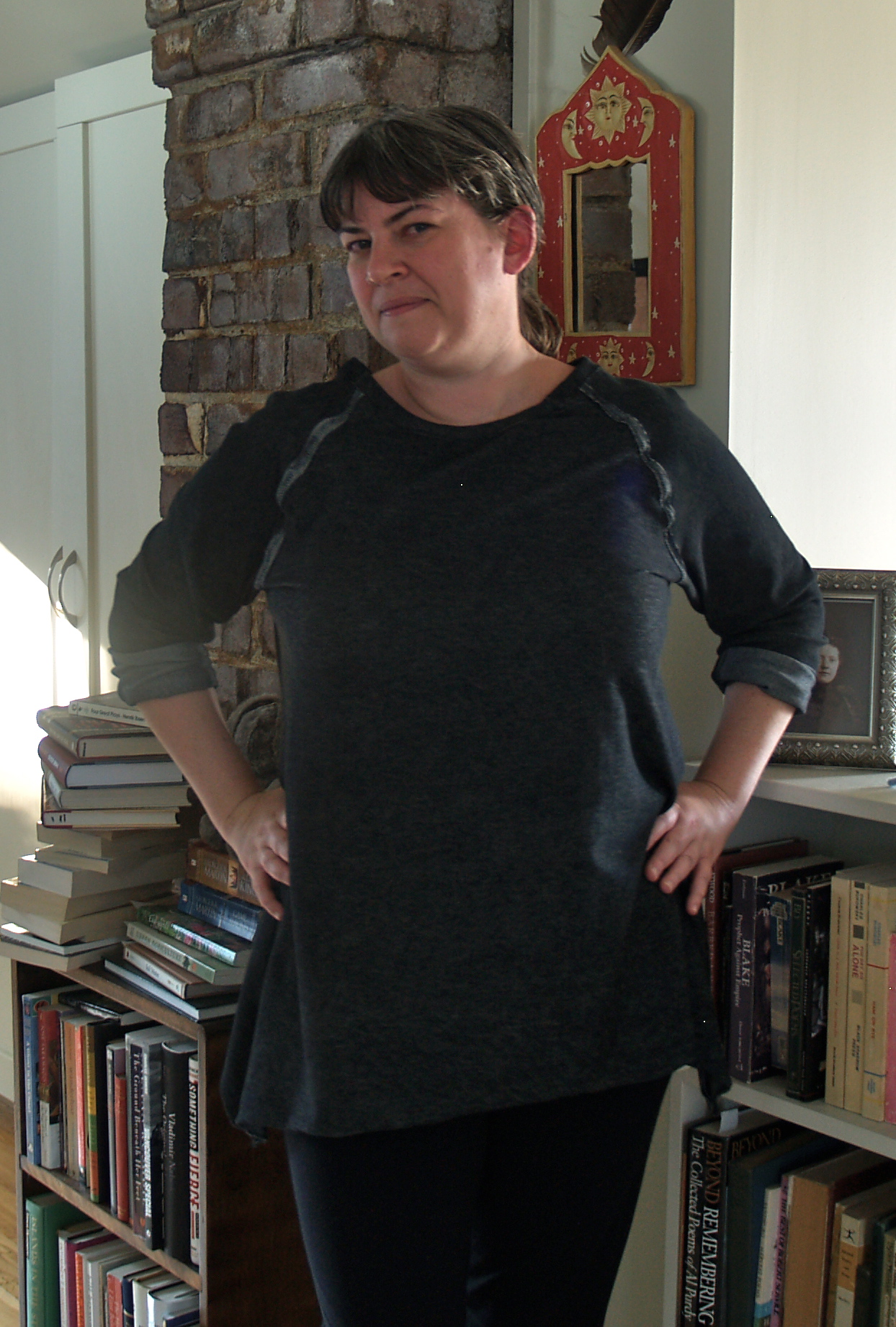 Going away put a dent into my sewing time, but luckily I had this all cut out and awaiting me on my arrival – a super comfy, drape-y raglan top. This is my second adventure with knits – this time a two-way stretch knit which was a bit of a challenge to sew (but ultimately worked out just fine). Not the most exciting piece of clothing I’ve made, but probably my favourite because I’ve been itching for more cozy, comfy tops this fall.


