Red Cedar
More apocalypse, less angst
Hume and Kant with video back-up
I am at a loss with this week’s reading – not that I can’t understand them – but I’m not feeling inspired to write much about them. For the time-being I think I am simply going to post a brief synopsis of both – hoping that after class discussion I can muster something more insightful. As a salve to an otherwise uninspired post I’ve ferreted out some video clips that are entertaining and useful. In particular, I highly recommend the RSA Animate at the end – it’s really uplifting from a potential for human thought perspective (not unlike the 18th century Enlightenment which we are exploring this week).
Before we get underway – pause for a moment to enjoy this clip of past commentary by the Simpsons on the nature of grad school:
David Hume – An Enquiry Concerning the Principles of Morals
Out of the Scottish Enlightenment, Hume wrote this treatise as a way to explain social agreement on morals and their origins in nature, in reason and in feeling. Essentially he argues that reason alone is not a motive and that the passions have great influence on shared feeling, that moral distinctions are not derived from reason alone, but are derived from feelings of approval and disapproval, and that at least some of our virtues arise from “nature” because they in some way have utility. As much as I have difficulty with the “nature” aspects of Hume’s argument (such as – women must naturally be more chaste because of their role in child-rearing), I do appreciate his position that humans have an innate recourse to virtue and good behaviour in opposition to predecessors like Hobbes who don’t have a lot good to say about human nature.
The utility to which Hume ascribes virtues is that which arouses sentiments of sympathy in the spectator – thus we look up to those who are rich because we like the sight of abundance, the monkish attributes on the other hand are vices because no one wants to be around a monkish-sort. There is no arousal of fellow-feeling there after all – who wants to be taciturn or inwardly-reflective anyway? This is an example of Hume’s radical empiricism at work – that is, his belief that we can only know something as true if we can witness it firsthand. Since we can witness the benefits of being cheerful and its impact on those around us, we know that this is a virtue. Because we can not witness a benefit in being meditative, it is a vice. This leads to a strange morality in which the accumulation of wealth is virtuous, whereas an ascetic life is villainous. I’m not sure there are many moral philosophers who take such a position (though I am aware that some new-age thinkers advocate wealth accumulation as a positive energy in order to justify their own riches).
Of course there are problems with the empiricist approach, not to mention an approach that attempts to deal in universals. While Hume’s empiricism supports the rise in the scientific method, not to mention the eventual splintering between church and state, and is thus important – it demands that everything be seen in order to be true and it leaves little room for the notion that what is seen depends on the eye of the beholder and that gender, class, race, culture, sexuality – may prompt a different perspective on what is a virtue and what is a vice. Likewise, any attempt at describing a universal morality is hopelessly trapped in the culture from which one makes the argument. Where chastity is considered a virtue of the highest order by Hume, we know that this is not the case in many of the world’s cultures where polygamy, sex outside of marriage, polyandry and other practices have evolutionary or economic utility and are thus promoted by the society. Of course, this gets to the heart of Enlightenment universalism and its exclusive nature – so-called universal truths in actualy fact applied only to a small percentage of the world population. *Sigh*.
Here’s a little 3-minute philosophy on Hume that talks about some of his other ideas:
Immanuel Kant – What is Enlightenment?
Immanuel Kant was a German Enlightenment philosopher who was awakened in disagreement to Hume’s empiricist perspective. Rather than accept an empiricism that necessarily lead to Hume’s atheism, Kant attempted to strike a balance between empiricism and rationalism – arguing that we could know things not only because we *saw* them but because we *thought* them. In this essay, Kant argues that the Enlightenment was man breaking free of his immaturity – his self-imposed tutelage – and the dawn of a new era in which “Dare to Know” was the principle motto. He argues that superstition should be replaced by reason, tradition is to be challenged, and intellectual laziness (one grown accustomed to things the way they are) overcome.
Freedom, he claims, is key to the process of human enlightenment – the freedom to make use of one’s reason at any point. And while he is clear to point out that some rules exist to the benefit of the whole society and we must be careful to obey orders within our social roles – he maintains that the freedom to speak out in critique of social institutions and customs is imperative to transforming them.
This essay is brief, and mainly gets to the roots of the liberal democratic concept that we enjoy today – that of freedom of speech and freedom of thought. In this he relies on the concept of autonomy in thought from institutions, while at the same time acknowledging that society presses roles and responsibilities upon us which bind us to our greater community.
Here is another 3-minute philosophy piece on Kant:
And finally, the best video of all – an RSA Animate exploring the possibility of a 21st Century Enlightenment – one that shifts the parameters that Hume, Kant and others set for us and explores a world beyond radical individualism (self-aware autonomy anyone?). I’ve been on the “ideas matter” kick for the last couple of months and again, this speaker approaches our future with the kind of optimistic ideals I would love to see our world shaped by:
The Hell Yes! Skirt
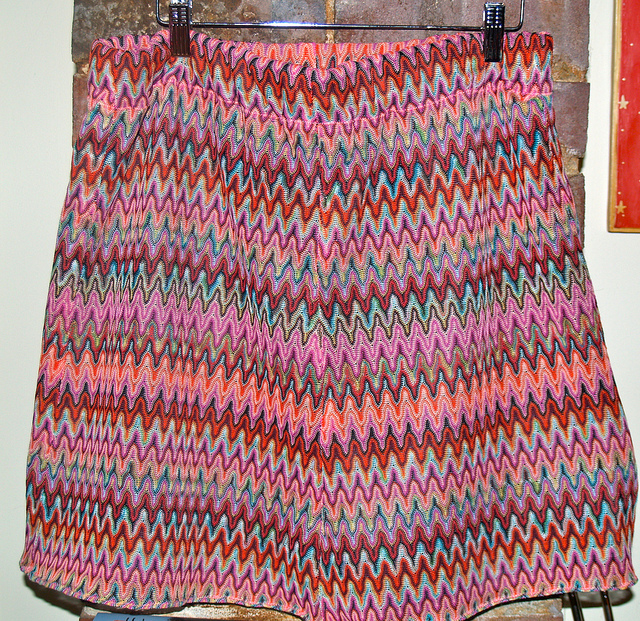
Here’s the latest from my sewing room over the weekend – a very simple skirt, with lining and 2-inch elastic at the waist – self-drafted. Brian picked the fabric out a couple of weeks ago and suggested that this would make a great skirt – so I paired it with some thrifted grey lining and voila! $6 and I’ve got something that a co-worker mistook for a Missoni piece yesterday (the Target line, not the stuff made from $300 a yard fabric). I’m particularly pleased that I got the pattern to match all the way around so there is no weird disruption to the pattern anywhere. I was skeptical at first, but having worn the skirt twice now (two days in a row) I’m convinced of its awesomeness.
Sadly, I am woefully behind on schoolwork this week, so the next couple of days I have to catch up with my academic posts. Hopefully I have time to finish a shirt I am working on – the exciting thing about that project? My first foray into french seams (and they are really easy and now I want to finish all my clothes with them). After that I’ve got pants waiting to be cut – and then its time to get to work on some kind of wool coat. It’s just that kindof weather.
Last Night……
I was lucky last night in being finally introduced to the music of Amanda Palmer (I went to a Night with Neil and Amanda because I’m a Neil Gaiman fan). Needless to say – I am smitten. I have searched YouTube for the my two favourite songs of hers from the set list last night and present them here.
The first song posted here one made me cry (and laugh) – and if you grew up a girl in the 70s and 80s I imagine you might feel the same way. All I have to say is thanks Amanda Palmer for getting this!
This one just made me laugh outloud:
Neil Gaiman was also fabulous – but posting him reading here is just not going to approximate the electricity that existed in the theatre last night. Thanks to both these talented creators for doing what they do. Fantastic.
Getting frosty.
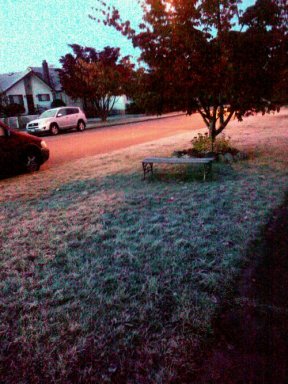
I know that elsewhere in North America there is already snow but I am surprised by the level of frost in Van this morning just the same. This may be our first real killing frost of the season which means I’ve got to get the dahlia tubers out of the ground and the fuschia indoors this weekend!
New sewing– Table Runner
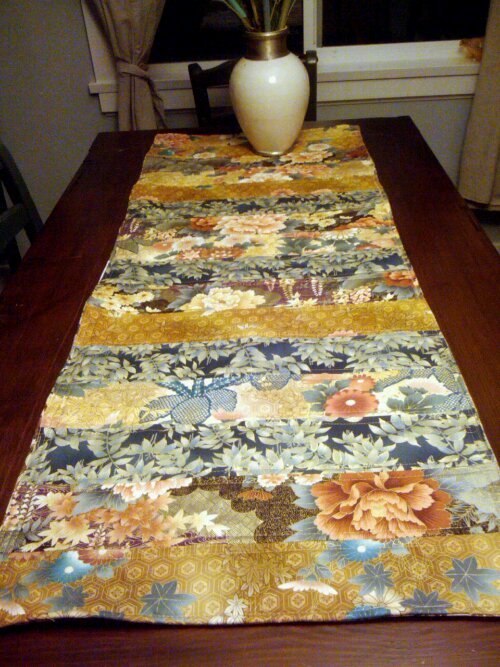
For those of you tired of the long school-oriented posts here is a quick pic of a table runner I finished last night. I have pledged to myself recently that I am not buying new fabric until I have worked through more of the stash… this fabric was a gift from my mother who took me fabric shopping for my birthday back in February. One stash-busting project down!
I also want to note that today I am wearing two made-by-me items. The blue dress from last week and a scarf I crochetes in early summer. Super satisfying!


 Red Cedar