Red Cedar
More apocalypse, less angst
Life Tidbits: School and home.
All my recent writing energy has gone into my final term paper and my presentation for tonight’s class – leaving me spent when it comes to blogging here. Sadly, I ended up writing two term papers – one which was discarded after several hours of attempting to rework it, and one which I banged out at the last minute because I wasn’t happy with the original (totally different topic too). That is the first time in my life I have ever discarded a nearly-finished paper! But I’m sure it was the right thing to do, as I was able to start fresh with a much more coherent thesis (basically stated as: The rise of reason in the last several hundred years has impacted the human relationship to nature, the body and the self.) In any case, I’m feeling intellectually spent and am sure glad that it’s the last class of term next Wednesday!
Brian is going away this weekend to visit a cousin, and I am staying behind in Vancouver to catch up on things – which means 3 whole days on my own to party! Or, really, to prep the living room and hallway for painting. Plus do some sewing. And maybe even clean out the fridge. Living it up alright!
On Monday I went and picked out the paint colours for our new living room – and I am pretty excited about them. York Harbor Yellow for the main walls, Caliente for the small hallway off the living room and Mistletoe for the kitchen (which will be painted in the new year). Our house gets almost zero sunlight in these areas, and yet for some reason the previous owners painted them all mid to dark shades which makes them really dim in the winter especially (photo here). I’m quite excited about spicing up our living room with a brighter colour, one that co-ordinates with the furniture we already own. After the painting, we’ll be putting up new curtains, cleaning our sofas, and rearranging some furniture which should give us a fresh living space for the new year. Lots of work in the next couple of weeks but I am eager to get started on it with my free weekend (Brian originally offered to do it all, but now I want to get started without him).
I’m also going to pick out some sheers for the window treatments and trim them in some co-ordinating colour – finally getting rid of the Ikea drapes we bought upon moving in almost three years ago. This is the living room we’ve wanted from the beginning – but in the flurry of moving we didn’t have the time or money to paint. Now that we’re a bit organized in other aspects of our life together this seems like as good a time as any for some minor redecorating.
I feel like such a recluse these days – give me a weekend and I just go domestic – but I’m truly in my place of contentment there. Which I suppose is what making a home with other people is about… creating that space of rest and peace. Given what goes on in the world, I am so grateful to have this small oasis to call my own.
Julie, a novel
This week – Rousseau. I am in the last books of the semester with a paper and presentation due next week – plus three books left to write journal reflections on. This being one of the three – Julie, or the New Heloise – a fairly hefty novel of 450 pages (that’s the abridged version) penned in 1761. Now considered somewhat of a slow read, this epistolary book was perhaps the best-seller of the 18th century and fanned the emotional flames of its readers who were enchanted by the doomed love affair of the main characters – Julie and the so-nicknamed lover Saint-Preux – which echoes the historical figures of Abelard and Heloise.
Purporting to be the letters between, and concerning the two lovers (lovers meet and fall in love/lust, match is deemed unsuitable by father, lover is sent away, letters between the lovers discovered by mother and all communication is cut off, Julie enters an arranged marriage with a man of perfect reason, lover returns to her side as tutor to children and family friend, Julie dies in tragic accident) Rousseau uses the novel to dig at deeper philosophical observations about the nature of emotion and reason, the human character, the relations between the sexes, and individual autonomy within society.
In the text emotion and reason are characterized by the different characters and their relationships to each other. Julie in the earlier chapters and St. Preux representing emotion, Julie’s cousin Claire and Monsieur de Wolmar (Julie’s husband in later chapters) representing reason with other characters supporting these roles. Through their travails, the characters demonstrate that while emotions bring out the beauty and heightened feeling for life, reason must always trump them eventually in order to bring about domestic harmony and a peaceful existence. In some ways this is considered to be a transition of age (Julie partially makes this transition after her marriage), but it is also a matter of central character (Monsieur de Wolmar asserts that he has never felt much passion and believes himself an observer rather than much of a participant in life). The measured detachment of Monsieur de Wolmar is depicted as mature and more desirable to the fevered state of melancholy the lovers exist in prior to his arrival on the scene. The cousin Claire also plays this counterpoint throughout, admonishing Julie regularly on being the author of her own heartache and being too attached to the sway of her emotions. We are to understand the ecstasy of the lovers only through the framework of their agony – thus paving the rational road for the more mature characters to lead us down.
It follows in the tale that it is in this maturity we may find the autonomy in ourselves and allow it in others – for to be held in the emotions is to be prey to jealousies and possessiveness which Julie and St. Preux both exhibit in their affair. By contrast we have Monsieur de Wolmar – who, with secret understanding of Julie’s former affair with St. Preux – allows St. Preux into his home and then encourages a close and affectionate relationship between the two former lovers. This is presented as the only truly honorable option – and it relies on the true nature of goodness that all characters possess once freed from their frenzied emotional states. There is a definite paternalism in Monsieur de Wolmar’s position — he refers to the two as his children at one point during a speech– as we are to understand that this reasoned approach is not without great feelings of affection even as the lovers are diminished by it. St. Preux is reduced to the status of Julie – a pet, a possession – of de Wolmar’s, even though he is returned from his own process of maturing abroad. Perhaps this is a nod to the castration of St. Preux in homage to the story of Abelard?
The women in Julie are strange objects, indeed – the stone-faced Claire contrasted against the virtuous and excitable Julie – which makes one wonder about Rousseau’s own relationships. Being dominated by women, my professor says, turned Rousseau on – so that would explain the strong female characters. That is, strong to a point, because Julie’s virtue is severely challenged when her lover returns under her roof. Thus, the only resolution for Julie is her death by drowning – otherwise the temptation of St. Preux in her home might prove too great. This really is the happy ending for everyone – St. Preux is left to tutor Julie’s children thus retiring from social life into a solitude in which he can nurse his past memories, de Wolmar is never betrayed by his wife, and Julie is released from the conflict between her emotions and reason eternally. It is made clear that because she is so tortured about her repressed love for St. Preux, she wishes to die, though it is undoubtedly an accident which takes her.
I quite enjoyed this work, even though the plot itself is a simple veil for Rousseau’s moral message – though the characterization of the voices behind the letters is sometimes so weak as to confuse the reader. But it’s the lives I enjoy, the details of life in 18th century Switzerland, the moral dilemmas that seem somewhat alien in the modern era – and these Rousseau gives us in great detail. The letter format brings an intimacy even as it also seems at times artificial – and I admire Rousseau’s inventiveness at pretending the letters to be “real”, found in a trunk somewhere and printed for the edification of the reader.
I am winding down on this semester – my books have now arrived for next – so we will be switching the Required Readings up soon which I am looking forward to!
Another holiday conspiracy
Perhaps it is too early – but since Christmas shopping starts long before Christmas, I direct your attention to this important holiday conspiracy. I know that many of you aren’t religious, but recognize that this subversion of American Christianity and consumerism for what it is – a message of hope and liberation:
Insert lumberjack joke here.

I have a post on Rousseau coming, but in the meantime here is a shirt that I finished last night. It was supposed to be made out of a light, summery material but instead I experimented with a cotton flannel that I bought on sale since it’s so the wrong weather for summer blouses. Worn with a thermal undershirt, this is super-warm and weather appropriate. Paired with the Daytons? Well that’s just ridiculously Pacific Northwest.
This is the shirt I learned how to do french seams on – another bonus besides the warmth!
I would like to make another version of this for summer – but that will have to wait until the cold winds stop blowing.
My nephew and Duplo!
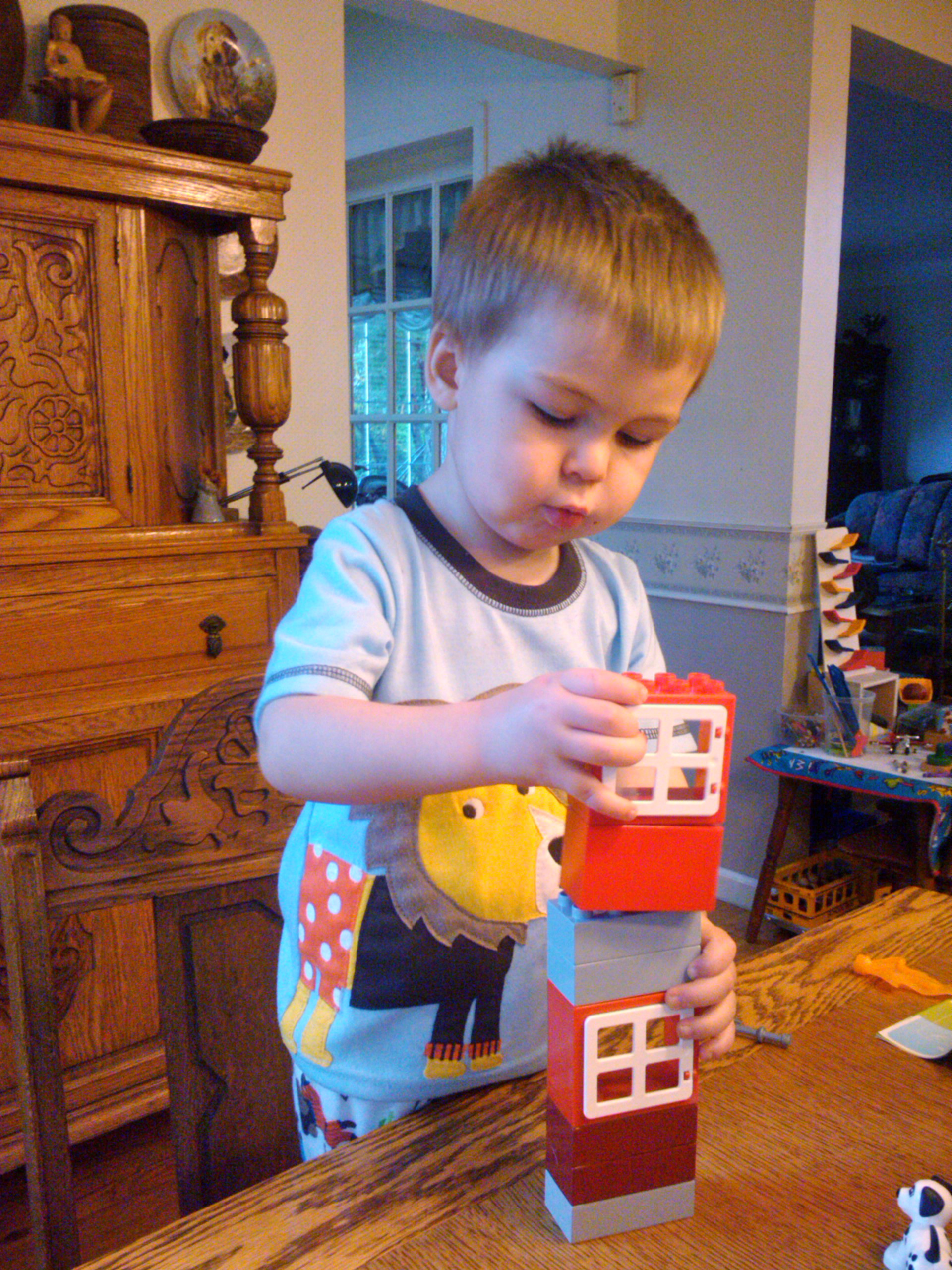
My two-year-old nephew Nicholas playing with the Duplo firestation set that I bought for his birthday. He’s finally old enough for some of the cooler toys! Super-cute 🙂


 Red Cedar