Red Cedar
More apocalypse, less angst
Adventures in vertical gardening
I can tell from my inclinations that it really is an early spring year, as my urgency to get outside and garden prep is much greater this year than at the same time in 2011. The ground never really did freeze this year, and it’s hard to imagine it might start now, though I expect we could get some light snowfall still before winter is officially over. But still, we have milder days – like yesterday – and all my anxieties have boiled over into a physical need to be outside, to work my body, to make myself tough and strong so I can run and cycle and hike all the stress away.Yesterday morning this manifested into a strong desire to build in the garden – inspired by this post: Vertical Gardens and Green Walls among other things I’ve been perusing on vertical gardening.
You see, I’ve got a north facing backyard with very few hotspots. One of those hotspots is the back corner wall of our shed which is right near the back gate, meaning I can’t widen the garden bed there without impeding access to the yard from the alley. So I’ve been thinking of vertical garden possibilities there for awhile, and it turns out that yesterday was the day for action.
$70 worth of lumber and two hours later I had accomplished this:
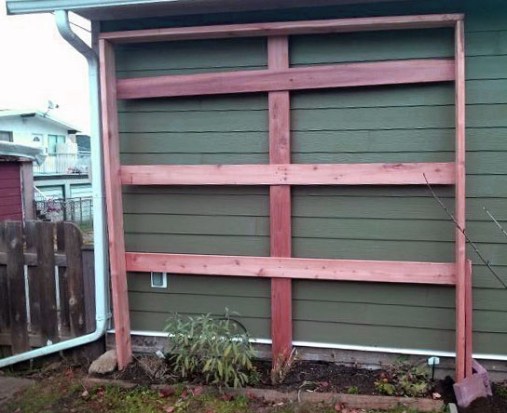
What is this you ask? It’s a frame that will hold 4.5 inch deep rain gutters which will be filled with dirt and plants. Made from 2×6 and 1×6 cedar boards, and balasted by stakes sunk into the ground – I am thinking that I might attach some hooks to the shed to chain the top half of the structure up and ensure it can’t fall when loaded with dirt and plants – it is sturdily standing at the moment however. My priority – besides providing lots of space between laters – was to ensure that it did not sit *on* the wall because that can cause damage to the building – but create a framework in front of the wall that would mirror the existing bed.
In a couple of weeks I will attach some cheap PVC gutters to the frame and mix a suitable planting blend together for container plants. Because this is such a warm and light spot, I’m planning peppers, eggplants, vining cucumbers (in the lowest rung) which are things I normally have difficulty growing in my not-so-sunny yard. It’s an experiment, really – who knows if it will work?
In the meantime, I am stitching together grow-bags out of landscape fabric to attach to this alley-score door:
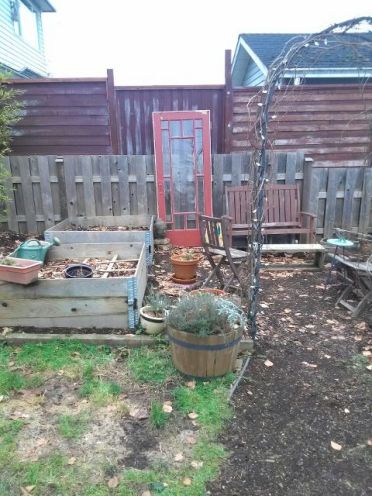
This is in a less-sunny part of the yard, and I’m thinking pansies, lettuces and perhaps a hanging fuschia from the top will at least create a spot of visual interest if nothing else.
As you can see from the shots here, the yard is still a bit of a fright, with just the earliest of signs that the light is returning in the tips of fruit tree growth and the bulbs pushing up some green. My next building project involves that box to the left of the door where I will build a new pea-trellis on two sides to replace the old one that was falling apart and looking a bit motley. Plus, my boxes are short of soil – and that will neecd to be rectified sooner rather than later. So many things to do, I’ve got a list that I add to every time I go outside – but new projects and experiments are exciting. I’m hoping that my vision can be as beautiful in reality as it is in my head!
The good, the bad, the federal government
Things over here are pretty awesome these days. Awesome both in the sense of being great, but also in the sense of being a tad overwhelming. The good, the bad, the life – you know – the life.
What’s good right now you ask? Well, generally we’ve been having awesome social time with lots of different friends. Our friend Red Chris moved back to town and in with his sweetie Clare (who is a month away from having a baby!), our friends Chris and Carla have been coming over every two weeks for dinner and games, I am developing good friendships with some of my fellow-grad-students, the writing group I am involved with is meeting semi-regularly and I even managed to get a crew over to play music last weekend. Plus! We’ve had lots of great dinner invites out of the blue – including one tonight for Raclette which I’ve never had before.
I’m writing extensively for school, reading like a madwoman, attempting to reformulate the Flying Folk Army for an early spring gig, and getting started in the garden. I’m feeling energized for the first time in months, which I attribute both to my naturopath and the returning of the light. And, I live in an awesome community where people organize events like last night’s movie showing of Queen of the Sun and Saturday’s Light, Water, Drums festival.
What’s not so good? The federal government, for one thing. Although layoffs have started out as a trickle, the expectation is that after the spring budget we will be flooded with pink paper since this government is so hell-bent on reducing its workforce. What that means for me is a lot of work as a union rep, but I am not immune to layoff either and like every federal worker right now the underlying stress is great. Will it be me? Will it be them? If it isn’t me, do I want to stay in a decimated and demoralized workplace?
It’s a little intense, and especially for someone like me who identifies so strongly with the world of work, and was raised with a lot of fears around joblessness. On the other hand, getting laid off would pretty much force me to change my career trajectory which I’m not altogether happy with at the moment. The worst part about it all is that we’re all to keep doing our jobs as if nothing is happening – planning for the future, purchasing new software for projects down the road, getting committees for next autumn set up – all with the knowledge that we may have to walk away mid-bounce.
I’m a bit bogged down by it at the moment, and tense for the worse which is yet to come. People keep telling me how great it is to have an experienced union rep around, how lucky it is that I haven’t found other employment yet (cause everyone knows I’ve been looking) – and I do feel a sense of obligation on that front, for sure. On the other hand? It won’t matter one bit what I do for anyone right now if this government is hellbent on its path of destruction. We’ll all be picking up the pieces for a long time to come.
Now, what I have going for me is an awesome partner, and a great social community that I am feeling really engaged with lately – not to mention some creative and intellectual outlets. If it wasn’t for all of those things, this whole downsizing situation would feel a lot worse. Even though I have a slow anger burning beneath the surface, I can honestly say that I feel generally very satisfied with my life right now – which seems incongruous, but life, you know? Sometimes it’s very weird.
Next goals are to get back to the gym and start doing more stuff outside as the weather improves. A little more exercise would go a long way right now. We’ve got at least another month until we know for sure what’s going on with that damned federal buget and I need to work that angst out!
Book Notes: The Case for Books
Whatever the future may be, it will be digital. The present is a time of transition, when printed and digital modes of communication coexist and new technology soon becomes obsolete. Already we are witnessing the disappearance of familiar objects: the typewriter, now consigned to antique shops; the postcard, a curiosity; the handwritten letter, beyond the capacity of most young people, who cannot write in cursive script; the daily newspaper, extinct in many cities; the local bookshop, replaced by chains, which themselves are threatened by Internet distributors like Amazon. And the library?
It can look like the most archaic institution of all. Yet its past bodes well for its future, because libraries were never warehouses of books. They have always been and always will be centers of learning. Their central position in the world of learning makes them ideally suited to mediate between the printed and the digital modes of communication. Books, too, can accommodate both modes. Whether printed on paper or stored in servers, they embody knowledge and their authority derives from a great deal more than the technology that went into them. They owe some of their authority to authors, although they commanded respect long before the cult of the author took shape in the eighteenth century. As book historians insist, authors write texts, but books are made by book professionals, and the professionals exercise functions that extend far beyond manufacturing and diffusing a product. Publishers are gatekeepers, who control the flow of knowledge. From the boundless variety of matter susceptible to being made public, they select what they think will sell or should be sold, according to their professional expertise and their personal convictions. Publishers’ judgments, informed by long experience in the marketplace of ideas, determines what reaches readers, and readers need to rely on it more than ever in an age of information overload. By selecting texts, editing them, designing them to be readable, and bringing them to the attention of readers, book professionals provide services that will outlast all changes in technology.
Robert Darnton, The Case for Books: Past, Present and Future
***********************
(By way of explanation – I am attempting to start a new practice with all non-school books I read, which is to document anything relevant or interesting to me from the book on my blog. I read far too many things which slip away from me and I would like to keep a record of that which intrigues me – or may prove useful to some academic venture, some time – thus Book Notes.)
- An interesting essay about the Gutenberg-E book experiment of 2000-2006 which underscores the difficulty in bringing down the price on books that have a limited audience – academic monographs – owing to the huge amount of institutional and editorial infrastructure which goes into any publication. Cheaper distribution in the form of e-texts doesn’t make for larger audiences which is not Darnton’s point but ultimately what strikes me as the fallacy about e-books being cheaper in a non-mass-market setting.
- A Paen to Paper gets in the whacky world of attempting to save every bit of printed paper ever produced which Darnton seems to support. I suppose it makes sense, because he is a historian, but I fail to see that any institution will ever have the storage/space capacity to keep every newspaper, magazine and book ever printed on its shelves ad infinitum. Miniaturization and now digitization give us real tools to making this history accessible in a way that warehouses of old newspaper never could. It seems to me that most things that have survived history, did so because an individual or institution hoarded or shepherded that thing and passed it on – it was precious in some way – the daily newspaper and O magazine would just not pass that historical test.
- In The Mysteries of Reading a lovely discussion of what the tradition of the Commonplace book can tell us about the minds and attitudes of some of our historic figures, or just about the age in which the individuals who kept them lived. The Commonplace book is a book of quotations taken from reading in snippets and copied into a journal to be easily referenced. Often these snippets were accompanied by droll comments or observations. I like the idea of creating a commonplace book on the web. There are now social media venues for this like Quotista, but any half-built social media startup is bound to fail before these records could make it into anything like posterity.
Matches struck unexpectedly in the dark…..
First of all – this post about Umberto Eco’s children’s book from the 1960s is worth a gander if you like beautifully drawn children’s literature (with a good moral message) but more importantly, the site for the post – Brain Pickings – has such great stuff every day, I could just live in the world of books and visuals that she curates!
************
I have not been sewing lately, I have not been watching movies either. It seems for the last two weeks all I have really been doing is reading, reading, reading. Mostly for school, but then again, I’ve got a stack of library books on positive psychology and the future of the book which I’m attempting to read snippets of for fun, and last night I was gifted Wayde Compton’s After Canaan for my birthday and I don’t know if I can wait until the end of semester to dive into it. Then again, there are stacks of books awaiting the end of my required readings, we seem to accumulate them like sand coming in under the doorway around here.
But all this reading is exciting, it’s not a drag even when it gets hard, because I’m learning that if I just push through – examining my prejudices to particular authors as I go – there might be something very rewarding on the other side. Case in point – Virginia Woolf – an author who I have always despised having once attempted (and failed) to read Mrs. Dalloway a number of years ago. Not only that, but I think that there is a certain amount of social teaching that weighs heavily on the feminist writers – and so I grew up with a sense that somehow I wasn’t supposed to like Woolf, or that she thought herself too good for other people, or something like that. And I can imagine that she would have been a difficult person, what with her hyper-intelligent mind and fits of madness – and perhaps that’s part of the reason we’re not supposed to like her either. In any event, I didn’t *get* Mrs. Dalloway or what all the fuss was about anyway because where was the story in all that reflection? So tedious! So slow! So inconsequential!
And so now, I am about to eat all those words and more – having finished To the Lighthouse on Saturday. My initial observations are thus:
- Reading Woolf requires patience, and the lyric novel is more like a poem than any other form of prose. Approaching it like a poem helped an awful lot in pacing my own reading.
- You don’t read Virginia Woolf for the story, the drama is all internal, which makes it no less gripping than if it were external.
- More than any other writer I have encountered – the form and central metaphor of the novel are more important than the dialogue or characterizations. Not to say these things aren’t important – but Woolf’s novel is the whole into which we are drawn, bobbing up and down in the philosophical waves of the book.
Those of you seasoned readers of Woolf probably know all that, and a lot more, but please! Understand that Woolf is like Joyce or Proust – these are not writers whom one can tackle lightly – and I think require a certain gravity or patience that I didn’t have at twenty and am only developing just now. (I mean, I even read the introductions to books now, the prefaces! Imagine!)
To the Lighthouse is considered to be one of the greatest novels in the English language. A masterpiece of modernism, a groundbreaking work of fiction! And even now, eighty years after its arrival into the world, it strikes me as cutting edge and towers so grandly over so much of what has come since.
Which is not because the philosophical questions asked in the book are deeper than those asked elsewhere, or even different (because really, it’s all about the meaning of life and what isn’t?), but because Woolf’s writing merges us with the minds of shifting others and I can’t think of many other instances in literature where I have felt so drawn into the perspective of another. And not just a single perspective – but of many characters as Woolf moves from one to the next with a fluidity befitting a novel where the central metaphor is water. Each personality is separate, distinct from the others, yet laps up against the edges as one perspective is replaced by another allowing the story (which is one of time passing, the questions we ask ourselves, the social conventions that we hold) to be shared amongst the characters. That great humanity which has us as individuals in one instance, forming a part of the mass in another.
Water metaphors abound in To the Lighthouse and I have a notion that I would like to go through and highlight every instance of watery language in order to document just how thorough the drenching of one story can be. It’s a magical thing to enter into – this use of metaphor so deeply embedded – even the structure of merging perspectives brings us to the sensation of floating, bobbing, being carried adrift on the wide-sea expanse. And for what ultimate effect? A contemplation of the vagaries of life – the traditions that pull us along even as our family lives are dispersed and are tossed apart, the individuals who weigh their own disappointments on their progeny is an attempt to anchor down life, the internal expanse which at times seems limitless and at others as small as a leaf.
This is apparently Woolf’s most autobiographical novel, and if so we get a great deal of insight into her own relationships – the mother-figure Mrs. Ramsay complex and uneasy in her motherhood and middle-aged beauty, the father and husband-figure Mr. Ramsay so needy for praise and attention, so sternly unable to give it to others, Woolf herself depicted as a painter (Lily Briscoe) angered by the limitations of male society on women artists, questioning her own ability to move through and beyond, to complete her work. She wonders about the conventions of being married and having children – at one point Lily musing at why Mrs. Ramsay was so eager to see the younger women married off when she seemed so unhappily trapped in her own marriage; she notes that each of us is questioning, and adrift – hoping always to be noticed and taken ashore by another. Thus is the nature of the search in which we find ourselves – the lighthouse of the central design, watching over and occasionally illuminating a wall or a scene or a piece of clothing.
“What is the meaning of life? That was all — a simple question; one that tended to close in on one with years. The great revelation had never come. The great revelation perhaps never did come. Instead there were little daily miracles, illuminations, matches struck unexpectedly in the dark…”
My writing about this work seems frail in the shadow of it – so hard to sum up the swells of emotion and insight I felt at the internal plights – angers, jealousies, discontents (and almost never joy – let’s just be honest about that) of each actor along the way. What to say except that I was wrong about Woolf and it makes me wonder if perhaps Joyce is next on the list of writers I might willingly encounter?
Let the poppy seed itself….
What power could now prevent the fertility, the insensibility of nature? Mrs. McNab’s dream of a lady, of a child, of a plate of milk soup? It had wavered over the walls like a spot of sunlight and vanished. She had locked the door; she had gone. It was beyond the strength of one woman, she said. They never sent. They never wrote. There were things up there rotting in the drawers–it was a shame to leave them so, she said. The place was gone to rack and ruin. Only the Lighthouse beam entered the rooms for a moment, sent its sudden stare over bed and wall in the darkness of winter, looked with equanimity at the thistle and the swallow, the rat and the straw. Nothing now withstood them; nothing said no to them. Let the wind blow; let the poppy seed itself and the carnation mate with the cabbage. Let the swallow build in the drawing-room, and the thistle thrust aside the tiles, and the butterfly sun itself on the faded chintz of the arm-chairs. Let the broken glass and the china lie out on the lawn and be tangled over with grass and wild berries.
For now had come that moment, that hesitation when dawn trembles and night pauses, when if a feather alight in the scale it will be weighed down. One feather, and the house, sinking, falling, would have turned and pitched downwards to the depths of darkness. In the ruined room, picnickers would have lit their kettles; lovers sought shelter there, lying on the bare boards; and the shepherd stored his dinner on the bricks, and the tramp slept with his coat round him to ward off the cold. Then the roof would have fallen; briars and hemlocks would have blotted out path, step and window; would have grown, unequally but lustily over the mound, until some trespasser, losing his way, could have told only by a red-hot poker among the nettles, or a scrap of china in the hemlock, that here once some one had lived; there had been a house.
To the Lighthouse, Virginia Woolf
Quite simply one of the most incredible passages of writing I have ever read.


 Red Cedar