Red Cedar
More apocalypse, less angst
Neighbourhood notes.

Walking by the corner of Salsbury and Charles these days frustrates me – as does walking by my old house on Kitchener Street just one block away. Seems like all the affordable housing is leaving East Vancouver, and although they might try to save the heritage facades (in this instance), there is no escaping the fact that a once-vibrant low rent apartment complex (which operated somewhat like a co-op) is torn to pieces. Replacement? Townhouse and condo units that cost a minimum of $700,000 to buy into. Same goes for my old duplex around the corner which is being turned into a fourplex as we speak.
I’m all for densifying our neighbourhoods so we can continue to grow up and not out – but not unless we consider the affordability of such options. In the guise of being “green”, the Vision city council is steamrolling over the very communities it assures us are integral. So where is the new housing for working class people, those with marginal incomes and no option to buy? Haven’t seen the city approving many of those developments lately…. And why would developers be interested in developing below-market housing when there are such big profits to be made in the bubble?
Lets’ just hope that it bursts soon – flooding the gulf growing between those who can afford the city and those who cannot. The fissures are there, in the form of $600,000 basement suites – it’s just a question of when this its all going to crack apart.
Who’s afraid of the brave new world?
I am supposed to be writing about Brave New World this week, but each time I sit down to do so, I am put off by the task. Perhaps because I’ve read it too many times? Because what I would say here, I’ve already thought about ad naseum and so the writing is not longer interesting to me? I’m not sure, but it feels done to me, and I still have the doing of it ahead.
While 1984 was the dystopia I was required to study in Grade 10, it whetted my appetite for fiction about fascist futures and post-collapse life, the next most obvious book being Brave New World. Since my first teenage encounter with it, I’ve made several readings – this being the fourth or fifth dalliance into Huxley’s cynical take on the possibilities of human control over life. Fukuyama would call this “our posthuman future”. For the record, although Huxley doesn’t even begin to imagine the type of enslaving technology available in our present, he did believe very much in the future he predicts in BNW as exemplified in a letter circulating on the Internet that Huxley wrote to Orwell several months after the publication of 1984.
For those few of you who haven’t read this classic novel – the story is premised on a society organized along the lines of Fordism. That is a mechanized, assembly-line, technologically savvy future in which everything – including humans – is controlled through design principles of efficiency and optimum production. A mastery of hypnosis and psychology have merged into the ultimate tool of mind control, and where that doesn’t work the drug soma is prescribed outside of working hours to keep the population in a continual state of disconnect (while simultaenous activity ensures they will never be alone). There are still “primitive” reservations in areas of the world which haven’t much development or exploitation potential – and it is in one of these “wild” zones that the Brave New World is cast into relief as protaganist Bernard Marx and his companion Lenina travel there on a holiday. Of course there is a full synopsis at Wikipedia if you don’t know the work…..
Of course we recoil at this “future”, one in which free will is traded for a type of cardboard happiness constructed out of conditioning and drug taking. While the reservation ostensibly exists outside of this, its marginal status ensures that the lives of people immersed in ritual, tradition and family are seen as ludicrous in their refusal to alleviate their psychic suffering through immersion in the controlled society. “Primitivism” to Huxley is a base thing, ignoble and dirty, a perspective shared by many of his fellow intellectuals of the 1920s and 30s unfortunately). In a 1947 introduction to the novel Huxley himself noted that he really only shows two possibilities: the insanity of the modern world, against the “lunacy” of the primitive and thus chides himself that a third option of break-away state of educated free people be proposed as a possible place of escape. (To some degree these states do exist in the modern world, as islands of exile for those Alphas who just can’t fit in – but Huxley doesn’t explore what those exile-spaces look like).
But although we are meant to turn away from Huxley’s vision, I can’t help but thinking that an awful lot of people in our society today would gladly trade their free will for a state of monotone bliss. In fact, I can’t help but thinking that a lot of people in this society are attempting to live in their own BNW bubbles through unbroken consumption of media, disconnected sexual encounters and the social hypersexualization in general, drug-taking and consumerism. If a government came along offering a permanent employment, extended youth and an end to relationship miseries alongside that culture of mindlessness which already exists – wouldn’t a lot of people raise their hand to participate with no revolution or civil war at all?
And why not? Unless it is, as Fukuyama suggests, the struggle for the self and recognition that is fundamental to our human nature – and it is this human nature that has some checks and balances built in based on our ability to reflect and empathize with others. (Not that it’s a perfect mechanism by a long shot, but it is posited by philosophers and evolutionary psychologists that empathy which grows out of the “theory of mind” implicit in believing in a deity, go a long way to keeping human behaviour in check). Without the threat of aging, without the struggle to form relationships with our children and spouses, without the stress of having to pick a course of education or find a vocation – what kind of humans would we be? Huxley posits that people are vapid and bland, though not necessarily difficult to get along with for the most part. Is this true of the consumer-obsessed of our current state?
While I would like to believe that we are not so cartoonish as the characters in BNW, reality television and celebrity culture would tell me otherwise. It’s this seeming lack of imagination which saddles so many of us into believing we want what our parents wanted, or what our neighbours have, or what someone else will look up to (money/fame) and so we shed our individual natures in order to follow a path of conformity fed by the constant messaging of lack (as in – you don’t have enough, you’re not good enough, you need more stuff to be better). And in the end who does this serve? Well to some degree it must serve us by creating a (false) sense of security and inclusion which the need for would be hardwired into us from our evolutionary past – and to another degree it serves the Alphas (Politicians, Corporate Overlords, and the Professional Class in general) who tap into those innate desires and needs in order to create their sense of security and inclusion. The difference between the Alphas and the rest of us is that they have some deeply-held need to dominate, and usually come from a class advantage that allows them to. (Not unlike BNW – ahem.)
And now here I find myself on the threshold of the question of whether free will even exists in the first place, and that’s where I will need to end.
I recognize that *everyone* uses BNW to talk about our modern existence and the seemingly empty culture we are living in and co-creating – but Huxley’s most famous work isn’t still read today because of its literary merit so much as that its commentary resonates within us. It still speaks to our deepest fears – which is the sense that to live controlled is to not live at all – that to mechanise birth is to introduce the sterility of death – that to stamp out our connection with nature is to destroy our link to the divine questions which have fueled our art, literature and politics. And then what? We lose the drama of living, of history, of violence, of change – flattened our, levelled (as Kierkegaard would say), and thus neutered of any desire except that which is sold to us in the form of a pill or a new skirt or a night in a hot new club.
Yeah, I think that sounds pretty dreadful, but I’m afraid there are a lot of people who don’t.
Listen: Max Richter, The Blue Notebooks
Everyone carries a room about inside them. This fact can even be proved by means of the sense of hearing. If someone walks fast and one pricks up one’s ears and listens, say at night, when everything round about is quiet, one hears, for instance, the rattling of a mirror not quite firmly fastened to the wall.
Franz Kafka, The Blue Notebooks
I am going to come right out and admit here that I own an awful lot of music in the minimalist existential genre – by which I mean classically minimalist with a certain amount of angst built into the backdrop. The type of music that swells movie scores, or that you turn to on a grey day with a cup of tea and The Myth of Sisyphus in your lap. Music for introspection we could call it, though I’m sure that there are new music critics out there who would just call it sentimental and not dissonant enough to provoke.
In any case, of this burgeoning collection I am fairly convinced that the album I most cherish for its ability to put me into a deeply reflective (and often melancholy) state of mind is Max Richter’s The Blue Notebooks.
Richter defines his music as post-classical, drawing from electronic, classical, spoken word and spontaneous sound recordings. It is is with this palette he paints scenes that are almost visually evocative in their lush loneliness. A typewriter echoes in a seemingly empty room, a voice reads from the notebooks of Franz Kafka, the single note of a violin sails high atop the human experience, while we are anchored by an undulating, underwater rhythm – each part of the composition restrained into perfect interplay, pulling the listener into a deep state of affect, an internal landscape that holds disappointment and promise in the rise and fall of the guiding heartbeat (Shadow Journal).
While each song on this album employs different composition and recording styles, a sensibility of emotion holds them together as a whole. From a complex arrangement of electronic and stringed instruments, the listener is taken to the sounds of nature and then a choir against an organ backdrop – and then released again into the solo piano reflection which bridges into another spoken piece. As a listener I find myself drawn into the depths, only to be reassured by the moments of release and even lightness that Richter builds in. This is a believable intimacy as it fully engages the self, while at the same time satisfying the voyeur who overhears the inner thoughts of others.
Recorded in 2004, Richter has put out several albums and movie soundtracks since, but I have not had nearly the time with them that I have with this recording. I am hoping to write more in-depth about the music in my collection which I think moving and thus worth sharing. While there is lots of music I enjoy, there are only some albums which are worth talking about. This – The Blue Notebooks – is a deeply affecting album, and thus one for those who need music for the quiet days inside them.
Bookshed: What’s Wrong with my Vegetable Garden?
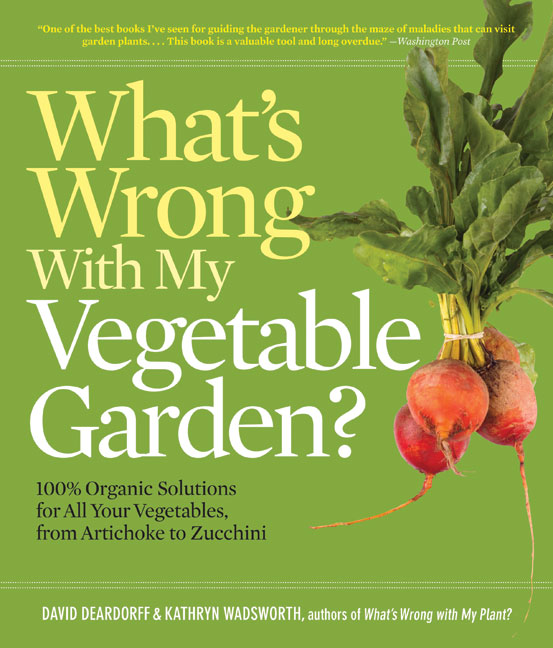 What’s Wrong with my Vegetable Garden?
David Deardorff & Kathryn Wadsworth
2011
Ever find yourself looking at a greyish leaf or a pattern of insect damage on a plant and asking yourself what’s going wrong? In my backyard I invariably find myself fighting the battle of powdery mildew, though blossom end-rot has also kicked over my zukes from time to time. But sometimes even when I can identify that there *is* a problem, I’m not entirely sure *what* the problem is, or how I might start to deal with it. Here is where a gardening handbook such as this comes in handy.
This richly photographed book is divided into three main sections with the goals of helping you to:
- Prepare: Setting up your garden for success requires diagnosing site and soil issues from the beginning. Photographs of temperature, soil, light and water-related problems show where problems may lie in site selection or deficiencies in soil nutrients necessary for a productive vegetable garden.
- Familiarize: Two-page long Plant Portraits help you to get to know your plants – each portrait includes photographs and descriptive text of the healthy plant and what problems may be common for it.
- Diagnose: This section, organized by table, gives a photo and brief description of the common pests and diseases for each plant family – along with diagnosing the most likely source of the plant problem.
- Solve: The authors propose various organic solutions to each identified problem – and these solutions are cross-referenced throughout the other sections of the book, making an easy to follow guide from diagnosis to eco-friendly solution.
As this book was just released in December, I haven’t had a chance to use it in my gardening action yet – but I am hoping that instead of leafing through interminable Internet resources (many of which contradict each other on problems and solution) this summer, I will instead be able to use this as my one-stop reference guide for diagnosing and taking action on plant and pest problems .
The system by which I clear out my psychic space.
It’s crazymaking – how much I want to cram everything in. Read every book, magazine, journal I come across – listen to music across genres and times – play music even, write. Make photographs and clothes. It feels like a sickness at times, and at others I am held aloft by the fact that there’s always something waiting at the periphery of my attention. The next discovery.
But the upshot is a collection of books for review that are collecting dust, a catalogue of music I haven’t found time to listen to, and some half-finished projects in the backyard that need doing before gardening season really gets going. The only way for me to reconcile these things is to consume or finish them and then write. It’s the writing the completes the act for me these days, the posting into the world my thoughts as if fixing them here makes something more done. Or more real.
So expect more reviews of things in the near future: books, music, garden projects, even sewing forays. I’ve got to clear the deck somehow – which just means plunging in and running everything through my internal system to export out again. Like a machine. Or a factory of endless opinions.


