Red Cedar
More apocalypse, less angst
Bookshed: Dressmaking for Real Women
 Lorna Knight’s Dressmaking for Real Women: How to Adapt Your Store-bought Patterns to Flatter the Curves You Want to Keep and Drape the Ones You Don’t
Starting with a section on measurement and body type, the novice sewist is lead through a series of considerations when choosing a garment pattern, and then recognizing what points might need alteration. Straight up, this is not a body-shaming book at all! But it does recognize that many of us who sew garments are doing so because our bodies don’t always fit neatly into “off-the-rack” garments. In my case, I’m busty and short, with an apple-y figure. Knight covers my body type and makes recommendations for the type of garments I might find most comfortable in (and she’s right, I always seek out and make upper body garments that flow over the hip and I hate clingy fabric). This provides a good starting point for pattern-browsing.
Knight mainly examines various points for alteration step-by-step, walking the reader through shoulders, neckline, bust, back, sleeve, hips, and pants-fitting considerations. In each section, she breaks down considerations the sewist might have and then tackles modifications to suit the wearer. She then guides us through making a toile (a dummy garment to ensure correct fit – something I almost never do but always think I should), as well as some basic sewing and finishing techniques.
After sewing garments for a couple of years, I’ve recently become interested in making better-quality pieces. That is, I’ve got the straight techniques of cutting, sewing and following mid-range patterns down and I feel like it’s time to move into more thoughtful garment-making. This means more careful pattern selection as well as introducing more couture techniques into everyday garments so as to get the longest wear and the best fit out of them. Certainly commercial pattern alteration is a skill worth learning as part of this quest for nicer DIY clothing!
Knight’s book is a real pleasure with up-to-date techniques, bright photos, body-image-friendly illustrations, and a lot of core information about sewing garments explained. Definitely on the recommended list for someone who is newly-engaged in garment-making, but slightly beyond the stage of just learning to follow a pattern.
Love Letter #2

Today’s contribution to The World Needs More Love Letters holiday campaign.
“In the country of loss, there are no words which can bring back what’s gone. All comforts are stripped in this rocky place, dark except the glimmer which keeps us going, one step after another. A lit candle, a crimson ray of daylight, a lantern held aloft – the light in the distance has various forms – but what it emits is pure love.
Our love of life and of one another. Our collective love which wraps its arms around us and holds us upright during our worst times. I hope in this season you have found that glimmer and known that light was shining just for you. It will get brighter as you continue to move towards it.”
Skirt city…..
No matter the time of year, I tend to lean pretty heavily on the basic skirt as part of my wardrobe. Dresses off the rack have rarely worked for me because I’m either too short or too booby or too whatever for them – and pants (as much as I love a comfy pair of jeans) often leave me feeling dumpy. Skirts in comparison can be flirty and cute, are easily altered, and go with almost any occasion (paired with long johns, I even wear them hiking). Fortunately, skirts are also really easy to make, which means I am forever collecting fabric that will “one day” get turned into something wearable.

The problem with that of course, is that so much of the fabric I appreciate is of the quilting cotton variety – which means that even for summer wear it can leave something to be desired in terms of structure and garment-worthiness. Quilting cottons are intended to be sew into layers with other fabrics – after all – and they can look a little flimsy on their own.
Since I have lots of cotton fabric that wants to be garments in my sewing closet, I’ve recently (in the last two weeks) come around to attempting the technique of underlining.

You see, there is creating a lining for a skirt, and then there is underlining – and the two skirts I’ve just made lead me to believe that the latter is superior for my needs and well worth the (slightly) extra effort. Underlining entails cutting out lining pieces the same as the main fabric pieces, and then basting those lining pieces right to the main fabric so as to create a whole fabric which is then used to create the skirt. Threads magazine has a much better description of it here: http://www.threadsmagazine.com/item/4999/understanding-underlining.
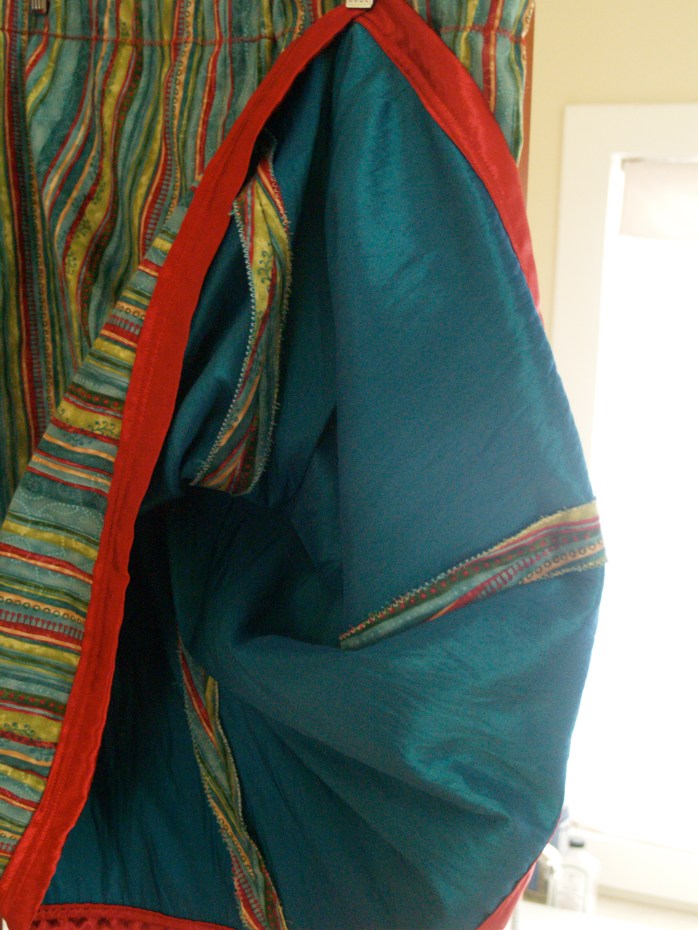
What I’ve discovered from this first foray into underlining my skirts is that the cotton looks a lot more substantial for garment-wear, the skirts have more structure and look better as a result, the cotton doesn’t wrinkle nearly as much from all-day wear, and the skirts are more appropriate to fall and winter weather because of the extra layer. Of course underlining also changes the “hand” of the fabric – which may or may not be to your liking. In the case of these skirts I was very pleased to stiffen up the limp cotton and I think they wear better overall.
Each of these skirts took me about two hours – they are simple elastic-waist constructions. The brown patchwork-looking skirt is my first attempt at self-drafting an A-line skirt which turned out surprisingly well. The second Christmas skirt came from a pattern I’ve used several times before. In any case, that’s six more yards out of the stash (including the linings) and into the wardrobe with very little effort. I’ve got some corduroy to use up next, just after I get my Christmas quilting finished!
If all you needed was love…

I finished my term paper and had it handed in by 10:30 this morning – which officially leaves me free to live the other aspects of my life until at least mid-January when the school term begins anew! And thus I’ve got the energy to return to this blog with a new (temporary) writing project – and without the guilt of “I should be working on my paper” hanging over me.
Phew! Now onto the fun writing: Love letters! I’ve recently been alerted to the World Needs More Love Letters which marshals group love-letter writing once a month to cheer up a person in need. From December 3-14 of this year, they are promoting a marathon 12 Days of Spirit writing event in which participants are encouraged to write a letter each day to the project-suggested recipient. I’ve just written my first and it’s sitting by the piano waiting to go out in the post – and I’m dedicating myself to doing this little exercise for the next eleven days hence – both as a way to work my pen and also because I want to live in a world where people exercise this type of indirect reciprocity.
I highly encourage all your spreaders of love and compassion to join in this quest to lift the spirits of someone in need during this holiday season (and beyond) – by writing letters, or by exercising some other act of anonymous kindness. Since working on my term paper I’ve been thinking again about how we achieve the world we want to live in – and I think that the only way is by doing it. That is, finding the space in our lives to be the people of our imagined better world.
But enough philosophy! Letters can be brief and don’t have to take up more than five minutes and a stamp – and for someone who needs love and support, who knows what brightness you might bring them.
Pre-atomic bridge.

In lieu of anything witty or crafty, here is a photo of Victoria’s Johnson Street Train Bridge in pieces at the scrap yard. This is the first part of the old blue bridge system to come down in order to make way for a new bridge. Very controversial this decision was, and most people I know in the city still aren’t happy about it. Interesting fact: this pile of scrap metal is pre-atomic steel, meaning that it has very low levels of background radiation. Metal manufactured after the first atomic bombs were deployed, have a higher ambient level of radioactivity due to fallout. Apparently pre-atomic steel is sought after in the production of medical devices, and in experimental physics for this reason.
(I’m in a moment of suspended animation at the moment – mid-term paper. I have three sewing/crochet projects to photograph that will appear here once I get to them. This means finishing the damned paper!)


 Red Cedar