Red Cedar
More apocalypse, less angst
These things also didn’t change last night……
Gah! Losing an election is so disheartening, frustrating, disempowering, depressing. No matter how you phrase it, I know a lot of sad people this morning and I too have been catastrophizing since the results were announced last night. But having lived through several governments who I did not vote for (in fact, my party has only ever won a single election where I was eligible to vote) I am also fully aware that this is not the end of anything, just the beginning of another round of struggle. While walking to work this morning I was thinking about exactly this, and exactly what did *not* change last night besides the ruling government:
- I still live in an awesome neighbourhood with great, compassionate people surrounding me. One way in which that manifests is the return of birdsong to our community, which has followed the return of food gardening, boulevard gardens and natural features to our urban neighbourhood. Another manifestation is the return of salmon to Still Creek last year, which followed on the cleaning up and restoration of the waterway by community volunteers. Still another thing I love about my walk to work is the railway overpass at Raymur, a bridge that only exists because mothers in the community banded together in the eighties to fight for it. Point being, Liberals or NDP, we make positive change by our actions and there are reminders of that everywhere.
- Poor people are still destitute, young people still feel disenfranchised, and there are still not enough options for low-income housing in this province. Sadly, the NDP made few promises for change on any of these fronts ($20 per month added to a welfare cheque is an insult not a promise) so it’s not like that was going to change either way.
- If I want social and environmental justice, I must be willing to take to the streets. No government *gives* us rights and benefits. No government willingly gives up privilege. We are still a population who needs to learn our collective interest and our collective power.
- My community still includes love and music and art and parties and great friends and funny nights of drinking and community gardening fun and rad parents and weird kids and so much of the stuff that live is *actually* about. Losing at the polls while winning at life is a balance I can handle.
Perhaps I am somewhat of a Pollyanna – but I want to say – cheer up! It’s not that bad! At least we’ll have some fun at the barricades, right? And that despite the government I love my life and the fact that I have found such purpose in it; win or lose the election.
Renewing spring.

For those of you who don’t live in Vancouver – know this – we’ve been having incredible (and unusual) weather for the past couple of weeks. Which somewhat explains my absence from here – that and the fact that work has been kicking my ass lately because I’m working on a big project. So big I even get overtime (which never happens).
The better weather has allowed me to double my walking to work, and I have started walking home from work some days as well. Between that and a few other gym workouts each week (pilates, body sculpt) all my aches and twinges have gone away. No more lower back pain especially.
And I am now 38 days wheat-free which has given me plenty of time to assess how that’s working – my sinus pain is so reduced that for the first time in two years I have stopped taking advil every day, I no longer have acrid mucus that burns my sinus passages, my hunger baseline is lower and my blood sugar feels more stable. I haven’t lost gobs of weight or anything, but between the cutting wheat and the increased exercise I feel a lot less puffy, and more streamlined.
So that’s pretty awesome. I’ve lost almost five pounds over the past five weeks, so I suppose that’s not a bad rate either. It’s just nothing mind-blowing.
Otherwise I have been gardening like a fiend and I think I am mostly underway for summer veggie gardening – not to mention getting prepped to do more work in the front of our house.
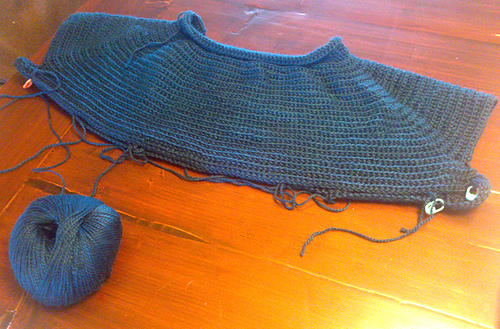
I’ve started a new crochet project also for the first time in ages – a pullover sweater that may not be needed until Fall but oh well, I had this beautiful bamboo-wool that I really wanted to work with:
I have also started an attempt at fitted summer capri pants which I hope to sew up over the next couple of nights. Since I’ve been walking *a lot* (sometimes as much as 12 km a day) I need more pants so it’s not skirts with leggings all summer long.
So yeah, life is basically rolling along – I’m pretty happy these days and working on lots of domestic things plus getting in shape! That’s where I want to be in spring – renewing!
This is my walk to work – why East Van is awesome.
I’ve been walking to work almost every day lately – and this morning I pulled out my phone camera to do a little documenting of the amazing sights of my 6 kilometre trek. A couple photos didn’t get uploaded, they are on my work computer I guess – but I’ll post them some other time (one is a photo of my office – ain’t that exciting). My route takes me to Adanac and Penticton, down the bike route to Campbell, up Campbell and over to Pender, and then along Pender to Burrard. Almost every time I walk I am astonished by something new and out of the blue – which is one of the many reasons I love East Van neighbourhoods.


A little note about photographic evidence.
I just wanted to post a quick note about Friday’s blog article – on the question of whether a photograph exists of my great-great-Uncle’s plane in flight. While the original photograph does not exist, John Brown believes he has found evidence of the photograph existing as part of an exhibition which you can read about here. There has long been a rumour that a photograph once did exist that showed the plane in the air (according the news reports and eyewitness accounts) – and according to some analysis of an exhibition photo – it looks as though that was the case. Unfortunately it requires blowing a photograph of a photograph up to such a degree that all you can really see are blurry shapes that might correspond to an object in flight.
Personally, I don’t think the photograph is what matters because history isn’t based on what we have a visual record for and there is plenty of other evidence that I think is way more compelling. But John Brown does make a good case for the existence of the photograph and has some analysis about the way lithographs were used instead of photos in newspapers of the day. Worth a read, for sure.
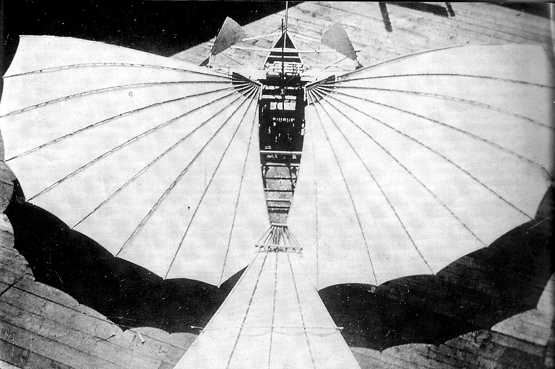
Yes, my Uncle Gustave did fly before the Wright brothers. Jane’s says so.
A German phone number showed up on my cel phone this morning – and in the midst of some work stress (read panic) regarding a web application I am launching next week – I decided to answer it. My family being from Germany originally (more than 100 years ago now), and having visited there in my teens – it seemed plausible that someone from Germany might actually be phoning (as opposed to a telemarketing scam, which mostly seem to come from Quebec and never from mainland Europe).
On the phone was the aviation historian John Brown – and Australian living in Munich – who apparently has been researching my Great-Great-Uncle Gustave’s case for first flight (before the Wright brothers) for some time. For those of you who don’t know, Gustave Whitehead (uncle aforementioned) was a German immigrant to America in the mid 1890s who (after a series of run-ins with the law and cranky neighbours in Pittsburgh and Boston) ended up in Bridgeport Connecticut. It is there, in 1901, that he is said to have flown the first airplane in history – 2 years and some months before the Wright brothers.
While no picture of the aircraft in flight remains, there is plenty of evidence that this flight happened – newspaper reports, eyewitness accounts, and recreations of Whitehead’s plane in the 1980s by Andy Kosch and again by a German group in the 90s which proved it could indeed fly. On the other side are the Wright family and the Smithsonian, with a conspiratorial contract drawn up in 1948 which states that if the Smithsonian is ever to give credence to others who flew before the Wrights, they will lose the famous plane which they have hanging in their aviation museum.
Anyhow – I have a website which documents this history – gustavewhitehead.org, as does John Brown – gustave-whitehead.com if you are interested in reading more about the history, the documentation and the controversy that has raged between the two sides over the past hundred years.
What Brown was calling to tell me in any case is that in its hundredth edition now in print – Jane’s All the World’s Aircraft has included a foreward attesting my Uncle Gustave as the first in powered flight.
This is an incredibly big deal, it turns out. (It took me a few minutes to understand exactly what I was being told). And there are articles coming out shortly in American History and Flight magazines which we hope will carry the same message: The Wrights were not first in powered flight.
Growing up in my family, with the books of Stella Randolph (a journalist who wrote a book about Whitehead first in the 1930s, collecting many of the affidavits that have proven to be invaluable to his case) and family stories floating around – it has never been a question that Gustave Whitehead flew first. Of course it had to be so!
But it’s not a story I share very often just the same because it sounds too “made-up” as my grade 10 social studies teacher told me when he gave me a poor grade on a paper about my not-so-famous relation. Sometimes when there are geeks about my house, I show them my dogeared copy of Randolph’s book from the thirties, and a later book from the sixties as well. But that’s about all. It’s one of those funny-little-facts about the family – and it’s not particularly relevant to anything in my life so it’s not like it comes up very often.
But still! Official recognition from the world’s definitive source on aircraft is exciting! And it was a totally unexpected phone call to be sure (he got my number from the registration for my .org website above). Despite the fact it’s been in the US media, I haven’t seen any stories up here so I would have completely missed this historic moment otherwise.
Apparently there’s going to be some kind of a thing in Connecticut in June and I’m thinking that if it works timewise, and I can get a ticket on points…. hmmm. maybe I might even think about going. Between that and the reunion later this summer, there should be lots to talk about with regards to our family name finally making it into the history books for real.


