Red Cedar
More apocalypse, less angst
Post #2080: Instant Pot breakfast goodies

As promised, here’s the quick skinny on my second set of weekend kitchen experiments — homemade granola and homemade yogurt in my Instant Pot. For those of you who don’t know about the magic of the 7-in-one Instant Pot, I highly recommend you look it up. It works as a electric pressure cooker, slow cooker, rice cooker, yogurt maker, steamer, warmer, and sauté pan all in one – and so far I’ve been very impressed with everything I’ve made in it. More on that later.
This weekend, I decided to get the week’s breakfasts in order by making both granola, and yogurt in the instant pot (but not at the same time!) Recipes and instructions are below – and let me tell you, this makes for one amazing start to the day. Also, given that both of these are multi-hour projects, I give a time breakdown at the bottom that can help you plan for getting this all done in a day for a week’s worth of good starts.
Cherry Almond Granola
5 cups rolled oats
1/3 cup sunflower oil
1/3 cup honey
1 tbsp vanilla
1 cup dried cherries
1 cup raw almonds
1/2 cup pumpkin or sunflower seeds
1/2 cup shredded coconut
Put everything in the instant pot except for the seeds and coconut. Stir. Turn the post onto slow-cook and adjust to high. Leave for one hour. After the machine beeps, add the seeds and coconut, stir and then turn down to low for four hours. After four hours is up, spread the granola in a roasting pan and pop into the oven for about 30 minutes – at 350 – stirring every 10 minutes until the granola crisps up. I didn’t find the slow cooker really got the granola crispy on its own, which is why I think the oven step is necessary. I’ve seen people recommend keeping the lid slightly ajar in order to let moisture escape – but really, the last bit in the oven is pretty straight forward and you can crisp it to your preference. Let cool completely on a cookie sheet and then store in an air tight container.
Instant Pot Yogurt
1 quart of milk
1/2 cup yogurt
Pour milk into the instant pot, press yogurt button and the adjust to boil. Milk will boil in the IP and then machine will beep. Take the inner lining out and allow the milk to cool in it (for about 1/2 hour or so) until it goes down to 115 F. Whisk the yogurt into the warm milk and then put the inner liner back into the IP. Press the yogurt setting again and don’t adjust this time! The IP will automatically set the time for eight hours. Once eight hours is up, the machine will beep and you’ve got yogurt! For Greek style yogurt, you can strain through a cheesecloth-lined strainer for three hours or overnight which will separate the whey from the yogurt and leave you with a really dense and creamy yogurt.
Timing for getting this all done on a Sunday
8:00 am – get the granola going in the instant pot. It will be done and cooling by 1 pm.
1:00 pm – get the yogurt going in the instant pot. It will be done by 10 pm.
Strain yogurt through cheesecloth overnight – in the morning there will be awesome breakfast!
Post #2079: Moosioloi and other kitchen adventures

Yesterday was a bit of a kitchen day – and a playing music day – and an eating day. It was a day at home after a month of mostly being away – and it was sorely needed.
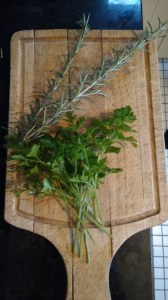
 The upshot of that kitchen day was a number of small experiments – the first being the olive-tasting that I wrote about in my last post. I later fed some of the olives to our friend Jon who came over to teach us about pasta-making and he said they were the best olives he had ever tasted. Real deal!
Then we got onto the pasta making. We had decided some time ago that moose ravioli was a think that should exist in the world. With a freezer full of moose, a pasta roller given to us by a friend, and Jon to show us how to put it all together – we decided that this was the time to make some food magic happen.
I won’t go into great detail here about the process, since there are a million places that you can learn about making stuffed pasta on the Internet, but I will give you the recipe (below) so that if you happen upon some ground moose (or venison, or beef) you can replicate the amazingness that was our pasta dinner.
The finished produce looked like this – not the prettiest thing I have ever made, but one of the tastiest by far:

We served this alongside pickled beets, a salad of greens, apple, and almonds, a tuscan bread and a nice chianti. All around fabulous food experience!
Moose Ravioli
Pasta Dough:
3 eggs
2 cups of flour
1/2 teaspoon salt
water if necessary
I do my dough in the Cusinart with the dough blade so I can only do a batch as large as this at a time. Basically, you throw all that into your food processor or breadmaker and churn until it forms an elastic and non-sticky dough.
We made two batches of dough which would feed 5-6 people (or 4 very hungry people and our dog).
Moose Filling:
4 cloves garlic
1 onion
1 pound moose meat
1 moose sausage (which gives a bit of fat and flavour)
1/2 cup blue cheese (or more if you like)
1/4 cup pine nuts
1/2 a bunch of Italian flat-leaf parsely
Saute the garlic and onion, then brown the meat. Once the meat is cooked, crumble the blue cheese into the mixture along with the pine nuts. Stir and season to taste. Add the parsely near the end. We added a lot of blue cheese which meant we didn’t need any additional salt, but fresh ground pepper bumped the whole thing up.
This filling recipe is enough for two batches of the dough recipe above.
Sauce
1-2 cups Tomato sauce
Fresh rosemary (to taste)
We used the tomato sauce that we canned this summer and added about a 1/4 cup of fresh rosemary from the garden to it. You don’t want the sauce to overwhelm the plate, so just make enough to coast the pasta.
Once the pasta is made, and then cooked, toss it in the tomato sauce and serve with parmesan cheese.
And delish! If you have a chance at some moose this season, and an afternoon with friends – this is a great social activity and meal rolled into one.
Next post? Homemade granola and yogurt – the second part of yesterday’s experiments.
Post #2078: Report back on the olive experiment
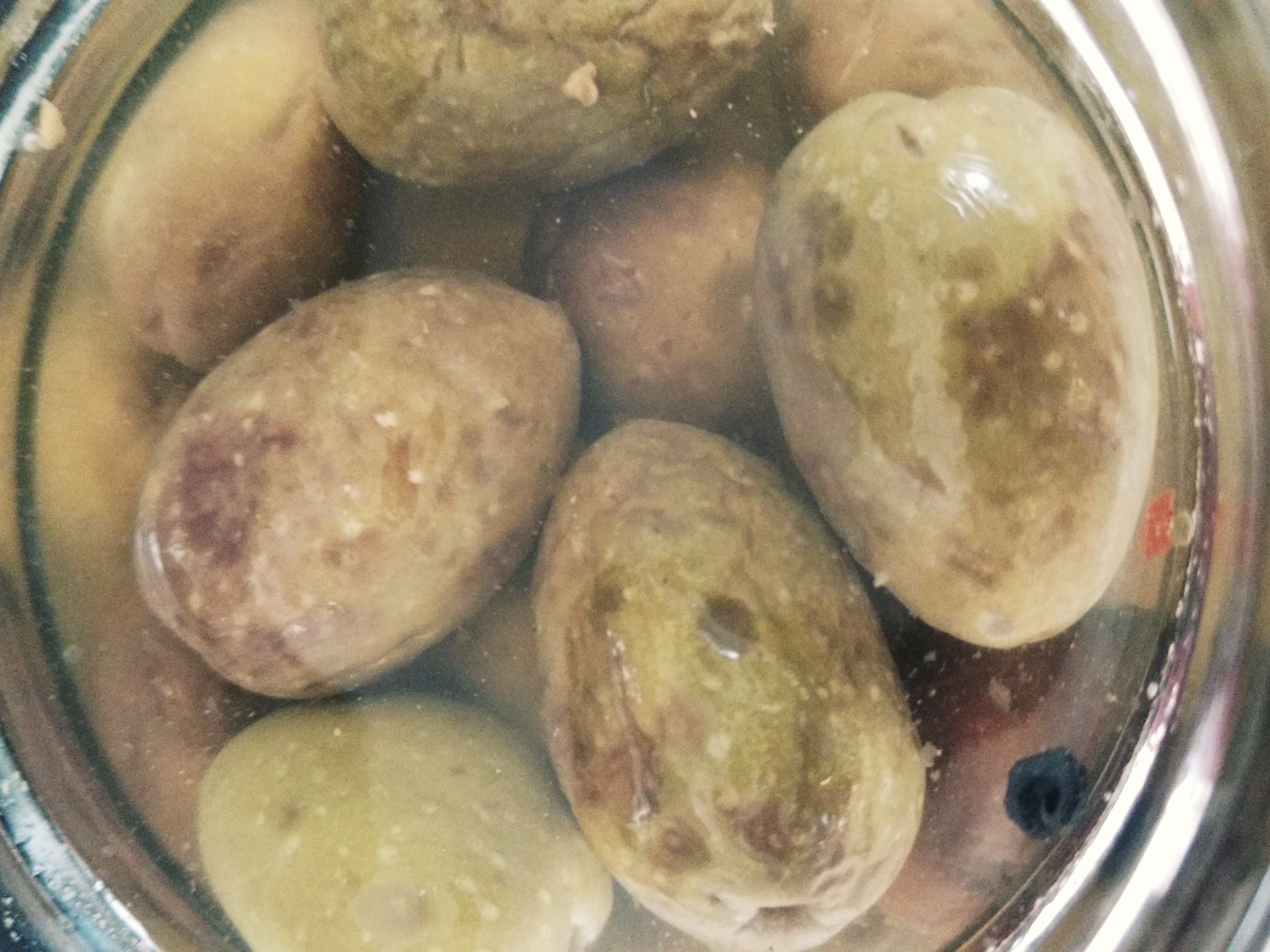
Remember how I bought ten pounds of olives back in September – and I wasn’t really sure what to do with them or how they would turn out? Well. I’m glad to report that the water-cured olives have so far turned out great, and the brine-fermented olives seem to be doing their thing. Here is the blow-by-blow on what I think about each:
Water-Cured: Cracked
 Besides lye-curing, the quickest way to cure olives is by water curing them. This involves breaching the flesh of the fruit and then soaking them in water for up to a month, changing the water each day. This leaches the bitter oleuropein out of the fruit, and once that is done, you can cure the olives in brine.
One way that you prep olives for water-curing is by cracking them with a back of a spoon – you don’t want the pits to come loose, by you do want to create a split in the fruit so the water can do its work. We transferred these olives from the water to a herb-brine at the end of October and started eating these about two weeks ago. Here is what my cracked olives look like now, two and a half months after I started the process:
By far, this is the quickest fermenting method as the smashed olive allows for a lot of “flushing” to happen in the water cure. Also, these olives pick up the brine flavours quickly (after four days in the brine they were edible). On the downside, the smashed olives seem to be degrading relatively quickly and they are softer on the inside than I would like. We have eaten close to half of the jar, so that’s fine – and I’m thinking of turning the rest into tapenade.
Water-cured: Cut
Everyt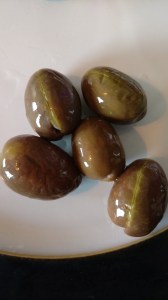 hing about these olives is the same as above except instead of smashing them, I took a paring knife to each one and made an incision. They look much nicer as a result, and they have held their firmness since being transferred into the fridge. They are certainly more bitter than the smashed ones, but not unbearably so and I think the slight bitter taste gives them a bit of kick. This combination with the brine makes for a very edible table olive, and truly – these can be ready in as little as six weeks. I just broke these open for eating today though and I do think the extra month in brine really makes a positive difference.
Brine-Fermented, Unbroken
 These olives have also been kicking around in the curing process for two and a half months, but unlike the water-cured olives they still about about two and a half months to go. Brine fermenting leaves the olives intact, but takes much longer to cure them. You can see from the picture that the olives look a lot more “whole” and less degraded than the split examples above (the photo at the head of this article is of the brine-fermented olives you see on the plate here. Although I know these are far from ready, I did brave a taste today – I couldn’t help myself really since I was photographing after all. And though these are still on the not-as-edible side of bitter – they are actually ok, as in they don’t make you gag from the astringency. I definitely want to leave them until the new year – but by far these had the strongest flavouring from the brine, plus they are as firm as ripe olives can be with no degradation of the flesh at all. I don’t think these olives fermented as actively as I would have liked in the beginning, but still they seem to be well on their way to becoming an edible thing.
Overall I am quite pleased with the olive experiment so far and have no problem serving the water-cured olives over the holiday season. That means that when olives come into Vancouver in early fall, there is plenty of time to cure some up for Christmas gifts with the water-curing method. Though cutting is more work, I think that I prefer this over the smashed olives because it leaves the fruit with better consistency over time – but if you don’t mind a softer olive, or want olives for tapenade, the smashed route leaves them less bitter.
I’m really looking forward to the brine-fermented olives in the new year – and I highly recommend trying this out when you have fresh olives available. I can easily see doing double the amount next year and putting together some Christmas gifts of small jars of olives to give away with the other seasonal treats.
Post #2077: Knowing the flowers

On Saturday, I drove up to the cabin with one of our land partners so we could drop off a loveseat that we got for free from someone in the city. It was a quick trip up and back on the same day, but we wanted to get in there before more snow hit the ground. Although it’s pretty bare in Princeton at the moment, the hills around and the elevation our place is at has definitely seen some cold temps and precipitation. There was just enough that I could take my showshoes for a spin up above our place, following the trail that Brian and I flagged in the summer.

Now the we have the cabin really underway, I am starting to know the landscape around our lot. I’ve taken up my plant guides for the interior, and started to photograph what I think might be edible for further verification. We’ve found the moose wallows, and noted the tracks of various animals – including snowshoe hare on this most recent trip. We’re cutting old trails back into place and following ones made by the deer. It’s a process – to really know a place deeply – and one that I feel is just beginning for us after two years of hanging around this place.
At the zen-do on Sunday, we talked about the climate change summit, and a poem by Gary Snyder was read. The last three lines of the poem sounded:
“stay together
learn the flowers
go light”
And it brought me to thinking about this long process of getting to know a place – to “learn the flowers” and how the transience of our current society makes it very hard for us to know places deeply enough to care for and caretake them. Some of that transience is forced – as in the migrations out of the Middle East right now – but in the North American context there is a sense that to be transient is to be free. And freedom is of high value in our context – thus to be tied down, to know a place, to live in a grounded and rooted way is to be unfree and that is deeply unhip.
But if we don’t know the flowers, follow the animal trails, learn the parts of our landscape which sustain life – then how can we in turn sustain more than just lifestyle?
I expect that is in effect the difference that this hinges on – we value lifestyle over life, and confuse the two in the process.
I don’t have a punchy way to finish this post – the thoughts are still in formation as I type and I’ve just flown across the country to attend a week of meetings in Ottawa. And that speaks to my own issues with status and lifestyle that are too much to get into right now.
So – to being grounded, placed, rooted, and a little bit stuck – I am increasingly of the mind that this is the only way we are going to get out of the mess that we are in. Dig in, plant a garden, watch the seasons rise and fall.
Post #2076: Fall turning winter.
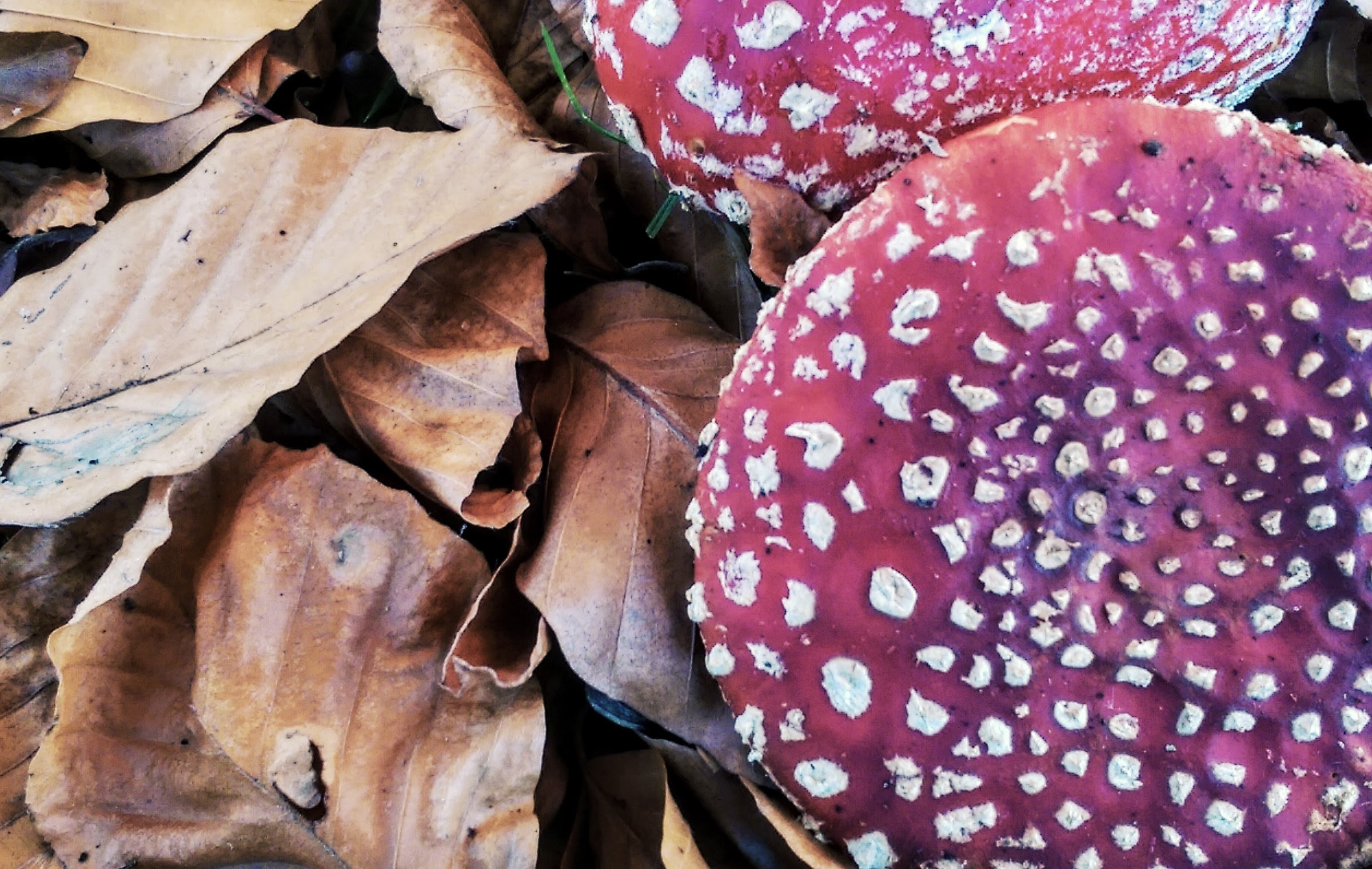
It’s crisp here, and I’m in between trips east – trying to catch up and plan all at once. So I leave you with a photo from my neighbourhood walk on Saturday. More shortly.


 Red Cedar