Red Cedar
More apocalypse, less angst
Post #3297: DIY discomfort

(If you are reading this via email – note that there are photos on the blog that show the before/after of our project).
Since moving into our house seven years ago, re-doing the downstairs bathroom has been on the agenda. I don’t think it’s been touched since the house was built in 1998, and no matter how hard I scrubbed it never looked clean. The floor was dinge-grey, the bathtub surround yellowed, and the vanity counter marked with some stain I couldn’t remove.
In the spring we chose and ordered new bathroom components (except the toilet which is relatively new and in good working order) and then waited for a window with no visitors to get going on our little project. We started immediately following a community emergency planning meeting at our house on the 20th, which makes it eight days since we started tearing everything out.
Neither Brian or I have any DIY-renovating experience at all, which means that we have both watched a *ton* of online tutorials in the last week. I am very thankful for the home contractors of YouTube for all the demonstrations and advice thus far! From them I have learned so many things such as how to:
- remove a tub drain and remove all other bath/shower hardware
- demo a bathroom piece by piece (which included taking a sawzall to the bathtub surround – terrifying but effective)
- cap off water lines
- test electrical lines and circuits on a malfunctioning hot water heater
- lay sheet linoleum (Brian did the measure and cut)
- patch seam lines in lino with “hoofer doofer”
- remove iron bacteria from toilet tanks
Brian has also learned how to remove and re-install a toilet, and we both learned some new things about how our house is wired.
Basically, we’ve both been operating in a place of total discomfort since we started this project, and yet we have gotten so far in just a few days! We have gained more skills to move onto other renovation projects as well as home repair issues. The upstairs tub needs a new drain, the shower in my studio needs replacing – we are now comfortable taking on both of these jobs in addition to reno-ing the laundry room.
The next stage of the bathroom involves a plumber, as we are not confident about working with the jogged copper pipe (which we hope to replace with pex), not to mention the replacement of a hot water heater with no shut off valves and that was soldered at all the joins. After that we’ll re-commence the discomfort as we cut and fit drywall around the new shower installation, and get baseboards back in place. If our plumber is able to get to us this week (he is coming to scope it out today), we could be finished this project by Labour Day. That includes an insert for our linen closet that my dad volunteered to make for me and is bringing up on the weekend.
I am attempting to take this diy-discomfort energy into the fall as I re-engage with the book I started writing in the spring of 2022. It’s a completely different kind of work but the same lessons apply: 1) discomfort leads to growth 2) doing a little bit every day gets the job finished, and 3) if the worst thing you do is cause a power surge that fries your hot water tank element – it’s not the end of the world. Okay, maybe the last lesson isn’t totally applicable, though it does serve to remind me that writing a book is a lot safer than taking a sawzall to anything.
I’ll post here with the finished bathroom pics, and also about the book progress as it unfolds.
Post #3296: Sesshin Return
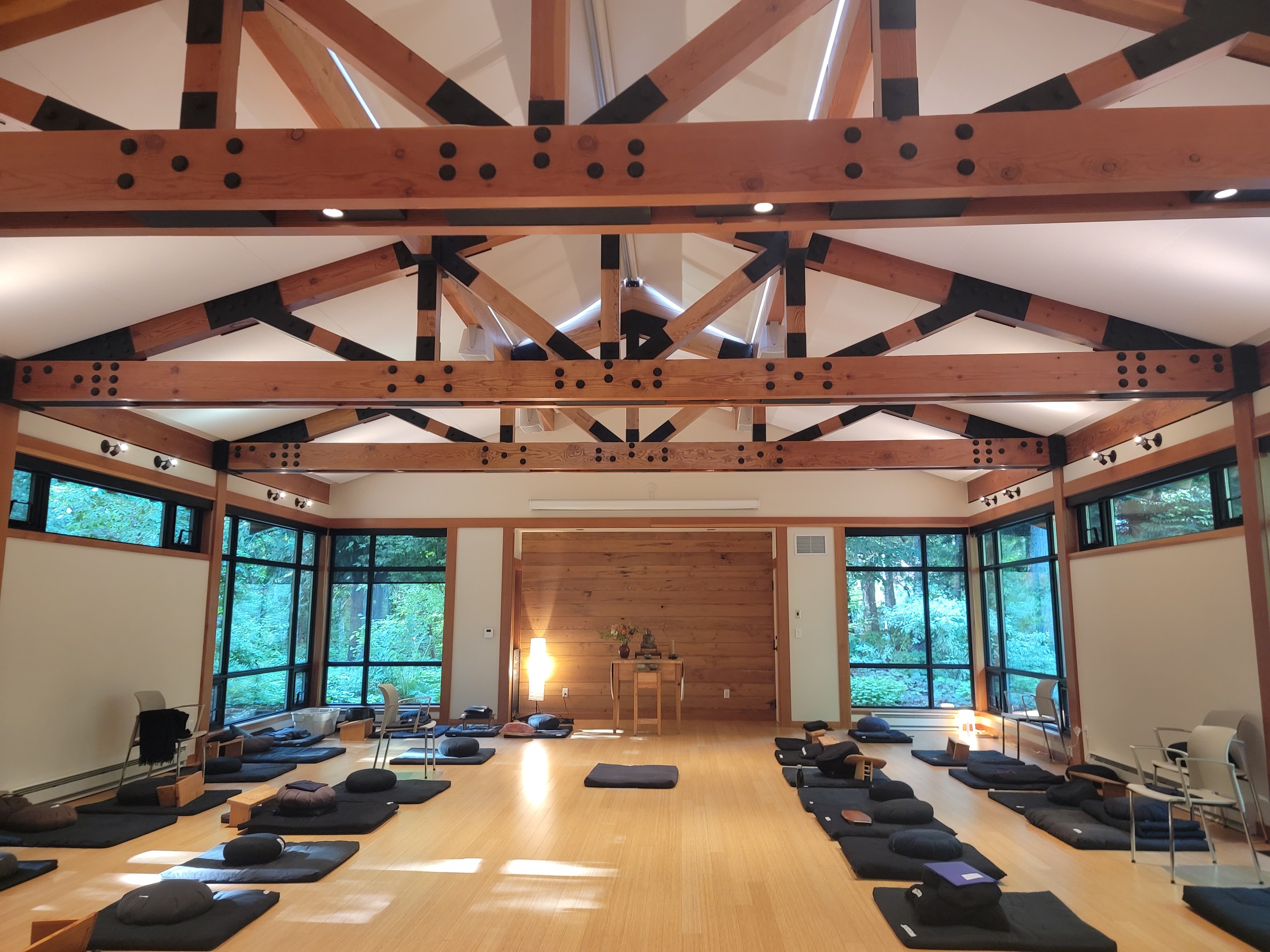
On Saturday night I returned from a 7-day Zen Sesshin in the mountains outside of Squamish. This was my 7th sesshin since I started practicing with my Zen community 10 years ago, but my first in-person retreat in over 3 years due to covid.
Sesshin is an intensive residential meditation retreat with a focus on monastic Buddhist practice. It includes many rituals to encourage full immersion in meditation, even during meals. Participants rise at 5 am and go to bed at 9 pm, and there is little “free” time during the day. At a regular sesshin, at least 8 hours per day are spent in the zendo (meditation hall), with the remainder spent at meals, in work practice, or taking short breaks for rest practice.
A sesshin removes one from regular daily life to allow for full engagement with meditation. It is sometimes liberating, occasionally illuminating, and always exhausting. Though it is not really the blissful/restful experience most people associate with the idea of a meditation retreat, it is always a heart and mind-expanding exercise for me, one I’ve really missed over the last few years.
I had big plans for my drop back into regular life (writing, working out, seeing friends) as soon as I got home, but on Sunday night I came down with a cold (likely picked up on the packed ferry). Though it’s a relatively mild illness, it’s put the brakes my return somewhat and allowed me to preserve a lengthened period of quiet. I went into a pretty altered state towards the end of sesshin, and I’m not sure that I’m fully reintegrated even now, so I think that having my roll slowed a bit is a good thing.
Although the forms are always the same (we sit, we walk, we chant, we eat – all together all the time), each sesshin has a totally different character depending where you are at when you arrive. While preparing to go, I thought I would spend a lot of my time on the cushion unpacking the last few hellish months and it would be a heavy retreat, but instead I was treated to the running hamster wheel that is every inconsequential thought I’ve ever had and found the letting go of them one after another to be the simple whack-a-mole of observing one’s thoughts. On the other hand, my sleep got very strange and started to blend seamlessly in with meditation practice (I would wake in the night frequently, already in a state of meditation or thinking I was). Although I slept very little, I was never actually mentally tired, though physically I would hit the wall every once and awhile and need to lie down. I’ve always slept quite deeply on retreat, but I do understand that this kind of wakeful non-sleeping is common enough and was in no way unpleasant.
It’s so hard to describe what sesshin is like, and as I say it’s different every time. But “feeling all the feelings” is an apt way to describe a week of silent observation. One thing that always trips me out is looking around at all the other people and knowing they are having their own roller coaster of experience right alongside me no matter how they appear to be getting along. I’ve never met anyone who didn’t have a whole lot of big feeling-self during a retreat like this, it just goes with the territory.
This was not a retreat of big catharsis for me, nor was it full of internal promises to “do better” or “be better” – but I did come away with more thoughts on a question about my spiritual path that has been open for awhile. I’m going to rest more with that question and the answers that are forming, but this retreat was a confirmation of how much this practice continues to resonate whether I’m on an intensive retreat, or sitting for my daily practice in the tiny Zendo at Birdsong.
Post #3295: A decade of cabin-building

For the first time since September 2021, Brian and I spent the past few days at our cabin outside of Princeton. Since the last time we were here, our cabin co-owners have done a bunch of work including hanging kitchen cabinets, some interior painting, and laying flooring on both the main and loft levels. The interior bathroom is now finished and the hot-water-on-demand is working as it should so we can have hot showers for the first time! From a piece of bare land with a collapsed cabin bought in 2013, it feels miraculous that I should be here now, sitting on my deck, having just enjoyed the convenience of a kitchen with countertops and the comfort of a flush toilet.
We realized yesterday that it’s been exactly ten years since we first came to look at this piece of land with our friend Leung – skipping a Monday of work to drive up and back from Vancouver to scope out the cheapest piece of usable land we’d found within four hours of the city. It was a tax sale with a history it turned out, and because it was so inexpensive and far out of town, the realty company had not bothered to drive out to put a sign on it. This made it difficult to locate from the landquest.com descriptions, but it also meant no one in the area knew it was for sale. By the time the week was out, we had an accepted offer for $34k, and another friend had come on board for the land purchase.
We have been building a cabin here ever since, starting that summer by hand-clearing a bunch of land and building an outhouse (which doubled as a lockable shed) as our base of operations. We hired builders and other professionals for the main work, but much of the finishing has been done via work parties, including a rustic outdoor kitchen, deck railings, indoor railings, kitchen finishing and more. We are pretty close to final inspection now, though given our pace I expect that won’t happen until next summer. Flooring on the stairs and trim are the final hurdles, and we all know how long trim can take to get around to.
Those of us who initially came together on this project did so because we wanted a place outside of the city to get away to – a hunting cabin, a place to escape the garbage-scented summers of city life, a stretching-out spot in the world. Partnering was the only way any of us could afford such an enterprise, and we have built at the pace we had money to do so (one of the reasons it has taken so long). Not only have land partners been the right choice in terms of finances, but we have each shouldered different parts of the work over the time we have owned together. In the early years Brian and I did a ton of the upfront work to get the cabin permitted – built, insulated, and drywalled. We also arranged the well drilling and the initial septic consultation. Our longest-term cabin partner Leung has carried out all of the finishing work on his own or with friends, and is the only one of us who uses a chainsaw (an essential skill in an eternally-dying pine forest). Our most recent cabin-partner Lisa (who bought out our initial co-owner Dave 7 years ago) has a partner with professional painting skills – and a mom who makes gorgeous quilts – adding more elements to our cabin mix.
When Brian and I moved to Gabriola, there was a bit of a question about whether or not we would keep our share in the cabin. But as we had only owned the land for three years and didn’t want to let our partners down, we figured we would at least finish the building before making a decision. Over those intervening seven years, I have questioned why we were holding onto the cabin project many times – especially when we faced challenges around well-drilling and septic installation – but ultimately Leung would talk me through my misgivings and we would stay in for another year.
It’s often been pointed out that owning two rural properties (our home and the cabin) doesn’t make much sense as we no longer pine to get away from where we live, plus have a two-ferry hurdle to get here. But there are many different kinds of “rural” in the world, and there is a big difference between Gabriola (rural-residential with direct float-plane access to Vancouver) and Bankier, BC (hundreds of kilometres from any city). It isn’t the end of the road up here, but feels pretty close. Besides that, the cabin isn’t “home” with all its attendant pressures, nor have we developed any kind of a social life up here – which means our time here is unstructured and free.We sleep in, read books, drink tea and go for walks. When the weather is warm there is swimming. Sometimes a pancake breakfast at the firehall. It’s pretty relaxed in other words.
Now that the cabin is near-finished, it’s much easier to spend time in. It will be even more so when we get some proper furniture which we’ve been holding off on all these years. At present, the only “comfy seat” is a beaten up loveseat that has a broken leg. I plan to bring a desk and chair up this fall, since I’d like to start working from here periodically, and our cabin partners have started scoping out a better couch (preferably one that can double as a bed). We will likely put a second bed in the loft, and get a better dining table than the patio furniture we are currently using – but given that we only have a 600 feet square down, 200 in the loft, we don’t have a ton of space to furnish.
We have stayed away so long due to floods, fires, and ferries – but these last few days have been a reminder of how much I love this place and surrounding environment (the ranch land drive in is the most beautiful thing I know in this world). I’m reminded that it’s worth the effort to get here, and also the effort it’s taken over ten years to get to this place on the deck where I write from now.

Post 3294: Drawing practice

A big part of my personal story is that as a child I learned early on I did not have the skill for drawing or other visual arts. This was evidenced by a note on my Kindergarten report card which read, “Megan lacks hand-eye coordination when using scissors,” and was proof enough in my family that my skills were to be found in other areas, such as writing and playing the violin. At the time, my parents believed that one best work with our natural proclivities rather than spending too much time on skills where we showed poor aptitude.
This never felt like a big deal to me. As a child with a mercurial temperament I was frustrated by things that did not come easily. Drawing and painting fell into that category – I had a hard time even colouring inside the lines on pre-printed sheets – so it didn’t seem much of a punishment to be deterred from spending time making art. My brother had more natural talent for drawing and so he got to be the artist; I got to be the writer/musician, and thus our family roles were set.
For all of my life until I turned thirty, I did not make art unless I was forced to in school projects (which always turned out miserably). I did pick up a few technical skills in my twenties, teaching myself how to cross-stitch using patterns from books, and learning how to use a sewing machine, but it wasn’t until I started quilting and sewing in my early thirties that I started to explore a bit more. At that point, I still believed that I would never effectively learn how colour or composition work because of my innate artistic deficiency. Even though I knew from years of making music, that the key to learning most things is practice and repetition, I saw art-making as separate and somehow related to genetics or inborn skill, and thus inaccessible to me.
*
One of the substacks I love is Draw Your World by the very talented Samantha Dion Baker. As someone with no skill for drawing, I am mesmerized by those who can turn a few lines into something meaningful.
In February, right around my 50th birthday, I won a draw via Samantha’s Substack (exciting!) and she mailed me a set of Derwent watercolors and a set of water brushes. At the time, I figured I would use them for application on textile, as I do occasionally use watercolors on fabric when making a textile piece. I was very grateful for the gift.
Not long after that I started taking a local, in-person workshop called “The Healing Power of Art” which has encouraged me to take up a kind of meditative drawing on a semi-regular basis over the last few weeks. Nothing figurative, with no intention to make “art”; I journal a bit, and then I draw a bit, sometimes incorporating a phrase that comes out of my writing.
It might look something a bit like this:
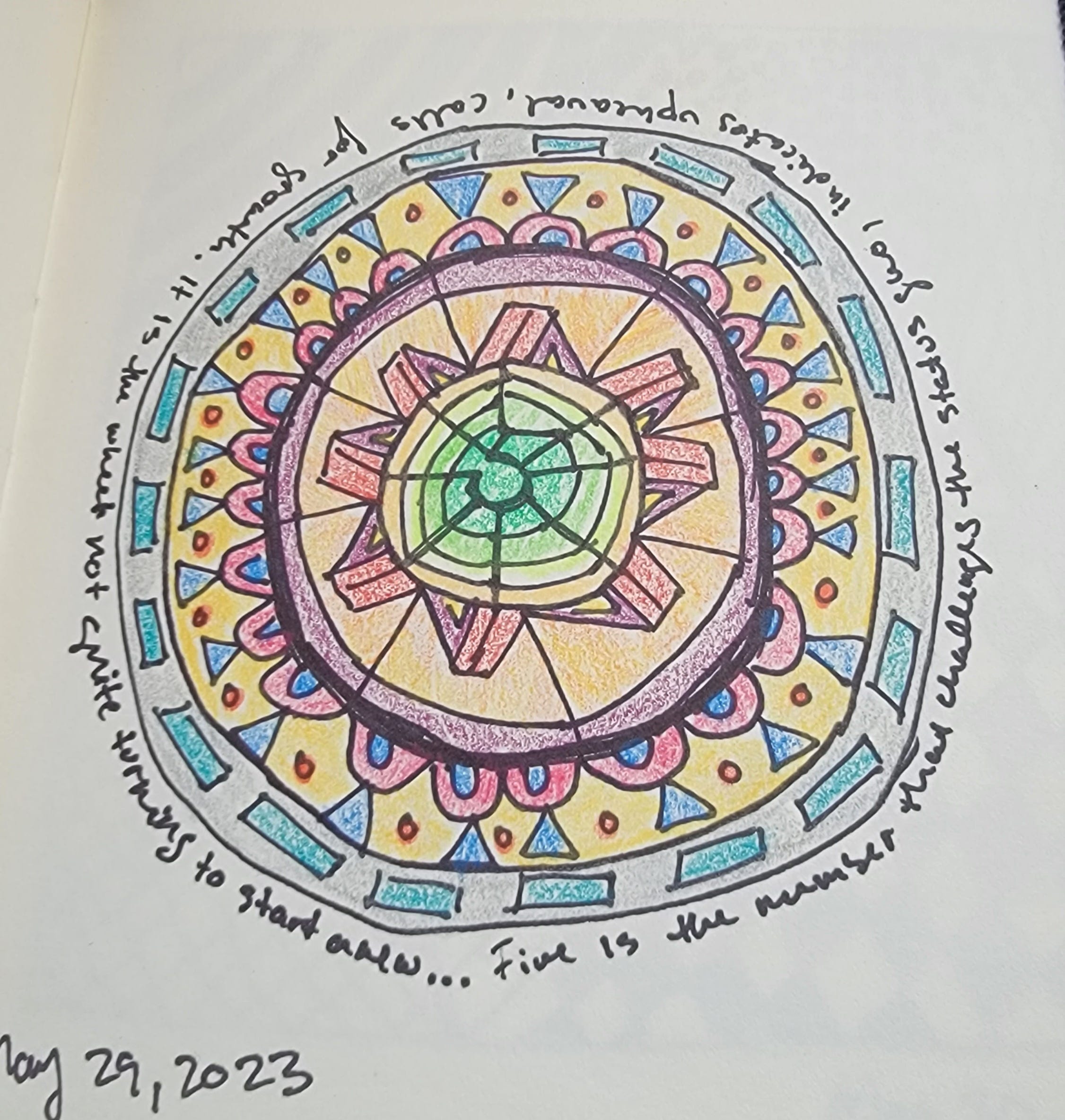
As you can see, there is no sophistication here. I draw like a six-year-old (likely because I stopped drawing entirely around that time of my life). But my total lack of skill allows me to turn off the inner critic in a way I don’t with pretty much anything else. The act of drawing gives me a period of focus, and no expectations leaves me pleased with almost any result.
All this recent drawing reminded me of the watercolour set in my drawer, and that in turn reminded me of Samantha’s book Draw Your Day which was sitting in my studio “to-read” pile. In it, Samantha encourages a practice of visual journaling, using drawing, watercolour, and collage techniques to make a record of the day. Her Instagram, books, and courses are full of positive affirmation, technical tips, and inspiring artwork – and somehow I’ve found myself yearning to learn how to draw figuratively, at least a little bit, so I can add some colour and texture to my written journaling practice.
Over the years, I have collected up good pencil crayons, pencils, waterproof pens, and ephemera for collaging because the impulse to draw and decorate has been there for a long time. I didn’t have to invest in any supplies to get started when I decided to get over myself and just start practicing!
It’s been ten days of daily drawing practice and so far what I’ve learned is that I really *don’t* know how to draw. That is, I struggle with looking at an object and knowing how to represent it in lines and colour. My pencil strokes are not confident, I can’t freehand a circle to save my life, and perspective is an elusive concept. However! I find the practice completely absorbing (an hour or more can go by and I barely notice), my drawing has improved a little in just a few days (easy when there is so much room for improvement), and I’m learning to see my world differently as I move through my days looking for basic stuff I can draw. I’ve realized it’s much easier if I draw from an object or photo, rather than from my imagination – so I snap a lot more pics with my phone during the day to keep as a reference. And I’ve discovered so many “how to draw” YouTubes, and Skillshare courses on lettering, drawing and watercolouring, that learning some basics is practically free.
Most importantly for learning is that I have become a bit obsessed in the last couple of weeks – which is what it takes for me to put other things aside and pull out some paper. I don’t have big expectations except that I learn to express myself visually for my own enjoyment – and I’m finally at a place where I can drop the baggage that has weighed me down in this area for so long.
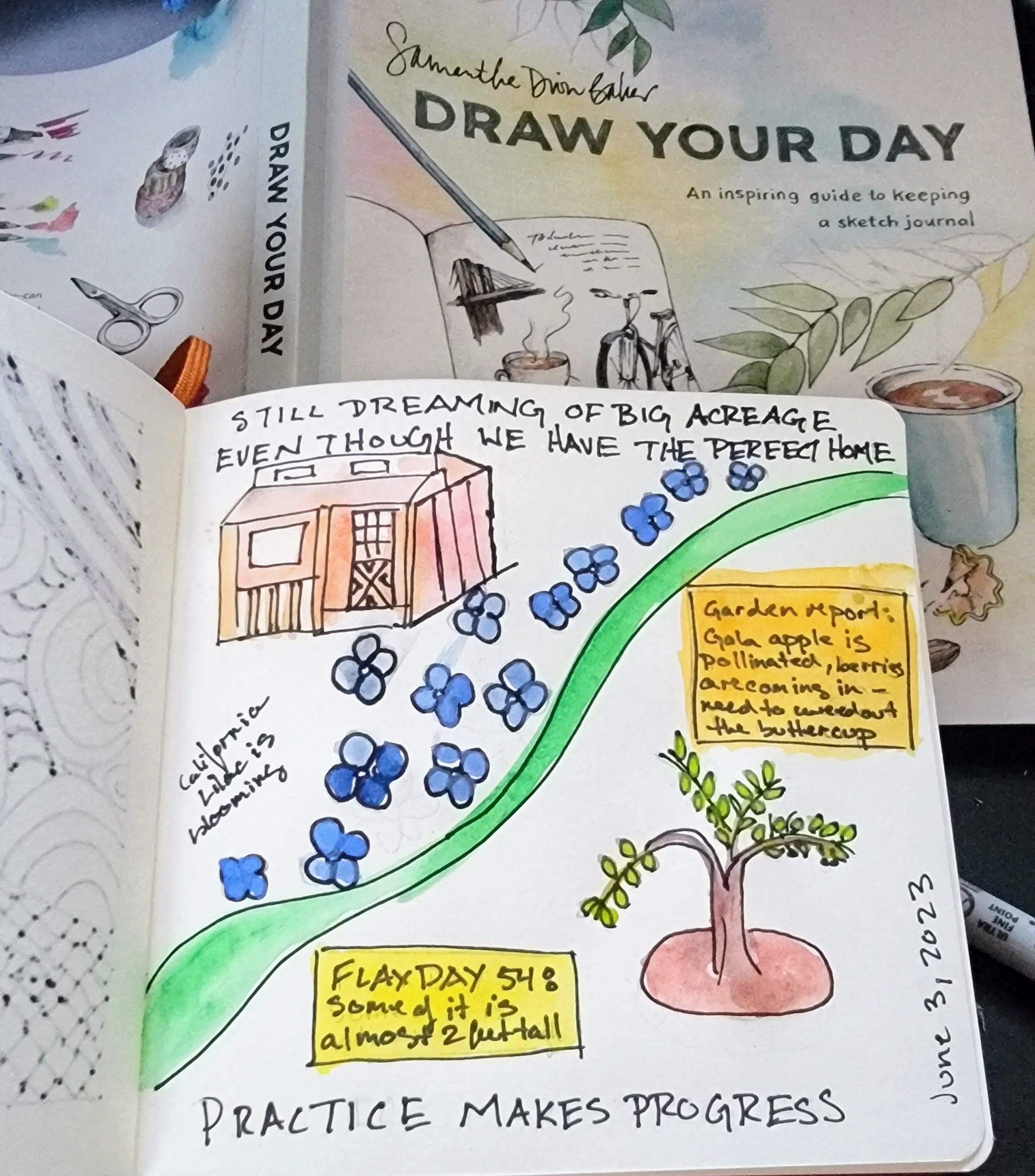
Below is my first attempt at a “Draw Your Day” page which I have followed up with other kinds of sketch and journaling exercises. This is such a portable practice that I plan to take it on the road over my summer holidays to see what comes of it.
Post #3293: Changing the lock
I feel like my “real life” has been on pause the last couple of months. Between a very difficult tenancy situation in my parents’ home (and by difficult, I mean that police intervention was required repeatedly as the tenants harassed and attacked my elderly parents), and perimenopausal symptoms that have seen a real uptick since turning 50 — I have been a bit of a wreck. Frozen at times, hyper-reactive at others; it’s been a roller coaster ride of reactions lately. Fortunately, the most acute situation (the tenants) was fully resolved this week and my brother and I changed the lock on the suite Wednesday. It’s remarkable how much my mood has lifted in just the last 48 hours.
Pretty much as soon as I got home on Wednesday night I started to drop back into the normal routine of my life – getting into my studio and finishing up some yarn that had been languishing, yesterday I wove two napkins on the small loom, and started plotting out my next weaving projects. This morning I found myself thinking about rebranding this dormant blog, or possibly another writing project. Though I am still exhausted from the last few months, my creative life seems much more do-able again.
I’m going to be careful though, not to take these signs as license to start a million more things right now. I’m making a pact with myself to get some studio work finished over the next couple of weeks, and then we’ll see about new projects over the summer. My theme for 2023 is “Making Do” which is something I landed on after realizing that task lists and daily goals just weren’t working for me anymore – so I’m going to continue to touch base with that – working with what I have at hand and taking things slow as I continue to recover from my period of perpetual anxiety.
The immediate resurgence of energy and interest has been a reminder of something I recognized after the whole work debacle last spring (when I quit a work assignment due to toxic dynamics and unrealistic work expectations). That experience taught me that no matter how on point you are with all the practices – creativity, exercise, meditation, eating healthy, etc. – they can only do so much for you when the stress valve gets turned onto high. When big stressors like high stakes conflict, abuse, or violence are present, the goal should always be to get away from/bring an end to the situation, not to find new ways of tweaking our psychology or spirituality in order to tolerate it.
There are, of course things that we can’t escape from, like perimenopause and past trauma – things we have to face head on using all of our skills and practices. Since changing the lock on Wednesday, I’m a lot more free to work on those things since I’m not getting out of this body anytime soon (knock on wood). So onward with the healthy practices! Not to mention the therapy and journaling. I’m just glad to be back in myself a little bit more as this week closes out.


