Red Cedar
More apocalypse, less angst
Post #3293: Changing the lock
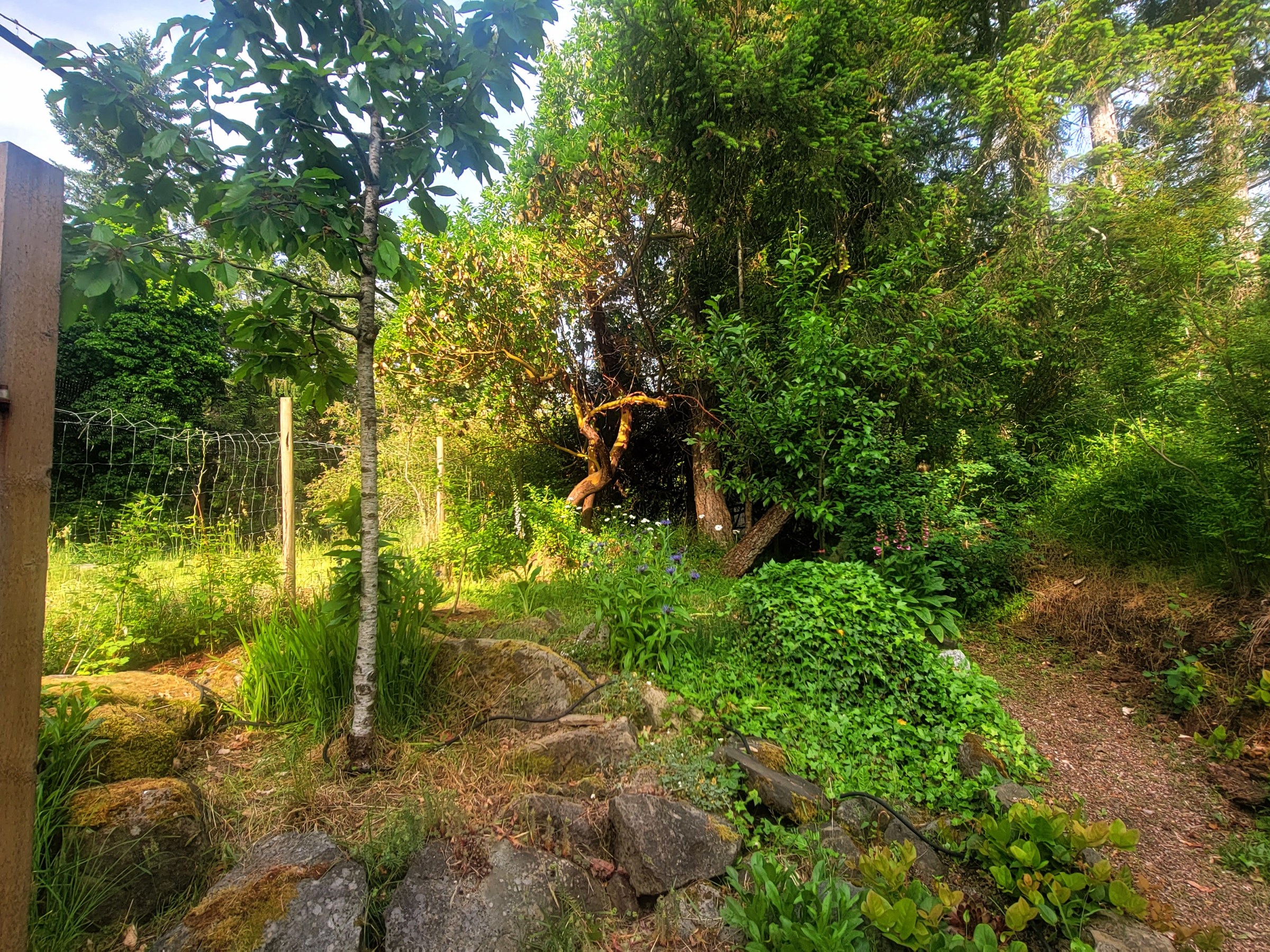
I feel like my “real life” has been on pause the last couple of months. Between a very difficult tenancy situation in my parents’ home (and by difficult, I mean that police intervention was required repeatedly as the tenants harassed and attacked my elderly parents), and perimenopausal symptoms that have seen a real uptick since turning 50 — I have been a bit of a wreck. Frozen at times, hyper-reactive at others; it’s been a roller coaster ride of reactions lately. Fortunately, the most acute situation (the tenants) was fully resolved this week and my brother and I changed the lock on the suite Wednesday. It’s remarkable how much my mood has lifted in just the last 48 hours.
Pretty much as soon as I got home on Wednesday night I started to drop back into the normal routine of my life – getting into my studio and finishing up some yarn that had been languishing, yesterday I wove two napkins on the small loom, and started plotting out my next weaving projects. This morning I found myself thinking about rebranding this dormant blog, or possibly another writing project. Though I am still exhausted from the last few months, my creative life seems much more do-able again.
I’m going to be careful though, not to take these signs as license to start a million more things right now. I’m making a pact with myself to get some studio work finished over the next couple of weeks, and then we’ll see about new projects over the summer. My theme for 2023 is “Making Do” which is something I landed on after realizing that task lists and daily goals just weren’t working for me anymore – so I’m going to continue to touch base with that – working with what I have at hand and taking things slow as I continue to recover from my period of perpetual anxiety.
The immediate resurgence of energy and interest has been a reminder of something I recognized after the whole work debacle last spring (when I quit a work assignment due to toxic dynamics and unrealistic work expectations). That experience taught me that no matter how on point you are with all the practices – creativity, exercise, meditation, eating healthy, etc. – they can only do so much for you when the stress valve gets turned onto high. When big stressors like high stakes conflict, abuse, or violence are present, the goal should always be to get away from/bring an end to the situation, not to find new ways of tweaking our psychology or spirituality in order to tolerate it.
There are, of course things that we can’t escape from, like perimenopause and past trauma – things we have to face head on using all of our skills and practices. Since changing the lock on Wednesday, I’m a lot more free to work on those things since I’m not getting out of this body anytime soon (knock on wood). So onward with the healthy practices! Not to mention the therapy and journaling. I’m just glad to be back in myself a little bit more as this week closes out.
Post #3292: Seeds and stuff

Here we are, right on the vernal equinox – and just like that the neighbourhood is full of bird and frog songs. The serenades started a couple of weeks ago, baby birds first, the frogs joining in about a week later. Such welcome sounds after late snowfall this winter. This morning there is rain, but also the strong scent of ocean in the air, the gulls were squawking well before dawn making me wonder if there is something dead on the beach they were excited about.
I’ve been pruning trees and moving plants around in the garden a bit as I start to orient myself outside again. The rhubarb was not thriving in the spot I planted it three years ago, so I’ve moved it into the orchard which left a patch of acidic soil open to move the struggling blueberries into. I’ve got some dye seeds in the planting tray, and flower seeds to sow outdoors (hollyhocks and sweet peas – both of which I need more of in my life). It’s really just puttering at this point, but pretty soon we’ll have to get serious about the yard again.
I’ve been a bit mentally absent from things these last three weeks, owing to an epic issue going on in another part of my life (not health-related, I’m fine – just stressed). Because my life normally hums along in a drama-free way, and I do lots of meditation and exercise to help keep things stable, I had forgotten how much acute stress acts to separate the self from the body (the chemical flooding, racing heartbeat, and dissociative states). It’s made it impossible to write anything other than my handful of daily instagram words, and I haven’t been very good at keeping up with anything not immediately in front of me.
As a result, some issues I thought were long resolved have returned. Fortunately I know that can be helped with a bit of therapy, so I’m figuring that out right now as well as doing what I can to alleviate the actual situation that created this chain effect in the first place. It’s been a trying time, all round, though I recognize how well-resourced I am, including having a very supportive life partner who pulls out all the stops in our life together.
I’ve got a new warp on the loom as of last night – napkins with squares of texture which you can see in the photo above. I’m not sure about my colour choices after the soothing blues I was working with last month, but I think when these are finished they will work and I do love the combinations coming out in the weave. Working with my hands is one of the things that calms me most, the project-oriented nature of functional work brings me immense satisfaction, whether that’s weaving a domestic item or winding a ball of yarn.
I’m not sure how to close this off except to say I’m still out here, doing my thing, and working through the stuff that needs to be worked through. More soon when the writing returns to me – and happy equinox to all! May your days unfold with grace as the season transitions to warmer days!
Post #3291: Notebooks
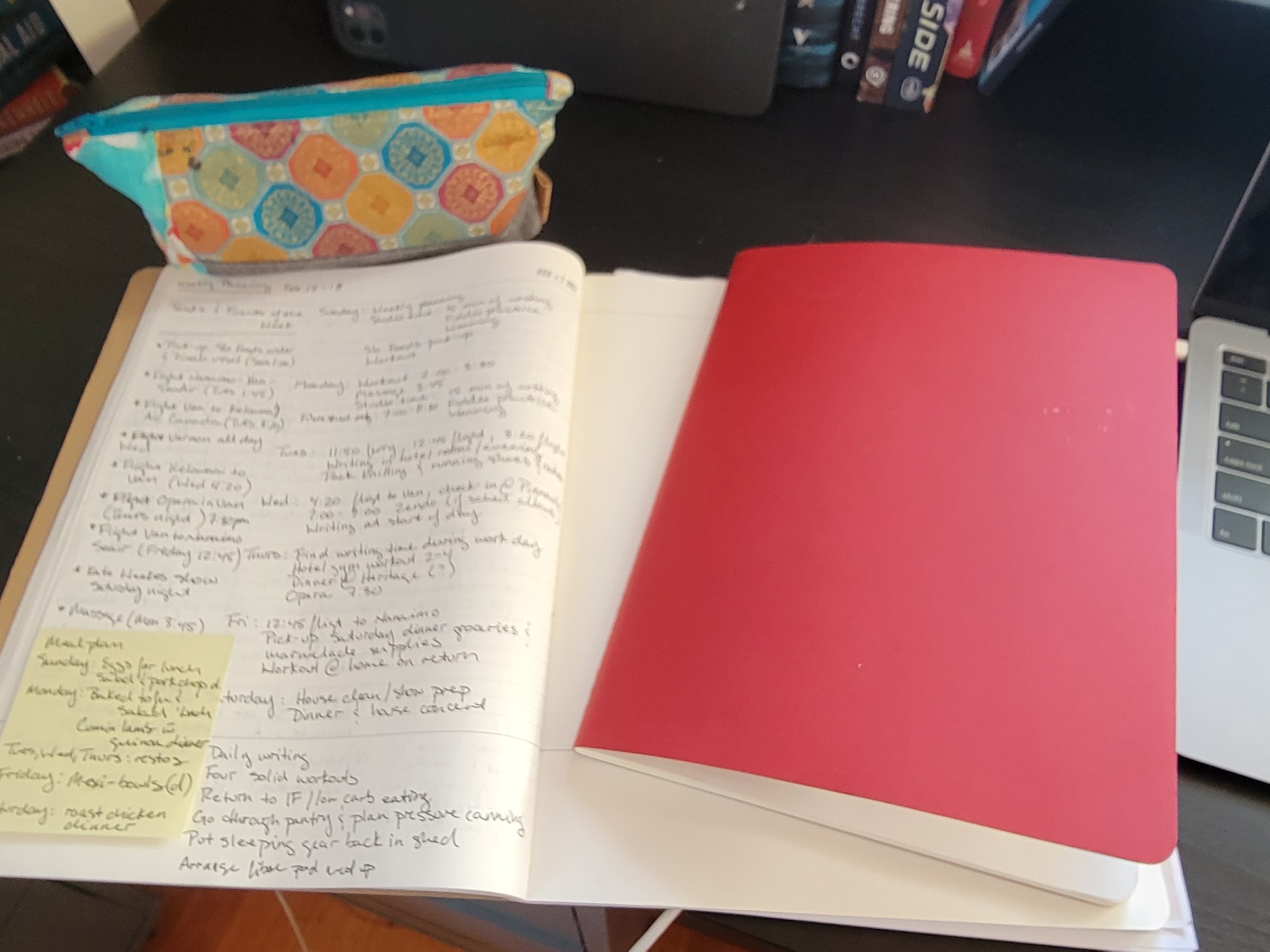
I have a too-many notebooks problem at the moment. I have one titled The Journal of Endings in which I note and write about things coming to an end. I have a process journal for the book I was writing last year. I have one titled Daily Noticing which has become more like a planner/catchall/tarot diary since the layout is not the best for free-form writing. I have one on the dining room table to catch thoughts from reading and reflections; and this week I have started another for daily writing practice. Though I wrestled with marking up yet one more blank book, I couldn’t see my way around it given the specific purposes of the other notebooks in play.
The problem here lies in the fact that by having this many notebooks on the go, I will never come to the end any one of them – or at the very least, my satisfaction of *finishing* a notebook will be delayed into the far future. Which begs the question of whether I really only keep a notebook in order to prove to myself that I write enough to fill one.
The other problem with multiple notebooks is that I will likely eventually abandon one or more of them, leaving the irritating half-finished notebook cluttering up my desk for the many months it takes me to come to terms with the drift of my attention. Future me will pull these half-finished notebooks out and feel frustrated at the fact so many pages went un-used, and yet she won’t be able to bring herself to re-start an old notebook. The chronology is wrong for one thing, not to mention the fact that the content from one period of life doesn’t hold up beside another.
My conundrum brings to mind the notebooks of Anna Wulff In The Golden Notebook, that classic of western literature by Doris Lessing. In attempting to analyze herself, Anna starts four colour-coded notebooks dedicated to various parts of her life (including her alter-ego Ella). She doesn’t like the idea of keeping a single notebook which she feels will lead to a kind of chaos, but over the course of the novel she starts slipping between them, confusing one for the other and inserting content in the wrong places. It is only when she embarks on the synthesis notebook (the golden one) that things in her life start to make sense to her, and she overcomes her alienation and paralysis in both relationships and creativity. Anna is integrated by drawing her worlds together into a single object of reflection. There’s a lesson in there for me, I’m sure, but I’m not heeding it.
Though I don’t write in order to self-analyze, that is likely the root of all this. After all, notebook content almost never makes it into the public except in roundabout ways. But by writing down quotations, reflections about my reading, thoughts about the day, things I notice, and conversations I am moved by, I show myself to myself with each new entry. In Harper Lee’s words: writing is “a self-exploratory operation that is endless. An exorcism of not necessarily [the writer’s] demon, but of his divine discontent.” And what is discontent if not the state of perpetually not quite knowing oneself?
Post #3290: My personal inbox situation

Since the beginning of the new year I’ve been in a decluttering and re-organizing mode: inbox, closets, studio, finances. It wasn’t a resolution since I didn’t make any this year, but it’s clearly where my focus has attenuated in these last few weeks. Perhaps it is connected to my “Making Do” theme for 2023, as that requires a bit of taking stock to find out what I am making do with – or perhaps it’s just reflective of the breathing space I’m feeling since stepping back from union responsibilities. Either way, it feels good to follow my attention to some long-neglected corners.
One area which has produced a tremendous result in a very brief period of time has been getting down to it with my personal email. Over the years I have subscribed, or been subscribed to, a shocking number of lists, newsletters, and systems/app notifications – to the tune of several hundred emails per week (if not thousands). When Google introduced it’s new inboxing system a few years ago, which included tabs for “updates” “promotions” “social” and “forums” – I figured this would help me deal with the email onslaught and I dutifully sorted inbox messages that came in, hiding away messages beneath their appropriate tabs.
Turns out, that only made my email-hoarding problem worse as I read next-to-nothing under those tabs and periodically found myself deleting thousands of emails in a go, invariably ridding myself of something important like concert tickets or receipts along with all the “clutter”. Plus, the Promotions and Social tabs deploy Google Ads, which can never be removed and lend to my email the overwhelm.
This problem with unread messages lead to other issues, like being billed for services I no longer wanted to subscribe to, but missing the notifications because they went into the updates or promotions tabs. There was also the fact that I wanted subscriptions to some things but didn’t see them because they were buried in the never-ending stream of irrelevant messages.
The problem was so bad, I had stopped recognizing it as a problem and just accepted it as the way that email works for me. It’s funny what we grow to tolerate just because that’s the way it is.
But near the end of 2022, I got to Zero Inbox on my work emails – which took a few days of sorting, deleting, and responding to things – and I recognized how much lighter I felt at the end of each day with only a couple of emails left to address. Looking for more lightness in my life, I figured I should apply the same to my personal inbox situation. I’m fine with my inbox as storage for conversations and connections, but I didn’t need to also keep thousands of ads and social notifications.
Since that realization, I’ve been unsubscribing from things like it’s my full-time job. I started by running through the first hundred or so emails under each tab and unsubscribing from everything I no longer wanted. Then, I deleted everything in my promotions, updates, and social tabs and got rid of the promotions and social tabs altogether, so things can’t hide there anymore. And now that I’ve got a handle on it, I evaluate each thing that comes in and decide whether I want to continue my subscription or not. The first few days of this were rough, but now I’m three weeks in, and there are only a handful of emails per day.
I’ve directed the subscriptions I want to keep to the Forums tab, which I review every morning and actually read now that I’m not overwhelmed all the time. The Updates tab is for receipts and reminders, which I delete when I don’t need them any longer. My main inbox is personal email.
There is no question this feels waaaay better than the “hide it under the bed” approach to my inbox I’ve relied on for years. I am not stressed when I open my email for one thing, but I’m also allowing time in the morning to scan the actual news bulletins from the NYT and Globe and Mail (subscriptions I pay for) so I feel more informed and in touch as I start my day. I’ve also realized that although there are many worthy Substack newsletters in the world, there are only a handful I am excited to get in my inbox. I can scan the rest from the Substack app once a week without all the clutter.
The inbox cleanse is also helping me identify automatic payments I no longer want to be subscribed to, and how susceptible I am to email advertisements from my favourite craft suppliers. As much as it pained me to unsubscribe from the Maiwa mailing list (not to mention all my fabric stores!), my bank balance is sure to be healthier without first-thing-in-the-morning impulse purchases prompted by email. Just last week I created a spreadsheet to track where my money goes on a monthly basis – an action completely related to the email taking-stock I have been doing.
Now that I’ve swept out the dirt from under the bed, is it possible to keep my room clean beyond the first month of the year? Only time will tell! I’ve never undertaken an inbox cleanse with this much rigor – but as we all know, old habits are hard to break. I think I’ll have to give this You’re Wrong About episode with Anne Helen Peterson on “How Email Took Over the World” a listen every six months to remind me how damaging the continued drain on attention can be – and I’ve set a recurring task in my calendar to take stock of my email situation every three months to see how things stand. Given the net-positive so far, I’d like to keep my inbox situation under control from here on out.
Post #3288: Cycles of creativity

I tend to flow between cycles of obsession when it comes to textile work. My sewing machine might sit untended for months with a project cut out beside it, my looms might be warped and left unwoven for as much as a year – but when the right moment comes, I return to my tools with a strong focus that can carry me through many projects, one after the other.
This would be a problem if I had to produce textile work for a living. I am so inconsistent with my output, and deadlines aren’t something I rise to when my pay isn’t assured. But I’m fortunate to be paid for something other than my studio work, which leaves me free to pursue what I want, when I want. This allows me to work with the physical implications of making (weaving, sewing and other textile work are hard on the body in various ways – and repetitive strain injuries are an issue for many professional makers and artists), as well as following my own (mysterious) internal cycles which flow between learning new skills and turning out work that I already have the technics to pull off. It also allows me to experiment and pursue things I am actively bad at (like figurative painting on fabric) without feeling like I’ve “wasted” my time.
Case in point is the photo at the head of this story – a warp that I started putting on in springtime 2022 and only fixed and started weaving last week. Between April and November I did not send a single shot through either of my looms, for reasons I cannot explain. The whole thing just suddenly seemed too tedious, and I turned my attention to other things like fabric collage and textile painting with natural dyes as well as taking long breaks from the studio over the summer when I was working away from home and picking away at a single knitting project.
But when I am on, I am really on. Since returning to the loom(s) in November, I have finished the tea towel warp that sat for several months (4 more towels), a huck lace sampler and table runner (from the Jane Stafford Weaving School courses), 2 huck lace scarves, 5 rustic tea towels (which I am hemming the last one of today), and a shawl which needs fringes completed before I can wet finish. I have also woven half of the above shawl, and have pulled out a tea towel kit from my stash that I’m going to put on my small loom over the next few days.
Of course, when I’m weaving at this volume (in addition to my 40-hour work week), I can’t get a lot else done. There is some television knitting (socks!), but writing, dyeing, and other creative activities take a bit of a back seat when I’m weaving obsessed. I do have a goal of learning some new fiddle tunes this year, so I am making 15-20 minutes a day of space for that at least.
I sometimes wish I was a bit more measured in my approach – wondering if my skills would develop more steadily if I stuck to one thing or didn’t take long breaks to pursue other interests – but this seems to be hardwired into my constitution. Lots of interests, but obsessive focus on one or two at a time. Over the long arc, I tend to return to things at least, and each time I do I note that subconscious has kept my skills up (and sometimes even improved them) in the meantime.
So, weaving it is right now! At least for the next few weeks.


 Red Cedar