Red Cedar
More apocalypse, less angst
Post #3069: All the made things
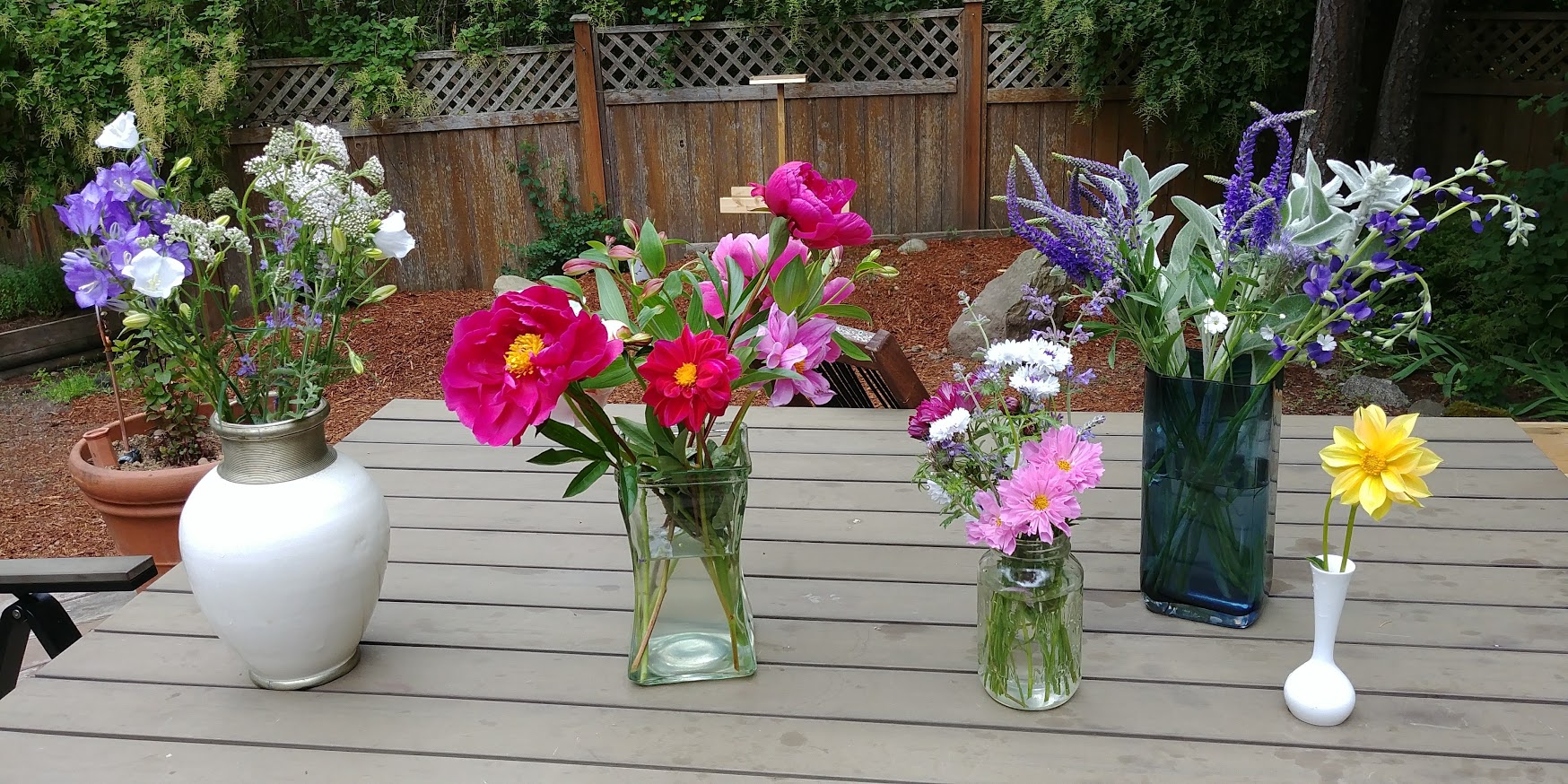
One year in and things here have their routines: Tuesdays are farm day now, the day when I pick up flowers from the flower farm, go to the meat store at the farm up the road (it’s an honour system store where you write down and pay for what you take), and pick up my veggie csa box. Up above you can see that for $20 a week I get a mighty load of flowers. Same goes for the veggie box – and so I come home from my drive around loaded with most of my groceries for another week. We don’t have a dairy on the island, so I get that and imported veggies from the grocery – as well as any prepared goods…. but as I purchase all my dry goods in bulk through an organic buyers group, I’m finding the grocery visits are less now that growing season is here.
As I’ve not been posting much, I thought I would take a moment to recap all the textile things which I’ve worked on or finished in the last few weeks – as my daily routine involves a healthy amount of studio time these days, and on sunny days I’ve been sitting on my deck with some hand work. I realize as I post this that pretty much everything I am showing you will be given away – a pleasing thought of time well spent while I learn and learn some more.
But first of all I will show off the gift to myself purchased 18 months ago and now finished and ready to weave on — Alice!
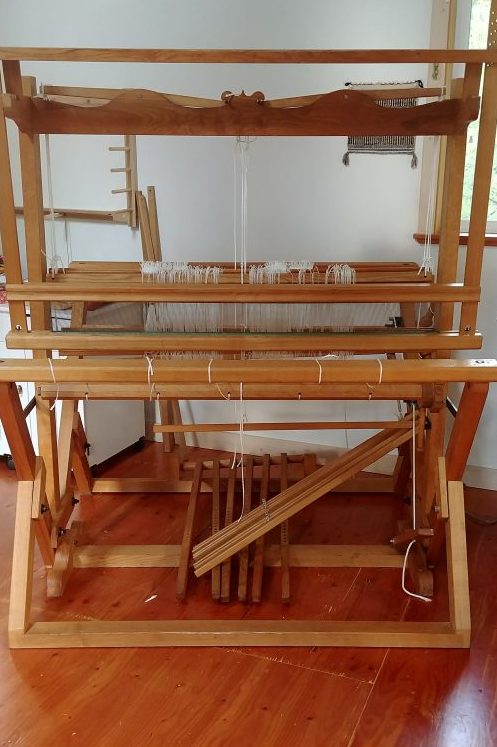
You might remember this purchase from around my birthday in 2016. I’ve written about her a couple of times, in particular I detailed restoration efforts here. After not working on this much over the last few months, I buckled down a couple of days ago and finished waxing the last shaft bars, putting heddles on them, and putting new cord onto the brake mechanism. Which means that she’s pretty much ready to weave on whenever I get a warp on and put ties on the treadles for the bottom shafts to attach to. I’m a bit nervous about this, as a countermarch loom is quite a different beast from anything I’ve worked on today. On the other hand, this last week I realized how this loom expands – and that it could easily be an 8 or 12 shaft loom with some additional wooden jacks, shaft bars, and treadles – so *if* I can get it to go, it could end up being all the loom I ever need. My dad has offered to turn any wood pieces that I need and it appears easy to remove jacks and treadles to use as templates for new ones. (For those who don’t weave – more shafts = more complex pattern capabilities.)
So while waiting on that loom, I’ve been weaving on Little-J for the last few weeks – a loom that initially I was skeptical of but have come to understand much better and appreciate for its simplicity. I’ve also realized that many of the problems I’ve had with the loom are due to my own lack of knowledge – I tied up incorrectly when I got it, and that’s created some abrasion on the texsolv cords (causing breakage), and I have been forgetting to separate heddles on both sides of the loom to create more balance in the shafts. Also, I don’t think this loom is really good for more than six yards of fabric at a time as it’s not big enough.
For the most part I’ve got it figured out now, though I still need to re-tie some cord. In any case I’ve just finished the fabric for six tea towels in two colours – the purple view is shown below with a strip of the dark blue. The weft is three gradating colours (violet, grey, beige):
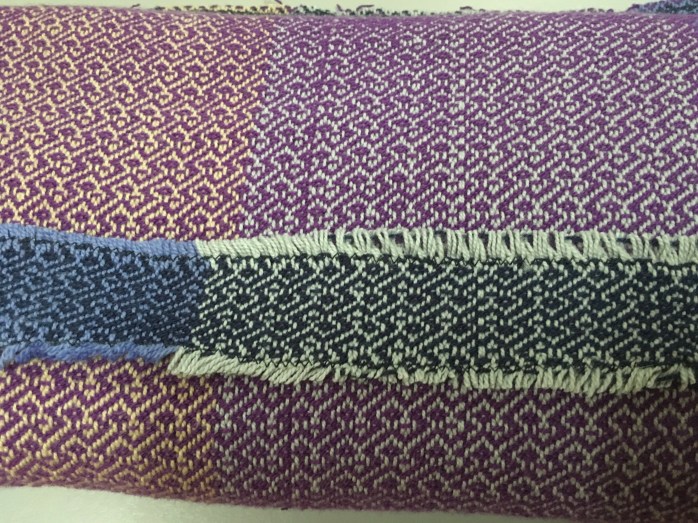
I still need to hem the ends of the towels for a finish – but that is a short bit of work and I’ve got three new sets of towels – two to give away, and one for our house. Now I’ve got a silk and wool scarf on the loom, in colours that I love but cannot wear (green makes me look sickly) – so this is definitely going to be a gift:

This yarn is beautifully soft but I’ve encountered something that I hadn’t yet experienced – because of the slipperiness of the yarn, there is no grip and so if I’m not careful the weave pattern gets lost if I beat it too hard (it packs right down and you can’t see a pattern at all). On the other hand, it’s fingering weight which means it is going much faster than a tea towel – so I should have this off the loom in a few days time – and then I’ll probably put more tea towels on since I’ve got some visiting later this summer and those make good gifts.
In knitting news I have finished eight memorial scarves to be given to the circle of our friend Bronwyn who passed away one year ago. Only seven are pictured here as I was finishing the last one when it was taken. Thus far I’ve given two of them to their intended recipients and have six more to pass along as I see people this summer. Knitting these over the last year was a form of processing, remembrance, and quiet sitting in honour of my friend’s chaotic, brilliant, and tragic life – tinged with the richness of intended gift to those friends who remain. The scarves are all striped (in deference of B’s love of stripes) and hobo-style triangle neckerchiefs to mark her days of travel. She probably would have found this quite ridiculous – or been flattered – or a combination of the two:

As I was finishing number eight – I knew that one more would still have to come after the anniversary of B’s death – for a friend who lives out east these days — but just as that happened, the friend out east wrote and told us that she has been diagnosed with breast cancer, so instead of a memorial scarf I will be knitting her a comfort shawl – something I’ll start as soon as the yarn I ordered arrives.
Finally, I have picked up an embroidery project that I prepped almost two years ago and then never started. This will be a bag or a panel for a bag once it’s done:
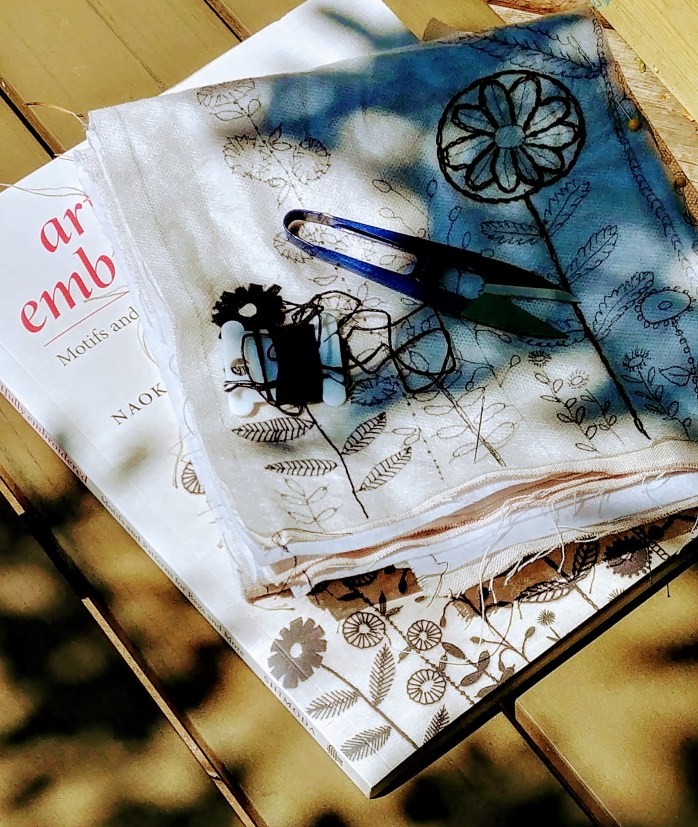
Embroidery isn’t something I have done much of – I am imprecise and impatient with it most of the time, which means I’ve never practiced enough to get beyond that state. As I get older however, I’ve noticed that once something is finished and usable – I’m rarely concerned with its perfection – which frees me to do what I want! And so I’m stitching – this will be for myself as I can’t get enough of small project and picnic bags in my life.
As I close this little review of work in the past few weeks I am reminded of the passage by Kahlil Gibran – which I take to heart more and more as I cut, sew, weave, and stitch each made thing to be passed from hand to hand:
And what is it to work with love?
It is to weave the cloth with threads drawn from your heart,
even as if your beloved were to wear that cloth.
It is to build a house with affection,
even as if your beloved were to dwell in that house.
It is to sow seeds with tenderness and reap the harvest with joy,
even as if your beloved were to eat the fruit.
It is to charge all things you fashion with a breath of your own spirit,
And to know that all the blessed dead
are standing about you and watching.
Post #3068: One year on this island.

A year ago we packed up the last of our things and left Vancouver. A year ago there was a big spaz about our money being transferred properly for our real estate deal so that while on the ferry to Gabriola we weren’t sure we would be allowed in the house we had just purchased. A year ago we got it all sorted out and slept on the floor of our new house, waiting for the next day when the moving van to arrive.
And so it’s been. One year.
There’s a lot of things I can say about this move – but the bottom line is that I am very glad for it, and I have no regrets about leaving the city for a small island, nor a desire to return to any city (even a smaller/cheaper one than Vancouver). We have just weathered a pretty crappy winter, with snow, power outages, and even a burst pipe caused by rats chewing through it in the kitchen- much of which I dealt with on my own while Brian was in the city. And even so ….
Because while some of the “convenience” of city life has receded, so have a lot of other things – noise, traffic, anger, angst, crowded sidewalks, crammed buses, and the feeling of civility ever diminishing around me. These things have been replaced by spaciousness – time in the studio or the kitchen, on the beach, and in the woods – a zendo of my very own – and plenty of room to throw parties when we don’t feel like being quiet. Brian and I have discovered more quality interaction despite the fact he is away three days per week – it seems that full absence on some days leads to increased presence when we are together. With all external life toned down, I meet the pressures of work and my union more gracefully and with way less freaking out! There is simply more time and energetic space, and working from home has allowed for a better integration of my life and my working life.
This is not to say that all things are perfect – all communities have idiosyncrasies, and the smaller the place the more pronounced that are. Living in a community of retired people has meant that it’s been difficult to meet and make friends our age who don’t have young children. Also related to the retired population, there is some real fussbudgeting in the community – people who make a party of filing complaints against local businesses and individuals – which is a drag. And while most of the island is super welcoming, there is definitely a vibe in some quarters that people don’t want newcomers or changes to the island – even though a lot of these changes are just about the greater society changing (you might have noticed this whole boomer to millennial changing of the guard is causing some tension out there).
But you know, people are people wherever you go. And this island is full of pretty awesome people as well – from the local farmers who put most of the food on my table, right on down to the folks who work at the foodbank and keep the Commons project afloat. I’m might impressed with the community-mindedness of this place overall – and although we don’t have a ton of time in our working lives, we try to drop in where we can.
In the last few weeks, we have met some local folks who might actually be friend material – our age, musician types, in our neighbourhood – which is pretty exciting. Not to mention the fact that our proximity to Victoria means that we’ve seen a lot more of our island people – friends and family – over the last year. Since we’ve been here I don’t think there’s been a single month without visitors – which very much plays to my hosting skills.
Although it’s only been a year, we’ve pretty invested here now – and I can’t imagine where else would allow us to be in a rural community and yet still close to city amenities and our families. We still have a place in the city if and when work calls us there – but for the long haul, this is where we have landed – and I’m feeling pretty good about that.
(Picture above is of a 72 million year old fossil that we found on the beach near our house. Video below was taken two weeks ago on the beach below our house at sunrise. Pretty great, eh?)
Post #3067: A weekend of sunrises

After what has been a pretty cold and wet winter, my corner of the west coast was treated to a weekend of beautiful sunrises, just in time for the May long weekend.
Post #3066: To office or not to office

This week has presented a bit of an odd situation in that I was told that I may no longer have access to an office.
For the last (nearly) year, I have been working from home three days per week and in an office in Nanaimo one or two days a week days per week. Going into the office makes my days long because it involves a ferry, but it also ensures that I see people during the work week. My actual work team is in Ottawa (and spread around to other places too) and some days (like yesterday), I’m in phone meetings for most of the day anyways. All my work can be done remotely as I do web planning, information architecture and so on. My work team doesn’t really care where I sit because I’m on a phone/chat with them regardless of my physical location.
So, I’m trying to decide whether or not I should fight to keep this office space which is a something I’m sure I could win, or should I just let it go since there seems to be some reticence to allow me to keep “squatting” there. Technically I do not have a right to office space in Nanaimo, as I do not fit within that part of the organization. Things changed with my work reporting and now I must reapply for the space with new managerial signatures, or I could just keep using the space as I do until it’s eventually cut off and deal with that if it happens.
I’m not sure that going into the office really does much for me even socially as I don’t share work with anyone in that office, and I’ve had days when I go in and no one’s really around anyway. Also, when I work from home, I can do things like bake a loaf of bread or throw a load of laundry in – which gives me a much better work/life flow. Productivity for me (I have come to learn) does not depend on location, but on mental state – so that’s not really a consideration.
At the root, this is about identity. If I am part of an organization, what does it mean if I no longer have a physical space in that organization? Is it easier for them to let me go? Do I have less stature in the eyes of my colleagues? Also, as the president of my union local, is it weird that I no longer work in an office building?
What I’m considering at this point is holding off on the formal paperwork and simply moving to less time in the office overall to see what that feels like. This week, because I have a cold, I only went in one day. Next week I have required travel in the middle of the week to somewhere else so I probably won’t go in at all. Perhaps the week after I’ll work from home the whole week. And I’m also aware that building will be undergoing refit in the next few months which means that I will work from home exclusively to avoid the noise and mess.
I used to believe that I was not the kind of person who could work from home, but I’ve found in the last year that this isn’t true and that there are lots of advantages to this arrangement. I’ve got good work hygiene in that I do get dressed properly every day; have a separate work space that is not inside my home; keep regular work hours that I stick to. And when I am working from home, I start and end my days much earlier which works for my counterparts in other time zones.
So far, so good. But what if? What if? What if not being in an office makes me more vulnerable to layoff? What if I get isolated from my work group? What if I can’t control my work future the way I want to? When I explore this a bit more I see that what I want is something I can’t have – a way to predict the future, some kind of control that is elusive no matter where I sit.
I also have to acknowledge that this is true – I’m pretty sure this isn’t my last position inside my organization. I have no desire to move on just yet, but with eleven years to go until I collect my pension, I suspect there is at least one more change of position ahead. I can’t know that of course, but given my past eighteen years of employment – there’s a good chance that will be so. There’s even some chance that whatever I do next will be at least part of the time in Vancouver, not Nanaimo at all! So I don’t know how much any of it matters in the end, as long as I keep contributing, keep working, keep showing up on the phone for every meeting – I expect where I sit is less of an issue than I am making it.
Post #3065: A weekend of practice
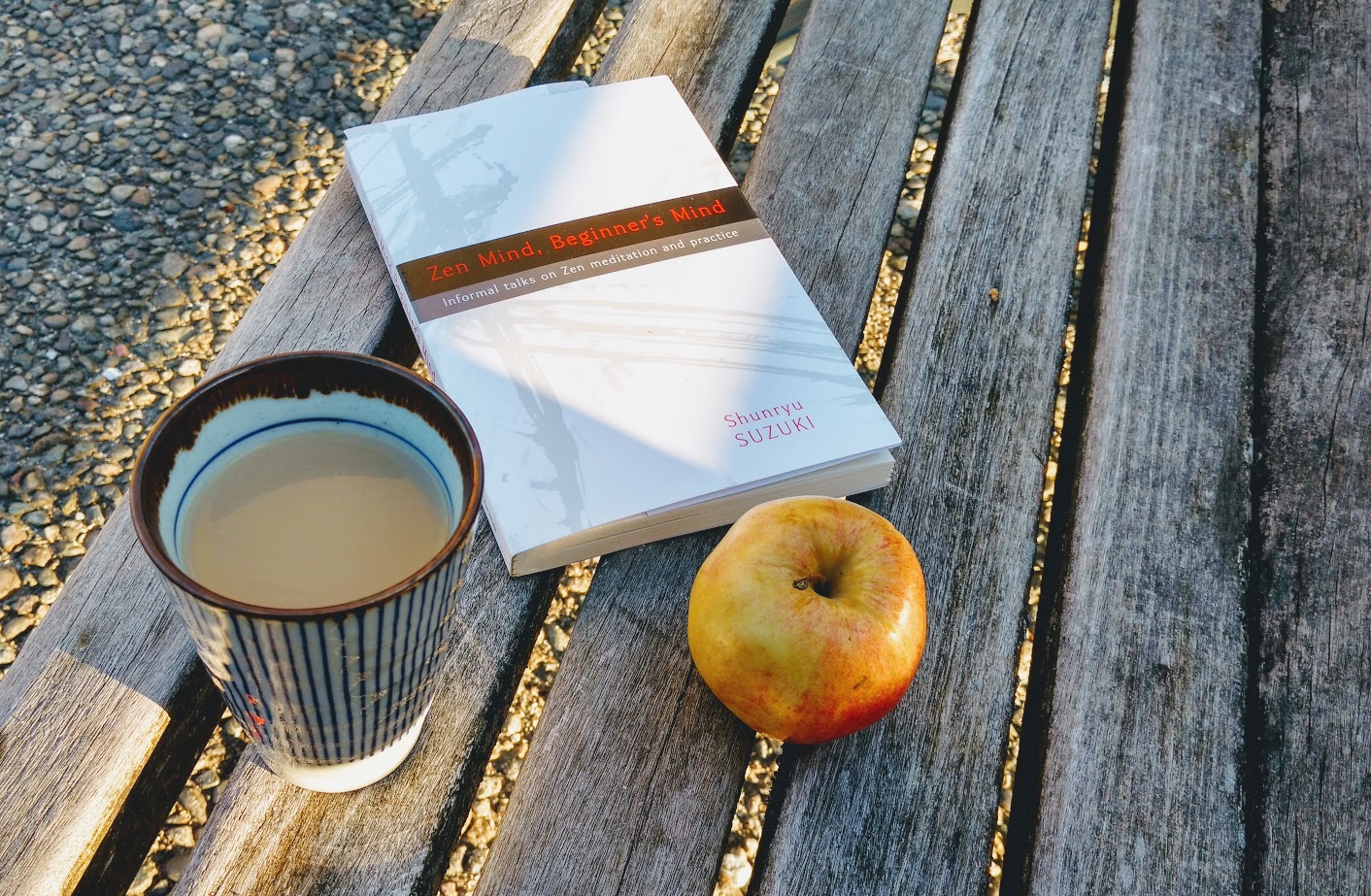
Let me start off by telling you that things last week were a bit crappy. I have a lot of work stress right now and that was compounded by 3 days of union-related meetings which made me feel frantic and behind at every step. On top of that, I was disrespectful to someone in a meeting because I had lost my patience with them – which is not how I want to be as a meeting chair – and so that resulted in an apology to everyone at the meeting. (I always figure it’s better to apologize right away and meaningfully rather than dig in.)
So yeah, I’ve been pretty stressed lately about work – and last week didn’t help – and then I was even more stressed because I had to leave my little paradise of an island to go to the city for a weekend meditation retreat. Can you imagine this? Stressed and then getting more stressed about meditation!
Glad to say that my misgivings about the trip were relieved the moment I walked in the door to receive a big, smiling hug from one of my teachers! It’s been three years since I started sitting with Mountain Rain and if nothing else, I can always count on feeling right at home when I show up. That was what I needed, a feeling of being where I belonged without a lot expected of me. (A lot of my stress right now is due to overwork which is all about what I let people expect of me – I need to lessen those expectations because I’m not getting rewarded for doing *everything all the time*)
So, I sat for the weekend with my fellow meditators and it was good. I had meetings with my teachers, I did some tonglen practice focused on equanimity, I felt each step in walking meditation as a grounding and an ease of being supported by the earth – and in addition to the time sitting, I rose early both days for a long walk, and brought simple healthy food to keep me going without having to dip into restaurants or shops at all. I ate mindfully, without distractions, kept phone and internet use at a minimum, and didn’t even read any books! In this way it was the most intensive effort I have ever made at a non-residential retreat – though I can’t say it was any effort because it was what my body and mind were deeply craving – some time to be quiet and alone.
By the end of the weekend the bad feeling in my gut and the tension in my neck had abated, and though I’m not fooled into thinking that the stress is all gone – I feel like I’ve got some new strategies to work with the internal resistance I have been feeling around some projects. I am feeling a bit low and quiet today – processing everything after a long evening of travel that involved traffic jams and late ferries – but also filled with the deep gratitude for my zen community, those people who show up and sit so that we may all experience our full human condition together. Without them, I would just be sitting alone; in a retreat or meditation hall I am part of a large and supportive body and after weeks of feeling under appreciated at work and in my union – I really did need that positive contact.
When I rose this morning I didn’t meditate as normal for I was a bit behind my schedule – and instead I took time to sit outside and eat my simple breakfast while watching the birds flit around the yard. It’s still grey here, but not too cold – and eating outside always feels like a picnic doesn’t it? I had forgotten that until the weekend when I ate my breakfast outside on a different bench both days (one day on the beach, one day on the UBC campus). I think this will be my practice for the next little while – as much as the weather and my schedule allows it – to eat outside in the mornings without distractions other than birds and the occasional insect.
Suzuki Roshi says that to find still mind in stillness is the easy part – it’s finding still mind in choppy waters that’s the real mastery of zen practice. This work is long and subtle – but each time I encounter a rough patch I become aware that whatever I am doing, it is working. I am more aware of my mind states, I am calmer in the face of difficulty – but at the same time, I also recognize how very far I have to go before I can navigate without tipping the kayak every once and awhile.


 Red Cedar