Red Cedar
More apocalypse, less angst
Post # 3303: Playing a new fiddle
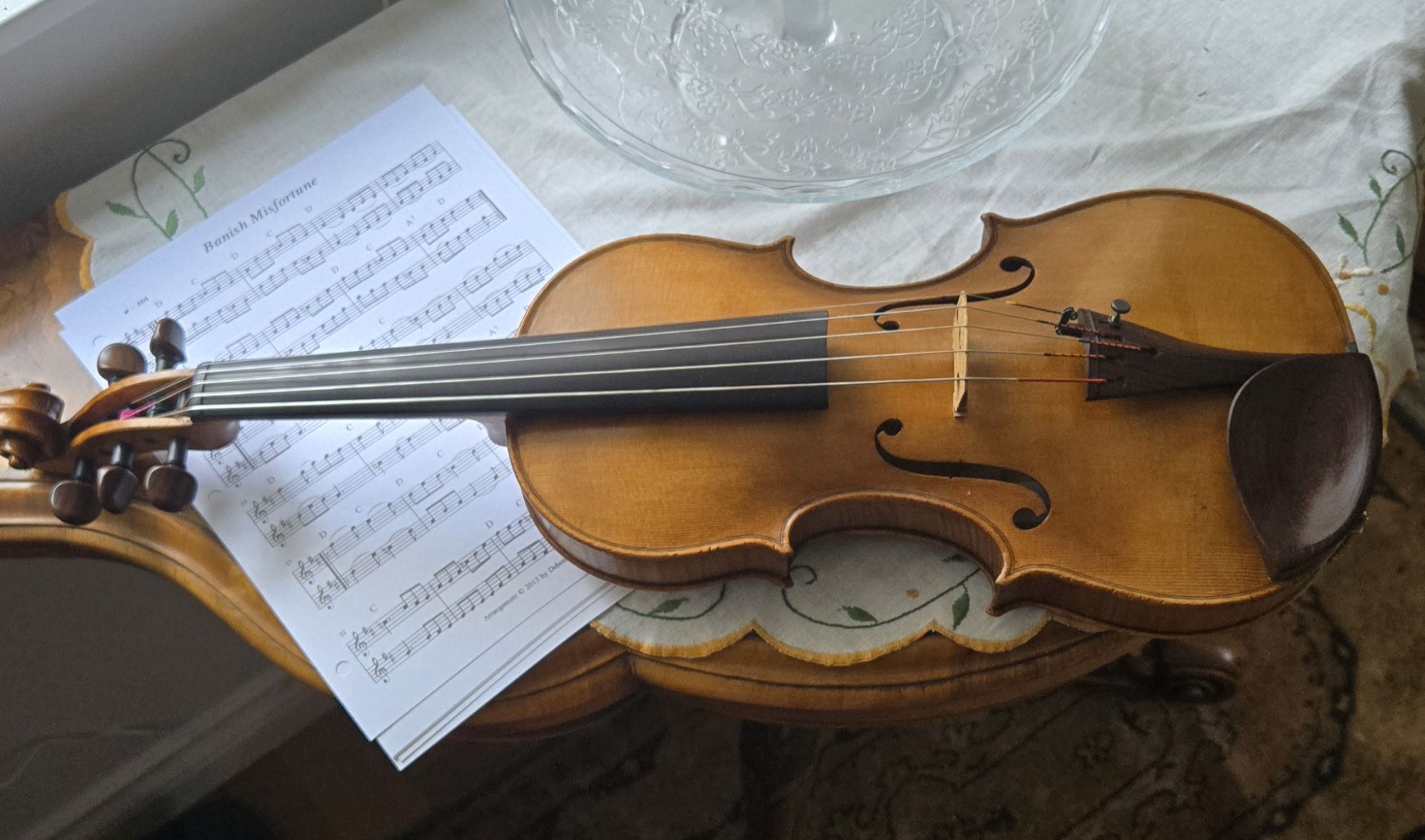
I’ve spent the past month purchasing a new violin — a process that moved much faster than I expected when I first started looking at the end of the summer. Though I’ve played on and off for most of my life (starting at the age of three), I’ve never owned a professional-quality instrument. When I was twelve, my family could only afford to spend about $1,000 on what became my “adult” violin and bow (a factory-made Stainer copy that is about 100 years old now), and as an adult, I’ve never made upgrading a priority. About fifteen years ago I did purchase a 5-string electric-acoustic instrument (a David Gage Realist) which gave me more range and a bigger sound, but it’s still “student-grade” and never really made the cut in terms of warmth and responsiveness.
After committing earlier this year to pay off my credit card debt (which I’ve pretty much done), I decided to start setting aside money for a new fiddle — something to mark my retirement in two and a half years. A milestone gift to myself, because honestly, I’m not getting any younger, and when exactly am I allowed to have a good-quality instrument anyway? (A friend of mine, a dozen years older, advised me this summer that we never know how long we have, and urged me to just put a new instrument on credit and go for it. Only a couple of weeks later, a musician friend of ours passed away suddenly after a catastrophic heart attack. How long, indeed.)
I started looking at instruments in September and quickly realized what a monumental task it would be to find and choose the right one. There are violin shops, private professional sellers, and about a thousand instruments on Marketplace at any given time (many of them total garbage, but some decent – you just have to meet a lot of weird people to find out which is which). I wasn’t sure if I wanted a standard instrument with four strings, or another five-string because I knew that one priority was a smaller and lighter instrument than my Realist due to anterior shoulder issues I’ve had for years (quick fact: 70% of violinists have some degree of muscular-skeletal damage by the time they are in college). Far from being a fun research project, the idea of having to meet a bunch of people and try a thousand instruments stressed me out.
And then I stumbled onto the website of Laura Wallace, a luthier who works (in part) with local wood and custom builds violins and violas. Boxes I didn’t know were on my internal checklist were suddenly ticked: female luthier, local to the west coast, using island maple and spruce. Intriguing! I also saw that her waitlist for a new instrument was at least 18 months, which fit within the timeframe that I wanted to purchase.
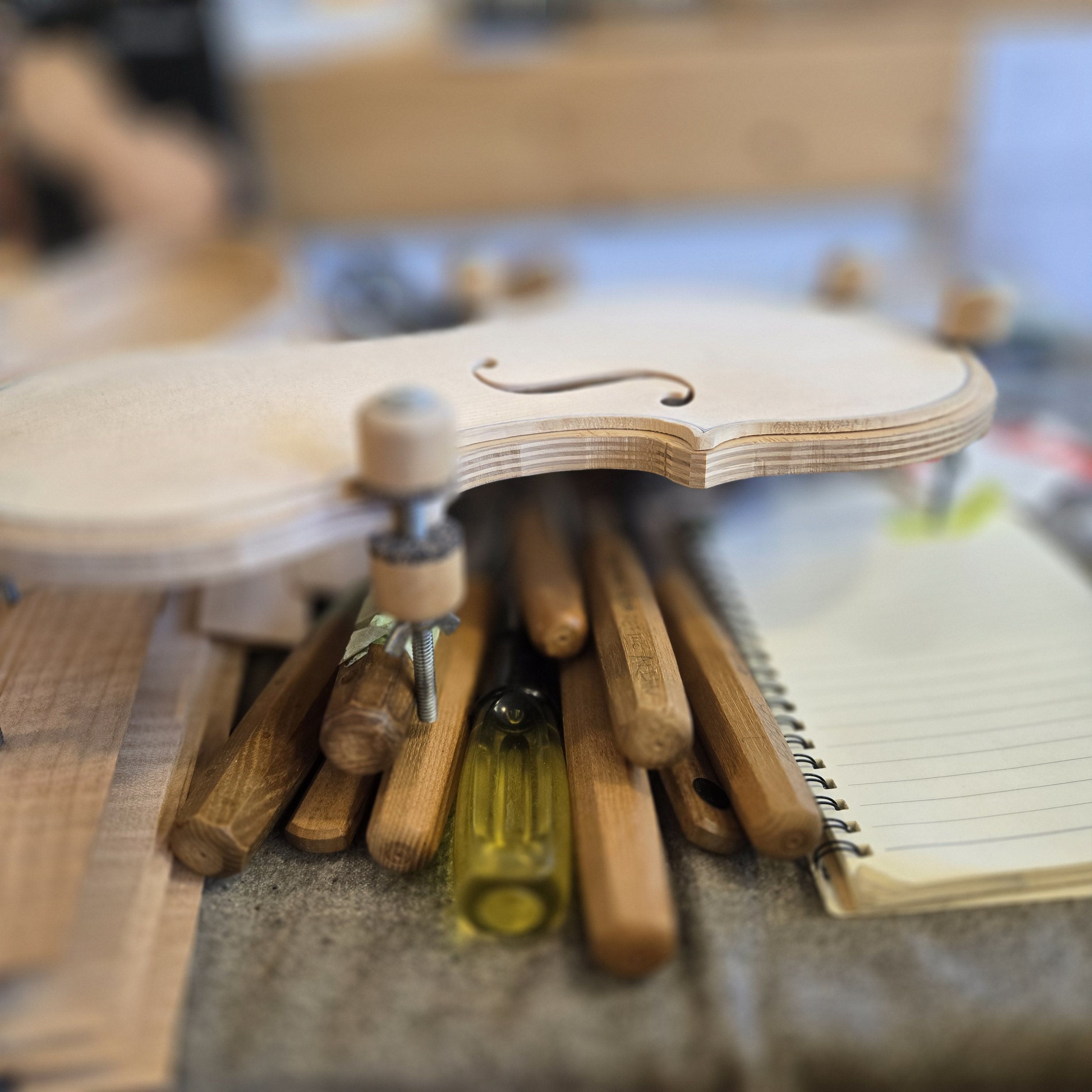
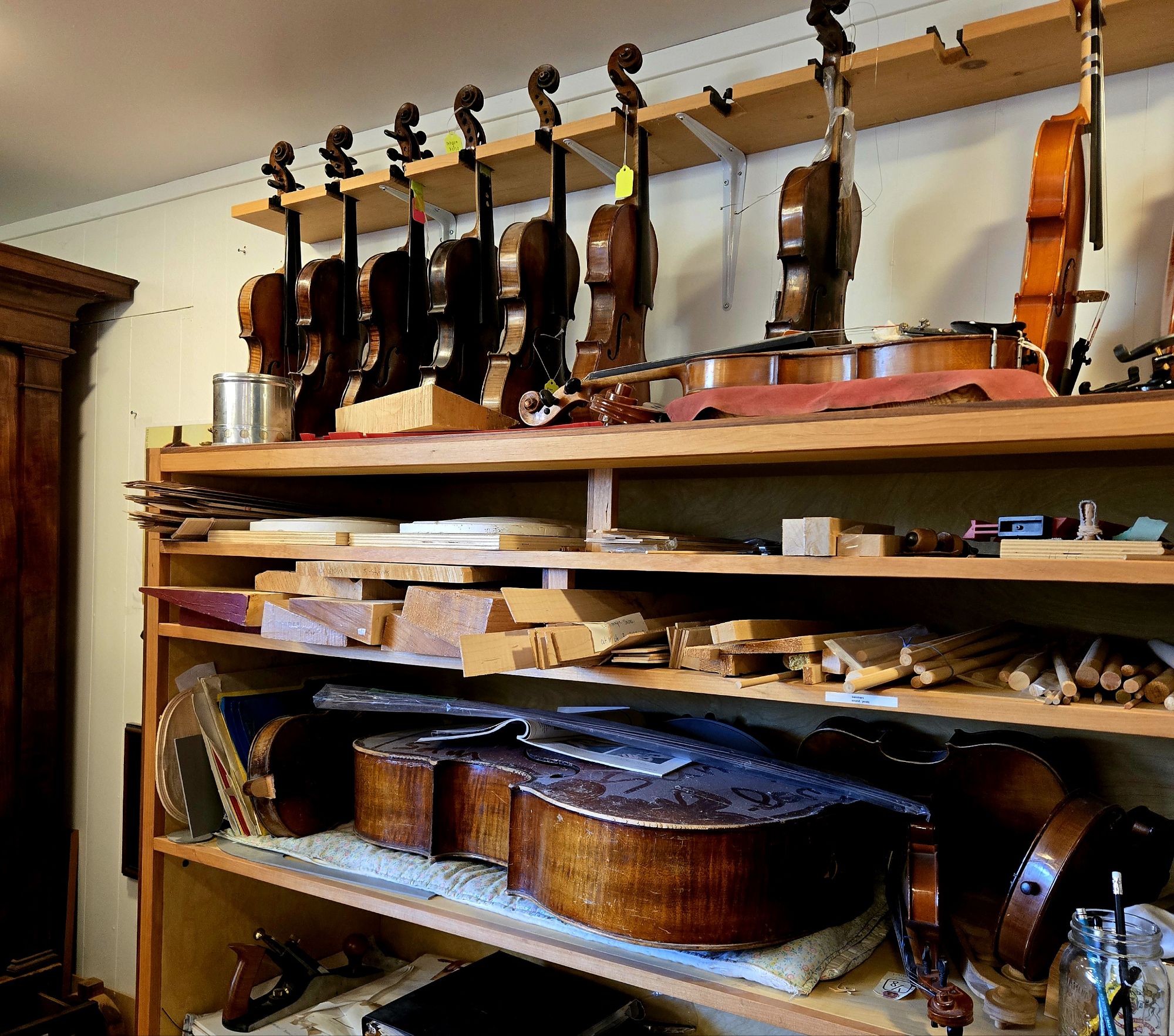
So I made an appointment for early October and took the journey to Powell River (two ferry rides and a drive) to meet Laura who turned out to be a delightful human being. I spent two hours in her workshop trading fiddle gossip and comparing the three instruments she had for me to look at with the ones I had brought (I needed to hear mine to know what hers sounded like).
One of the violins was a custom build for a fiddler in Victoria, one was made in 2019 and had just been returned as a downpayment on a new custom instrument, and one was a newer four-string (2022) also available for purchase. All of them are beautiful instruments, but from the very moment I tried all three, only one of them really captivated me – the 2019 build.
I’ll speak more to the instrument in a moment, but before I go on any further, there is a little bit of woo in this story – as there really should be in any tale involving the purchase of an instrument that is to fit within the hollows of the body. A fiddle isn’t just an object to those of us who play, especially if one has played their whole life. We are raised with it as an extension of ourselves and the body adapts around it accordingly (there are several studies that show the neuroscience implications of this, and of course the aforementioned muscular-skeletal damage). We are in a deep relationship to our instrument, and though I’m sure the same can be said for most musicians, violin and fiddle players have always seemed a bit *more* in this regard. When I came into Laura’s studio and said, “do you want to hear my violin story?” she knew exactly what I meant. Violinists and fiddle players always have a story.
I digress. One of the slightly mystical parts of this particular tale is that while I was waiting in the ferry line to Powell River, my mother sent me a somewhat astonished message. She had just woken up, because the YouTube app on her phone had started playing music of its own accord. As she laid there, a bit groggy, she knew it was me playing even though she’d not heard the recording before. When she rolled over to look at her phone, it *was* a video of me playing a song on the beach with a neighbour (something we recorded during the pandemic) – which I had totally forgotten about. Of course there are lots of algorithmic reasons that YouTube might connect my mother to my music, but the timing of it was….. odd. I hadn’t told my parents I was purchasing a new instrument at all and she had no idea I was on my way to go look at fiddles that day. Her phone just happened to spit up a video from three years ago at that moment I was to board the boat.
The second bit of fortune involved in all this is that the day I contacted Laura looking for an instrument that fit some smaller specifications I had in mind, was the same day the first owner of the 2019-fiddle contacted her to arrange a trade in for a different build. This first owner is also a woman of small stature and she had the instrument custom made for her proportions which are apparently similar to mine. Not a terribly dramatic coincidence, but just another bit of timing which gave me a nudge.
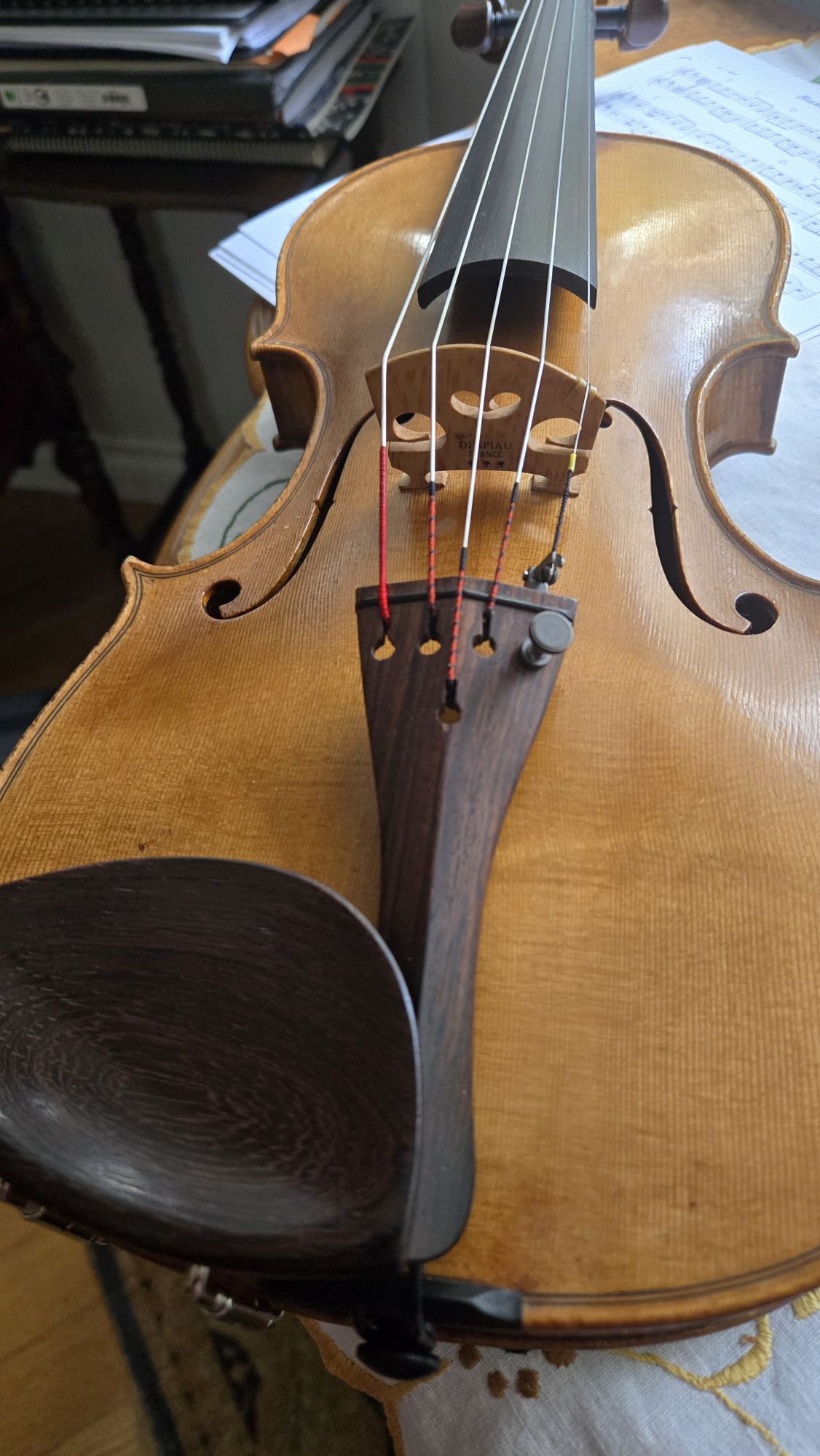
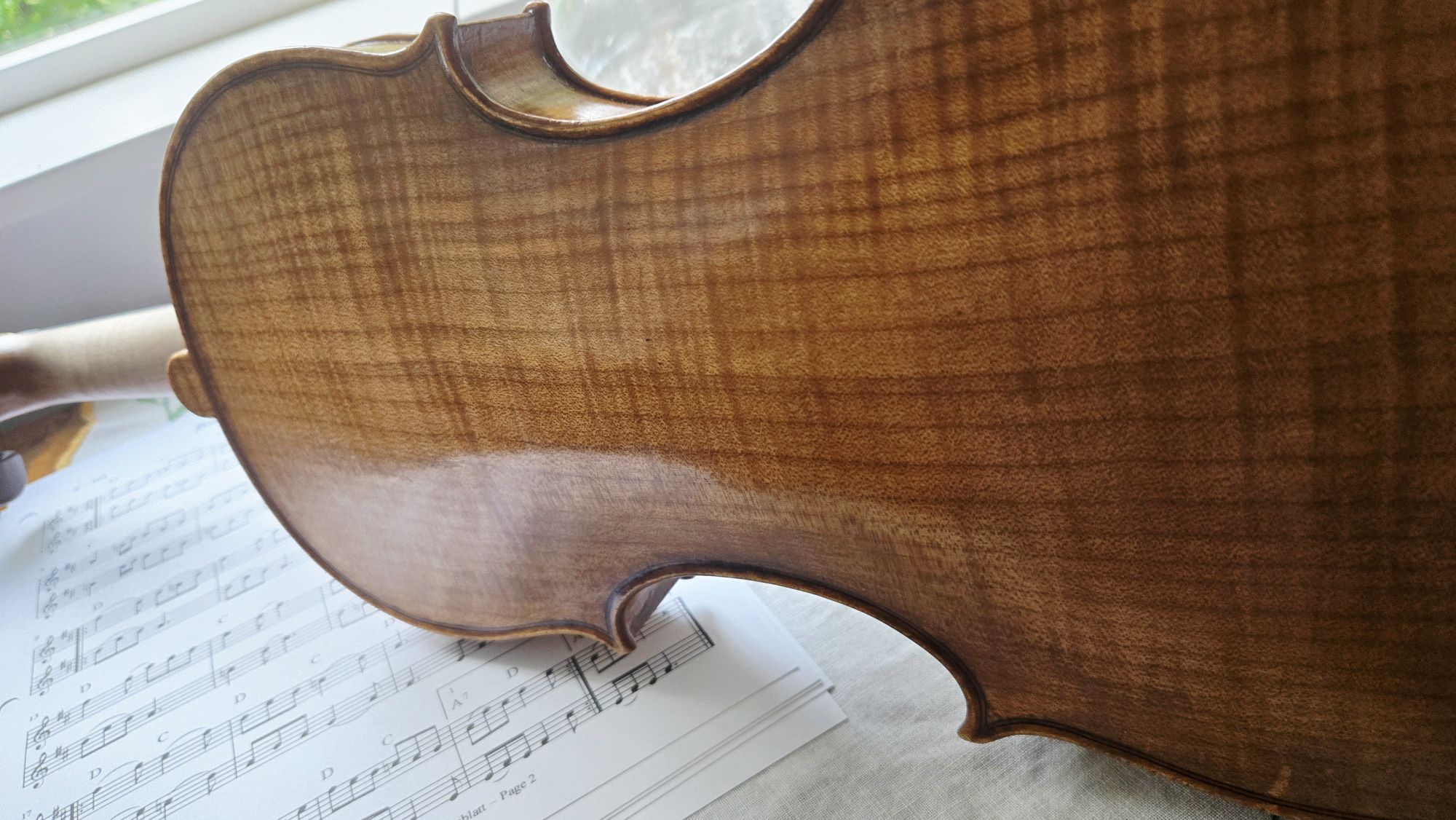
I like these kinds of nudges, but I also was entranced by the sweet voice of this instrument, which carries a warmth and body unlike anything had the privilege to play before. Not only that, but the proportions are a perfect fit to my body. It is an Amati copy, slightly smaller than a typical Strad, and the custom build choices resulted in smaller proportions which somehow don’t reduce the sound (which really carries). The violin is made from Vancouver Island Big Leaf Maple (back) and Haida Gwaii Sitka Spruce (front), and finished in a subtle way (not overly antiqued or high gloss).
Now remember, I had met Laura to discuss a custom-build which would be ready in 18-24 months. Trying the three violins was just a way for me to find out about the sound of her instruments – with no intention of walking away with anything. But the fact there was an instrument already made with all my choices – and that I felt magnetically drawn to……
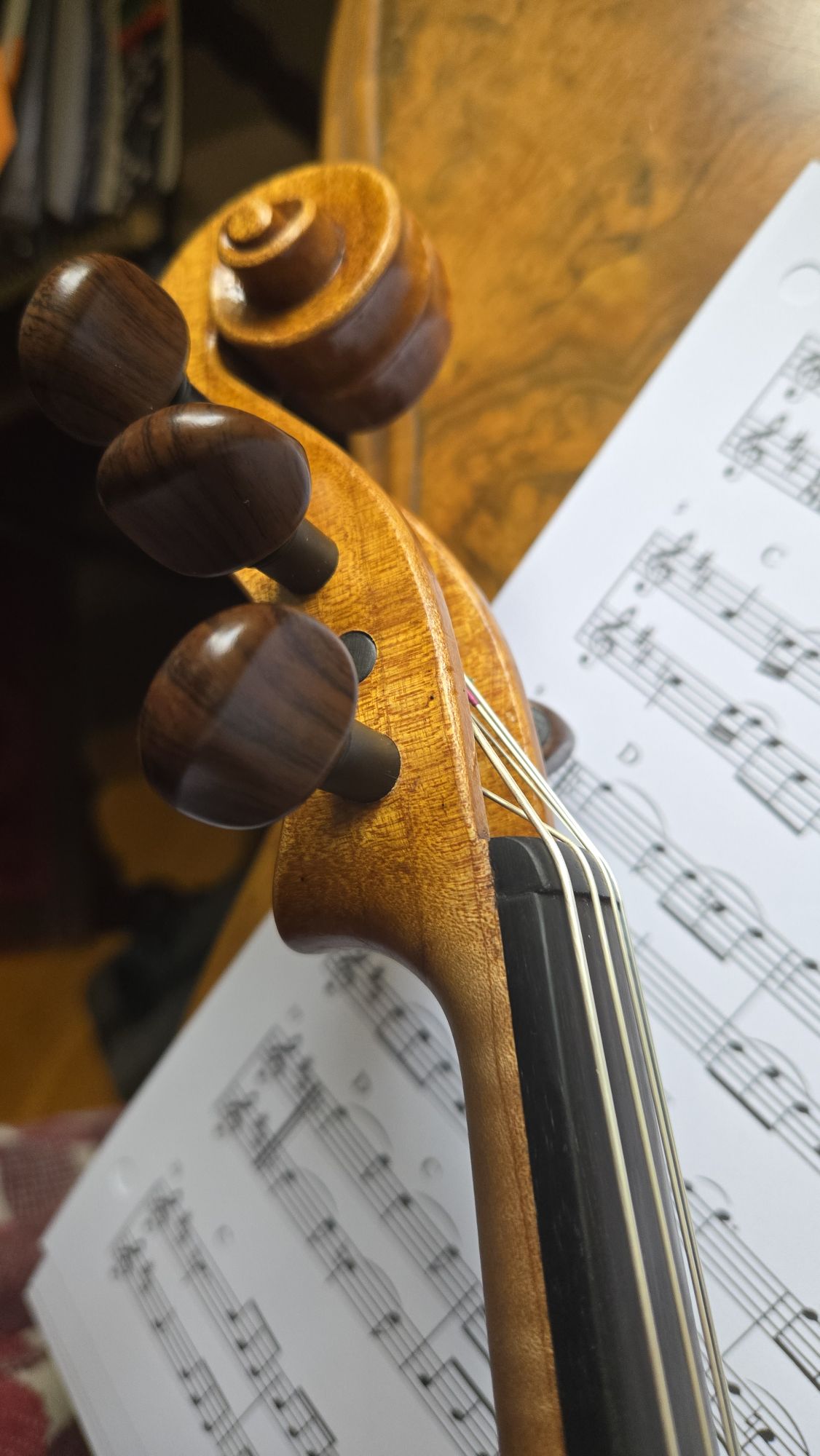
So I brought it home for two weeks to try out, during which time I confirmed a few things important to me. One, the sound is impressive. The sweetness wasn’t a mirage of the studio (or my excitement) and Brian confirms that. I sound like a much better player instantaneously. Two, my left shoulder did not tire out within fifteen minutes of playing and everything just *fits*. And three, it’s just a lot less work to get a good sound out of it in both home and performance environments than my other instruments (I took it to the open mic to test).
After the trial period, I reluctantly returned it to Laura – but only because I wanted some final changes to the fittings! Specifically, a rosewood chinrest (to match to custom-drilled tailpiece) and the installation of Wittner mechanical tuners to replace the friction tuners.
Luckily, we were only parted for a little over a week and a friend returning from Powell River was able to pick up my new fiddle from Laura and bring it to me on Saturday. Can I just say now that I am grateful to the fates that brought us together? Because it does feel a bit fated to be holding this instrument two years earlier than I expected to be.
So that’s the story of my new fiddle, and while it means I’m in debt again, I’m not sorry about it at all. How can one walk away from their perfect match?
Post #3302: Getting warm

This week I cleaned the spiders out of my outdoor sauna, readying it for its season of use. Since then, I’ve been in it three times already, trying to ward off the chill that’s blown in with the rains. I’m not sure if it’s age or the lingering effects of having had COVID in the spring, but I feel colder than usual these days. It’s become clear that I need to take my wool layers and woodstove more seriously (and earlier in the season) than I used to.
It strikes me that this is true of so many things now. Skip a workout, and my joints complain for days. Forget to drink enough water, and I wake with the dull ache of dehydration low in my back. My body, once forgiving, now keeps a close accounting. The onset of winter only amplifies these small reminders, sharpening them into something like instruction.
A reckoning perhaps? I’m not yet in the November of my life, but I am far past the part that passes for spring. The corporeal work is no longer about new growth, but tending to the present: layering on warmth before I’m cold, moving before I’m stiff, resting before I’m spent.
In our North American culture, November is a time of remembrance. Between Samhain, the Day of the Dead, and Remembrance Day we are called to reflect on our losses, as the last colours of autumn are leaning into low grey skies and first frosts. Today I have dahlias in the garden, but they are sogged with rain and won’t stand against the turning season much longer. Noticing them as I pass by, I’m reminded that endings ask as much attention from us as beginnings. It seems to me that the work is in staying present through the fading light, and finding what beauty exists in the gloaming season.
In creative work I am shuffling around the studio, using the summertime flowers to bring bright colour to life in the dye pot and winding skeins of thread onto bobbins for later use in textile projects. My fiddle practice similarly brightens the gloom as I bring myself to the instrument daily — warming both my hands and the room as I learn new tunes for some future social gathering. It is the glow I seek as this season begins — the brilliant autumn sun after a night of pelting rain, the flame against the glass of the woodstove, the bright spark of new tunes in an otherwise cold room.
What do you look for in these days of waning light?
Post #3301: Life in the trees


I went for a walk in the woods yesterday, for the first time in quite awhile. Since having covid in the spring – I’ve been cold a lot and also a bit lazy. I’ve never had anything like “long-covid”, but both times I’ve had the virus it’s taken about six months for my energy and core body temperature to return. I did not swim much this summer as a result, and I have not wanted to walk outside in the cooling autumn much either.
But yesterday, the weather was reasonable and I felt the need to get a workout outside of my little gym – so I went out and up the hill in the forest, across Wild Cherry into another forest and then down to my house again. On my way into the second forest, I spotted the no trespassing sign at the head of this post – at first glance believing it to be vandalized (which most no trespassing signs on this piece of woods have been) – but then realizing that the tree itself had done the damage in response having a sign embedded in its bark! Ironic and oddly delightful!
When I was at our cabin outside of Princeton in mid-October, I found myself taking photos every day. Part of the reason for that is it’s a special place for me, and especially in its fall splendour – but also because when I’m there I make an effort to get outside every day. At home on Gabriola, it’s a little too easy to sit at my desk and then slip downstairs into the garage gym rather than engaging with the outside world – especially when the weather is bad.

So embedded in that are two efforts I would like to return to my life – getting out and about more on a daily basis, and documenting my life no matter where I am.
Thus, my return to this blog. I’ve missed having a place for everyday life things! The Comfort for the Apocalypse substack is too formal for the random bits and pieces, and I’ve found it overwhelming in terms of the sheer volume of stuff I feel expected to read whenever I open up my app (I’m working on that by unsubscribing from things). It’s great for getting an audience, but I’m not sure that’s what the daily ordinary of my life demands. This blog feels like a better spot for the quiet record-keeping of days – and if folks stumble onto it (or I remind people it’s here) and they wish to read about me – great! But it’s mostly just for me.
So, here I am, with some photos and words about the small discovery of a mangled sign in the woods and not a lot else to say about any of it.
Post #3300: My word of the year is study

I’ve been intentionally quiet in this space for a few months while trying to decide whether or not to roll everything I write into a single Substack account, or keep both the blog and the newsletter going. For the last couple of months, I’ve posted in neither place — but in breaking my silence, I find its here I want to return first. This May will mark 20 years of writing here at Red-Cedar, which has been a chronicle of my life through many things. I have not been consistent in frequency of posting, but I have been constant in the sense of keeping this up over many years and experiences.
I will keep the newsletter also, but that feels a little less personal, a bit more formal and somewhat less about me than this space does. At some point soon I will resume writing there as well. I can feel it welling up inside of me.
It occurs to me that if you are anywhere in North America at the moment, you are probably freezing like I am. Although it’s warmed up considerably where I live, my studio doesn’t like anything below zero, and so I am very chilly in my workspace today despite the fact I am wearing lined jeans and a worsted-weight wool sweater. I just pulled on some fingerless mitts and a wool shawl in hopes that it helps my hands stay operational on the keyboard today. Thankfully, I see rain and six degrees in the forecast for later this week.
As the title of my post states, I have been working with a new word for this year. Last year my word/phrase was “making do” and it really served me well given all the things that came up and had to be dealt with, plus it gave me a focus on using what I have rather than purchasing new materials in the studio. I intend to keep making do this year, as it’s a good habit all round.
In order to choose my annual word, I open up the question inside myself in December without thinking about it too much – and let whatever comes guide me. Sometimes I try to wrestle the word or idea into shape, but mostly I just work with what appears. For 2024, the word that came to me while meditating one morning, was Study. At first I was curious about that. Study what? With whom? What does this word mean to me? And in that inquiry I realized how much I miss being a student with a program of study, a focus, a defined set of material to read and so on. I am always reading and absorbing and experimenting, but there is something about being a student that demands more commitment of the self to those activities. It also requires starting from the place of “I don’t know,” or even “I need help to know more.”
Now, I’m not in a position to go back to school, nor do I know what I would want another degree in, so that is not in the works for me. On the other hand, I have felt a deep pull towards Zen study in the last couple of months. I’m also really interested in learning more about colour as it applies to painting and textiles, as well continuing to learn to draw.
Thus, one of my big projects of the year will be studying the Shobogenzo, the seminal work of Soto Zen founder Eihei Dogen written in the 13th century. This will include reading key fascicles, as well as commentaries by modern teachers in the form of dharma talks and written articles. This is a huge undertaking, and not one that I will finish in a year, but it provides a point of departure for exploring the history and philosophy of the spiritual lineage in which I practice. Because Zen is embodied in practice more than it is studied, I will likely spend some time in the Zen practice house in Vancouver (Bring Stream) this year and will definitely do at least one residential retreat (if not two).
For the colour study, I am working on a weekly colour palette derived from photographs of moments in my day-to-day life. This helps me study colour theory, watercolour mixing, and brush technique. I have thus far produced three of these and am trying to figure out the format I like best for documenting them. I’m making two of each palette, one to go in my writing journal weekly, and one that will go in a final collection all together at the end of the year. As for the drawing, I have no real program for continuing to learn except for doing it regularly and using books and other tutorial material to help me figure it out.
My textile and community projects will, of course, continue this year, but I do have to eke some time out of those activities for the Shobogenzo study in particular (it’s time and mind-consuming). I expect that I will choose a new weave structure or technique to study this year once I see how the other study subjects are taking off. And in the fall I’ve got a music recording project planned with Brian that I need to put some real thought to as well.
Since there is no one to read my final papers, or test me on my study subjects, I expect I’ll be posting here instead. I do have Zen teachers who I will be talking to about the Zen stuff, but mostly I’m on my own for this year of self-directed study. So far it’s been strangely energizing. We’ll see how far that takes me before the feeling of hard work sets in.
Hope all of you reading have entered the new year with some grace and good cheer, and that it gets warmer wherever you are right quick!
Post #3299: To stay or go?

Last week, I discovered my WordPress subscriptions page, something I haven’t looked at in years. Apparently there was a time when I actively found new blogs on this platform and subscribed to them. According to my subs history, 2009, 2011, and 2015 were spates of adding a lot of new follows. But because the reader and writer environments here aren’t linked up very well (so much so that I forgot about my subscription page for years), I didn’t follow anyone all that rigorously even though I had gone to the effort of adding them to my feed. There were a few I read avidly, but I had those ones bookmarked for easy access.
When I clicked through the links to each of my subscriptions, I discovered that 95% of them were no longer functioning. Either the posts stopped somewhere around 2012, or the links took me to broken pages of php code. Of those frozen in time, it was apparent that many of these small-time blogs had tried to monetize using Google Ads shortly before they were abandoned completely. We all remember the era of famous bloggers such as Dooce (Heather Hamilton – recently deceased) who rose to fame in the early 2000s and at one point was reportedly making $40,000 per month on banner ads off her site alone, I’m sure. This kind of success reported in the blogosphere encouraged many (with few to no followers) to believe that somehow their blogs might become a source of passive income. Google Ads capitalized on this fact by partnering with WordPress to make it easy to do. Looking at some of those defunct properties now, it all seems a bit naiive, though there *were* some people who made big money through these channels, and we can all hope right?
My favourite blog-niche was “personal” blogs by non-moms (mom-blogging was similar, but focused on the antics of children and difficulties of parenting which I didn’t relate to). I can’t remember the specific names of any of them now, but there were several I read and commented on with regularity. I was not interested in aspirational content so much as I wanted to hear real stories and reflections from women close to the same age as me. I might be a little jealous of their particular life circumstance, or intrigued by choices they had made – but these were mostly women I might be friends with if we happened to live in the same geographical zone.
It was all very pre-social media, which explains why a lot of this type of blogging dropped off entirely by the 2010s with the rise of Facebook and then Instagram. These days, the blogosphere is dominated by sponsored content (sponcon) which seems mostly to be generated by Chat GPT. There are a handful of WordPress blogs I read on the regular, but these days I get my content and connection elsewhere on the Internet. Ditto social media like FB and Instagram – I drop in for brief periods, but I don’t spend much time there engaging (liking or commenting) with folks other than my friends, and I try to steer clear of anything that smacks of “influencer” content aside from a few people who make me laugh. I am a sucker for reels, unfortunately, which is why I can never go near TikTok as I find the whole format time-wasting to no real purpose.
More and more I find myself drawn to communities within Substack publications. Substack really is the natural evolution of something like WordPress, but better. As a creator, it’s way simpler to use, free, and allows direct monetization through subscription fees set by the creator. Substack makes it’s money through taking a 10% cut of all subscription fees. Though it does not penalize those of us who publish for free, the platform promotes monetized newsletters at a much higher rate than non-monetized ones (which makes sense from a business perspective). As it has grown from being the newsletter platform it started out as, SS has added a lot more features that support community engagement such as pod and video casting, community forums, notes, and recommendations (which looks a lot like the old blogrolls of the past). It’s really become the all-in-one blogging platform over the last couple of years – one that I log into daily for reading and writing projects.
This leaves me wondering what to do about this blog which serves an entirely different purpose than my Substack, Comfort for the Apocalypse which has a focused publishing schedule and categories of interest (recipes, textiles, the ongoing collapse of civilization!) Red-cedar has always published in the meandering and personal vein, something I do not want to give up – but I wonder if I’d be better served as an author to have content that is more discoverable, on an easier-to-use (and free) platform. I’ve often wanted to do an audio-segment to companion this blog, which SS facilitates seamlessly. I can port my twenty (!) years of content over, as well as my domain. What I would lose are the comments and likes, as well as the ability to really customize my blog interface (but from a usability perspective the minimalist interface of SS works way better for users, so I’m happy to abandon the templating system of WP which isn’t very good for people at the lowest level of the payment structure).
As I write all this out I realize that I’m going to at least experiment with porting my content over to see how it translates – I’ve talked myself into it as I’ve written this post (I rarely know what I think until I write it out – here is evidence). This might lead to some other aspects of this long-term project shifting, or it might not. But I’ll not be giving up on Red Cedar either way, as it has always been a blog in the truest sense – a log of my days and years, a journal, a place to share what I think whether it’s polished or not.


 Red Cedar