Red Cedar
More apocalypse, less angst
People who stick.
I wrote here awhile ago about Joseph, about reconnecting with him online after at least 10 years of not seeing him at all, and 18 years after we “dated” as teenagers. I don’t know if I also wrote that he was the first boy I ever slept with – something that gives him a resonance in my life that no one else could ever have. Our conversations online since re-acquainting have been sporadic and friendly, about children (his) and photography (mine) and social networking tools (we’re plotting this one together). Because I haven’t seen him so long, he is still the shiny 17-year old boy I was once in love with – even though I know he has long since grown into fatherhood and marriage, as his online photos reflect.
Yesterday, I had a realization when we were talking (he was giving compliments on the desert photos and asking to use them as a frame of reference in some drawing projects), that despite the gulf of years and experiences between us – he is a person whose opinion still matters very much to me. More than that, he is a person who I have never given up in my heart entirely, perhaps because of the pivotal role he played in one aspect of my teenage development.
And that got me to thinking about those people who stick in your life – and why that is. My friend Anna – for example – lived overseas for years and yet I feel as though we have never had a break in our friendship. In fact, we are much closer as adults than we were as teenagers and I suspect her voyages have something to do with this. Like Joseph, her opinion on my writing is one of the voices I take to heart more than almost any other. Partly this is because I feel our years of knowing each other qualify her to understand it, and I also recognize that our honest relationship does not require her to lie to me or stroke my ego. This sense is not only true of Anna, but of all my core group of female friends from those years – I never doubt my ability to become a part of their lives again, nor that we will be friends well into old age, even if we don’t live in the same places all the time.
But it is not only friends from my teenage years who have stuck, of course. There is the obvious Darren – a partner who left me for someone else over 5 years ago and yet has continued to be a regular feature in my life and still sees himself as looking out for me (even from jail). Or my friend Aaron, with whom I have never spent more than 10 days in the same place as, yet have shared some of my most difficult moments with (a voice on the phone is better than voices in the head). Or even Bear, my ex-husband’s best friend, who pops into my email box periodically and adventures out here once a year or so to visit and prod at my life.
In a lifetime we may meet thousands of people, and at 34 I am not done with new influences, friendships and important bonds. I suppose what I am curious about is who sticks in the heart and why. Sometimes it is because the bond is so profound upon first meeting that there is no turning away from it, sometimes it is just the persistence of one party in following up enough times that it becomes a habit, and still others it is just the solidity of years filling in a knowledge of the other that is unshakeable. It certainly isn’t just shared experience that makes this so – as some of the people who have stuck in my life have far less shared experience with me than others – though I’m not enough of a fatalist to believe that anything is “meant to be” either. I have to believe it is just some stroke of good fortune that I have consistently known high-quality people, so much so that I want to keep them some way in my life in until I am very very old.
* (There are of course other examples I could use – my Vancouver girlfriends, my FFA bandmates – but I used the above individuals as references to those who are remain in my life in a more unlikely fashion.)
Weird Sunday.
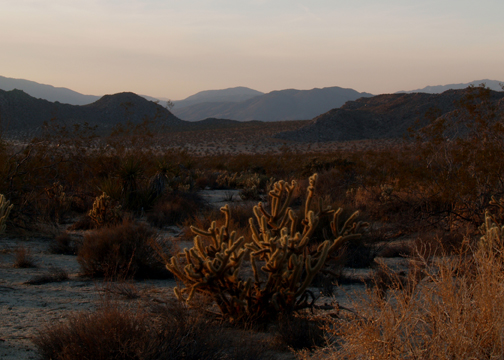
I have made this photo the desktop on my computer – a picture I didn’t think much of when I took it, blown up it takes this lovely 3-dimensional quality on. I feel like I could just step into the picture and be back in Anza Borrego and away from the endless rain of Vancouver spring.
A few blogposts ago I made a comment about needing to end things with ex-lovers – to which I was really speaking about one person in particular. Today, it actually happened, even though I did not expect it to come in the form that it did – when it became apparent to me (through an IM discussion) that this relationship was going to continue to hurt me even with the peace offering of “friendship”. In the end I was called extreme and my desire for understanding the basis of friendship stupid and hung up on in IM to which I responded with an email requesting an end to all contact for a good long time. (Note to everyone: hanging up on me is tantamount to screaming abuse in my world – far more wounding than anything you could say – after a four year marriage to someone who often shut doors in my face and refused to talk to me when upset.)
Perhaps I am extreme when it comes to protecting myself from further hurt. I think there are worse things than that, even if it does result in a little obstinancy at times. I suppose at least now he can tell himself that he tried and I am just being unreasonable *sigh*.
So then I pulled a book of Neruda’s poems off the shelf. A book I have not looked at in at least a decade (Odes to Common Things) and I was reading the Ode to the Violin when I thought – hey! I need to play my fiddle which I have not touched in a couple of weeks. Imagine my disappointment when I opened the case and found the strings all unwound as the support peg at the bottom had broken off completely! I knew that was a possibility as long as a couple of years ago (having noticed a weakness in the wood) but I was still surprised. It needs a bunch of work – that fiddle – so I guess I’m taking it into Long and McQuade downtown tomorrow to see if the luthier is in and can do some magic with it.
At least before all this happened I managed to organize my desert photos for printing as I have promised Darren copies from the trip, as well as pictures of my house (which will one day be his residence too).
I guess today was meant to have a little upset in it, and really, I felt much better once I sent that email to my ex-lover. I think I’ll just spend the evening curled up with a good book (but perhaps not the Neruda).
Reproductive rights and me.
This morning, at 7 am, I attended a breakfast in support of the West Coast Legal Education and Action Foundation with other members of my union. You know, one of those fundraising things involving food and speakers that we get tickets to once and awhile. The food is usually passable, the keynote excellent – you can tell where this movement’s priorities are at (or we could just say it’s more academic than aesthetic and leave it at that).
Anyhow, the speaker this morning was Dr. Sarah Weddington, the woman who fought Roe v. Wade, the case that won abortion rights for women in the US in 1973 (in Canada, abortion rights were secured through the Morgentaler case, also in the same year). A native Texan, she spoke with charm and humour about her role in the case as a brand new lawyer, and how the fight continues for abortion rights in a United States run by a fundamentalist Christian right (she noted, quite rightly, that historically traditional conservatives supported reproductive rights because they don’t believe the government has a right to interfere in the private decisions of individuals). It was an interesting talk and the room was full of people who have fought on legal and political fronts to secure and defend abortion rights in Canada.
It is only on occasion that I see abortion rights speakers these days, but whenever I do – and particularly when pioneers in the movement speak – I feel a fair amount of gratitude. Having grown up post-Morgentaler and Roe v. Wade, the right and ability to access abortion have never been in question to me, and I have exercised that right when necessary at more than one crossroads in my life. (My birth control practice is now foolproof, internal and entirely in my control – again, access to contraceptive choices a right only won around 1960, and essential to the well being and health of women). Hearing women speak about the bad old days before these legal changes, I get almost-teary with a certain relief and realization of how this self-determining right has allowed me to shape the life I have and enjoy now.
And I say this in the context of realizing that more control over these things leaves less up to chance. And chance (or “accident”) is still the reason many children are conceived. It means that women like me, who want to rationalize having children as opposed to just letting them happen, are less likely to experience motherhood at all, having taken chance out of the equation as much as it is possible. My friend Kyla and I have discussed this quite a bit recently, how the ability to choose not to breed often makes it much harder to choose to have a child. Unless it is thrust upon us in a burst of fertilized energy and hormones – we may not logically ever want a child (for all the reasons we know- expense, not the right time, giving up freedom etc) – we may not even be able to feel the need for it in our deepest moments of biological insanity.
Most of my friends who have had children got pregnant without planning – either with partners or without, with partners who left them, with partners who died. And in all cases, the reasons I rationalize to not have children (in the rare occurrences of wanting one of my own) are always overcome in the motions of raising healthy, happy kids. And each of those children are a crystalized surprise in themselves, an explosive joy, and part of their parental’s progress towards their own integral growth. It’s why I’ve learned to get excited when a good friend gets pregnant, whether intentional or not, is that I now see how those chances that blow logic out of the water bring us a magic and new perspective.
So yes, I guess what I’m saying is that I realize there is a tradeoff in these rights – or at least there is for women like me who feel the need to work out every detail before making such a radical lifestyle choice. None of that makes me want to give up my right to reproductive choices. None of that makes me want to discard my IUD and just see what happens. I am so very pleased that I know people who have had fate deliver them from their logic-driven processes, just as I am relieved to be able to make decisions about my life without an extra being to consider right now.
Oh. The wingnuts.
I direct your attention to this article apparently targeting me and some other people who do radical tech work. Not only does this guy not realize that I do not work with riseup (except through ties with resist), but .ca stands for CANADA not California. Loser. I’m going to try to get my name here removed since it is clearly a delusional fabrication – but in the meantime get a kick out of it at my expense. I sure did.
Two deserts and a toxic sea.
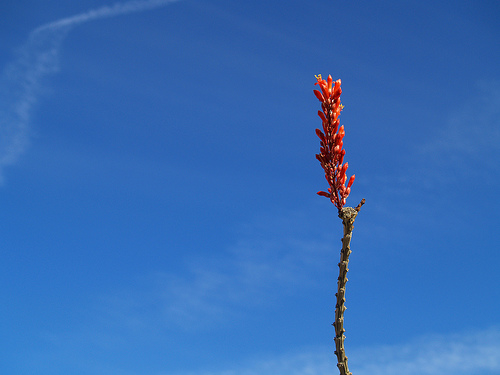
If you are interested in deserts, cacti, toxic oceans and joshua trees, you will find a photoset with the same title as this blogpost on my Flickr account. I have managed to winnow 300+ photos into 50 fairly decent ones for browsing. Please comment on the ones you like – my ego appreciates the feedback.
Although it was brief, my trip to southern California was excellent and packed with lots of hiking, sunshine and even some gin drinking. For the first two and a half days, my friend Aaron and I tripped around Anza Borrego which is a stunning, sea-level desert north of San Diego… and then I met up with some other folks and traveled east to the very toxic Salton Sea for some picture taking and then north to spend a night and a day in Joshua Tree (high desert – a very different ecosystem). Tuesday was spent bumming around with friends in LA before heading out – and here I am at home again! Sunburnt and cactus-scratched has never felt so good.
My first vacation in a year and a half – and a reminder that I should take some more of that time in the holiday-bank 🙂


