Red Cedar
More apocalypse, less angst
Just a little update.

I’ve been blogging everywhere this week except here! But since I’m about to embark on a four-day holiday to Galiano Island I figured I should probably put in an appearance here today with a quick garden update. Not that there’s much to say except that my beans are sprouting in the garden, and quickly! Which means that planting them a week earlier than I was supposed to didn’t hurt them.
I should note that for the last week or so we’ve been regularly eating out of the garden – in particular radishes, joi choi, lettuce and the first spinach last night. Last Sunday’s shopping was the first time in months that I haven’t bought greens and I’ll be happy to see less and less produce in my grocery basket as the summer comes on and we’re taking more from the garden.
When I get back from the Island, I think it will be time to plant out my cucumber starts and possibly even my peppers which are currently languishing in the studio out back, all ready to flower with nowhere to go until I’m assured of warmer temperatures. I’ve got more of everything to plant, but the boxes out back are starting to look pretty damned green!
In other gardening news, on Tuesday we got the $1300 grant to move ahead with the boulevard gardening project and while at the ceremony, one of our project folks ran into someone from the city staff who was excited about us doing food plantings (including possibly fruit trees) as part of our project and suggested that the city might kick down for soil testing so we could be a community pilot project. We’ve got our first planning meeting next week so from there we’ll start mapping out the work plan, and figuring out what exactly to spend that money on.
It is definitely spring in the East Side garden, and I’ll be updating with more photos soon!
Inspired. And a bit nervous to begin.
Goddamn I’m awash in ideas and inspiration right now! In addition to the activist-interview project I mentioned in yesterday’s post, I’m also decided on attempting an audio slide show piece about the boulevard-food-gardening project we’re embarking on with our neighbourhood grant this summer ($1300!). This will feed both my need to learn some new multimedia skills, as well as provide a nice document that could be used to convince the city to continue with this small grant program. (Brian went to the cheque-awarding last night and apparently more than 60% of the grants were handed out to neighbourhood food security projects of some incredible diversity).
So I’ve dusted off the digital recorder I bought two years ago (and haven’t used) and am taking it away this weekend to practice interviewing and recording with Brian. And I’m trying not to get pre-emptively frustrated by my rustiness at interviewing or crafting audio stories. It’s been so long since I took those sound courses in university, and even then it was all analog.
So far my plans look a little like this: 1) take lots of photos of everything related to my two project themes this summer, 2) get people to answer a series of questions via Facebook status updates for inspiration and ideas, 3) start getting people to do short interviews with me on one of my project themes, 4) start researching archival stills on my project themes. Oh – and yes, I need to learn all about the software to edit the audio and then the slideshow.
Good summer projects? It’s just investigating stuff I’m interested in already, so I’m hoping it doesn’t become too onerous.
For those who missed it last week, I posted about the boulevard grant at Among the Weeds. Additionally, I posted a bit of a rant at Viaduct yesterday about the crazy fighting over Grandvew Park.
Retrospectives.
This year seems to be one of retrospectives – or at least in my case I’ve now been asked to write two of them in commemoration of different activist histories. The first one was published last month in Resistance Magazine (posted below) in honour of the fortieth anniversary of Earth Day. The second I’ve been asked to write on twenty years of activism in BC for the Under the Volcano program this year, as well as participate in a workshop on the same topic. This is UtV’s twentieth anniversary and last year in operation, sadly bringing a particular icon of BC activism to a close.
While the forty-years piece was clearly a “history” piece for me – I’m not quite forty yet and can really only claim 23 years of involvement in activism – this twenty-years piece feels much more like a walk down memory lane. On Facebook yesterday I asked people to give me their action highlights of the last twenty years which generated a nice timeline of my own activist trajectory, including actions and groups I would have entirely forgotten otherwise. Definitely helpul as I work through my own process of determining what it is I want to say about it all. It’s not a chronology after all, it’s meant to be a reflection on the role and relevance of BC activists – or something like that anyway.
So I’m thinking about all this stuff and realizing how nostalgic I am for certain actions and movements and people – not to mention the twenty-two-year-old me who really believed that the revolution was right around the corner – and I’m thinking how lovely it would be to go and interview some of my friends of the last twenty years about their activism and their lives and whether their thinking about things has held up or not – how their activism shaped their lives. Not for the retrospective piece of course – but for another separate project. A blog project maybe? A book? A series for one of the activist papers? Perhaps even a series of audio shorts for Co-op radio?
Another project may not be possible, but I do think having worked across such diverse causes and communities gives me a different perspective than a lot of folks would otherwise hav. Just thinking aloud right now, perhaps some potential here for some summer-projecting?
Not too little. Not too late.
Confrontation and conflict in the last forty years of Canadian environmentalism.
(Published in the Earth Day issue of Resistance Magazine, 2010)
 “It is to this new-found resolution to reassert our indivisibility with life, to recognize the obligations incumbent upon us as the most powerful and deadly species ever to exist, and to begin making amends for the havoc we have wrought, that my own hopes for a revival and continuance of life on earth now turn. If we persevere in this new way we may succeed in making man humane … at last.” Farley Mowat, from Sea of Slaughter (1984)
*
In 1988 I traveled into the eye of a massive clearcut for the first time in my life, beyond the beauty strip and up a rough logging road an hour from the highway. The destination was the Carmanah Valley and I was bounced along in the back of my friend John’s Land Rover with a group of high school friends determined to participate in the movement to save the valley from the logging industry destroying Vancouver Island’s old growth. Even though I grew up on a loggers’ island in a province dominated by the forestry economy, I had never seen anything so devastating before: the slash burns right up to the edge of the road, the choking dust filling the creeks with silt and turning them thick brown, the tallest trees I could imagine jumbled together as “waste” wood because they weren’t straight enough to bother hauling out of the forest once they were felled. Here and there, chewed up greenery poked through, fireweed had begun its long process of repairing the soil, but I remember distinctly the fear that pricked along my skin as I took in that scene: it already seemed too late to change anything so what were we doing there?
Fortunately we were doing there what thousands of people would over the next handful of years, spending time in the luscious uncut parts of the valley in order to take back that experience to the front lines of protest with the vigor we would need. Fortunately I came to this at a time when the environmental movement was in tremendous upswing in Canada and it *mattered* what high school kids thought about the devastation as we joined the demonstrations and blockades to save forests, rivers, and wildlife in BC and the rest of Canada in the decade following.
*
In British Columbia, it’s customary to believe that modern environmental activism begins and ends with Greenpeace. Whether talking Canada or the rest of the world, GP and its offshoots are still carrying out highly visible actions and fundraising millions of dollars per year from supporters, and they’ve been kicking around for a very long time. But with that success Greenpeace and its supporters have had a tendency to write their story to the exclusion of organizations that came before and afterwards. Before Greenpeace, the stage was being set for them by other Canadian individuals and groups who realized by the late 1960s that the Canadian economic reliance on resource extraction wasn’t sustainable and that the environment mattered as much as stopping the bomb or securing womens’ liberation. Whatever sparked it? Toronto historian Ryan O’Connor traces this growing awareness back to a 2-part CBC documentary that aired in 1968 titled The Air of Death. This exposé took issue with the deadly impacts of air pollution in industrial Ontario. Highly controversial, The Air of Death alarmed Canadians with graphic accounts of animal birth defects, evidence of poisoned food supply and human health problems which could be traced back to the phosphate industry.
Boulevard brainstorming.

For the last two months, B. and I have been attending a local community gathering at a neighbour’s house. Every few weeks we get together to discuss potential community projects, ideas we have for making more connections with other people in the hood, and positive environmental actions we can take to encourage more sustainable practices on our blocks. We haven’t done much more than get to know each other yet, but in the brainstorming process we applied for two neighbourhood grants – one for a block party, and one for a boulevard gardening project. I am pleased to say that on both counts we’ve been successful and thus have $400 towards an end-of-summer gathering plus $1300 for the boulevard idea.
If nothing else, our group has proven itself successful at raising money.
The boulevard project is aimed at encouraging people to tear up the lawn in the boulevard in front of their houses and replace it with more sustainable, drought-tolerant, climate-cooling plants instead. Additionally, we would like to see more benches and other type of seating for people to visit around, not to mention the introduction of more food plants in the neighbourhood overall. I would really like to see us experiment with a mix of native and food plants (not to mention native food plants) which are particularly adapted to the former forest Hastings-Sunrise was.
On Wednesday night, instead of our regular meeting, the group took a neighbourhood walk about to look at what’s out there in the way of boulevard gardening already. Being in Vancouver (and in particular East Vancouver) we’re in a really garden-centric place, not to mention a somewhat artistic community, so there are tons of examples within three square blocks of our house to draw ideas from. The walk gave us a chance to walk, chat with each other, and bounce ideas around all at once which opened up a whole new meeting space for the group – plus we were joined by four or five new people who had been meaning to come out previously (I think the walk appealed more than a meeting might have).
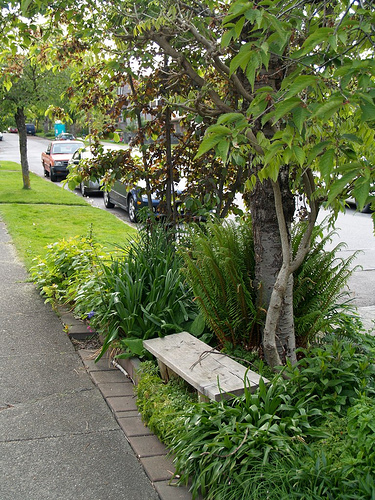
I won’t do a detailed summary of each boulevard garden we looked at (about ten in all), but I did take over 100 photos so I could keep in mind what we discussed at each plot. Overall though, I think the gardens that impressed the group most were those which:
- were lush and a little wild – as opposed to overly manicured with isolated perennials
- had features like the bicycle garden above, or a bench, or a little sculpture made of golf clubs – though too many “knick knacks” were a turn off for some people
- were mainly native plants
- had good access to the street in the form of paths through the garden
- didn’t crowd out the roadside or the sidewalk
- had food plantings mixed in (there was only one of these – with some bright chard alongside the flowers)
- used recycled materials for planters such as concrete rip-rap or driftwood.
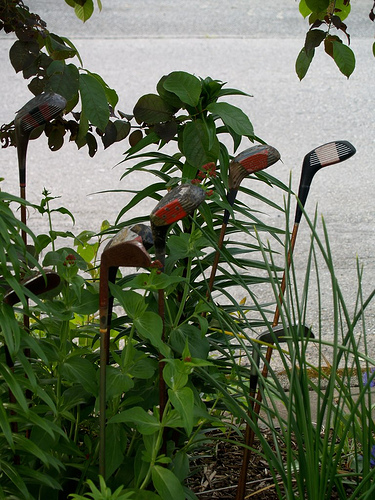 With $1300 we think we can do quite a few boulevards in our hood, particularly if we go after local businesses for donations of plants and other materials and scout Craiglist for cast off paving brick and other recycled goodies. I’m also thinking I should get ahold of the landscapers who did some of our backyard patio because they seem to have stuff they pull out of people’s yards in the course of their work.
After the walk, we met in our backyard for cookies and wine and tea where I got to show off my garden and the new studio and we did a little more brainstorming around how to move ahead on the boulevard project as well as the block party. I’ll be excited to write here as we develop the boulevard gardens around the hood, and hope by mid-fall we have a few decent projects to show for our work. Next is organizing a sub-committee to actually develop an approach and a rough plan which I’ve agreed to do, and then we’ll see about getting our work gloves on!


 Red Cedar