Red Cedar
More apocalypse, less angst
In the bookshed: Soil Mates
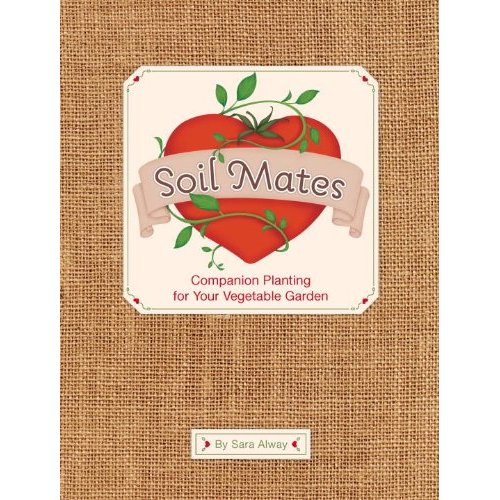 Soil Mates
Sara Alway
Quirk Books, 2011
Oh Valentine’s Day! What better way to celebrate than to mate your plants in a match bound for glory? That’s just the idea in the new Quirk Books release – Soil Mates: Companion Plants for Your Vegetable Garden
Soil Mates is an easy entry to the world of companion planting – a style of gardening that pairs certain combinations of veggies, herbs and flowers together for increased yields and pest resistance. Included here are twenty pairings described in detail, along with recipes that use the paired veggies as main ingredients *and* advice on seed starting, natural pest resistance, container gardening and planting timelines.
Useful as all that is, what really makes this book for me is its style and design appeal. Written like a matchmaking guide to plants (with sections including turn-ons, turn-offs, love triangles, stalker alert and foreplay), Sara Alway gets away from the dry language found in many garden how-tos. The illustrations are bright and inviting and include helpful visuals for plant placement and spacing – and overall this is a visually appealing book in the hand or on the shelf. This is definitely something I would give to a new or burgeoning gardener as a stocking stuffer (or a Valentine’s Day gift) for something fun and informative (even a little romantic – gotta watch those veggie pairings before they run off and elope after all).
Overworked
As I prepare myself for another week of work, this passage comes to mind… we may tell ourselves otherwise, but we are certainly overworked by any measure.
One of capitalism/s most durable myths is that it has reduced human toil. This myth is typically defended by a comparison of the modern forty-hour week with its seventy- or eighty-hour counterpart in the nineteenth century. The implicit — but rarely articulated — asumption is that the eighty-hour standard has prevailed for centuries. The comparison conjures up the dreary life of medieval peasants, toiling steadily from dawn to dusk. We are asked to imagine the journeyman artisan in a cold, damp garret rising even before the sun, laboring by candlelight late into the night.
These images are backwards projections of modern work patterns. And they are false. Before capitalism, most people did not work very long hours at all. The tempo of life was slow, even leisurely, the pace of work relaxed. Our ancestors may not have been rich, but they had an abundance of leisure. When capitalism raised their incomes, it also took away their time. Indeed, there is good reason to believe that working hours in the mid nineteenth century constitute the most prodigious work effort in the entire history of humankind.
Consider a typical working day in the medeival period. It stretched from dawn to dusk (siteen hours in the summer and eight in winter) but, as the Bishop Pilkington has noted, work was intermittent — called to a halt for breakfast, lunch, the customary afternoon nap and dinner. Depending on time and place, there were also midmorning and midafternoon refreshment breaks. These rest periods were traditional rights of laborers, which they enjoyed even during peak harvest times. During slack periods, which accounted for a large part of the year, adherence to regular working hours was not usual… The pace of work was also far below modern standards — in part because the general pace of life in medieval society was leisurely.
Juliet Schor, The Overworked American

Sewing, book reviews and getting ready for the bees

For your visual pleasure – here is a phone-picture of the market bags I finished this morning which are a housewarming present for some friends. I really love making these because they are so straight-forward, and the inside pockets can be customized for whatever the bag is being used for. I also managed to make a simple zippered pouch today using this tutorial. I had started with another tutorial that just wasn’t doing it for me, but since there about a hundred different explanations for making zippered pouches on the web, it was really easy to find a better one. I can’t say it turned out perfectly, but for the first time ever, I sewed a zipper into something and that’s progress in my books.
I’m hoping to have some garden pictures by tomorrow, along with some of the finished beehive because B. and I were hard at work this morning (early, before the torrential downpour started) clearing out our bee-space at the back of the garden. Over the winter it became our bucket and planter stashing spot and so we moved everything out of the way, planted a couple more vines along the back fence, and re-mulched the area with half-rotted leaves and bark mulch. Tomorrow morning we’re going to work on putting the top-bar beehive together now that I’ve glued all my wood – I’m a bit nervous about how this is going to go, but I suppose the worst that can happen is $10 of wood gets trashed and I get frustrated, so that’s not particularly awful. On the other hand, I believe my bees are on their way in the mail (c/o West Coast Bee Supply) and I want to make sure things are all set-up for when the package arrives.
And for those of you who are curious – yes, I am buying a package of bees, they come in a box with a caged queen and apparently 3 pounds worth is what I need to start a hive.
Look forward to lots of book reviews in the next couple of weeks here as well as I try to get through the stack of books for review in an orderly fashion. I’ve been really blessed lately to have a number of great volumes end up in my possession and I’m working my way through them for posting here as the spring season kicks off. Wet as it was this morning in my garden, I found myself getting really excited as we moved planters around and tidied up a bit – I’m hoping for another great gardening year with a steep learning curve on the bees and some fine-tuning of my planting plan from 2010.
It’s a month for loving yourself!
I’m doing a weekly program at the YWCA right now which I signed up for in January to help motivate myself back into daily workouts – something I was in the groove on for almost three years before I just petered out and stopped going. Believe it! is about developing healthy habits and mindframes around our bodies and our goals – and about ten of us meet on Wednesday nights for both coaching and workouts of various kinds.
Last night we had a coaching session on negative self-talk, which is something I am *highly* aware of in myself, though I’ve never been able to put an end to it. Of course lots of discussion of inner fears and torments ensued and it really triggered me to hear that these awesome women have so much internal struggle (cue: self). But then again, as that video (which made me cry when I saw it on FB yesterday – thanks Joanna for posting it) reminded me – everything that is in my head was fed into it from outside of my head. That is, we live in a society that can be cruel, sets impossible models to follow, engages in shaming and mocking behaviours, and is generally smug in its attempts to force conformity. And in addition to internalizing that, we also engage in externalizing our own feelings of inadequacy through negative verbalizing about ourselves and others. While most of us engage in suble ways – we support a mean-spirited and money-hungry media culture to do the rest of our judging and sizing-up for us.
At dinner on my birthday, B. and I were talking about just this subject – about how I’m really content in my life and where I’m at right now – and yet I’m still nervous about an upcoming high school reunion (20 years, omfg) and whether or not other people (who I haven’t seen since I left the graduation dance early in 1991) will think I’ve made enough success of my life. Because, you know it’s not important that *I’m* happy, it’s really important that virtual strangers care about what’s going on for me. Oh, and of course it’s really important that no one think I’m fat either. Because after all this time I’m sure everyone else I went to school with is in perfect shape. Uh huh.
The thing is, this negative self-image is limiting! During last night’s exercise we had to image where we would be without one particularly destructive belief of our choosing…. but I think my answer would be the same no matter what negative self-belief I picked: Without [insert negative belief here] I would be happier, more joyful, less stressed, more resilient and less worried about the opinions of others.
(I know this is true, because already in my life I’ve done some of this work and it has lead to a more open, joyful me than I would have been otherwise.)
Over at the Fitness Cheeleader, Janice has declared February the month of self-love which is fitting in with all these other things I’m thinking about. The more we love ourselves, the more we stop judging ourselves – the more we can love other people and reserve our judgement on them.
So I’m going to start right now. One thing I love about myself is my willingness to engage with the world – with different ideas, projects, fitness classes, community groups and academic courses. And also I have a huge capacity for love. And finally, not to be too smug about it, I have most excellent cleavage.
How about you?


