Red Cedar
More apocalypse, less angst
Sage infusions
 I cleaned up my garden a bit today – whacked the weeds on the edges (my once a year use of the stihl), staked up some floppy tomatoes and raspberries, and hauled out a harvest basket full of produce. Very satisfying for a garden that I consider only “ok” this year due to the weather. One of the plants doing best at the moment is a sage that I planted when we moved in three summers ago. Not only does it produce for most of the year, by mid-summer it puts out an incredible amount of beautifully scented leaf. Like most herbs, I really prefer to use sage fresh, so I’m not inclined to dry too much of it – so this year I decided to get on the infusions. Late summer is the exact right time to be thinking about such things – for the late fall dinner party “wow” factor.
Today I put up a Sage-Rosemary olive oil and a Sage-Lemon Vodka. I have no idea what either of these will turn out like, but given the ingredients – and a method I know well – I’m feeling confident these are worth sharing.
Sage-Rosemary Olive Oil
Pack a clean jar tightly full of sage leaves, add some rosemary sprigs and a couple cinnamon sticks or peppercorns if desired. Fill the jar to the top with good quality extra virgin olive oil – make sure to cover everything. Cover with a cheesecloth and secure with a rubber band or jar ring. Put away in a dark place for a month or more. Strain to use.
Lemon Sage Vodka
I used this recipe from the Cap and Hare forum which is as follows:
2 – Lemon Peel
3 – 8″ Sage – Fresh
2 cups – Simple Syrup
4 cups – Vodka
Create your Simple Syrup.
Place the flavorings in the bottle.
Pour the Simple Syrup over the flavorings while the syrup is still hot.
Add Vodka to fill the bottle, usually about 4 cups.
Age for 1 month in a cool dark location, closet or cabinet is fine.
Remove Lemon Peel & Sage and filter out all of the small bits with a coffee filter to clear the Vodka.
Sweeping out the financial house
 I am in the midst of a financial house-clean in preparation for reducing my work hours to four days a week in the fall. Despite my fears at having less in my pay packet, I’m feeling great about tightening things up and putting my spending and accounts under a microscope. As I’ve written here before, Mint.com has really opened my eyes by alerting me to monthly and annual fees, interest payments and other items that otherwise escape my notice. After using it for several months, it is clear where my money is going and what steps I need to take for financial responsibility:
- No more extraneous accounts! I have a lot of accounts set up – a legacy of moving cities, having various loans and mortgages and switching banks. Of course, more accounts mean more hidden fees (even on a no-fee account like my RBC Savings which is charging me $2 per month in bankbook fees) which really add up over the course of a year.
- Switching to no-fee banking and credit cards. Using Mint, I have realized that my credit cards and bank accounts charge me close to $400 a year in fees. I have since switched to the ING Direct No-Fee chequing account and applied for a no-annual-fee credit card so that I can eliminate my fee-based accounts in the fall.
- Getting rid of stupidly high amounts of interest. Seeing my interest payments roll into my email account as “alerts” every month has really underscored the importance of paying off my debt – since I was paying close to $100 per month in interest alone. Fortunately a well-timed work payment allowed me to pay off the highest interest debt, and I’m working on the lower-interest portion now.
- Putting savings aside first. There are short-term savings and long-term savings. Right now, our house is the long-term saving – short term savings are there to help with car repairs, house emergencies, and vacations. Just because I am working less, I can’t skimp on this (or else it means accumulating more debt).
- Moving to a “cash-only” system. Which means that on payday I take out the cash I’m allowed to spend, and that’s all I get to spend. If I do use a credit card for a purchase, I immediately take the cash out of my wallet for the credit card payment and set it aside so I don’t spend it twice. Dealing with myself this way feels a bit infantile – but let’s face it, spending money in plastic form where the wallet is never empty is far too easy.
And that’s the plan I’m working with right now – really a reorientation away from plastic cards and debt and towards savings and reduced spending overall. Which is a little challenging given my somewhat lax habits and the fact I have a crap-load of school books to buy this summer. But I really think working one less day a week is worth it!
Ladyslipper Lake in ice
 A photo from our recent trip to Cathedral Lakes Provincial Park. This is Ladyslipper Lake at the end of July, replete with icebergs! I love the reflection of the mountain in between the floating ice.
More canning chatter.
 Among the many conversations I had during the garden tour was lots of chatter about canning. How to make it simpler especially – which I am all about. Blanching tomatos and peaches? Apparently it’s not necessary as long as you wash well and (in the case of peaches) get off all the fuzz. Sugar syrups? Nah, just put a tablespoon of honey into each jar and fill with boiling water. And on it goes.
Two days after the garden tour, we were off to the interior for some high-alpine camping in Cathedral Lakes Provincial Park – and on the way home from there we picked up our first interior fruits – 2o pounds of bing cherries and 20 pounds of apricots. A tad more expensive than last year, I’m sure the late start to summer has hampered good production – but still Keremeos has the best deals going and we couldn’t resist.
Which means now we have a larder full of the following:
- Cherry pie filling
- Cherry-apricot brandy sauce (for meats, or anything else) – several of these in gift-size for the holidays
- Cherries
- Apricots
- Pickled Red Cabbage (the cabbage from my garden, how satisfying)
August will be the month of peaches and tomatos – salsas and chutneys which we eat a lot of. Not to mention more pickled things and I’m also hoping to get to canned sauerkraut in the fall.
I really do find the late-summer food stockpiling so very satisfying – a lot of work and cost outlay over a couple of months puts so much amazing stuff in our cupboards for the rest of the year. I am also really grateful that my partner does so much of the prep work!
In any case, here is a recipe share:
Cherry-Apricot-Brandy Sauce
(almost firm enough for toast, makes a nice sauce for red meats or pork)
Makes 6-8 250-ml jars
3 cups of cut apricots
4-5 cups of pitted cherries
2 cups of water
1 cup of sugar (or more to taste)
1 box no-sugar-needed pectin
Brandy (the cheap stuff is fine)
(alternately, you could omit most of the water and the pectin since this is a sauce – I like a little “set” in my sauces and the water makes it go further)
- Boil the apricots, cherries and water together until the fruit is crushable.
- Add sugar, boil again. Add pectin and boil for a full minute.
- Into sterilized jars drop 1/2 a tablespoon of brandy and 1/2 a teaspoon of lemon.
- Fill jars, process for 10 minutes in water-bath canner.
(Note – this is a completely unscientific recipe, but with the fruit, lemon juice and alcohol – contains lots of acid to prevent the growth of botulism. As with all canning recipes, please follow all sterilizing and processing steps you would normally.)
Hastings-Sunrise garden tour success!
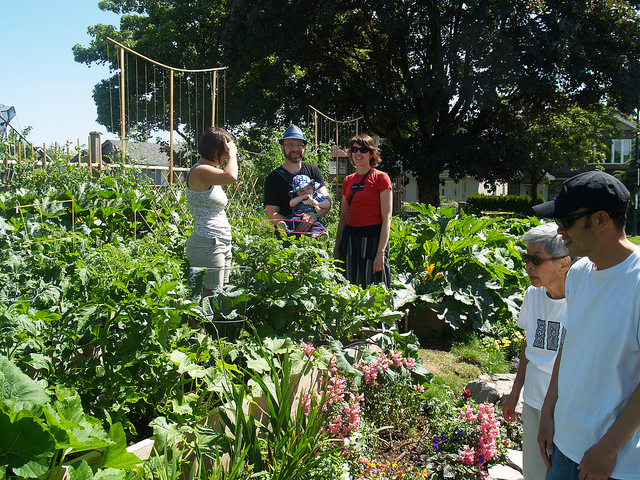 It’s been awhile since I’ve posted here, summer in the garden being what it is, and the fact that I was totally wrapped up in organizing the Summer of Sustainability Garden Tour which took place on July23rd.
Despite my gnawing misgivings leading up to the event (what if no one shows up? what about the weather? maybe I should just give back the grant so someone else can use the money) – I can happily say I was wrong and our neighbourhood rocks! See here for more photos on Flickr.
Three workshops went off without a hitch, our master-gardener was in fine form answering questions all day, and we gave away hundreds of free seed packs as well as four gardening books (in the raffle). At final count, we believe that 120-150 people participated in the event – most people going to an average of four houses, and each house getting between 20 and 30 people visiting. Which is pretty good number for a word-of-mouth event like this one.
In the end, all of our participating households said they were glad to be a part of this and it gave them a chance to meet people from their neighbourhood. For my part, I met lots of people who I hope to hang out with again (we’ve already got a dinner invite out of the deal – yay neighbours!)
I will be putting together a report for the grant wrap-up event in the fall, which I will surely post here and elsewhere, but for now I just wanted to say – PHEW! I am so glad that’s over and proud of how it went.
For all the people who want it to happen again? Let me know and next year we’ll do it with a community committee 🙂 – cause that is a hell of a lot of work for one person.


