Red Cedar
More apocalypse, less angst
Same time next year?
 Four years ago today, at 4 pm, I walked into a restaurant in my neighbourhood and met the man who is my match. One year ago today, at 4 pm, I married him at this spot on the west coast of Vancouver Island. Today, at 4 pm, we’re sharing a moment again in this most gorgeous of places – crazy in love, content in companionship, and ready for another year of the beautiful life we have together.
Autumn dahlia
 This is my first year with dahlias in the back garden and I am definitely a convert. Hopefully I get lots of tubers for expanding my flower patch next year!
Place in Euripides’ Medea
 Class discussion about Medea raised some interesting points which hadn’t occurred to me on my first two readings of the text where I focused mainly on gender and the division between revenge and justice. Specifically some inquiries related to place were raised that I thought worth noting for future reference.
Foreign-ness
Something I had given very little thought to when reading the text was the whole notion of “othering” that Medea embodies. Not only is she from “away” (dark, Asian, implied to be from a barbaric place) – but the feeble excuse that Jason uses for his marriage to Glauce is that by marrying Corinth royalty, he will cement a place for himself, his children (and by extension Medea) in a city where they are otherwise foreigners. Medea is driven to murder at the point where the King exiles her – his fear stoked as much by her foreign origins as her threats. Medea, barely settled in a strange land, living on the edge of the city where her husband has abandoned her, is pushed once again into landlessness.
Homelands
And of course, she can’t go home because she has murdered her brother and betrayed her father. More than once Medea reviles Jason for the position he has put her in – barred permanently from the land of her birth, she will never again call a land “home”. In Ancient Greece (and really, many parts of the world today) this would be a truly pitiable state – for we are defined by our people and the customs to which we are born. Not only is Medea feared because she is believed to be a witch, but because her habits come from elsewhere and she has knowledge that the people of Corinth do not (herbal medicines and poisons both demonstrated in the text of the play). In her own land she would be revered as the daughter of royalty, but under the spell of the God Eros she has given it up for Jason. This causes a deep psychic rupture – is it any wonder that she is distraught by it? To lose one’s homeland is to grieve deeply.
Oaths
Much is also made of oaths in the play – that Jason’s punishment is somehow warranted because he has broken an oath to the Gods to stay faithful to Medea. As our prof pointed out – we no longer make oaths when we marry, but contracts – but there are still some times that we do make oaths even in our modern context. What is it that the oath implies? Belonging, essentially. We make an oath to an institution when we wish to be included within it and are willing to adhere to and emulate the collective values of that institution. When Jason breaks his oath, he is rejecting the power and will of the Gods and is in essence suggesting that he sees himself outside or above his culture. This demonstrates profound hubris, and in Greek mythology hubris pretty much always gets punished severely.
The question which I haven’t resolved even now is whether Medea remains a somewhat sympathetic figure even though she commits the most unspeakable crime of our human society – filicide. Jason has left her in an untenable spot: landless, unable to provide for her children, and certain that if she leaves them behind in his care that his new wife will have them dispensed with (see the wicked step-mother plot in one of its earliest incarnations) or else they will be treated cruelly. Does she do them a service to end their potential suffering as landless migrants – the suffering that so enrages her? For as much as Jason believes that her anger is rooted in her sexual passion for him, it is clear in her language that she is experiencing much more profound loss than a husband. Her family, her identity, her homeland all float in the broken oath of Jason – her actions a desperate maneuver even the balance so that she can be released to something greater.
Autumn Wool
 If you’re on my Facebook or Flickr, you’ve already seen this jacket – a hybrid of a bunch of sewing mistakes which started with choosing the most unflattering pattern ever for my figure (Sew Serendipity is an awesome book for learning to sew, but for some reason every jacket/tunic/dress in it has a high waistline which basically cuts my short body in half and makes me look a little rounder than I would like).
Body-image-pattern-issues aside. The green wool (vintage boucle) I got for $6 at an estate sale in August. The silk on the scarf was $5 at Dress-Sew. The brushed cotton plaid was leftover from a plaid-jumper that didn’t work and ended in the scrap pile. Plus two spools of thread = $15.
About half-way through the jacket, I realized how much it wasn’t going to work with front closures. The jacket fits and all, but somehow the fittedness plus the flare partway down only served to accentuate aspects of my body that I don’t like. But even so, I decided to keep on with it because it was really just an experiment in jacket-making and I wanted to see how it would turn out. I really love the fabric and I didn’t want to resign in failure – so I thought perhaps I would just close it at the top with a button or a large pin and be done with it.
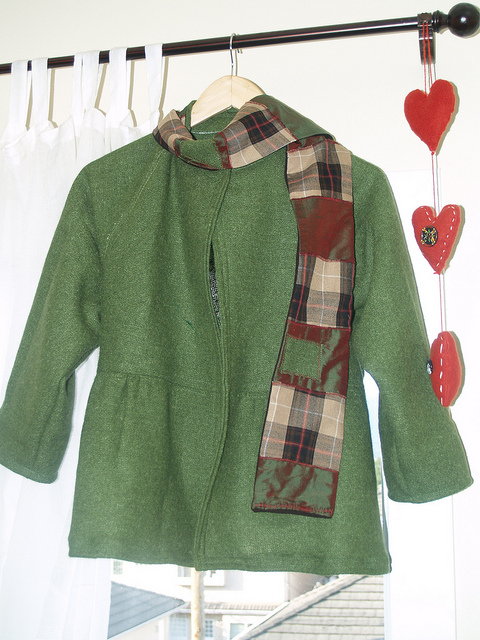 But…. without any closures on the front, the jacket looked really plain. The night I finished hemming the sleeves, I wasn’t very happy with my sewing-self and so I decided to work on a scrap-scarf.When I have a sewing fail, I always return to something I know I can do so as just to get right back on the horse. The scarf was devised with ultimate-scrap appeal – the edges of the fabric are joined with a top-stitch, the wool bits were pasted down with a simple zig-zag after being cut fairly randomly to fit on the silk panels….. and I backed the whole thing in chocolate-brown piece of wool from the same estate sale as the boucle. I love these scrap scarves!
And then I had one of those magical, inspirational flashes…. what if I attached the scarf to the jacket and used the scarf instead of a button as a make-shift enclosure around the neck? This would give the neck more of a collar-like importance and add to the overall jacket appeal. I felt super-brilliant for a few minutes as I pinned it on and tried it. With an extra snap added at the top of the jacket for stability – it totally worked! I stitched it on and ended up with this autumn wool jacket/cape/scarf combination that still isn’t overly flattering but it doesn’t matter because wearing it open shows off your actual figure underneath. Brilliant yes? And now I get to move onto something else!
Some initial thoughts on Medea. (1)
One of two readings for tonight’s class – I’m having a hard time coming up with anything about Medea that doesn’t seem cliche – perhaps because this myth of the passionately, murderously motivated woman is so done, so analyzed, so interpreted through every possible lens – that I’m not sure what I could possibly add to the discussion (other than the impressionistic retelling above which I found on YouTube).
While re-reading the play Monday I was thinking about Joseph Campbell’s theory that myth is present in culture in order “to come to terms with the world [and] harmonize our lives with reality.” Not that women murdering their children in Ancient Greece was probably much of a reality, but what’s interesting about Medea is that her vengeful actions – the murder of Jason’s new wife and father-in-law, and then her two children (sired by Jason) – are apparently supported by the gods who aid her escape with a winged chariot. Following the narrative, the reader/listener/viewer is to understand that Jason’s punishment is just, because he has broken his oath to the gods by spurning Medea for another wife (he had sworn eternal faithfulness).
For his part, Jason is no counterbalance to the murderous passions of Medea, so blinded by his need to save face in front of his new family that he delivers the instrument of his new wife’s death to her boudoir. Are we to understand that he is bewitched or unable to comprehend the full horror of what his former love might be planning? Or is it that his self-rationalizing excuses make him blind to the pain and suffering he has caused others (the exiled Medea and her children). And is this in part what he is ultimately punished for?
Although Jason attempts to rationalize his choices and bring Medea to see the reasonableness of his actions, his spoken motives are clearly false as betrayed by the reaction of the princess to his children (she recoils from them). Jason is not only shirking his marriage duty to Medea but his parental duty to his children – for in order to have the love he wants he is willing to see his children cast out. It’s difficult to see Jason as any less a creature of passion though his appears more tightly controlled, or at least, more socially acceptable. On some level we are supposed to sympathize with Jason, but it is hard to get around the fact that he is willing to overthrow all prior commitments for increased power and wealth.
I suppose, too, that Medea leaves us with the question of the dividing line between revenge and justice. While the chorus remains supportive of Medea in her quest to kill the princess and her father (justice), they vocally oppose the killing of the children (revenge). While Jason is enraged at “justice”, he is destroyed by revenge (womanized through the act of wanting to perform burial rites). It is the act of revenge which deviates both actors from their gendered scripts, and releases Medea from her tortured love as she flies off into the skies (to be later married in another myth).
All curious lessons from the collective mind of myth. Explanations for madness, revenge, and murder? An exposition on the importance of duty and loyalty? Both?
More thoughts soon – stay tuned.


 Red Cedar