Red Cedar
More apocalypse, less angst
Post #3242: Not ready Yet
Yesterday I received an invitation to a June 2022 wedding in New York, one that was delayed due to the pandemic and is now rescheduled. Though I knew it was coming (my friend had told me on a phone call), it still felt shocking, and I couldn’t tell whether the tension that followed came from a place of anticipation (the novelty of a different vista!) or fear (omigod, I can’t ever get on a plane or go to the US again!) I expect it was a mix.
I clicked yes on the e-post RSVP, but I won’t make the actual decision and reservations until sometime next spring. With new variants kicking around, it still seems impossible we will ever travel further than our bioregions again. And to be honest, I wouldn’t be all that sad about it. Travel is the thing I’ve missed least in the last fourteen months, even as much as I’d like to see faraway friends and family again.
Post #3241: Dye Studio Planning
Every summer since we’ve moved here, I’ve decided that *this* is the summer I am going to set up an seasonal dye studio under the eave of my sewing/weaving/home office space, and every summer I get way busy and it doesn’t happen. You would think that 2020 (when visitors were far fewer and travel non-existent) would have been the year but I had a bit of pandemic-depression and very little happened in my studio at all except a bit of sewing.
This year, however, I have a place to start and a focal point as Felicia Lo from The School of Sweet Georgia (and Sweet Georgia yarns) has announced a Natural Dye Study group which will commence in June. The study group will combine the classes of caitlin ffrench (available through the School) with some additional online workshops, and has an online forum for sharing and asking questions. Though I tend to be bad with following through on online instruction, a time-bound learning period and real-time virtual community are things I know will help me stay engaged. I do think this summer will be a tad busier than last, but still we will be sticking pretty close to home as we won’t be fully vaccinated until August or September.
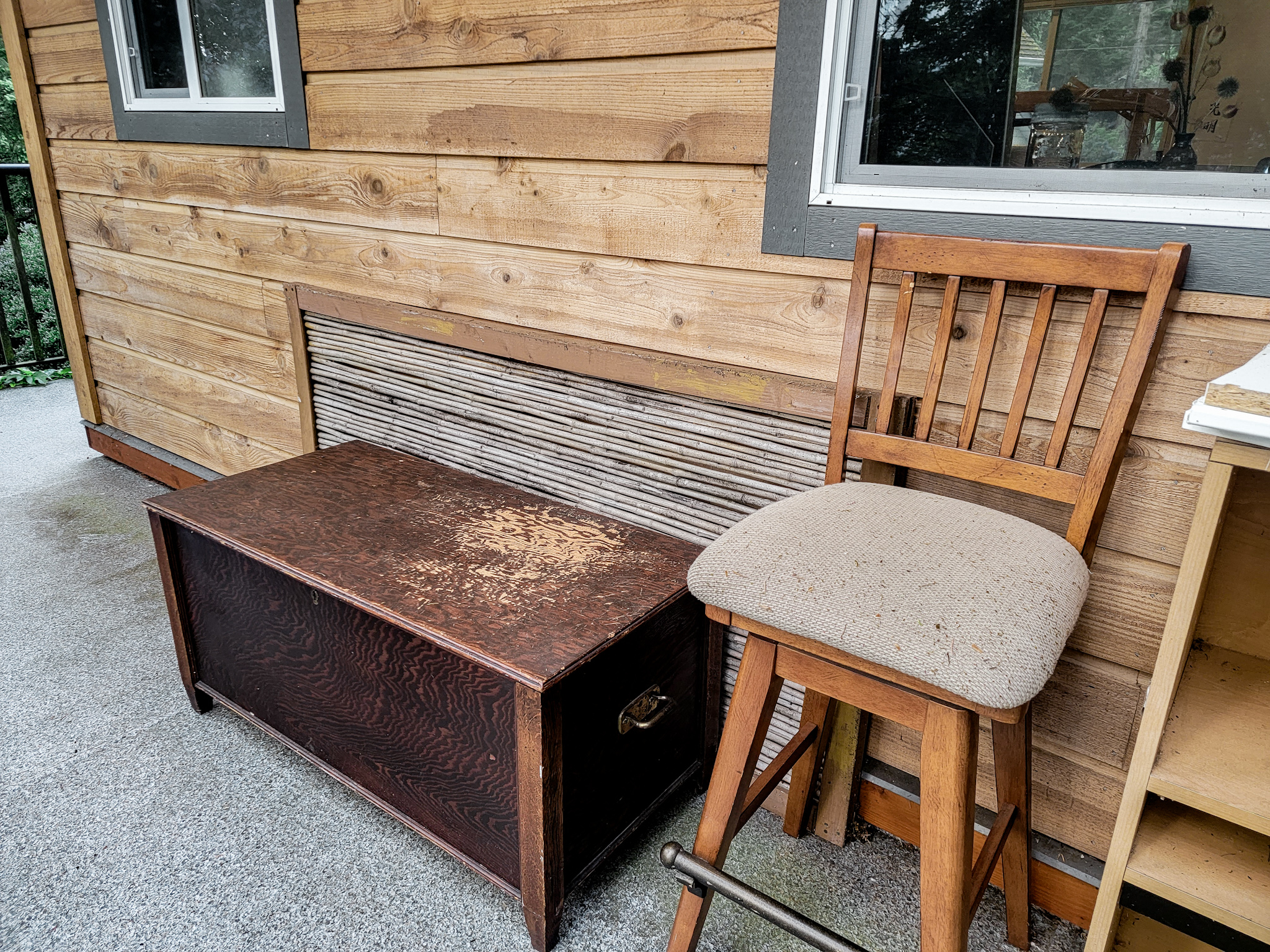
The photo at the head of the post is the spot where I plan to set things up – it’s become a bit of a furniture repository lately and I plan to clean that up next weekend. The wood chest is going to my brother, the barstool into the shed for now. To the right, there is an old office hutch not included in the photo. It’s been sitting outside for five years and I’ve been meaning to move it, but good thing I didn’t because it will be perfect as shelving and storage for supplies. This whole area is covered by a broad overhang, so things stay really dry here and there is enough width to set up a work table.
Because I’ve been thinking about doing this for so long, I’ve got 90% of the supplies I need including mordanting agents, natural dyes, and basic equipment, plus a ton of books. I just bought a single electric burner for easy water heating, and am hoping our recycling centre and store will open again soon so I can try to source a couple of large stainless steel pots. I do have some fibre and fabric for dyeing, including a huge cone of merino and mohair that I had spun from some fibre given to me a few years ago.
My intention is to dye materials this summer for fall/winter weaving and sewing. I am particularly interested in setting up and learning how to hand-paint warps, but also plan to work on a colour gamp shawl in reds, as well as a shawl in shades of indigo. I have some bleached hemp fabric to dye for making a shirt and am considering purchasing enough linen for a hand-dyed dress. I would like to use what I have on hand as much as possible. If for some reason I don’t take to dyeing, it would be nice to use materials that are taking up space in my cupboards.
But if I do take to it, I’m interested to learn more about natural dye plants in my local ecosystem. I purchased the prepared natural dyes I’m getting started with, but lobster mushroom, dyer’s polypore, tansy, marigold, willow, and blackberry are just a few of the plants and fungi which grow here and can be used to dye protein and plant fibres. There are quite a few people on Gabriola who wildcraft and grow dye plants, including at least one person I know who grows indigo! I am really hopeful that in the future, I can source quite a bit of what I want right here and will start this summer by harvesting the tansy that grows in the ditch in front of my place. In the meantime, there is Maiwa and Sweet Georgia, which are both local-ish to me and selling natural dye supplies.
I am pretty excited to get started but I’ve got a couple of other projects to finish before I do. As soon as I can though I’ll be cleaning my studio deck and getting rid of the extra furniture, getting some kind of curtain closure going to make a cupboard out of my shelving, winding up some bouts of wool/mohair yarn to prep for dyeing, and ordering the rest of the yarn that I need for my projects on payday. Progress photos will be posted here and on Instagram!
Post #3240: Let the Long Weekend Begin
I would have never remembered to post here today if it wasn’t for another blogger who posts on Fridays. Her post reminded me that it’s the end of the week (and a long weekend for me). Somehow I’ve been drifting along this week, the days slipping by without getting much done. Suddenly it’s Friday and I don’t have much to show for myself!
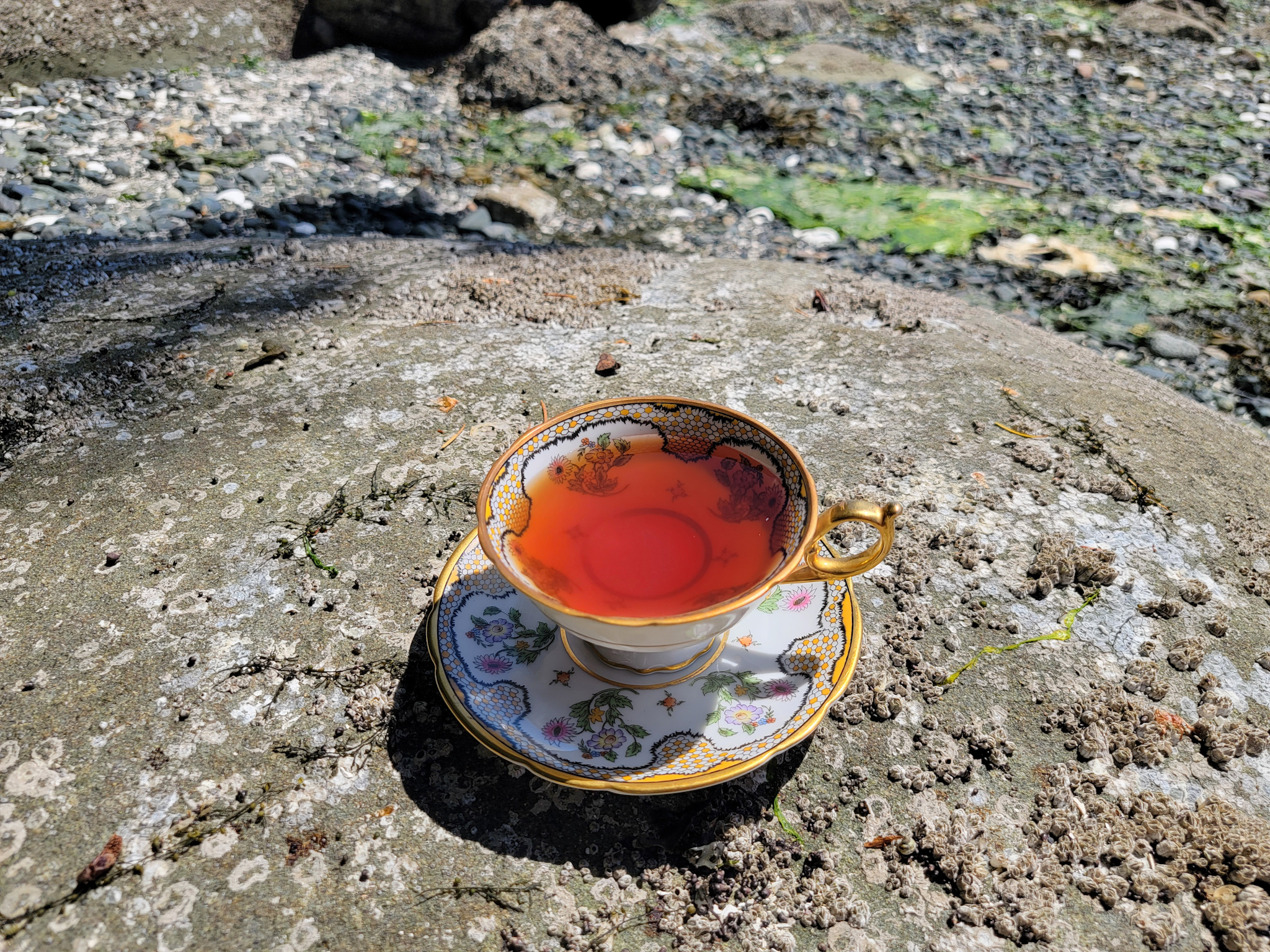
Last Friday was Brian’s birthday which is where the photo above comes from. We slipped off to a little secret beach spot and had a picnic which included iced tea in china cups. The weather was really on side and it inspired us to commit to trying to get out somewhere together – for a picnic, kayak, walk – at least once a week this summer. We’ve fallen into a routine since moving here of spending most of joint time at home, which was never the case when we lived in the city. Difference in an urban area is there are all sorts of places to go and have dinner, drinks, etc. Where we are, it’s outdoors or nothing – save for a handful of restaurants and a new food truck that just opened up.
The fantastic weather has brought a bounty of local food back into production and this week I got my first community-supported agriculture box of the season from the farm down the road. That is probably the most excitement I’ve had in ages. Neighbours! Conversation! Bags of Greens! I now have enough rhubarb to make my first batch of rhubarb ketchup for the season which will be one of my projects this weekend coming up.

In the textile studio this week I’ve been working on samples. Over the last several years of weaving, I’ve somehow not made napkins yet, even though we use cloth napkins every day at the dinner table. There are lots of recommended patterns out there for napkins, but I have discovered recently that I get a lot more enjoyment out of a project when I figure it out on my own from beginning to end. So I got to sampling this week, with various permutations of cotton, linen, and cottolin (a blend of cotton and linen) and I’ve decided on napkins in the three primary colours with a cottolin warp and a 9/2 linen weft – sett at 18 epi with 2 dents skipped every inch. If you don’t weave, I know that sounds like a foreign language – but what it translates to is a napkins that is floaty and rustic at the same time. You’ll see when I show them to you when they are done.
For my next project I’m putting on a set of tea towels in blue and white. This project is straight out of a pattern inspired by Finnish weaving, and I’ve noticed how reluctant I am to get on with it. It’s what has made me realize that 90% of weaving fun is designing my own fabric and projects to go with them. I see all these amazing fabrics on Instagram and in magazines and I think I want to replicate them, but what I really want is to be inspired to create something new. Even a basic plain weave napkin can be “new” when I make all the choices – yarn type for warp, yarn type for weft, spacing in the reed, how hard I “beat” the fabric, how I finish the item and so on. Because of all those factors, the chances are good that when I experiment with all the variables I will end up with a fabric I’ve never encountered before – and that is interesting to me.
I have made a couple of investments this week in loom-land. I mentioned last week the 20+ system which I went ahead and ordered this week (an extra cheque came in for some weekend union work which gave me to boost to go through with it). I should have that delivered and installed by the end of June. I also decided to try out something called a warp wrench – which is made by some enterprising weavers in Wisconsin – it is supposed to help tension a warp during wind-on so no extra hands are needed. The current iteration of the warp wrench will fit my small loom, so I thought to give it a try. I won’t put long warps on at the moment due to difficulty keeping tension during the wind-on – but this tool might allow me to put on the 13-yard warp I have stashed in a cupboard finally!
I think the only thing really inspiring me at the moment is weaving – everything else just makes me feel tired. I’m not sure why the malaise when it comes to writing and music, but it’s where I’m at right now. Even as I commit to putting in the time for practice – which is how I get through these times without giving everything up (except sometimes I do give everything up) – it feels like a lot of effort and I don’t feel like I’m making any headway. At least with weaving I can *see* the progress on the loom as I work. And even when I’m exhausted from working all day, I can still sit down and thread a few strands into the heddles, something that writing doesn’t allow for. When I’m tired, my output on that front is zero.
With the long weekend ahead of me I’m hoping for some sleeping in and some outdoor visiting with folks in addition to lots of time in the studio and garden. I’m in need of something for sure, and I’m pretty sure I’ll find it in one of those places! At least the weather looks to be fantastic and Brian will be home from the city soon to eat homemade pizza with me.
Post #3239: Opening the door
The first time I was invited to a Jewish Passover Seder twenty-five years ago, I was struck by the traditions of welcoming that open and close the ceremonial part of the dinner. The first is the invitation for the stranger to join the table, accompanied by an opening of the front door. The second is the invitation to the prophet Elijah, who has a place set for him at the table and a glass of wine poured. At this recitation, the household door is opened again, an invitation to the prophet to take his place at the table. The Seder recounts the flight of the Jewish people from persecution, wandering in the desert as refugees from slavery in Egypt. As people who have experienced the pain of being “unwanted refugees”, it is no wonder one of their central rituals involves welcoming in strangers and blessed ones alike.
As a young social justice activist, I was moved to learn of a tradition that encoded the act of making space for the wandering soul in need. It defies “charitable” giving (a hierarchy which I despise); it is not the act of setting food outside one’s door or dropping a couple of cans into a hamper on the way out of the grocery, which is so often where our notions of giving end. The opening of one’s door and home is an act of solidarity and intimacy. It is to join another as an equal at the same table, and participate together in a ritual of sharing and nourishment.

After that first seder, I thought about that type of invitation a lot and how to bring it into my own practice of potlucks and household gatherings. At that stage of my life, I lived with a changing cast of roommates who all cooked for each other and friends regularly. There was almost always a stranger at the table (or sitting on the floor in the living room) back then. I lived most of my life by this admired principle. But as I’ve grown older, my life has become more private and to some degree more constricted by work and a need for order. In middle-age, my husband and I do not live in a way that invites people randomly into our home though we both live with the expectation that someone might just show up – having come from households where that happened (we both grew up in families that took people in – it’s how I ended up with a “foster” brother).
In pre-Covid times, we hosted large dinners at our home with some regularity. Given our very loose invitation policy and the fact people ask to bring a friend, or cancel at the last minute, errant place settings frequently end up on the table. When a gathering is particularly sizable, we put on an extra setting or two intentionally, just in case we miscounted our numbers. Brian and I refer to this the place for Elijah, in the nod to the tradition of inviting in both stranger and prophet (who may be one and the same – prophets do not always come in a guise we recognize). It’s a symbol of our approach to both hosting and helping, something that shows up in our daily practice of making enough food at every dinnertime so an unexpected guest can be fed, and the fact we keep a spare room ready for overnight guests.
We don’t do this out of “kindness” or charity, but frankly, because it’s a joyful way to live. To shout over the fence at a neighbour walking by to join us for dinner is to enliven the day with unexpected company. To have a guest bring an add-on is to meet someone new and expand our circle. To hear about the struggles of others is to widen our compassion and empathy for those living in different circumstances. To fire up the oven to cook and bake for others is to warm the house. For all of the quiet days Brian and I choose to live together, we welcome the chaotic ones even when they are inconvenient or a bit messy. It’s one of the things I value most about our life together – the willingness on both our parts to attempt a response to what life is asking of us rather than shutting the door because it is too much.
Covid has made it difficult to imagine inviting in friends, let alone strangers. But the needs of others persist, for community, kinship, and help in getting by. As things start to shift over the next few months, I hope we can collectively let go of some of the fear and start letting people back into our lives. We have found it difficult to live with a mostly-closed door in the last year, not because we want to get on with shopping and international travel, but because our lives are poorer for the strangers we have not met and the friends we haven’t broken bread with in all this time. After this first shot we are opening our door little by little, in hope that by autumn we are flinging it wide open for a 30-person Thanksgiving feast!
Post #3238: Vaccination Week

I know that summertime is not really here yet (we still have June-uary to get through), but the last few days have been turning towards summer and it’s a very welcome change after a coldish April.
I’m having a hard time separating the days from each other lately. It seems to me that the last month has gone by in a single block of time and I’m not sure how that’s happened. It seems sudden that the days are really long, the garden demands daily watering, and it’s light enough in the mornings to consider going for a run before work (to beat the heat). I suppose this is why I document here, so that I have a record even during the times when I am not paying that much attention.
The most exciting thing that’s happened in the last week is that we got vaccinated on Sunday! First shot of Moderna is done, and while we did have some side effects (sore arm, exhaustion), I’m feeling back to normal and much better about the future. Apparently 50% of the province has now had their first shot, with a lot of people still in the queue to receive theirs. I won’t be surprised if that number is 60% by the end of the month and that is trending towards herd immunity and a resumption of normal life by the fall when we all get our second shots. Though many people have reported feeling relieved at getting their vaccination shot, I have to admit that my reaction in the hour that followed was more one of frustration. We’ve been waiting so long, and some part of me wanted things to be different *right away*. But of course, they weren’t and so we went back home and our lives have continued along in quarantine, something that I’m definitely reaching the end of my patience with.
My workouts this week were definitely impacted by the shot. I didn’t have one at all on Monday. Tuesday I went for a run and my app showed me that I “worked harder than normal” (according to heart rate) even though my pace was significantly slower. I’ve managed to get through the last two days of strength workouts, but only by taking maximum rests in between sets. It’s interesting because in my daily life, I don’t feel much of a different in energy levels, but in my workouts I’ve noticed a downshift. It’s not something I’m concerned about because I know that as my immune system processes the input, things will return fully to normal.
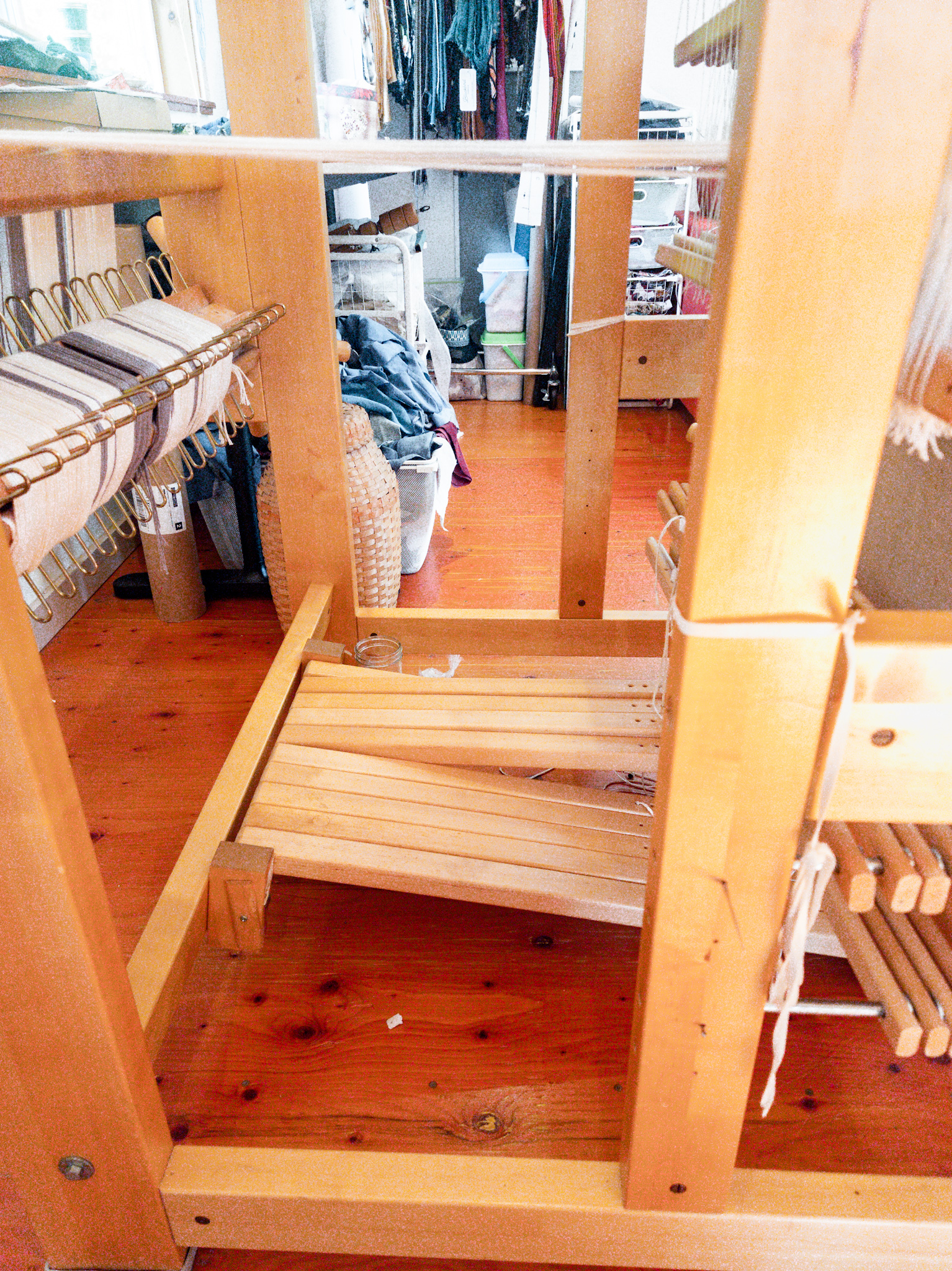
I don’t have any new weaving to show off this week since I’ve been winding some new warps and working on re-tying the treadles on my Berga Savonia loom (for the billionth time – my approach keeps changing). I am looking at investing in a bit of equipment to assist the tie-up since I’ve never met a loom that has a more awkward position for the treadle tie-up (you literally have to sit in the loom, under the beamed warp in order to reach the lamms and treadles). You can see from this picture, a tall person would be very cramped (you have to sit on the back of the treadles underneath the warp which you can see running across the top as a white line)! But even for a short person like me, my hips do not like being scrunched up in there for too long. There is a system called the 20+ which changes the tie-up position from inside the loom to the back of the loom. It’s called the 20+ because it’s said to add twenty years to your weaving life. A lot of people end up leaving weaving because it’s too hard to get under the loom, down on the floor as they age. This device brings the tie-up to the back of the loom so that the weaver can sit on a stool and do the tie-up with more ease. I love everything about the Berga Savonia loom except its treadle tie-up, so it seems like a no-brainer to sort that out and make my weaving life easier – once I save up the money I’m going for it.
It’s Brian’s birthday today and so I’m skipping out of work early and have planned a picnic at the beach for this afternoon. Though it’s a bit windy, the weather seems to require that we get away from our desks to enjoy it and I’ve planned super-yummy foods to take with us, including mini-apple pies, pesto pasta salad, and ham and brie sandwiches. He’s turning 49 today and our hope is that by his real milestone birthday next year, we’ll be able to throw some kind of great party – but for this year we’ll enjoy what we have available which is miles of beautiful beaches and good weather. Can’t really complain about that.


 Red Cedar