Red Cedar
More apocalypse, less angst
The monster in us.
The last time I read Frankenstein was in high school and I don’t quite remember it being as wonderful as it is. In fact, I think I must have skimmed most of the book in an attempt to get through it as the narrative was barely familiar to me on this re-read. Such is the seventeen-year-old’s attention span.
What struck me upon this reading was the depth of the work. Although written quickly, in a sporting challenge with lover Percy Shelley and friend Lord Byron – Mary Shelley creates a work touching on many of life’s most fundamental, (if you will – existential) questions. In particular I am intrigued with the inquiry about what it means to be human, versus simply being possessed of life, or in contrast to the life of nature – questions which are obviously explored through the tortured existence of Frankenstein’s monster.
For Shelley creates a very “human” monster, but in whom the physical and emotional characteristics are magnified to the degree of becoming grotesque. This is a monster with whom we can sympathize – his desires and needs are familiar to us – while at the same time recoiling from their excesses. Everything about this monster is out of proportion, and yet whose fault is this? The creator in his lack of foresight and his incredible hubris, is more to blame than the created forced to roam the earth without companionship.
First of all – we have the physical countenance of the creature – which although Frankestein claims he had “selected his features as beautiful”, he acknowleges that “I had gazed on him while unfinished; he was ugly then….” Of course he couldn’t have know that “when those muscles and joints were rendered capable of motion, it became a thing such as even Dante could not have conceived….” and yet still one wonders at the lack of foresight with which Frankenstein animated this pastiche atrocity?
From this we derive our “larger-than-life” not-quite-human figure who features “…yellow skin scarcely covered the work of muscles and arteries beneath; his hair was of a lustrous black, and flowing; his teeth of a pearly whiteness; but these luxuriances only formed a more horrid contrast with his watery eyes, that seemed almost of the same colour as the dun white sockets in which they were set, his shrivelled complexion and straight black lips.” Not mentioned in Frankenstein’s narrative, but referenced at the start of the book is that the monster is also physically very large – “a being which had the shape of man, but apparently of gigantic stature” – and so the reader is brought to understand that not only is the creature ugly, but of a threatening size to his human cousin and creator.
Rather than taking responsibility for the horror, Frankenstein immediately departs the room and leaves his accomodation for the outside courtyard, passing the night there. When he returns to his rooms the next afternoon, he is “relieved” that the monster is gone rather than concerned for its wellbeing (or worried about the ramification of an animate but inhuman creature roaming the streets), and the onset of his subsequent psychic/physic illness renders him incapable of taking any further responsibility for his creation.
Of course, this is not the end of the story and the creature later returns to murder those loved by his creator, thus attempting to render Frankenstein as alone in the world as his creation. We are invited into the monster’s story when he confronts his creator in the mountains and tells his side of what has happened – and here we realize that not only is he physically large, but he also possesses an enlarged capacity for both intellect and emotion – for the monster is the most verbally eloquent character in the tale as well as the most ruthless when it comes to avenging his orphaned state. In this scene, articulates his struggles at making connections in a hostlie world and advances rational argument for the creation of a female counterpart, so as to solve his burden of solitude. While Frankenstein is emotionall moved by the plea of his creation, he is equally revulsed, and refuses to take any responsibility for the plight of his experiment and its outcomes.
It is clear that Frankenstein, doesn’t hold a candle to his creation on any front which is why he ultimately can’t contain what he has unleashed into the world. He carries not the intellect or the passion to truly see through killing the monster, no matter how many of Frankenstein’s loved ones perish (for the record this includes his brother, a family-friend and serving girl, his best friend, his wife on their wedding night). The monster manages to outwit his creator at every turn (Frankenstein misses even the most obvious clues), which demonstrates the superiority of the creation right into the end of the tale.
But as much as the creation is “greater-than-human” in many respects, his grotesque appearance keeps him from being able to bond with others. Not even Frankenstein will take him in as a friend, for that would require admitting to his own family of his mistaken arrogance (and connection to the muder of his young brother William). What the monster is thus denied in these rejections, is the ability to become fully human through society with others. While he is able to learn to speak, read, and about family relations through watching a poor cottage family over a one year period (thus attaining some knowledge of the world and notion of socialization), the fact that he is ultimately denied community is what turns the monster towards the murder of William (and revenge on his creator). Not only solitude, but the knowledge it will be never-ending, drive the creature to a madness in which his emotional responses are enlarged to encompass even acts he knows to be hideous (the killing of a child).
I believe that this need for companionship is in some part a need for a witness to his life – something reinforced by the structure of a narrative inside a narrative inside a narrative which Shelley employes in her tale. The story is told to Walton by Frankenstein, and the monster’s story is told to Frankstein who tells it to Walton, leaving the reader as the final witness in a chain of witnessing. This is what the monster is after – to be seen! For he can live alongside humans while concealing himself quite easily, but this is only half a life. To fully live, one must engage with others and must be seen to have lived.(As if to underscore this lack of identification, the monster is never even given a name).
Some other themes I think are worth exploring through Shelley’s Frankenstein (and would if I didn’t feel so poorly at the moment) include:
- Frankenstein as a birth narrative (Mary Shelley’s birth killed her own mother)
- The relationship between created and creator
- Class relations in emergent industrial society
- The monster as sympathetic (of us)
- The essence of creation – what is natural? what is not natural? where do we draw the line in a world where the “creation of life” is a possibility?
Spring dreams – around the corner from green…..
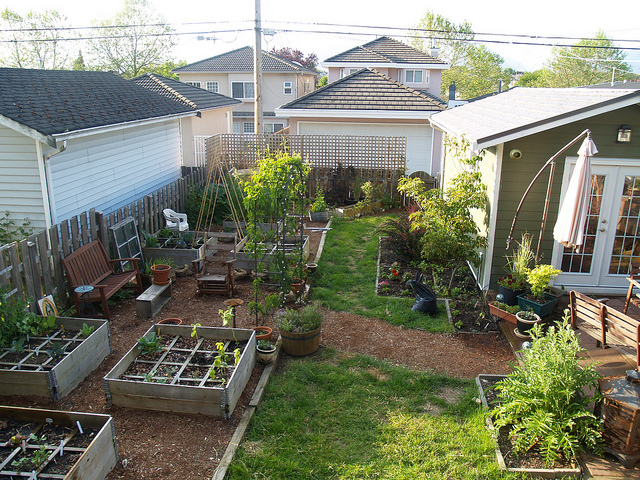
After three heavy reading posts in a row – it’s time for something dreamier, lighter, more inspiring don’t you think? That is, it’s almost the end of January and I’m thinking about the garden again.
Though it’s hard to imagine when I look at the yard right now – sodden, muddy and partially frozen mess that it is – in only a few short months the signs of spring will be upon it, followed by the abundance of summer. Winter gardening, I’m convinced, is not appropriate for my backyard since its north-facing – though I’m curious to see if my winter veggies – brussels sprouts and broccoli – in the front yard take shape in the spring before the leaves come back on the trees and shade it all in again. They are still alive at least, and the plants look relatively healthy. I also have a single broccoli in the back which *is* still alive.
Already my garlic are peeking through, little green shoots of promise that they are every winter….. though it’s a long way off before anything else is going to go in given the very wet winter we are still having!
A first priority this year is going to be to finish the front yard. I’m actually considering getting some hardscaping done in the form of a front-fence/gate just to give our yard a little structure, though leaving the sides open and landscaping them instead of installing fencing. We’ll see how afforadable (or not) that ends up being. Other than that we’re going to keep mulching the lawn and installing perennials (food and decorative) as the finances allow.
In the food garden out back, on the first dry-ish day that allows it, I will be heading out to get compost and mushroom manure for the boxes which all need a top-up. To lighten up the soil, I think coir will be my choice, and I’m going to put a load of sand into at least one of my boxes to make a good carrot bed for a change. Last year I made the mistake of skimping on re-nutrifying my boxes and that lead to less than stellar yields – especially in the greens box which doesn’t get a ton of sun to start with.
In planning for the upcoming year, I like to think of what my favourite things from the last growing season were. Fortunately, I take lots of photos of the garden in progress which makes it easy to remember most of what went on!
Best things about the last growing season:
- The Bean Tunnel: At the edge of two boxes I erected bamboo poles and grew beans up them – which turned out an incredible crop and the tunnel (vs. the traditional teepee) was easy to get inside and pick from. I’ll be changing the location of the tunnel this year for crop rotation purposes, but otherwise pursuing the same strategy.
- The Garlic: This is just the easiest thing in the world to grow and I had a stellar crop last year. Not ony did I get lots of scapes during the growing season, but I still have lots of bulbs in my larder from the July harvest.
- The Cauliflower: I only put a couple of these babies in because of space considerations, but it turns out my yard has perfect cauliflower (and cabbage) conditions. I am going to eschew some other plants in favour of more cauliflower this year. And the same amoung of cabbage as last year.
- Berries! Both the blueberries and raspberries produced prodigiously last summer (one of my raspberry plants produces right into November). I planted some more bushes at the end of the season along with two plum trees and am looking forward to more fruits from the garden this year.
- Dahlias: Last year was my first dahlia year, and while I didn’t successfully save the tubers – I am prepared to re-invest in some this year and work harder at keeping them over the winter. I loved having such incredible flowers late in the summer and look forward to more this year.
Worst performers last season:
- Tomatoes and tomatillos: Not only do I have a cool-ish backyard, by the end of August (when these things are ripening) there is a lot less daylight back there once the sun shifts. I’m going to stick to container gardening a couple of tomato plants this year and otherwise forget about the hot weather crops unless the spring makes for a promising summer. Last year was late and cold, and I could have used the space better.
- Summer Squash: I get excellent summer squash yields but they tend to get powdery mildew and blossom end-rot which I suspect is from overcrowding. Perhaps this year I will only plant two summer squashes, far apart from each other and super-fertilize for better yield. Or I might find a climbing variety and a bush variety in order to rearrange my space use.
- Potatoes: My potato yield hasn’t been great for all the work that goes into the bags (I grow them in burlap sacks). We’re not big potato eaters anyway, so I’m not sure if I’ll bother with them this year at all.
Things I would like to grow some or more of:
- Snow peas: Every year I forget to buy snow peas for planting even though I have a trellis for peas. Not this year!
- Fava beans: I know they aren’t a big producer and they get aphidy – but I love them anyway and I missed them last year when I didn’t plant any.
- Winter squash: I skimped on planting location for these last year and got nothing as a result. But I *love* winter squash, so I’m thinking I might build a little box along the back fence this year in which to put a couple spaghetti squash plants and the scarlet runner beans.
All in all I’m planning for: snap peas, snow peas, carrots, beets, fennel bulb, cabbage, greens, pole beans, summer squash, winter squash, fava beans, scarlet runners, cauliflower, leeks, slicing cucumbers and radishes. The garlic, rhubarb and berries are already well in hand. Not to mention my plum trees which should at least come into leaf this spring.
Just writing this I feel the joy of spring coming on me and also forseeing the need to set some cash aside to pay for it all! But it’s all for the glory of having a productive and beautified outdoor space, and if I start now, I can spread the spending out over several months…..
The gradual road to nowhere.
Of Weber’s Vocation Lectures, we were asked to focus in on Politics as a Vocation for the purpose of our class, but having read that I am equally as interested to see what he has to say about science as a vocation so hopefully I’ll find some time to back and read that as well. One of the struggles I have in my course is that each reading opens up so many other potential readings and its hard to stay on track with what I have to get through before starting on anything else. On the other hand, picking up the occasional extra book really does supplement my ability to contextualize… so I hate to just eschew everything not on the course list for three months!
Delivered during the brief German revolution in 1918-19 (and right before the end of Weber’s life) Politics is an examination of political forms, personalities, history and ultimately winds up in a discussion of two kinds of political ethics. It is the ethics which I am going to talk about here because I was most moved by these passages and I think they get to the crux of the political paralysis that we face in North America nearly one hundred years later (and they also get to the heart of Kierkegaard’s argument in The Present Age not to mention the reason/passion divide more generally).
In Weber’s analysis, there are:
1) The ethics of conviction: Acting according to one’s beliefs regardless of the potential outcomes. Ie: Engaging in workplace sabotage may lead to an increase in workplace surveillance and potential firings, but someone who acts from an ethic conviction would argue that the response of the boss is not the fault of the saboteur. It’s a “shoot them all and let God sort them out” approach that gets things done in the immediate, but may have long-term consequences that are the opposite of the intended.
2) The ethics of responsibility: Taking responsibility for all forseeable outcomes or consequences of a given action which would (most likely) have a moderating influence on which actions are taken. Examples of this are found throughout the modern bureaucratic political order where (at least at the civil service level) all possible outcomes are mapped out extensively before a decision is taken. Analagous to the workplace sabotage example, a union leader practicing the ethics of responsibility would weigh out all potential outcomes before encouraging members of the union to take a strike vote, and then again before actually going on strike (and would never encourage random sabotage or wildcat action which could result in circumstances outside the leadership’s control).
What was interesting to me when reading the descriptions of each and Weber’s arguments which follow – was how swayed I was by the criticism of the former and the props Weber gives to the latter (for he is clearly one-sided on this, though he does attempt to resolve that at the end of the lecture). Swayed, that is until I considered what the ethics of responsibility looks like in practice and how deadening it can be to change.
Given my traverse between radical activism, trade union leadership and work in the government, I am intimately acquainted with both the ethics types which Weber describes.
“With an ethics of conviction, one feels “responsible” only for ensuring that the flame of pure conviction, for example, the flame of protest against the injustice of the social order should never be extinguished. To keep on reigniting it is the purpose of his actions.”
I can so relate to this statement, perhaps delivered somewhat derisively by Weber, but true to the overriding sense of purpose which drives many individuals into political activity. Coming out of a particular self-reinforcing activist community some years ago, I can only attest that I spent many years of my life feeling responsible for doing something, anything, to arrest the social and environmental travesties occurring around me. That a small group of people could take actions which would influence more and more people (until the masses rose up) was a religion I took to be my own, and that the job of the revolutionary in non-revolutionary times is to keep the flame of resistance burning is something that I still believe.
Of course the problem of conviction is that it puts us in a place of situational relativism where the ends most certainly justify whatever means are at our disposal. We may decry the use of violence in our opposition, but believe that one must “fight fire with fire” in order to be successful in our aims. As Weber points out, this relies on a particular kind of fundamentalism that is not out of place in the language of religion. “In the world of realities, or course, we see again and again how the representatives of an ethics of conviction suddenly become transformed into chiliastic prophets.” (By which Weber means individuals who argue that we must just use this use of force *one more time* to be transported into a future golden age without any violence). Not only that, but I have been witness to the conviction in radical friends that they are “special”, “chosen”, or “destined” in their path – which even among atheists – can be a powerfully romantic idea to carry into dangerous or potentially violent situations.
Because of my experience in conviction-oriented movements, I am now highly suspicious of the individuals involved in them – but at the same time I struggle with an ethics of responsibility that holds us back from taking most forms of action “in case” it causes one or another repercussion. The modern civil service under “risk-averse” governments is the worst example of this type of thinking. Weber was a big fan of gradualism, and promoted the civil servant as the professional best able to bring about social change without resorting to violence. And while it’s true that professional civil managers have the knowledge to make recommendations on policy and practical reforms within a system – it’s equally true that gradualism in any system eventually grinds to a halt under the weight of bureaucracy, over-consideration of risks, conservatism and internal negativity.
Take for example an issue like climate change. Inside the federal government – among the civil service – there is a fairly uniform view on 1) the reality of climate change and 2) the Canadian government should be participating in finding ways to stop or mitigate the effects of climate change. So for the last twenty years, many professional civil servants have traveled to international conferences and gatherings and research colloquiums to discuss, debate and sign onto various recommendations around this issue. Yay! Something I really do value about the government I work for is the number of intelligent, dedicated and well-researched people that I work with. But so what? Because we’ve spent probably over a billion dollars on climate change related activities and instead of listening to their own people, we have a political leadership who has pulled out of Kyoto and ramped up the Tar Sands. (It occurs to me as I write that what we might be seeing here is in fact a crisis between and ethics of responsibility and an ethics of conviction.)
Point being, that all this careful negotiating around an issue that has a time-sensitivity to it (like the polar ice caps are melting right now people) has actually allowed the opposition to change to take hold and slowly milk away what *small* gains had been made in the first place.
Canadian trade unions have been similarly guilty of practicing the ethic of responsibility to death since the eighties when the practice of fining unions large sums for work stoppages became de rigeur. Every potentially-spontaneous worker action is now drowned in fearful considerations about losing homes, being individually fined, or having the union go into receivership – not to mention a fear carried throughout the union movement that any worker action will reflect negatively on the NDP come election day. To the worst degree we find ourselves in the midst of a working class who seems to have forgotten that they can take action without a vote, without permission, and without being nice about it – simply by walking off the shop floor. Workers reported smelling gas at the Burns Lake Mill on Friday morning (several hours before it exploded), workers empowered by their rights (instead of afraid of job loss as the system is perpetually designed to make us) could have refused unsafe work and walked off the floor until the gas smell was investigated thoroughly. But in a culture which stresses the irresponsibility of leaving one’s work post vs. one of conviction around the right to a safe workplace – well we know the outcome in this situation. And it’s tragic.*
Ultimately, Weber tries to resolve what he originally has called two “mutually exclusive” modes by saying:
“… I find it immeasurably moving when a mature human being – whether young or old in actual years is immaterial – who feels the responsibility he bears for the consequences of his own actions with entire soul reaches the point where he says ‘Here, I stand, I can do no other’… In this sense an ethics of conviction and an ethics of responsibility are not absolute antitheses but are mutually complementary, and only when taken together do they constitute the authentic human being who is capable of having a ‘vocation for politics.'”
This is a tidy way out of having to account for history, which as we know has both gradualist and dynamic phases of change owing to stable governments and periods of peace (on the one hand) and revolution, war or catastrophe (on the other). It’s too bad that Weber doesn’t spend more time in exploring this dynamic of mature political thought because it’s here that I think the challenge for the political actor in society lies. How do we walk the line between conviction and responsibility, suspending our own egos long enough to engage in rational debate?
* I in no way mean this as an indictment of any worker action in this situation, but use this as an illustration to a larger social problem of inaction bred by too closely following the gradualist position.
Of course there is a point.
Waiting for Godot by Samuel Beckett was written in 1948 and first performed in 1953 to acclaim all but unimagined in the world of modern theatre. Contextualized by the European tragedy of World War Two, Waiting was voted the most influential work of the 20th century. The plot involves nothing but two men waiting by the side of the road. A rock and a tree form the basis for the set. And during their time waiting, the two main characters encounter a total of three other characters with whom they interact. Though they wait for a man named Godot for the entirety of the play, he never arrives, and the play closes with the men deciding whether to commit suicide or await another day on the elusive Godot (who might punish them if they aren’t there if/when he arrives).
Beckett claimed that Godot was not meant to be God, but elsewhere spoke to the subconscious nature of his writing. There are of course numerous analyses of this play – Freudian and Jungian, literary and political out there – but I personally find it difficult to read this play as anything but a cry arising from a destroyed Europe as the Nuremberg Trials rolled on, exposing the crimes against Jewish people and all of humanity. Where could God possibly have been during that horror? And what part did humanity have in pushing God away? In the absence of God, could humans find the right path back to healing and redemption? Countries like France (where Beckett participated in the Resistance movement) were physically destroyed and internally divided between those who collaborated with the Nazis and those who formed the Resistance. And yet no one wanted to take responsibility for what they had done, or not done, professing not to have seen or known about the atrocities being committed at their backdoor.
Character naming in the play indicates a pan-European dilemma with one obviously Russian (Vladimir), French (Estragon), Pozzo (Italian) and Lucky (English). Vladimir and Estragon play everyman characters, tramps without means and trapped in the circumstance of waiting while trying to pass the time, while Pozzo and Lucky play the more extreme master and slave roles, one believing he not only controls his own fate and circumstance, but that of another. Each of these characters is hobbled in some way either at the outset of the play or within it. Estragon has an injured foot and then leg throughout, Lucky appears both mentally incapacitated as well as being rendered mute by the second act, and Vladimir is crippled by his awareness (he is the only one who remembers the days before, the people he meets, the past in general).
Pozzo, who at first I couldn’t figure out, is introduced mid-way through both acts and I now believe represents one such post-war reaction. As Italy is linked with WW2 fascism, I read Pozzo as “the Good German” who emerged during the Nuremberg Trials and afterwards. With specific regards to the war this term refers to those who who were “not to blame” for the persecution of Jewish people by Hitler, and who professed that they did not know about the Holocaust as it was occurring (thus freeing them from the moral responsibility of acting against their despotic government). This is more generally an example of a very real social fascism that has the potential to exist among all nationalities and ethnic groups – a tendency to refrain from involvement in the sufferings of others out of fear, lack of empathy, or conservatism.
In any case, Pozzo strikes me as this character – dominating over his slave in the first act and attempting to order around Vladamir and Estragon as well – Pozzo plays the role of the landowner, the master and the commander in all his buffoonery. In the second act Pozzo returns to the stage blind, professing not to remember the day before, not to remember when he went blind and arguing that to ask him to remember it at all was unfair! (For the blind have no notion of time).
Waiting for Godot was written in this psychically painful environment and so it does posit the question of meaning. How are we to understand our world after this tragedy? If there is no meaning to all this suffering, if there is no one watching out for us aren’t we better off to just kill ourselves and be done with it? Beckett, a masterful writer, gives us characters who are at once comedic and sympathetic, drawing us into their own perplexity and inability to decide whether to stay, go, or end life all together. Towards the end of the play Beckett sums up the whole problem of human existence in the speech of Vladimir who says:
“Let us not waste our time in idle discourse! Let us do something, while we have the chance! It is not every day that we are needed. Not indeed that we personally are needed. Others would meet the case equally well, if not better. To all mankind they were addressed, those cries for help still ringing in our ears! But at this place, at this moment of time, all mankind is us, whether we like it or not. Let us make the most of it, before it is too late! Let us represent worthily for once the foul brood to which a cruel fate consigned us! What do you say? It is true that when with folded arms we weigh the pros and cons we are no less a credit to our species. The tiger bounds to the help of his conveners without the least reflection, or else he slinks away into the depths of the thickets. But that is not the question. What are we doing here, that is the question. And we are blessed in this, that we happen to know the answer. Yes, in this immense confusion one thing alone is clear. We are waiting for Godot to come— “
And the audience is devastated in the circularity, the feebleness of it all. Sure there is a point. The point is that we’re waiting for Godot.
******************
Themes for further exploration: Absurdism, existentialism, memory, physical injury as it relates to psychic characteristics, the solitary traveler, the human condition, meaning
******************
Last weekend I had the chance to see the Blackbird Theatre staging of Waiting for Godot at the Cultch in East Vancouver. As it is one of the readings assigned for my school term I wasn’t going to pass up the opportunity to see it performed and am I ever glad that I did. First of all, Blackbird put on an excellent production with fine acting and “true to the original” characterization and staging. Secondly, I’m not quite sure I would have gotten the humour or the pathos had I simply read the text. For all of its dark moments, this really is a very funny play, and the interactions between the two main characters are priceless. I’ve always been a bit afraid to see this play because I have often thought it might be too intellectual for my taste – and I suppose it’s not a play for the immature of mind (as one of my classmates mentioned she had seen it at 20 and didn’t get it at all) – but it’s certainly not hard to grasp at more than one layer of meaning in the dramatic action.
If you are in Vancouver reading this, I will let you know that it has been held over until January 28th so there is still the possibility of checking it out (but book your tickets before you get to the theatre, they have been playing to sold out shows all month). I would really encourage it, if you have ever wondered what all the fuss about Waiting is all about.
Leaving a less-than-beautiful corpse. (Dorian Gray)
[youtube:http://www.youtube.com/watch?v=nNIR-dqoJk8%5D
My recent reading has been all worshippers of the individual from the 19th century – Kierkegaard and Nietzsche most recently – but not until I read Oscar Wilde’s A Picture of Dorian Gray did I quite see Wilde’s connection to these philosopher’s of “free spirit”.
A Picture of Dorian Gray can be found on Wikipedia after the SOPA blackout ends if you are looking for the plot summary – but in brief it is the tale of a young gentleman who pledges his soul in order that he may stay forever young. Instead of having to experience the ravages of age and experience, a portrait of Dorian begins to take on the ill effects of the corrupt life he has begun leading. Free from the constraints of normal men, Dorian pursues a path of hedonism that includes allusions to sex (with both men and women), drug use, the corruption of others and finally, murder.
More fairy tale than horror novel, one wanders through Wilde’s themes of art and artifice, the nature of reality, individualism, hedonism, immortality, the value of youth and the duplicity of modern life. A simple tale on the one hand, but with each of its main characters (Dorian Gray, Basil Hallward the painter and Lord Henry – Gray’s friend and mentor) putting forward various perspectives on what a life truly lived should look like, and specifically, what the life of the artist should look like. As Wilde himself commented about his work – these questions were autobiographical in nature: “Basil Hallward is what I think I am: Lord Henry what the world thinks me: Dorian what I would like to be–in other ages, perhaps.”
It is Dorian who represents a certain debate about the meaning of life, or exceptional existence – following in Lord Henry’s assertion that “…. if one were to live out his life fully and completely, were to give form to every feeling, expression to every thought, reality to every dream — I believe that the world would gain such a fresh impulse of joy that we would forget all the maladies of mediaevalism, and return to the Hellenic ideal — to something finer, richer, than the Hellenic ideal it may be.” Because Dorian is extremely well off, and with his additional charm of never physically wearing the effects of his lifestyle – he is free to live the life of the elect. That is the life of one who pursues aesthetics without committing to them, one who pursues experience without having to pay for it in any way.
Where Basil Hallward is an artist (the painter who commits Dorian’s likeness to canvas) living a somewhat reclusive life, touched with deep feelings of love and depression (that is, struggling with himself) – the aesthete is not burdened with the actual weight of creation and instead builds himself by identifying with the creations of others. Early in the novel Basil demonstrates this dichotomy in saying “An artist should create beautiful things, but should put nothing of his own life into them.” Whereas Dorian puts a great deal of stock, of his own life in fact, into a creation that belongs to someone else. Much later in the novel (as Dorian has become increasingly evil) we see how much stock he puts in this creation and his visceral connection to it – “On his return he would sit in front of the picture, sometimes loathing it and himself, but filled, at other times, with that pride of individualism that is half the fascination of sin, and smiling, with secret pleasure, at the misshapen shadow that had to bear the burden that should have been his own.”
Through the progression of the novel we can see several dualities that Wilde sets up – like this one of artist/aesthete: body/soul, individual/society, sense/intellect, beauty/ugliness are all touchstone points in the novel. Dorian for all his appreciation of the duplicity of his own life, seeks a very one-sided existence rooted in body/individual/sense/beauty from the beginning. Though many examples of this can be found, one particularly striking one (which is reminiscent of Nietzsche and later Camus as well) is found in:
“To be good is to be in harmony with one’s self… Discord is to be forced to be in harmony with others. One’s own life — that is the important thing… Individualism has really the higher aim. Modern morality consists in accepting the standard of one’s age.”
Though towards the close of the novel, Wilde makes a strong argument that neither Dorian, nor anyone else can live on one side of the glass and that each side of these dichotomous pairings requires a response from the other. In a powerful paragraph we see the torment of Dorian, a creature whose soul is as ugly as the painting he has stashed away – we see that his pursuit of the senses, of the aesthetic – has only lead him to the other side of the circle where he is now stuck in his own diminished state:
It is said that passion makes one think in a circle. Certainly with hideous iteration the bitten lips of Dorian Gray shaped and reshaped those subtle words that dealt with soul and sense, till he had found in them the full expression, as it were, of his mood, and justified, by intellectual approval, passions that without such justification would still have dominated his temper. From cell to cell of his brain crept the one thought; and the wild desire to live, most terrible of all man’s appetites, quickened into force each trembling nerve and fibre. Ugliness that had once been hateful to him because it made things real, became dear to him now for that very reason. Ugliness was the one reality. The coarse brawl, the loathsome den, the crude violence of disordered life, the very vileness of thief and outcast, were more vivid, in their intense actuality of impression than all the gracious shapes of Art, the dreamy shadows of Song. They were what he needed for forgetfulness.
Interestingly, Wilde places the blame for this state of Dorian’s entirely on the portrait – or perhaps aestheticism generally – for who but a young man raised in a particular aspect would sell his soul in order that he might live a physical ideal forever? (I ask this question knowing full well that we are living in a heightened age of narcissism and that there are millions of shallow people like Dorian who would gladly have chosen to do this).
In his article “How Oscar Wilde painted over “Dorian Gray”” in the New Yorker from last summer, Alex Ross argues
It was the portrait that had done everything.” Art is not innocent, Wilde implies. Violence can be done in its name. Indeed, the twentieth century brought forth many Dorian Grays: fiendishly pure spirits so wrapped up in aesthetics that they become heedless of humanity. Wilde’s anatomy of the confusion between art and life remains pertinent with each new uproar over lurid films, songs, or video games.
Reflecting on it this way it seems we live permanently in the time of Dorian Gray, in a culture that posits an ability to live on a single side of the dichotomy without consequence – in a society of rights without responsibilities. As Dorian experiences, and as Francis Fukuyama argues in Our Posthuman Future – once we are divorced from the consequences of our physical selves – the final links between cause and effect are removed. This removal unhooks right from wrong, disables empathy, and Fukuyama would argue – sets the stage for a radically different human nature (and not a nice one either).
It’s interesting that Wilde’s book caused such outrage when it was first published, as promoting moral decay. In my reading, Wilde is not promoting radical individualism, in that we see the truly separated being of Gray die in a state of conflict and turmoil. Rather I see him as posing the questions of his time, and writing the answers on the corpse of our literary anti-hero Dorian.


