Red Cedar
More apocalypse, less angst
Signs of life
 Things come alive in fits and starts once the days get longer. My evergreen clematis is making signs of flower for the first time.
 Garlic is the first edible to show itself, in time with other bulbing plants which foreshadow the true spring weather.

Blueberry growth like arrows pointing upwards to new life after a winter of sleep.

And the rhizome of rhubarb births new leaves, drinking water from the sky to replenish its roots towards a new year.
Reading rooms.

Want a little glimpse of the inside of our home? (Hint: that’s not our home in the photo above).
For a real glimpse – I am offering a peek into our personal library on Library Thing – a project Brian has been working on for some time. I’m somewhat abashed to admit that between the two of us we’re pushing the 1500 mark. Still a little ways to go, but given our book-acquisition habits, I can see we’ll be there in under a year.
This project of cataloguing began when I decided to rectify the organization of books in our home – which we had hastily done upon moving in, but with the building of the bookshed two years ago we needed to update. This I did in the fall, relegating all the non-fiction to the office and bookshed, keeping poetry, fiction and drama for the bedroom shelves. In our dining area we have one bookcase of collectibles. There was nothing intentional about this decision exactly – the bedroom books just fit better on the bedroom shelves – but I have to admit that I like having all those stories crowding our private room, not to mention poetry quickly at hand for lazy mornings in bed, or bathtime meditations. It’s cozier to bed down with imaginings rather than facts.
I was thinking about this yesterday after reading this blog post at publishers weekly where the author admits to a large collection of 371 books, only about 80 of which he has read. Now I don’t consider 371 books much of a collection at all – at least not in any way problematic – but I don’t understand having a collection that is largely unread. Several commenters on the post go on to admit to their own book-collecting tendencies which involve (in some cases) rooms stacked floor-to-ceiling with books which have never been opened. Mostly these people have intentions to read the books they own, though some don’t even have that – one commenter admitting to simply being in thrall with the new ink and paper smell, he has a room in which his books are packed away as soon as they are opened, not even perusable in their crammed-together state.
Brian and I may have a ridiculous number of books, but between the two of us, most of them have been read. In the to-read piles at any given time are thirty titles which remain unshelved until they are read. Books that stick around in the to-read pile for “too long” without being considered for reading, end up in the discard pile eventually – and on it goes.
There was a time when I was getting into that dangerous territory of shelving books without reading them – back when I was subscribed to the Friends of AK Press who sent me tremendous volumes from the anarchist archives which I had little interest in – and so I put a stop to that. Books must be intentionally chosen if they are to come into our home – otherwise, the shame of the uncracked spine will forever stare out from the shelf accusingly. Ownership for ownership’s sake only cuts it in the world of collectible books – recent reprints of Rudolph Rocker do not fit in this category. Besides the collectibles (some of which are too fragile to read) – if I am not going to read it, I do not need to own it.
But once I have read and loved a book, I cannot let it go. I find myself plagued with the memory of books which I have let out of my possession in purges past. I am upset with myself over hastily-made choices when I reach for something to lend to a friend and it isn’t there. Though I recognize that if I held onto all the books I had ever read and loved, there wouldn’t be room for anything new to make it onto the shelves.
These days we take a lot of books out of the library first, read them, and then decide whether we need to also own them. So far that has happened with about 1/10th of the books we have taken out – research and political theory books mainly, though the occasional novel gets purchased via that route as well. This really works to quell some of the urge for acquisition – for instead of being on the opt-out model (whether I want to keep a purchased book or not requires a decision to part with something), we are forced into the effort of opting-in to acquisition.
Even so, there are books which I instantaneously covet, and which I know I will want a first-edition hardcover copy of in twenty years – and those get purchased without library vetting. Plus there are so many cheap and free books out there, and we bring an awful lot of those into our home too. Probably about half of the to-read pile at any given time is made up of free books.
At the moment I am reading The Berlin Stories by Christopher Isherwood for school. In the library pile are two books which must be read in the next week: Flourish: A Visionary New Understanding of Happiness and Well-being and Out of Character: Surprising Truths about the Liar, Cheat, Sinner (and Saint) Lurking in All of Us. Once I dispatch those, I’m onto Camus:A Romance and Voltaire’s Bastards which are both leering at me from the weight bench in our bedroom (a weight bench which has seen very little action beyond being a holder of books). Plus more reading for school – I have about six more readings to get through before the end of April. Oh, and then there’s the new Umberto Eco which just came in the mail last week – This is Not the End of the Book. I should definitely hope not!
If I could have the funds to start-up any project in Vancouver, it would be this.
Book Notes: The Belief Instinct
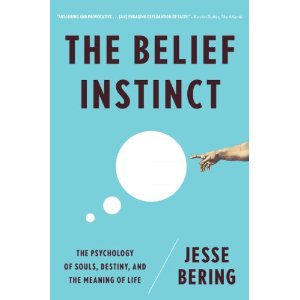
As we’ve seen throughout this book, our private experiences generated by thinking about our individual purpose, the meaning of life, the afterlife, why bad things happen to good people, and so on, are highly seductive, emotionally appealing, and intuitively convincing — in most cases leading directly to belief in God. It is therefore more than a little foolhardy to think that human nature can ever be “cured” scientific reason. As a way of thinking, God is an inherent part of our natural cognitive systems, and ridding ourselves of Him –really, thoroughly, permanently removing Him from our heads — would require a neurosurgeon, not a science teacher. So the real issue is this: knowing what we know now, is it wise to trust our evolved, subjective, mental intuitions to be reliable gauges of the reality outside our heads, or do we instead accept the possibility that such intuitions in fact arise through cognitive biases that——perhaps for biologically adaptive reasons—lead our thinking fundamentally away from objective reality? Do we keep blindly serving our genes and continue falling for this spectacular evolutionary ruse of a caring God, or do we peek behind the curtain and say, “Aha! That’s not God, that’s just Nature up to her dirty little tricks!”
Jesse Bering, The Belief Instinct
- Brian and I both really dug this book – an exploration of the evolutionary psychology that frames the human capacity for belief in the supernatural and the divine with stops along the way in existential writers, personal anecdotes, and fascinating research case studies.
- Getting down to what it is that primes us for belief in God? That is the “theory of mind” that humans possess. “Theory of mind is the ability to attribute mental states—beliefs, intents, desires, pretending, knowledge, etc.—to oneself and others and to understand that others have beliefs, desires and intentions that are different from one’s own.” This may be what truly separates us from animals – our ability to project mental states onto others, including the inanimate and invisible others.
- Which leads me to the human predeliction for teleological thinking. “A teleology is any philosophical account which holds that final causes exist in nature, meaning that design and purpose analogous to that found in human actions are inherent also in the rest of nature.” Which basically means that from a very early age our theory of mind abilities lead us to ascribe end causes for nature that suit us or other animals. An example Bering uses involves a child’s explanation for why a mountain exists – “so that the mountain goat has something to climb on” – the child answers. It is this type of teleological thinking that gets us into creationism, and given that humans quite naturally start from this place of explanation (at our earliest ages), Bering posits that there will always be more believers in creationism than evolution. Belief in evolution actually requires some real intellectual work, whereas a teleological theory like creationism is inherent in most people.
- Our over-active theory of mind is making connections and seeing signs everywhere. We connect a thunderstorm to our bad feelings about a potential road trip, some claim an earthquake as an Act of God designed to punish us.
- And because of this on some level we believe we are forever being watched and judged, which has a huge impact on our behaviour – making us more pro-social than many primates. In the most obvious examples, we don’t shit, have sex, or pick our noses in front of others (as a general rule) – because we are aware of the other in a way a chimpanzee is not. While we have more propensity for cheating or dishonest behaviour when we think no one will find out (see the quote below for even more evidence of this), it is obvious that a theory of mind which posits an unseen watcher and ascribes judgement and motivation to it – can be a powerful force in keeping impulses in check. (Gossip in humans serves the same purpose as grooming in primates.)
- This pro-social behaviour has obvious evolutionary advantages for a social species like humans who rely on others for survival.
As we learned earlier in this chapter, however, we also possess an especially effective, adaptive safeguard to protect our genes against our evolved impulses and our vulnerably overconfident judgment: the inhibiting sense of being observed. Again, ancestrally speaking, eyes meant carriers, and carriers meant gossip. What further derails our selfish streak is the conscious awareness that an observer can identify us as an individual: a specific person with a name and a face. The more obvious —or traceable— our individual identity, the less likely
we are to engage in intemperate, high—risk behaviors that, though they may well reap immediate payoffs, can also hobble our overall reproductive success, owing to the adaptive problem of gossip. Only a rather dim—witted bank robber, for example, would enter his targeted establishment without a disguise. If one is convinced of being absolutely unidentifiable, the fear of punishment—or retribution vanishes. The famous social psychologist Leon Festinger referred to this general phenomenon as the process of “deindividuation,” which “occurs whenever “individuals are not seen or paid attention to as individuals.” ” Deindividuation is quite clearly a potentially dangerous scenario for the social group as a whole; if the individual actor cannot be identified, then the threat of gossip loses that personal punch, one that otherwise helps keep the actor’s egoistic needs in check.Deindividuation is, of course, at the core of a mob mentality. It can also lead to acts of brutal violence against out—group members, because a “deindividuated” person is absorbed into an anonymous group identity and no longer fears the consequences of toting around an insolvably tarnished reputation. When faced with a frenzied mass of angry, anonymous people, relatives and friends of the out—group victim wouldn’t know where to begin looking for revenge against a specific perpetrator. In anthropological circles, it is well known that Warriors who hide their identities before going into battle are more likely to kill, mutilate, or torture than are those who do not bother to disguise themselves.
Brief notes on God.
(Some disjointed thoughts from reading The Belief Instinct, and Varieties of Religious Experience. Themes I have thought very much about in the past several years of my life and would like to return to in a better essay eventually).
It seems to me that to definitively answer the question of God (as people on both sides of the debate claim they can) would be to fundamentally change human society in a profound and negative way. It is the question, the lack of surety, and the struggle to attain faith (in religion or science or some combination of the two) which keeps us moving forward. Even if we could answer the question through some scientific “proof”, I doubt (based on some very interesting research presented in The Belief Instinct by Jesse Bering) that most humans on the planet would accept it as evidence as anything much – because we are hardwired with (or at least psychologically driven by) a theory of mind which projects sentience and motivation everywhere, not least of which is the universe.
Whether that theory-of-mind-brain was created by intelligent design, or is part of a great cosmic consciousness, however, is the part where everything gets hung up. Because some people will argue that it’s evidence of a supreme energy, and others will stand on the side of random chance and evolution.
I know what my side is, secular humanist that I am, but it isn’t without a little doubt and wonder. And it definitely isn’t without my own profound experiences that I would describe as spiritually-inspired.
In The Varieties of Religious Experience, William James collects a series of lectures delivered in 1901 and sets out to discuss the psychological realm of the reglious experience – unseen visitation, the healing or lifting of the melancholy mind, conversion, and saintliness among other topics. His aim is not to attack religion with science, but rather to use these events as an avenue through which to explore them as part of human psychological experience. There is no question posed here about whether God exists, at least not overtly, for that is irrelevant to the question of whether experiences perceived to be divine manifest themselves in individuals, and the answer to that is a most obvious yes. Our literature, poetry, and folk tales are full of such encounters, and they inform so much of our art and music – it would be strange to deny the role that “revelation” has played in our human culture.
And yet that is what the fundie-atheists would have us do – dismiss a whole realm of human experience due to its illusory and backwards nature. According to Richard Dawkins, we shouldn’t even be allowed to ask the question of the meaning of life:
If you happen to be religious, you think that’s a meaningful question. But the mere fact that you can phrase it as an English sentence doesn’t mean it deserves an answer. Those of us who don’t believe in a god will say that is as illegitimate as the question, why are unicorns hollow? It just shouldn’t be put. It’s not a proper question to put. It doesn’t deserve an answer.
(as quoted in The Belief Instinct).
Not unlike the brimstone religion which demands unquestioning adherence to God-belief, Dawkins threatens the rest of us as being perceived as quite silly should we dare to wonder even one time about our own purpose – how we fit into an increasingly chaotic world, and what the quotients of a meaningful life might actually be. In the case of James, I can imagine that Dawkins would dismiss him quite readily as not being hard enough on those proclaiming divine experience. For James does not take a scalpel to the writings and thoughts of others, but instead accepts these moments and revelations as the life-changing events they were. He does not belittle the psychology of those – such as Tolstoy – who felt very strongly that without religious revelation they might have become suicides or worse. Likewise, he does not claim that these experiences are proof of anything except to those individuals who experience revelation, conversion, the healing of the sick soul.
Though I have sometimes described myself as an atheist, I have to admit two things:
- I don’t have a definitive position on this. I am pretty sure it’s all just random chance and evolution, but that is all – I can’t prove it either way.
- I have had transcendant (and possibly demonic depending who you talk to) experience, I have a living (walking, breathing) guardian angel, and I have deeply felt the sublime on more than one occasion. I believe deeply in each of these things, but none of them has lead me to a belief in God – not in the all-seeing creator or the cosmic energy formulation that seems so popular at the moment.
If we read James, we will discover how encounters with the spiritual serve a particular balm to those sick souls in need of assistance. If we read Bering, we will see how the development of the theory of mind assisted our evolutionary ability to survive and adapt as a species. Neither of these things precludes the existence of God, though they do provide explanations of why we might have developed particular thinking patterns in support of our own survival.
I find myself wondering though about how much it matters – this whole existence of God question. Either transcendant experience comes from God, or it comes from inside and around us – but ultimately it does the same thing which is to expand our egos to connect with the greater creation inside of which we exist. Whether that happens in dramatic or small ways isn’t important – so much as the fact that it happens for us at all – the feeling of connection and belonging being paramount to our psychic survival in what is a life of difficult work (and random cruelty). And faith? Well you can have faith that God is the architect of it all and gain your comfort in that. Or you can have faith that you aren’t supposed to know and leave it there. Which means that even atheists can have faith, as can existentialists. A lack of faith heaves us up on to the plains of fundamentalism – as bloody and arid a place as anything.
You know that famous answer in the Hitchiker’s Guide to the Galaxy when the character asks the mega-computer Deep Thought, for the Ultimate Answer to the Ultimate Question of Life, The Universe, and Everything? 7.5 million years later the computer returns the answer 42. Explanation being that the Ultimate Question itself is the unkown variable.
As wittily clever as that scene is, it’s a passage which has always stuck with me. That as soon as we find an answer, we realize the inadequacy of our question – not to mention the restricted understanding from which we base it.
I started above by saying that to remove the question about God from society would surely impact us in negative ways – though I must also acknowledge that the question of God has brought us to misery beyond belief. Perhaps that is just the self-correcting nature of the human-population at work, or perhaps all those holy wars and battles are a problem of too-little faith compounded with diminishing resources. Certainly in the post-modern world we mix our religious and economic motivations up to such a degree that they are impossible to extract from one another. All of that acknowledged, I can’t envisage a world without doubt. I can’t envisage a world without wonder. For it is where belief chafes against experience that we get so much of our fantastic philosophy, literature, and art. What world would we live in if this question and our so-called divine experiences didn’t exist?


 Red Cedar