Red Cedar
More apocalypse, less angst
BookShed: Landscaping with Fruits and Vegetables
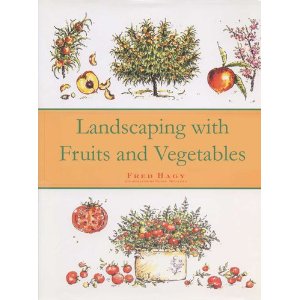 Landscaping with Fruits and Vegetables
Fred Hagy & Clare McCanna
First published 1990, reprinted 2011
Although I have only owned this book since last gardening season – it is showing some serious signs of wear and tear as I find myself referencing it constantly in the planning of my back and front gardens. Not only useful, but exceptionally beautiful – if I was going to purchase one reference book for garden aesthetics and edibility this would be it.
I know, that’s some pretty high praise, but look what you get inside – landscaping advice, sample garden drawings, practical advice and tips for various yard types, zone maps, care and maintenance information and lots of aesthetic considerations explained. And that’s not even getting into the plant information sheets. Divided by sections according to type and height, Hagy gives a full page to each cultivar with the essential information given in brief form. Here, in few words the garden landscaper can quickly look up each species for landscaping values, seasonal interest, planting considerations and tips. McCanna’s drawings which head each page make an excellent reference to tree shapes, fruit types and planting possibilities. If the tree does well in a container, it is shown in a container. If it has a particularly attractive blossom, the blossom is drawn out in detail. As a planning guide, I find this extremely helpful in that I don’t have to scan pages of text to get the answer to my immediate questions (how much sun? do I need more than one tree for fertilization? will that grow on my patio?) because the most important characteristics are pictorial, and the brief notes make for an easy scan.
Though most fruits are covered in this book, the only vegetables which make an appearance are those with some aesthetic value in keeping with the focus. There is a section for plants that are primarily ornamental with some culinary value, and also some information on what grows best in containers. In the back are handy reference lists for recommended cultivar lists as well as bloom-time corrections for different parts of the US (sadly, no Canada here, we can only guess using the zone maps as a guide).
As an urban gardener without acreage to plant on, I am always looking for ways to maximize both the appeal and the food-yield of my small lot. This book is one that I find inspiring in both projects every time I take it off the shelf for a browse.
A recipe for container soil (lemons and limes, oh my)
I recently purchased a Meyer Lemon and a Bearss Lime from a very special person on Vancouver Island – Bob Duncan. You can see Bob in the video above, where he discusses growing lemon trees in Canada – outdoors even! While I have seen lemon trees at the garden centre previously, I always believed they needed to be planted indoors or a greenhouse in order to succeed in our climate – but I was pleased to learn that this is not so, and even more important, bringing them inside in the winter can really stress them.

Despite the hail and snow yesterday morning, I managed to get my new trees potted yesterday in some 15-gallon planters that I bought on the cheap at the Re-Store a few weeks ago. These are much bigger than I needed for the trees at this stage, but because I had them I figured I might as well just fill them up with the right potting mix and give the trees some room to grow. Apparently in 4-5 years I will be re-potting these in 25-gallon containers, which is the maximum size needed for the full-grown trees.
Because I am anxious for these trees to live and prosper – I followed Bob’s instructions for the soil mix to the letter. This is a new thing for me, as I am frequently the kind of gardener who just uses whatever soil, fertilizer and drainage materials that I have on hand – but while that works out in my garden boxes for the most part, I have always struggled to get my container plants to thrive. In the case of a fruiting tree, I know that I will have to stay on top of feeding and nurturing them – so it makes sense to get them started with the best possible mix.
I am sharing the soil recipe here, because I haven’t seen anything this detailed in the past and there might be other interested lemon/lime growers out there who want to try them as container plants.
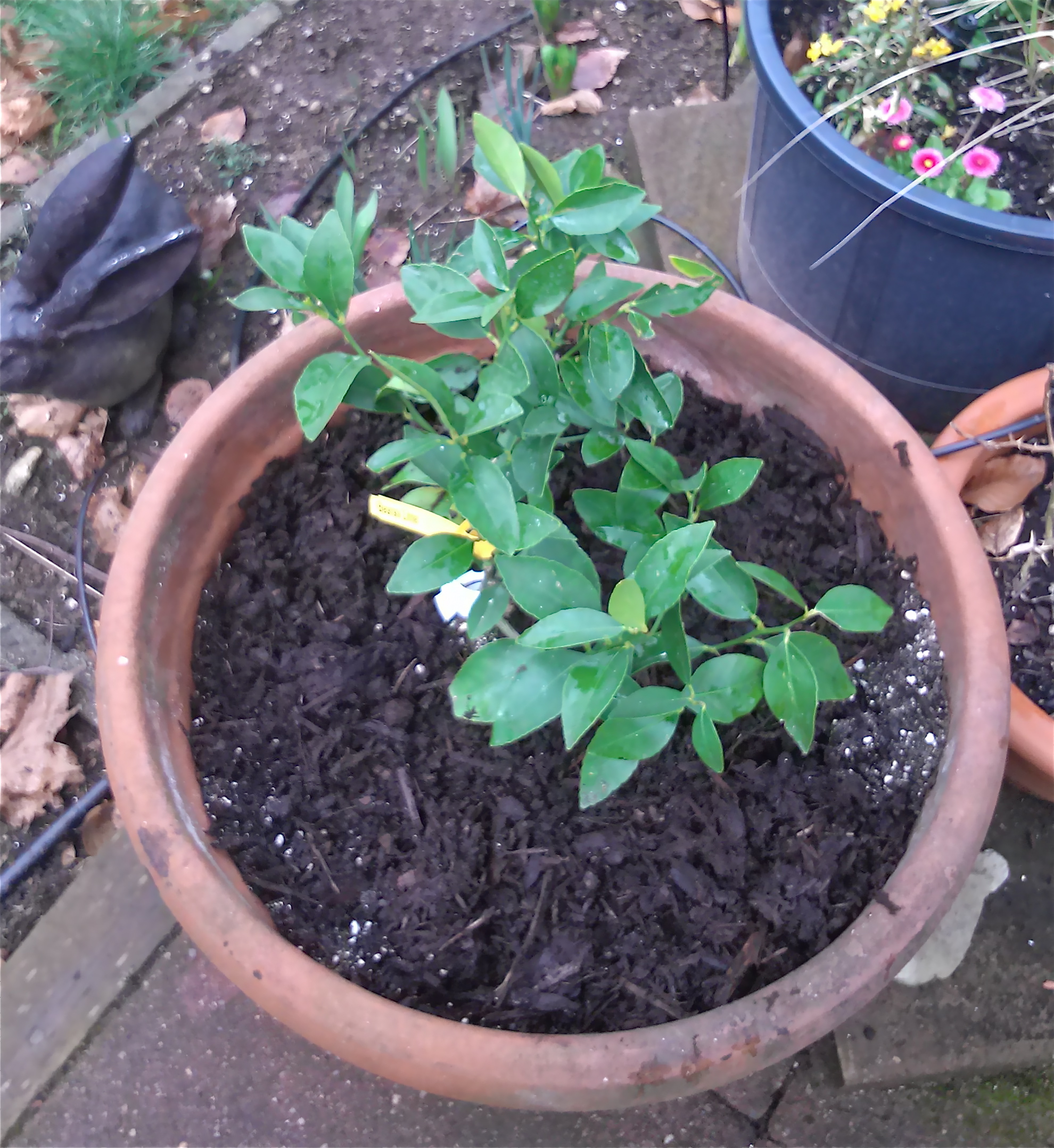
The formula: 1/2 screened bark mulch + equal parts pumice, coarse pearlite, sand and sea soil + 2 tsp dolomite lime and 2 tsp of bone meal per gallon of potting mix + 1/2 tsp chelated iron or other micronutrient per gallon of potting mix.
For example, a ten-gallon pot would include 4 gallons of bark mulch + 2 gal each of pumice, coarse pearlite, sand and sea soil + 1/2 cup dolomite lime + 1/2 cup bone meal + 2 tablespoons of chelated iron. (You will note that to get the numbers right I decreased the mulch and increased the other ingredients slightly).
My plan for these trees is to overwinter them beside our studio and under the overhang, stringing white Christmas lights for protection and using Reemay if the temperature really drops. We don’t get particularly cold winters here in Vancouver – though some years are harder on plants than others. I am hoping starting out in such a large pot won’t be a problem for these little guys, and suspect it will be fine as long as I pay attention to fertilizing at the right rates for the extra soil.
If you are on Vancouver Island, I would highly recommend going out to Bob Duncan’s place and checking out his orchard and greenhouses. He is only open a few hours of the week (see his website above for details) but apparently you can book a tour (which I intend to do at some future trip over). One thing I will say is that it probably pays to call ahead and/or reserve the plants you want to pick up. He has a wonderful selection of apples, as well as berries, and some other rare-to-find plants. In addition to the lemon and lime, I also bought a tea bush which I will write more about later when I get it in the ground.
Not only will he sell you the tree, but you will leave with complete growing and care instructions for whatever your purchase – and there is also the opportunity to buy marmalade made from the trees grown on the Duncan property. This is a gem of a place – run by fantastic people. So much more gratifying than the typical big-box nursery experience.
Oh! The childish poor!
I have to say, I’m really disappointed that The Tin Flute by Gabrielle Roy is the only Canadian work chosen in my program – not only is it a questionable choice in terms of its parochial approach to the struggle of people to live meaningful lives, but there are far greater works of Canadian literature that get to the heart of ethnicity, social estrangement, working class limitations and the constraints of background than this. Margaret Laurence’s The Diviners for one. Not to mention many of the Chinese Canadian authors who have emerged in the past few decades (Wayson Choy being the most notable example). I suspect however, that it wasn’t just the themes for which this book was chosen, but also for the time period it was written in and depicts (the outset of World War 2 at the end of the Depression).
There are all sorts of claims about this book out there, that it was a “realistic” portrait of working class Quebec, and was the hard, cold look of themselves that Quebeckers needed – fueling the Quiet Revolution of the sixties. But it should also be noted that Gabrielle Roy is known as English-Canada’s favourite French-Canadian writer which is some damning faint praise…. and might give you an idea of how accurate her portrait was. It certainly did fit into the stereotype that English Canada held about Quebec at the time (and still does to some degree), if that what is meant by “realistic”.
Roy’s story mainly focuses on the doings on the Lacasse family with Florentine (aged 19) and her mother Rose-Anne occupy parallel shorelines in a recounting of life in poverty in the St-Henri suburb of Montreal. In the early pages of the book we learn that Florentine is a waitress who gives her earnings to the support of her family (perhaps her only redeeming characteristic as she also comes across as naive, vain and not very smart) and her mother Rose-Anne is pregnant *again* with her eleventh child. Though they have been on relief, they get by for the first chapter on the wages of Florentine and the father (Azarius) until he loses his job as a taxi driver for loafing in the cafes instead of waiting at his cab stand for customers.
And so it goes. Florentine falls in love with an unsuitable man who pretty much rapes her while her parents are out in the country visiting family. Pregnant out of wedlock, she machinates to get another man who is smitten with her (the middle-class Emmanuel) to marry her before he goes off the join the war. In the meantime Rose-Anne has a gaggle of malnourished children, one who is eventually diagnosed with leukaemia and dies which she chalks up to “bad luck” as she does every hardship in their lives. Along the way we come to understand that many rural Quebeckers in the city of Montreal live this way, and that they have not adapted out of their ignorance despite moving to a city with other (higher) influences. Aware of their poverty they live in continual resentment of their lives and each other. Occasionally the characters do incredibly stupid things which have obvious outcomes that Rose-Anne, Azarius and Florentine seem unable to foretell – like Azarius taking a work truck out to the country without permission (he has an accident), Rose-Anne giving her son $10 set aside for rent (he hires a girl for the night with the money and the family is evicted a couple of weeks later), or Florentine inviting her crush over to an empty house in the hopes she can manipulate him into loving her.
In short, Gabrielle Roy’s Quebecois are lazy, non-adaptive, stupid, mean, manipulative, small-minded and short-sighted. Not to mention endlessly pregnant. On the other hand, we are supposed to sympathize with the characters because they don’t know any better, coming (as they do) from ignorant rural people who have so many children they can’t even give them a little love.
The problem here isn’t that Roy depicts people who are somewhat trapped in circumstances due to background, lack of education and family support – but they are continually engaging in behaviour that is morally reprehensible as though they couldn’t possibly understand the ethical implications of their action (though the reader clearly can). Yes, Emile and Florentine might have flickers of reflection on their behaviours – but these are ultimately over-ridden by their need for self-gratification. The poor are essentially children when it comes to meeting their own needs, and that is why they remain poor.
In contrast, the only reflective character in the book – that is, the only one able to look at his situation without the superstition of “luck” clouding his judgement is the middle-class Emmanuel who has voluntarily joined the army for the “right” reasons (because he believes in the cause and the possibilities of the outcome) unlike many others who have joined out of poverty or the need for escape. Though he is blinded by his concern for Florentine (loving her even more because of her weakness and small-mindedness), he is ultimately portrayed as noble and pure-of-heart (not to mention educated, interested in the larger world and handsome) against the backdrop of the city’s poor.
And so, what I expect was assigned as a meditation on making meaning out of hard circumstances became an entirely different read for me. Instead I come away from this wondering who it is that determines what “accurate” representation is across time, culture and ethnicity. While Gabrielle Roy was French-Canadian and Catholic like her characters, she clearly came from a background of some middle class privilege as a journalist and then novelist. I also think it’s worth noting that she only moved to Quebec as an adult having been raised in francophone Manitoba. It is from this vantage point that Roy descends into Montreal and begins her”portrait” which comes across as little more than judgement wrapped in sympathy (not unlike the charity-model so popular among upper-class women).
It’s difficult to attempt to speak for another – but that’s something we’ve only come to analyze in the last thirty or forty years. For a long time we had white men of the upper middle-class and then eventually some women (but also white and middle-class) attempting to tell all sorts of stories that didn’t belong to them, stories that didn’t originate from their own lives. Often that didn’t work so well (think Kipling), but sometimes it really did (Dickens, Steinbeck) – but either way, it wasn’t until the end of the 20th century that we really thought to question how the authorial experience and voice might be shaping narratives in favour of the dominant socio-cultural paradigm.
It’s common knowledge (I think) that English and French Canada have had an uneasy relationship ever since the Battle at the Plains of Abraham (in Quebec City the signage at the PofA park doesn’t indicate anywhere that the French lost that one), and I believe much of English Canada is still engaged in an attempt to diminish the French culture in Quebec, Manitoba and New Brunswick. Much like the Euro-Canadian attitude towards First Nations people in Canada, the English would just rather the French problem went away altogether – which of course involves assimilation rather than annihilation (we’re Canada after all).
While I don’t believe this is Gabrielle Roy’s interest (she is French-Canadian after all), The Tin Flute reads like a plea from one who doesn’t want to lose their French culture but instead wishes it would gentrify – not in order to see everyone lifted up per se (socialism! how naive) but because to be related to such backwards, superstitious and shiftless people is an embarrassment. It is a little like Bill Cosby lecturing Black America – cringe-inducing in that you can see the author/speaker means well, but the impact of their words simply fuels an already-present racism/bigotry in the dominant population.
No doubt The Tin Flute is an historic Canadian novel – but nowhere near the calibre of the rest of the works we read this semester (and last) in terms of quality or significance. I have to wonder whether this is just some hastily added Can-con and if so….. I would rather have none than this rather weak addition to our reading.
Neighbourhood ghosts

At the corner of Victoria and William, this ghost image was uncovered a few months ago during the renovation of this storefront (which looks as though it will become a pizza place? Or perhaps it was just made to look that way for a film set). In any case, it’s good to see the loving preservation as the building undergoes more renos. And it’s nice to see an older building being reno-ed rather than just torn down for new.
Quite passive, recording, not thinking,
I finished The Berlin Stories this morning on my way to work, turning my commute into the last days of freedom in Berlin during Hitler’s rise to power. I don’t know if this is a function of age, or simply of the thousands of hours I’ve spent with books, but I more deeply immerse in my reading material than I ever used to – text becoming image, image blocking out the rest of the world for that moment. The last days of Isherwood’s Berlin left me shivering as I stepped off the bus, wondering what degree of social chaos must exist for facism to seem like a reasonble option for order. (Given the state of Canada’s politics these days, can you blame me for thinking about it?)
The Berlin Stories are actually two novels – or one novel and a diary/short-story-collection really. Set in Berlin during the chaotic last days before World War Two, rather than deliver a grand political narrative, Isherwood examines the small characters in life – the bombastic landlady, the prostitute-cum-cabaret performer, the government official with a taste for boys books, the hustler, the communist true-believer, the naive heiress. Of course his best-known character is Sally Bowles and the film Cabaret is based on Berlin Diary.
Of all the readings I have done for grad school, this one left me with the least to say. Not because I didn’t enjoy it, but because it seems rather straightforward to me – an attempt to click the shutter on the lives of everyday people in a tumultuous time – to capture the snapshot before those people and days are blown away in a haze of atrocity. (Isherwood lived in Berlin during the years he wrote about, though his novels weren’t written until the mid-forties, with the benefit of hindsight one living there wouldn’t have had in the moment.) There is a question I suppose of how people go on as normal, concerned about jobs-relationships-familyproblems while something as stark as facism is rising around them. But I’m not sure why we would ask that question of Germans in Berlin in 1938 without also casting it on ourselves in Canada in 2012. How is it that we turn a blind eye to cruelty, meanness, chaos, and the poverty of spirit that infects so much of our society? But we do. Because the jobs-relationships-familyproblems are so much more present than the politics.
Working people, feeling no stake in the world of government, mostly try to keep their heads down and unnoticed. These are the characters of Isherwood’s sojourn – those who exist on the margins and yet create their own centres of power and intrigue and scandal. They are real, these characters, even as Isherwood’s eponymous central character is a mirror of the others rather than any distinguishable self. When Isherwood makes the fatal mistake of introducing two female friends (Sally and Natalie) we understand how much he treasures his relationships – that he is willing to risk them to show one part of himself to another (as if that could ever work).
If I had more time to reflect on this I would, but I don’t and rather like that the Berlin Stories washed around me without encouraging a lot of highlighting or note-taking on the text. It strikes me as just stories of what was, a picture really, as Isherwood himself attested – “I am a camera with its shutter open, quite passive, recording, not thinking.”


 Red Cedar