Red Cedar
More apocalypse, less angst
All of what is me right now.

I’ve just got to start with family-member bragging time today because my niece turned one on the weekend and took her first three steps. To me! Which was resulted in one very surprised looking baby and a round of applause from her parents, Brian and me. She is pictured above wearing her new onesie-dress to match the doll my mom made for her – a little stunned from all the attention.
It was a nice weekend away on the island with family – we had dinners and played with the kids, and had conversations about things. THINGS. Like the development behind my family home, the indiscretions of family members, and the fact that my brother and I want to know each other better but don’t know where to start. And there are impediments, like distance and personality quirks. But we all want the kids to have a close relationship to their aunt and uncle, and that means we have to figure it out. So we are starting to.
We brought back two frozen chickens raised by my sister-in-law (plus 3 dozen eggs) and ate one of them last night. This is a pretty cool thing they are doing, and I hope that we can foster some food trades that work for them since we can’t raise meat in the city. Like healthy canning for the kiddos being a good place to start – reduced sugar jam, unsweetened applesauce and so forth.
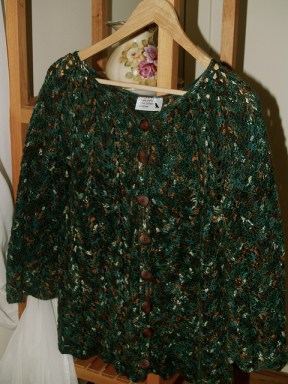
When I came home on Sunday, I unpinned this sweater from blocking and discovered that it fits perfectly! Not only that but I have received three compliments on it today, despite the fact it has a weird camo-ness to it. This photo isn’t great, but the variegation turns out to be quite flattering and not at all “urban-hunter”…. rather tweed-ish instead. I’m wearing it office-side today with a short brown skirt and my long grey hair down. I either look like a super-confident and stylish-type woman of forty-ish, or I look like an older woman who makes her own clothes (in the worst sense). Hard to really judge that one, though the people around me assure that I look great. So I am going to have to go with it (and disregard my mother’s comment about grey hair making me look old).
I find myself insecure these days about my looks and persona, which I think have to do with aging and the fact that once women move out of the madonna/whore paradigm of our fertile years – we immediately move into the cougar/crazy years. A woman either “looks so good for her age” or “has really let herself go” – and I want to be neither. Really, I’m aiming for “has a good life,” which involves a balance between staying somewhat fit without worrying too much about what other people think. Easier said than done (on the latter count especially). Fortunately I *do* have a good life (exceptionally so) and when I can filter out all the social noise about “who I should be” (thin, more accomplished, whatever, whatever) I manage quite fine. More than fine. Dialing down the outside noise is something I’m going to be working on over the next little while – particularly because I’ve got lots of awesome coming up and I don’t want to be distracted.
In one more piece of pre-forty news I am in the process of taking care of a number of little chore-items in my life – and yesterday I finally (finally!) took my graduated driver’s test and passed! Yes, that’s right. For ten years I have been driving with an “N” but as of yesterday I am N-free! I’m not sure if I’m proud of that or not, given that it took me ten years to get around to it – but at least I’m not going to be forty under the pretense of being a “new” driver.
And that, folks, is all of that is all of what is me at the moment.
Island-bound, with gift!
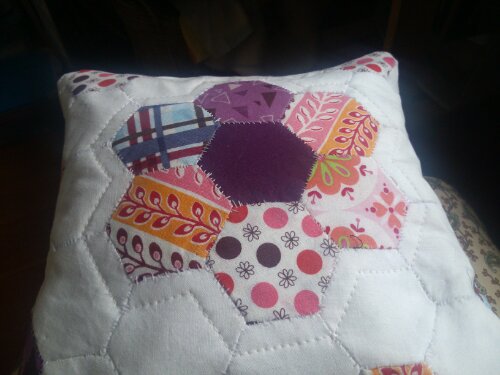
Things have been busy lately. Work busy, school busy, and home busy – which hasn’t left a lot of time for posting here. I have, however, been making things steadily for the last few weeks. I finished a sweater last night (10 days from start to finish – not bad), and I have three small crochet pieces blocking at the moment. I have big plans to photograph it all on Monday so I can share those items through next week.
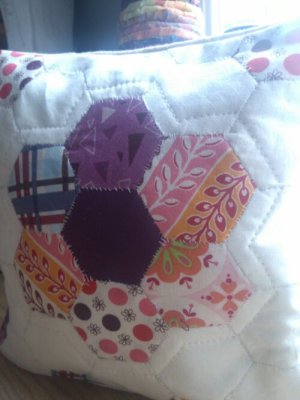 This weekend is my niece’s 1st birthday, and for that occasion I have made this 8×8 hexagon pillow for her little-kid rocking chair. This is the first hand-stitched piece I have done – I have become addicted to hexagons which can only be hand-stitched so I see more in my future. (I am now working on a large-scale quilt with hexagon appliques for our queen-bed). Although I will admit that I am not the tidiest of sewists, I note that as with all things handmade, the finished product doesn’t suffer for it. Either your stitches are perfect and everyone oohs and ahhs over your technical precision, or they aren’t and the piece has a whole different level of heart that shines through. Win either way.
Plus, one-year-olds don’t care about perfection.
We’re heading to the island tomorrow for a weekend of birthday reveling – my niece’s birthday party is Saturday afternoon, and Saturday evening my parents are taking me for dinner for my 40th which is in two weeks (!) One very exciting thing about the weekend is that we will be getting the first of our meat-birds from my brother and his wife who are now raising chickens for food (as well as eggs which we’ve been getting from them for the last couple of years). After watching Food Inc. last week I am doubly-committed to doing anything I can to stay out of the industrial food system.
So it’s off for the weekend, next weekend is the cabaret at our home plus friends visiting for a little pre-birthday love, and the weekend after that? My birthday! A little spell of lovely things, coming right up!
Another East Vancouver dust-up.
I’ve got to admit it, as much as this may be a very unpopular sentiment in East Vancouver right now: my outrage-o-meter is pretty much all tapped out when it comes to the recent kerfuffle about the Waldorf Hotel and the announcement that Solterra Developments wants to put some kind of project (condos, hotels, bars?) along Hastings Street.
I mean, don’t get me wrong, I hope the Waldorf can be saved through some creative architecture, and that the City is looking at ways to provide financial incentive to see that happen. Venues for artists are important, and the Waldorf has a history people feel attached to (though the current clientele can’t really testify to that since they kicked the long term sports bar and longshore drinkers out when the building was renovated three years ago) – on those counts it would be nice to see it get saved.
But I’m struggling with this becoming a fight about gentrification without a larger discussion about the future of housing in Vancouver, and I do think there needs to be more thought put into the discussion around what happens along the Hastings corridor as a whole.
Firstly, much has been made about gentrification and how the Waldorf is being impacted by that. But really! The current lease-holders of the Waldorf re-built the hotel knowing that the neighbourhood (from below Clark to Renfrew) is all potentially slated for mid and low-rise condominium development. There are condos going up at the old Canadian Tire site beside Gourmet Warehouse, not to mention the Millenium development across the street from the hotel; Penticton and Hastings saw a development four years ago and is about to experience another one with the London Drugs building coming down later this year. And up at Kaslo and Hastings is another three-story condo development going in with a credit union in the bottom, right next door to where the Pharmasave/condo development went in two years ago. (Those are just the ones I can think of off the top of my head.) It was this future the Waldorf folks hoped to cash in on. They just didn’t expect the building they were leasing might become impacted as well.
If you know the neighbourhood, you will recognize that besides the Waldorf, these new condo developments are mostly replacing vacant lots, parking lots/auto dealerships, or single-rise storefronts that were all but falling into the ground. Basically, we are losing a lot of fallow space in exchange for more housing on transit corridors. That is – more housing suitable for the growing number of people who live alone, more housing close to work and that doesn’t require owning a vehicle, more housing overall.
But housing is an issue that people can’t seem to come to terms with in this city. While we know that we need more and cheaper housing, we aren’t sure what that means in practice.
One way to get cheaper housing is to increase the available stock. While I don’t know what the specific plan is for the Solterra development, I do know that condos built right on Hastings Street (a highway for all intents and purposes) are not generally of the high-end, luxury variety and a great number of them will eventually end up becoming rental stock (as happens in every condo building, low or high-end). Is it gentrification because these are condos? Would it be better if it was high-rent apartment building? Low-rent apartment buildings? What if some of the condos become low-rent units? What is the model of housing development that people would like to see beyond social housing?
We really do need a mix of housing models – condos, townhouses, socially-owned, co-ops, and private market….. And of course there is the demand that a percentage of social housing units should be provided for in every condo development that goes up in this city.
But again, this isn’t about a community engaging around the future of the neighbourhood – this is about a community engaging around a single business that for all intents and purposes came into the neighbourhood with the hopes that it would gentrify. These are people who have the attitude that “there is nothing there” but the Waldorf – never mind the other businesses and the Native Friendship Center and the Longshore Union Hall and the live/work spaces down on Powell, and the quirky galleries and etc. Never mind the pre-reno Waldorf itself, which catered to people who actually lived and worked in the neighbourhood. And all that stuff I’ve heard in the past few days about how the Waldorf has “revitalized” that strip of Hastings? Where’s the proof of that exactly, beyond the destination of the Waldorf itself? The new commercial development going in on the Canadian Tire site has very little to do with the hipsters across the street – the car lot next door is as skiddy as it ever was (in the last two years the owner has used his fence space for men’s rights banners detailing his child custody issues – not exactly an upscale approach to car sales).
So let’s go back to the beginning. I think there are creative ways to save the Waldorf, to have it planned into whatever is being developed in that corridor. Not only that, for the developers, it serves as a draw in selling units not to mention cut them a break on some City taxes. I would like to see the unique building that is the ‘dorf saved but I think all the facts need to be straight, and it needs to be recognized that there are various approaches to what we want (and really, the infantile comments on the Solterra development FB page? not getting you anywhere people.)
As someone who uses and travels through the Hastings corridor every day, I do not want to see it preserved as it is right now – a zone that often feels unsafe due to lack of pedestrian traffic, where traffic whips through above the speed limit and there aren’t nearly enough pedestrian crossing lights. The paved over earth without a bench or a patch of grass, are signs of an old model of development in East Vancouver that I’m pretty sure we can move on from now. But what do we want instead?
We want artistic venue space, and we want meeting/drinking/eating places, and we want housing. More of it. Cheaper. Closer to work and places to go. We need to remember that vibrant neighbourhoods have people living right in them, not traveling to them. We need to think about how vacant lots and car dealerships are crap uses of land when there still isn’t enough housing (affordable and otherwise). We need to put pressure on the city to demand a higher social tax from housing developers so that we get the mix and range of housing to meet the widest arc of need. We also want businesses that cater to the actual residents of neighbourhoods. We want space for community social services, libraries, recreation centers and parks. In short, we want it all, right? And we want to engage in more than just a public temper tantrum. So I would encourage people who care about the *neighbourhood* to get engaged in letting the city know what you want beyond a single hotel in the middle of a concrete sea of parking lots…. because there’s got to be more than just that, right?
(There’s a whole other argument in here about the need for urban industrial space that I don’t really want to get into….. mostly because I don’t know the stats on declining industrial space and need, and I also know a lot of the warehouses in the Waldorf area are empty and/or under-utilized. Funny how everyone gets upset about the possibility of empty condos everywhere, but at the same time fights to preserve the crumbling architecture of empty apartments and warehouses.)
Yammy goodness (and eating almost clean)
 In 2011, for about ten months, I went on a lower-carb eating kick. Not no-carb, but I pretty much tossed out white grains, wheat flour, simple sugars and everything refined, chemicalized or non-naturally coloured. I kept all veggies, legumes, meat, and dairy in my diet – so it was by no means Atkins or Paleo – but it was a pretty big departure for someone who had previously been a carb-loving vegetarian.
And you know what? It really did make me feel better, and look better – not to mention helping me to manage my weight and blood sugar issues. Plus! Less digestive weirdness (another term for gas, really, I have a lot less gas when I get the simple carbs out of my life).
So, being the new year and all I’m at it again – this time inspired by some pretty awesome paleo food blogs (for the record I think the paleo “science” is anything but and I have zero pretensions around eating anything approximating a “primitive diet”). And after a week (during which I have eaten wheat exactly once, and no other grain product besides) I can already see that my stomach is less bloated and my digestion less crabby. I’m also finding myself inspired to cook again for the first time in awhile and I’ve been stocking up on good, healthy stuff to build easy meals out of – which is the trick for me when trying to get “convenience foods” like bread and crackers out of my diet.
In any case, I’m feeling all food-empowered at the moment and I just wanted to share this little recipe that I concocted for lunch (that was so good, it might be my new favourite lunchtime thing).
Yam and Sausage Hashy-hash Serves 2-3
Ingredients:
2 Italian Sausages (mild or medium)
2 yams – peeled and shredded
1 sweet potato – peeled and shredded
2 tablespoons worcestershire sauce
1 tsp onion powder
1 tsp garlic powder
Best cooked in a big frying pan or wok (I wok-fry everything possible). Squeeze the sausage out of its casing and brown in the wok, breaking it up into pieces. Once the sausage is all cooked and the bottom of the pan has some oil to work with, add the yam and sweet potato, worcestershire sauce and powders. Cook on medium heat, stirring frequently for 5-10 minutes until the mixture is to your liking. Salt and pepper to taste.
If you’re eating clean you can leave out the worcestershire sauce and add a bit of stock for liquid.
So simple and incredible! Inspired by the Sweet potato hash recipe on Nom Nom Paelo, which has some awesome recipes that I intend to get to trying over the next few weeks!
A life of our own.
Woah Nelly! I have been really sick the last two days. I mean not-getting-out-of-bed sick. Feverish snot factory over here! And I’m not exactly better yet. Or at all. But I’m sitting up today and that’s some kind of improvement (well, now I’m lying down again, but it’s on the couch not the bed, still a step forward right?)
Given a pretty strong constitution, getting sick is a once a year affair for me. Not that I get ill only one time, but most bugs pass without too much fuss, they almost go unnoticed. But every year between December and February I get a real thing. A thing which pins me down for a few days and makes me vow to wash my hands more obsessively in the future, or stop taking public transit because biking is germ-free. And that’s what I’ve got right now. That once a year nasty bug, and at just the wrong time because I’ve got work deadlines to meet and meetings that I HAVE TO BE AT.
Except that I don’t.
Because one thing I have learned in the last few years – is that nothing is more important than taking a time-out when I’m sick. I didn’t used to be this way. As I wrote on a friend’s blog this morning:
” I’ve been reflecting on this (external validation) since I’ve been really sick this week and remembering the last time I was this sick two years ago I forced myself through a bunch of speaking engagements in order to satisfy “commitments” I had made. Doing so made me much sicker (of course) and resulted in a sinus infection which has not gone away since. And did it result in more external validation? No! Of course not!”
Besides the fact that external validation isn’t much of a goal, the other thing I have come to realize is no one much notices what anyone else does. Yes, I might feel like the deadline on a document is a really big deal, but whether I make it or not will go largely unnoticed by my boss. Even if he notices it in the short term because he needs to submit it to committee, by the time 3 weeks passes, he will have forgotten about the document and the deadline entirely. Lastly, even if he does notice and is ticked off about it, what am I to do? One person might be upset, another person might be understanding – but that is completely outside of my control – just as the illness is outside of my control. I can’t get rid of the fever which impedes my ability to think/work by snapping my fingers – just like I can’t control the reactions of others. Sure, I can have an influence on how my boss feels – keeping him updated and so forth – but even so his judgement is in his control, not mine.
In some ways that is the gift of illness – a realization that very little is in our control.
I’ve just got bronchitis, which isn’t much of anything in the grand scheme except a reminder of how dominated we are by our physical well-being – and a shadow of what chronic and debilitating illness could be like. We structure our lives and our society around wellness, but what happens when that physicality is taken away from us? Chronic illness or not, we all face aging which imposes the same constraints. But despite illness, infirmity, or age – we all want to live with a measure of contentment – which requires working within our limitations to craft a life that is our own. This is something achievable for all of us, if we give up on the external forces which tell us we must purchase, strive and gain status in order to be fulfilled.
And so I am here, on the couch for another day, realizing that all I can do it make a drug store run and then come back and lie down some more. And it doesn’t make me bad person because I can’t work. It doesn’t matter at all beyond the fact that I need rest to get better.


 Red Cedar