Red Cedar
More apocalypse, less angst
February is my New Year
 As you might have noticed January has been a bit of a wash for me. I have now been sick for one full month – starting with a late December cold and then morphing into either a worse cold or the flu – I have missed out on countless fun activities and good times, not to mention the fact that my work targets have all gone entirely out the window due to excessive absence.
But most of all, what has really sucked about this is the timing. As someone who looks forward to the turning of the year for all the psychic relief and goal-setting it brings me – January 1st is a time of great intentionality as I think about all the possibilities for the year ahead. But this year? I was too busy blowing my nose to come up with anything resembling a sustained thought — and the 1st came and went without a single wiry resolution poking its head up.
You’d think I could let it go, just this one year – but sadly, no. I’m all pent up with my need to resolve — not to mention stir-crazy with being stuck inside during all these nice days we’ve had lately. So I’m going to use February as my New Year – which is appropriate not only because I’m finally well enough to care about life, but also because my birthday happens in the first week of the month — so it’s a new year for me regardless!
I haven’t quite worked them all yet so I’m going to wait to post on this until tomorrow or Saturday – which is the actual start of the new year according to me.
Part Seven: Spiritual Practice
A human being is a part of the whole called by us universe, a part limited in time and space. He experiences himself, his thoughts and feeling as something separated from the rest, a kind of optical delusion of his consciousness. This delusion is a kind of prison for us, restricting us to our personal desires and to affection for a few persons nearest to us. Our task must be to free ourselves from this prison by widening our circle of compassion to embrace all living creatures and the whole of nature in its beauty.” Albert Einstein
 As someone who holds strongly to the belief that there is no great cosmic force or god working behind the scenes, I have found myself inquiring into the nature of the sacred and what it means to be spiritual. I have never believed that faith in God or karma is required in order that a person be moral, nor am I stirred by the beauty and majesty of nature to discover a creator in explanation of this world. Without any religious path I find myself often moved by the unexpected sight of a wild animal, the stirring of the wind around the tops of trees, the words of a great sage or the unselfish actions of people around me. Which I suppose are all what comprise a moving of the spirit, that inner force, which constitutes my secular spirituality.
In class our instructor attempted to engage each of us to answer the question of whether we believed in the sacred, which most people did not answer, and to which I said that I did not know. I realized later that my indignation at what is commercially sold as spirituality in the new-age movement, indicated that I must believe in a real sacred, if I am to rail against what I perceive as the false prophets becoming wealthy off the fears of social and environmental crisis. And if I investigate that further, I would have to be honest and admit that I do harbour an idealism about the human condition which is rooted in our capacity for goodness, compassion and wisdom. It’s this belief that makes me a socialist as well as an optimist, despite all signs to the contrary.
It is possible to hold that there are sacred things – teachings that should not be sold, landscapes which should not be destroyed, sanctuaries and the idols of faith which should be left untouched – and still not believe in God. It is also likely that we can agree to a definition of holiness which is rooted in the wholeness of our human potential and the earth we inhabit without calling on an outside force in witness of our deeds. All of human society is simply agreement on what the rules of engagement are, and if we come to terms with the fact that we’re all in this together, all suffering, all connected, all living the best way we know how – then spiritual approaches from all corners, including the secular, are permissible and should be understood as having the same aim. For we are all seeking a life of unity, an Eden which we are certain we have arisen from and will return to, whether that urge is drowned out and obscured by the noise of the world we are in.
As much as I believe in this potential, for each of us to accept ourselves exactly as we are and still work towards unity and equanimity, I don’t believe this happens by accident. It is a rare person who is “naturally” tranquil and balanced in all ways of living, and more often the case that those people have worked at becoming over the whole course of their lives. Which isn’t to say there is a single route we all must take. As the famous opening stanza of the Tao Te-Ching intones: “The tao that can be told, is not the eternal Tao. The name that can be named is not the eternal Name.” Which can be interpreted to mean – the way (the path) cannot be defined nor taught. It’s up to each of us to figure out how we get from here to there.
Though our path is solitary, we are fortunately not alone on it, and because we live in a world where teachings are prolific and available we are not without teachers either. Universities, temples, churches, study groups, community organizations, are all vehicles that exist to assist in the development of our potential for compassion and wisdom. Practices such as meditation are no longer the domain of a few monks on far off hill tops, nor is access to reading confined to a single ruling class group. In Canada, even those with limited means may avail themselves of community centre programs, discussion circles university lectures and cultural events, often for little cost. And the ability to practice our compassion and tolerance is available to us in all circumstances (more often than we would like).
But first, I think, we must get over our embarrassment at not being able to answer the question, “do you believe in the sacred?” and instead find the space in which to open this line of inquiry in a non-dogmatic, non-programmatic way. I have been lucky in these last few months to have a taste of what that might look like, through both my university course and in my workplace meditation classes. Both places providing support and instruction as I began to learn a slightly modified way of living. More time for inquiry, more time for quiet and learning to filter out the distractions so I can spend more time in connection with my family or just gazing at trees moving with the wind.
These things which move the spirit, they are sacred.
Part Six: Awakening
(There has been a rather long break between the last part and this owing to sickness to great that I couldn’t care about much and watched too much bad tv).
It happens that the stage sets collapse. Rising, streetcar, four hours in the office or the factory, meal, streetcar, four hours of work, meal, sleep, and Monday Tuesday Wednesday Thursday Friday and Saturday according to the same rhythm – this path is easily followed most of the time. But one day the “why” arises and everything begins in that weariness tinged with amazement. – Albert Camus
 I prefer the term awakening to enlightenment because waking up seems so much more attainable than acquiring great knowledge. Awakening can refer to a lofty spiritual state, or it can be used as in the Camus quote above, to imply awakening to the falsity of the world in which we live, a notion that may or may not have spiritual implications. And finally, it seems less divisive. Just as every sleeper has the capacity to wake, so does every person, and the person who is awake is no better than the one who is still sleeping. These are states each one of us can relate to while the concept of enlightenment may seem alien or distant from our day-to-day experience.
But how can we know what awakening is in the spiritual sense? In The Myth of Sisyphus Camus argues, “Properly speaking, nothing has been experienced but what has been lived and made conscious. Here, it is barely possible to speak of the experience of others’ deaths. It is a substitute, an illusion, and it never quite convinces us.” Which speaks to my own skepticism – as one who is asleep – about the existence of people who are awakened. Because we cannot experience what we haven’t lived, it’s difficult to believe this state exists, even though I have encountered people in the world who clearly have some particular clarity the rest of us don’t possess.
When I am in a deep state of meditation or bringing mindfulness to bear on some routine activity, I have on occasion felt an intense and almost-indescribable pleasure. For example, in walking meditation, if I bring my attention to the soles of my feet, I experience a feeling as though my feet are being massaged by the ground. Since discovering this particular sensation, I have experimented with it in daily life and discovered that I can bring this attention and stimulate the “foot massage” effect in any situation where I am able to be mindful. Likewise in a reclining meditation, when I bring my attention to the points of contact which are touching the ground or bed, I experience an almost-overwhelming feeling of being held which is accompanied by a similar good feeling of warmth and homecoming.
From this limited vantage point I believe to be awakened is to live in this state of calm and well-being most of the time and to meet all suffering and struggle from that place. This is my experience point from which to inquire, and thus my own projection of what awakening must feel like, but on a much grander scale. I also recognize that such a state must be indescribable, as I find my own ability to talk about something as basic as meditation effects severely challenged. These sensations are not translatable to language in a typical sense because they are so deeply felt, and I suspect very individual to our own inclinations and openness.
Down but not totally out
Sorry for the disappearing act last week (5 parts into a 7-part reflection!) – but I’ve been horribly ill since last Wednesday night and I haven’t had much brain space for blogging.
I’m pretty sure that I’ve had the flu, still have the flu for that matter, though the Dr. wouldn’t say much about it when I went into the clinic on Friday to get a prescription for an asthma inhaler – something I don’t normally need but the cough with this thing has done a number on my lungs, not to mention my sinuses, my ears, my throat and every muscle and joint in my body.
After two years of taking almost no sick time, I am now on day five of sick leave since January 1st – making me glad that I’ve got it to use, but disappointed because I was hoping to get to year end in March without having used any!
So yes, I’ve been bed-ridden. But lucky for me I (mostly) haven’t been so sick that I can’t sit up and do things like read, and hand-sewing. The first couple of days were spent mostly sleeping, but since then I’ve been intermingling bed-appropriate activities with my naps – I would be going crazy if I didn’t have some vestige of “productivity” at hand otherwise. I also have been able to be at my sewing machine for an hour at a time (not longer, I get dizzy) on a couple of days – so that’s been a nice break from bed.
Here are three things I have worked on in the last week that I feel like sharing right now:

Up first is this table runner that I started hand-piecing early in 2013 and then left to languish. Last night I finished the last row of piecing and now it sits on my sewing table awaiting borders and quilting.That’s 253 hexagons paper-pieced and stitched together – my first substantial pieced work by hand. It doesn’t look like much here – but once it’s ironed and finished — so excited!
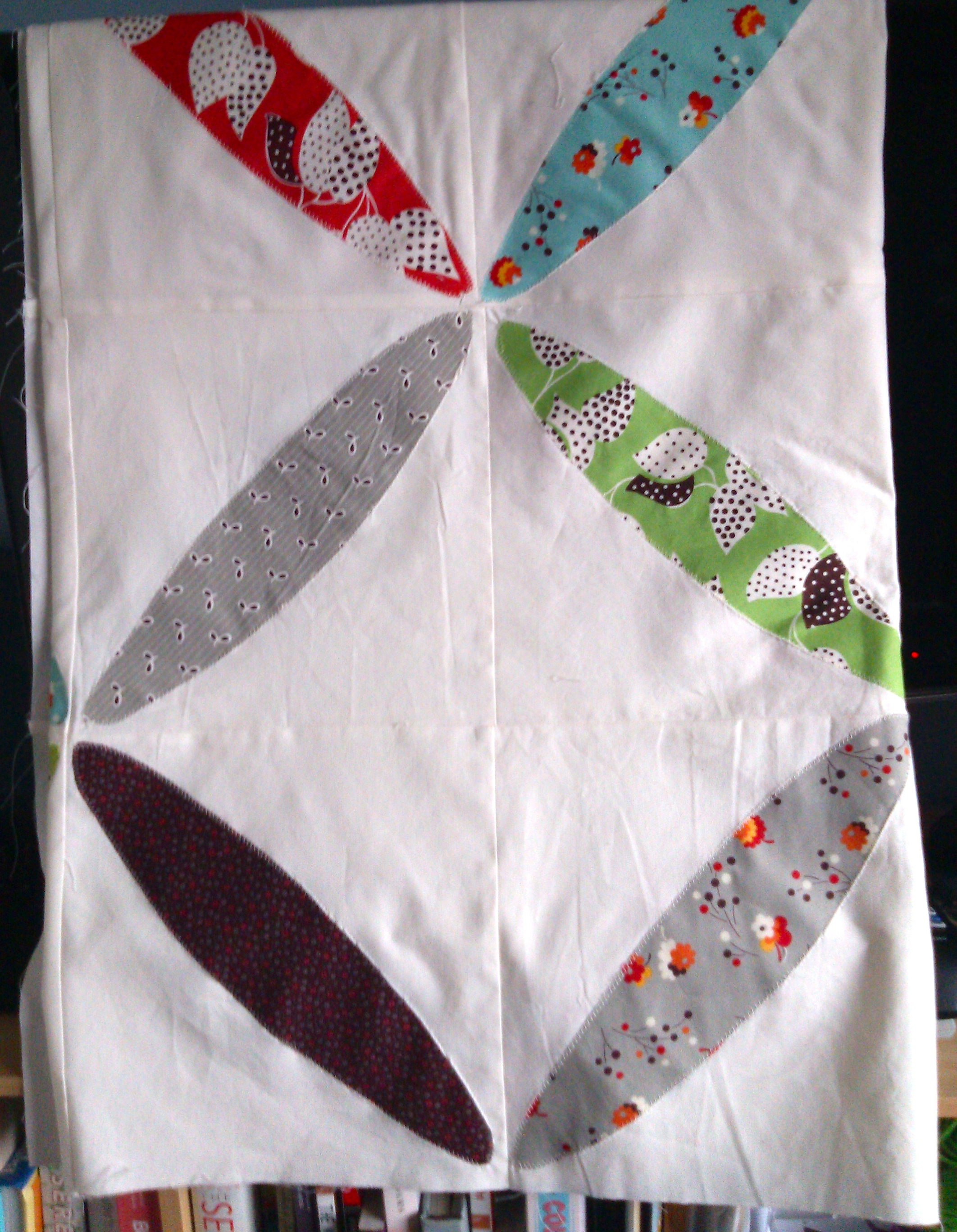 Like the above photo, this item is folded so you only see part of it. Also like the above, I started this way early in 2013, cutting out the petals and the background fabrics. Originally intended as a gift, I decided at some point that it was way too much work to give away and so set it aside to complete for our bed….. And now finally, I have started work on it again. Mostly I did these squares before I got sick, but yesterday i managed to sit up long enough to put together another row and have now got half a queen-sized quilt pieced.
 I hadn’t done any crochet since getting sick because the stuff I wanted to work on requires too much concentration – but last night I decided to give this pattern a shot – completing a motif I started in December, and finishing a whole second one as well. Twelve of these plus a few other motifs will eventually make up the Bloomsbury top. I’m hoping to get a couple more done today.
I’m feeling a bit quilt-crazy at the moment and thinking that 2014 may have a fair bit more home sewing in it than 2013 did. We’ll see. Something I have been thinking about in the least little while is turning more of my attentions towards textile arts once I finish my Master’s degree next year. I’ve been deriving so much pleasure from the limited work I do currently and I’m thinking that would be a natural place to expand my skills and energies.
Part Five: Attending
 “An unfortunate one is a rootless ghost,
His walk a mad angel’s gait.
Insolent steps of one thrown from
heaven
To toil in red dust,
As if he had not had enough
In a thousand previous lifetimes.
Where is his heart? Where is his soul?
To call this heaven’s will
Is a cheap answer.” – Deng Ming-Dao
What does it mean to attend to the world, to be present? Meditation is one practice of attending to ourselves and to the world around us, but as Ming-Dao observes it seems a “cheap answer” to limit our engagement with the world’s problems our of some notion of predestination.
In class one student observed that the world is perfect just as it is, and our desires and efforts to change it are a byproduct of ego we must let go of. But this contains its own conundrum, for if the world is perfect as it is, then even those who are struggling to reduce poverty, war, racism, ecocide, and the like, are part of that perfection. And taken this way, we could understand that all things have a place in our world, even those which are forceful and sometimes violent.
We have the examples of great spiritual teachers across cultures – Confucius, Socrates, the Buddha, Jesus, Mohammed – all who possessed some level of enlightenment. Not one of them rejected their role in bringing an end to suffering. The Buddha did not attain his awakening, and then keep it to himself. Jesus, upon understanding the conditions of oppression and a path to grace in this life and beyond, did not remain a lowly labourer in Nazareth. Each spiritual elucidation has been accompanied by the responsibility to impart that knowledge in an effort to ease the suffering of humankind.
This is a kind of action, and not one without consequences.
There are no actions without consequences, and more often than not the outcomes contain both the light and dark. We fought for more social housing in the Downtown Eastside of Vancouver for decades, creating a ghetto no one can leave because social housing is confined to a single neighbourhood of the city. Quebec students marched against one government’s bad education policies and were successful in bringing them down, only to see another party elected who has now launched attacks on the religious freedoms of non-Catholics. In achieving one thing, we invite unintended outcomes, which was my classmate’s point. We might just be making things worse.
If we do not act against suffering, we are cruel. If we do act to effect social change, we might cause other suffering to occur as a byproduct. Bound by this paradox we might think it’s better to abstain completely, to remove oneself from society and meditate ourselves to enlightenment instead. But then we still must accept that there is no way to be human without being a part of the wheel of suffering, in which case the lesser evil seems to include being active rather than passive in the face of injustice, lack and violence. It seems that assisting others to live in ways that allow them to fulfill their potential has a much better chance of minimizing the world’s sorrows than choosing to remain in hermitage. And it also appears that in so doing, we might also fulfill our own potential for a good life, one in which we nurture measured action and a turn towards those who suffer instead of away from them.
This does not preclude the possibility that some action is taken out of the deepest of delusions and the needs of the individual ego – and there is no doubt that much of what passes for protest-activism at the moment is focused on the “I” and the individual, no matter how much it implies otherwise. The Occupy movement being a case in point, where various Occupy encampments, ostensibly set up for the purpose of bringing justice to the many, became battlegrounds over the selfish and self-centered behaviours of some participants. My own history in protest activism has lead me to reflect on the damage caused by ego-driven behaviours, and the lack of overall effectiveness when we pursue things with force and violence.
But because we live in an world increasingly stratified between the illness of greed at the top and the sickness of poverty at the bottom, it is too easy to cynically turn away convinced that we are above it all, or retreat to the monastery in an attempt to do no harm. Our ability to attend starts with us, our practice and our compassion, but it does not end there.
“We need to be weapons of mass construction, weapons of mass love. It’s not enough just to change the system. We need to change ourselves.”- Assata Shakur


 Red Cedar