Red Cedar
More apocalypse, less angst
Post #3079: Distinctive trees of fall.
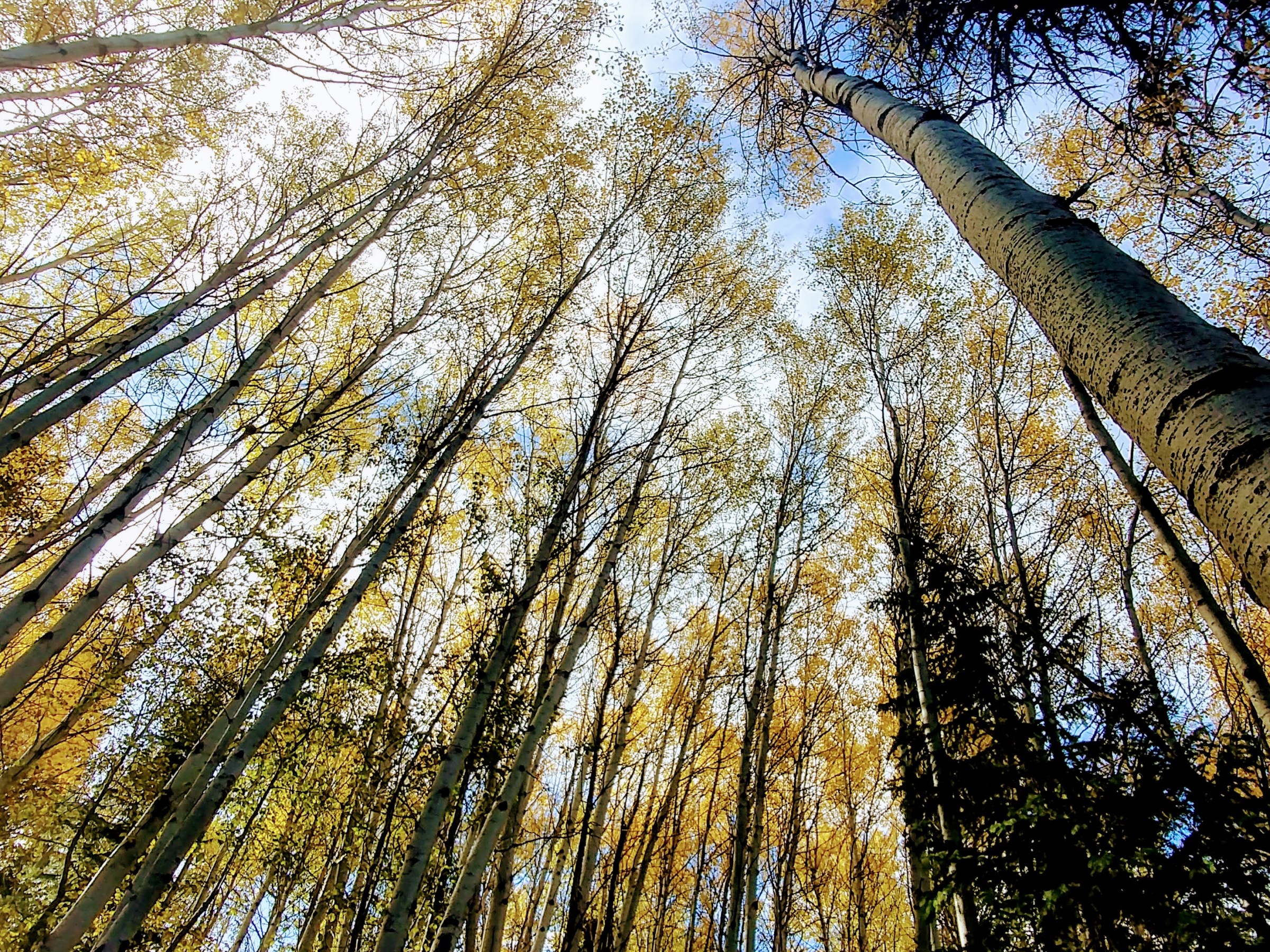
Trembling aspen taken near Link Lake in October, 2017. Each of these “trees” is part of a single root mass – comprising a single organism that could take up as many as 100 acres. Each shoot may only live for a short time (50-150 years), but the mass as a whole may live for 80,000 years or more. The sound of the wind in these trees is what makes them most notable – a fluttering of thousands of tiny wings against one another. I often find myself on my knees in the forest loam – the best posture for both awe and photography.
Post #3078: More on learning to weave

I anticipate a lot of weaving in my near future. Not only that, I anticipate a lot more methodical approaches, experiments and fine-tuning of my skills – because I think that I might actually be heading towards a solid base of knowledge at this point. That is after a year of having a loom in operation in my home – the J-Made that I set up last November.
I’ve just taken the first weave off Middle-C and am pleased with the results:

I didn’t really do much math on this project, and so it turned out to be a bit short for a wrap – I mean – it works, but it’s not as long as I had hoped. I have another ball of the striped yarn in reds and oranges and enough charcoal weft to do this project again and so I think I’m going to make the next version narrower and wider to be more of a scarf than a wrap. That will be the next project on Middle-C before I put on ten yards of warp for tea towels.
Using my newfound knowledge of back-to-front warping which I employed for the first time in this most recent project – I am in the process of warping Big-A for twill tea towels in sage green and white. To facilitate the pre-sleying of the reed (so I don’t have to use a raddle) – I made two sets of reed holders on the weekend:
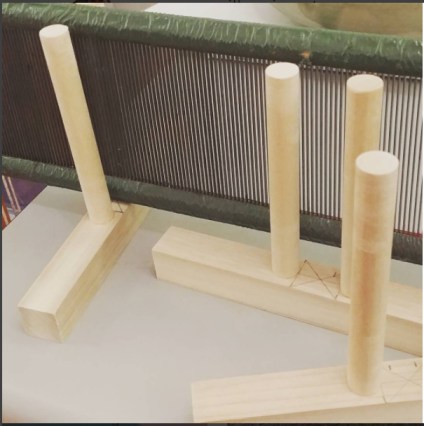
Obviously a very simple thing to make – but a set of these retail for $30 US! I made two sets for $8 Cdn and about 30 minutes of work cutting the pieces and gluing them to the correct width. I am pretty excited about these because propping my reed up between two sets of coffee mugs last time was not optimal – and this solves a lot of problems.
I’m also moving to a live-weight tension braking system on Big-A because the brake-band that the former owners jerry-rigged did not hold during my first weave and I ended up hanging a weighted milk jug off the back of my loom to keep it going. Live weight tension means using weights hung off the back beam to create the friction needed to stop the warp from moving forward. My dad gave me two 4-pound sash weights during a weekend visit so I’ll be tying those on shortly and will take pictures when I do. Big-A is all around a great loom, but the brake problem really needs to be solved.
My goal this week is to get warps on the two main looms and weave off the tea towels that are on Little-J – which are within inches of being done. As I said – lots of weaving in the future – I look forward to sharing photos of all three looms set up at the same time!
Post #3077: Warning, nerdy weaving post ahead.
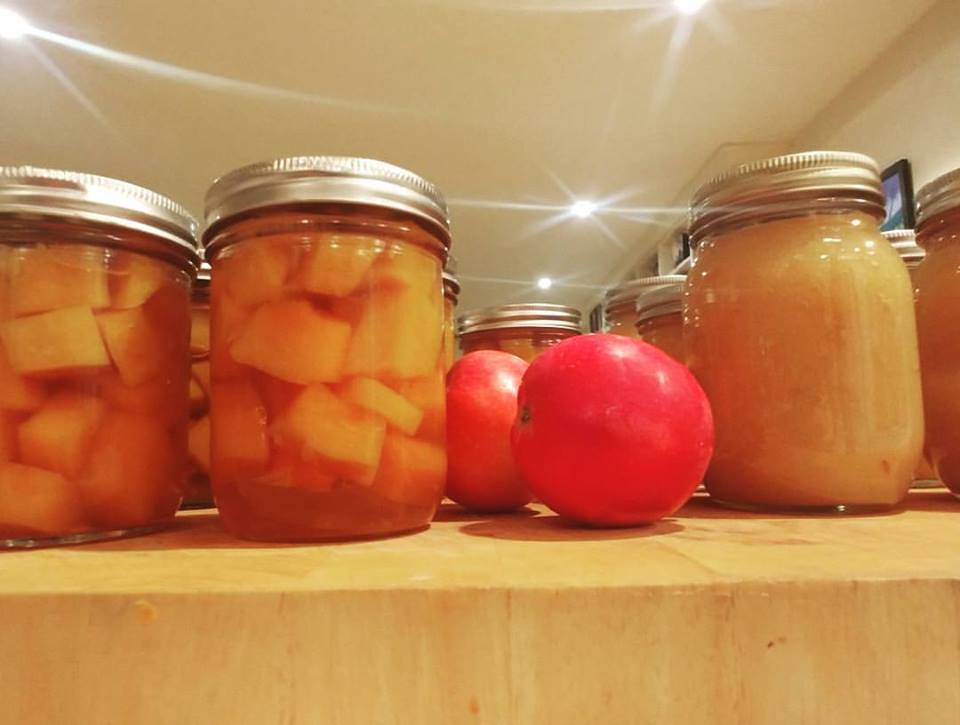
The feature photo at the top of this blog marks the near-end of the fall canning season: cubed squash (butternut) and applesauce. I have a few more delicata squash that I plan to cube up for pressure canning – and then I am pretty much done that phase and can move onto mustards and other condiments for holiday gift giving. Our move last year + the fires in the interior this year – changed my approach to canning in 2017. Specifically, we did not do one giant purchase in the middle of summer (at rock bottom prices) as we normally do. The canning this year has taken the form of smaller batches, and more variety in the strange condiments department (cherry chutney, lime pickle, rhubarb ketchup). But it’s been easier to manage, truthfully, and I don’t have an overabundance of any one thing for a change.
The squash and apples above, did come from Keremeos – and have been waiting patiently in my larder as I first went to Anacortes, then Ottawa on my return from the cabin. Ottawa was a work trip – full of meetings and dinners and walks in the bright fall by the river.
But Anacortes was all business – an overnight for the sole purpose of picking up my new weaving loom.
As Brian has noted – looms are a little bit like guitars – weavers often own more than one. I’ve wondered why that is with certain objects – one rarely finds a person collecting multiples of sewing machines or breadmakers or lawn mowers – but cameras, guitars, looms, spindles/spinning wheels fall into a category that occupies both utilitarian and aesthetic sides of the being. The loom as tool has many permutations, as does the loom as history and aesthetic object – which makes weaving a pastime that takes up a lot of physical space.
In the stable I currently have a rigid heddle/knitter’s loom (Rigid-B), a 45 inch 4-shaft countermarch (Big-A), and a 22-inch, 4-shaft table loom with treadle conversion (Little-J) – and my most recent acquisition – a 27-inch, 8-shaft Countermarch that I’ve dubbed Middle-C since it sits within the middle of the range of my looms:

(If you are wondering, those letters all correspond to female names: Brigid, Alice, Josephine, and Clara – but it feels antiquated to feminize working objects out loud so I’m going with the gender-neutral versions.)
Middle-C is a Glimakra 8-shaft of Swedish origin and was purchased new through the Eugene Textile Centre – I was fortunate to get a floor model which was brought as far as Anacortes where I picked it up from the shop owner in a parking lot transaction outside of a motel at dusk. I stayed in that same dodgy-motel overnight and then got up first thing in the morning to take the ferry back to Sidney and then drive home. Altogether a long journey – but one that resulted in saving several hundred dollars in shipping, plus I got a discount because it was a floor model.
Pretty much as soon as I got it home, I left for Ottawa so it wasn’t until Friday that Brian and I got down to putting it together. I have to say that the instructions that came with it were relatively easy to understand if you knew about countermarch looms in the first place – but god help someone who didn’t have any knowledge at all! We were fine though because I did know.
For a first warp I decided to put on a skein of Kauni, a striped yarn from Denmark (so much Scandanavia in this post!) which I bought some time ago at the Loom in Duncan. Because countermarch looms prefer to be warped from back to front, I decided it was time to learn that method of warping – and so I wound my warp chain, and followed every instruction in The Big Book of Weaving until I had got the warp on nice and even – you can see how nicely it sits in the picture above.
Then came time for tying up 8 treadles. On a countermarch loom, every shaft is tied to every treadle via the lamms – so on an 8 shaft loom that is 64 tie ups plus 16 tie-ups from the jacks to the lamms – 80 tie ups total. How much do want to bet that I made a total botch of my first attempt? After three hours working with little texsolv pegs I ended up with shafts that wouldn’t lift at all! So the next day (yesterday) I pulled all the cords off and started over with some knowledge I had acquired the day before in my attempts. And that time – success!
Even better – what seemed confusing and impossible the first time I did it – made so much more sense the second time which bodes well for all future tie ups. I went from 25-minutes per treadle on the first go, to ten minutes per on the second pass – meaning that the average tie-up shouldn’t take more than just over an hour in the future.
And so I wove a couple of different sample wefts yesterday afternoon – a dk-weight yellow which is evident in this photo, and then a thinner charcoal above it.

I prefer the effect of the charcoal – and so after work I’ve got to go in search of enough yarn to complete this weave since I am ready to advance the warp and get started for real. What I can tell so far is that 1) the warp is tensioned exactly right, and 2) this loom is nicer to use than any of my others – it needs only a light touch to operate and is so quiet!
And not to be forgotten – Big-A is getting a small add-on in the form of a live-weight tension system that my Dad is fashioning for me – as I’m unhappy with the brake-band that is currently not really working and I like the idea of using weight to hold back the fabric rather than a brake. This means that to advance the warp for weaving, there isn’t a brake to release, just force needed to turn the beam. This harkens back to the earliest looms in which warps were weighted directly One thing I’ve noticed about the weaving community is that they are some of the biggest hackers around – a necessity in a craft which requires a significant amount of problem solving (or as I like to say 50% problem-solving and 50% magic). You would think after hundreds of years of weaving on looms, all questions would be answered – and yet people are hacking up their looms in new and old ways all the time.
Middle-C needs no such hacking, though I do need to build a reed holder and fashion a few other bits and pieces to make the warping process easier. Something about weaving always demands another tool!
Post 3076: And now it is October

I have not had the head space to write here lately – so busy doing, traveling, moving around in the world and sorting things out. And then there’s the fact that I can’t write about a lot of the things I’ve been dealing with at work and in my union life – discreet I must be when it comes to work and the private lives of the people I represent.
Last week we were at the cabin in the interior for a week of amazing fall weather, hiking, hunting, and photography. For our efforts, we came home with 52 pounds of venison, and I also made my way up to Keremeos to load up on winter squash and apples, as well as a case of wine and cider. On our way home, we stopped through Victoria for a dinner with friends, and I was gifted 5 pounds of quince as well to turn into jelly. The quince, apples, and squash are still in the cupboard waiting to be processed – the cutting, grinding, and wrapping of the deer took many hours, and I haven’t quite got my food prep mojo back.
It was an interesting vacation together, as Brian was out all the days hunting, which left me on my own but somehow *not* since we ate our meals and spent the evenings together (plus, he made me coffee and a fire every morning). Although he kept apologizing for being out in the bush so much, I have to admit that I found it freeing to be on my own – and for the first time in years I did some solo hiking in the area.
Always aware of the potential for bears and the cougars – I spent my days poking around old logging roads, uncovering animal trails, and exploring the hills above our cabin – and on one occasion went down to Hedley to hike up the creek (first), and then up a mountain into an old mine camp.*
On one of my trips I recorded 30 minutes of audio which I have yet to transcribe – a kind of hiking essay about wildness, the fallacy of being able to escape civilization or its collapse, and the nature of self-rescue. I’m curious now how that will relay once edited. The recording is an interesting artifact in itself though – as it captures the sound of my feet on the trail, and my breath as I ponder and plod along Osprey Lake.
Brian and I noted how much more pleasurable it is at the cabin in the autumn – particularly this year. We first went to the cabin in July and because it had been a late/wet spring – it was incredibly buggy. Then it warmed up when we were there and the whole province caught fire at once and we got smoked out. In the fall, there are neither bugs nor fires. And the days can still be warm enough for swimming – the day that Brian got the deer it was in the mid-twenties.
I realize now that when Brian and I first met, I was used to taking holidays in September – when the weather is great for hiking and camping, but all the families had gone home. Of course, with a kid in school, I had to shift to a more routine summer holiday schedule – but we’ve both realized that we now have the capacity to shift our holidays fall-ward again since M. has been out of the house for 2 years (!) – and so we probably will angle to spend more time at the cabin in September/October in the future.
I have a boatload of photos from our trip, some of which I will post here – as well as some percolating ideas for posts. We’ll see where that goes. It just seemed time for an update here, and I’m hoping that the next few months will bring a quieter time – with more space for writing. This weekend I am off to Anacortes where I will pick up a new loom as well – so that’s a whole post just waiting to happen!
*When I was younger and single – I hiked alone without letting anyone know where I was going. These days I’m not so stupid. Between radios that we can use anywhere in the area of our cabin (they have amazing range) and a check-in system whereby I message Brian to let him know where I am parked and the direction I am hiking – there was not any time that it was not abundantly clear where I would be.
Post #3075: Big city textile inspirations
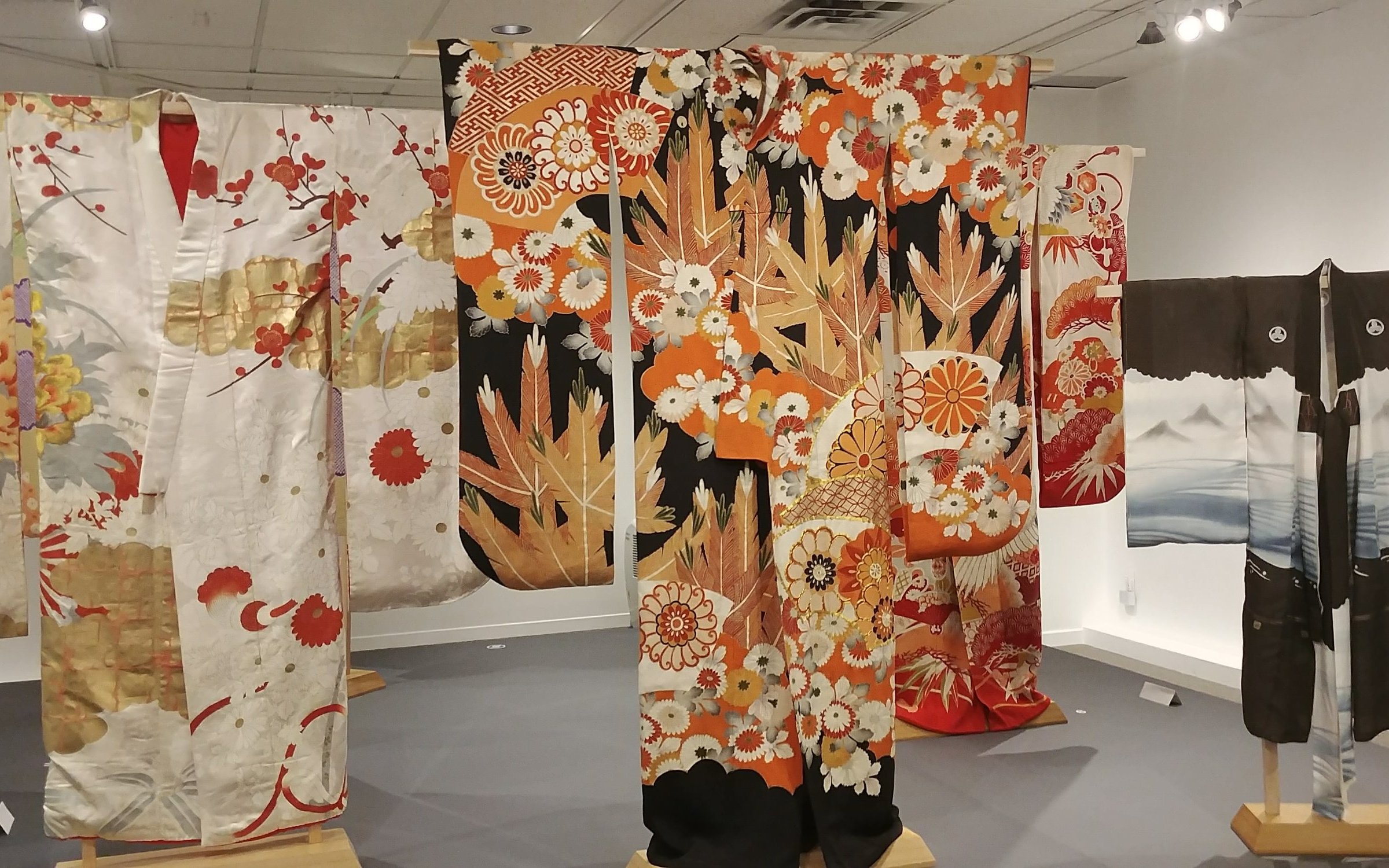
My trip to Toronto and New York has involved trips to the Textile Museum of Canada and the Met… Both of which have provided much fodder for inspiring textiles. A few shots I am leaving here for future reference.












 Red Cedar