Red Cedar
More apocalypse, less angst
Post #3307: Crossroads

I had a very busy weekend, and somehow managed to take no photos of any of it – so I’m leading this morning with a photo taken down the road from our cabin in October. Between the yellows of autumn and the first frosts which visited when we are there – it suggests to me exactly the transition between fall and winter we are in on the coast right now.
Transitions are much on my mind these days as I travel through (what I hope are) the last months of perimenopause, watch my parents become truly elderly, witness an old friend in what I think might be end-stage liver disease, think about my own transition between work and whatever comes afterwards. The last couple years I have been fully living my life, but with an eye to the seismic shifts I know are on the horizon – what will my life look like after I have experienced certain losses, or am not required to work for the first time since I was 15 years old?
I’m suspended in a kind of liminal space with all of it right now…. the aspect of change I’ve always found the hardest. It feels like standing at a crossroads, waiting to see which direction life will ask me to go. Some paths I’ll choose for myself; others will simply arrive, and I’ll have no choice but to meet them without stumbling around too much.
William Bridges writes ““We resist transition not because we can’t accept the change, but because we can’t accept letting go of that piece of ourselves that we have to give up when … the situation has changed.” And not only a piece of ourselves, but a way we’ve lived our lives or the people we’ve with in those lives.
In the meantime, what can we do? I work, I exercise, I attend to my community responsibilities, and I make art – hoping these things will provide a compass when it becomes time to take the next step forward. I will be curious to see where these journeys take me.
Post #3306: Making a mess
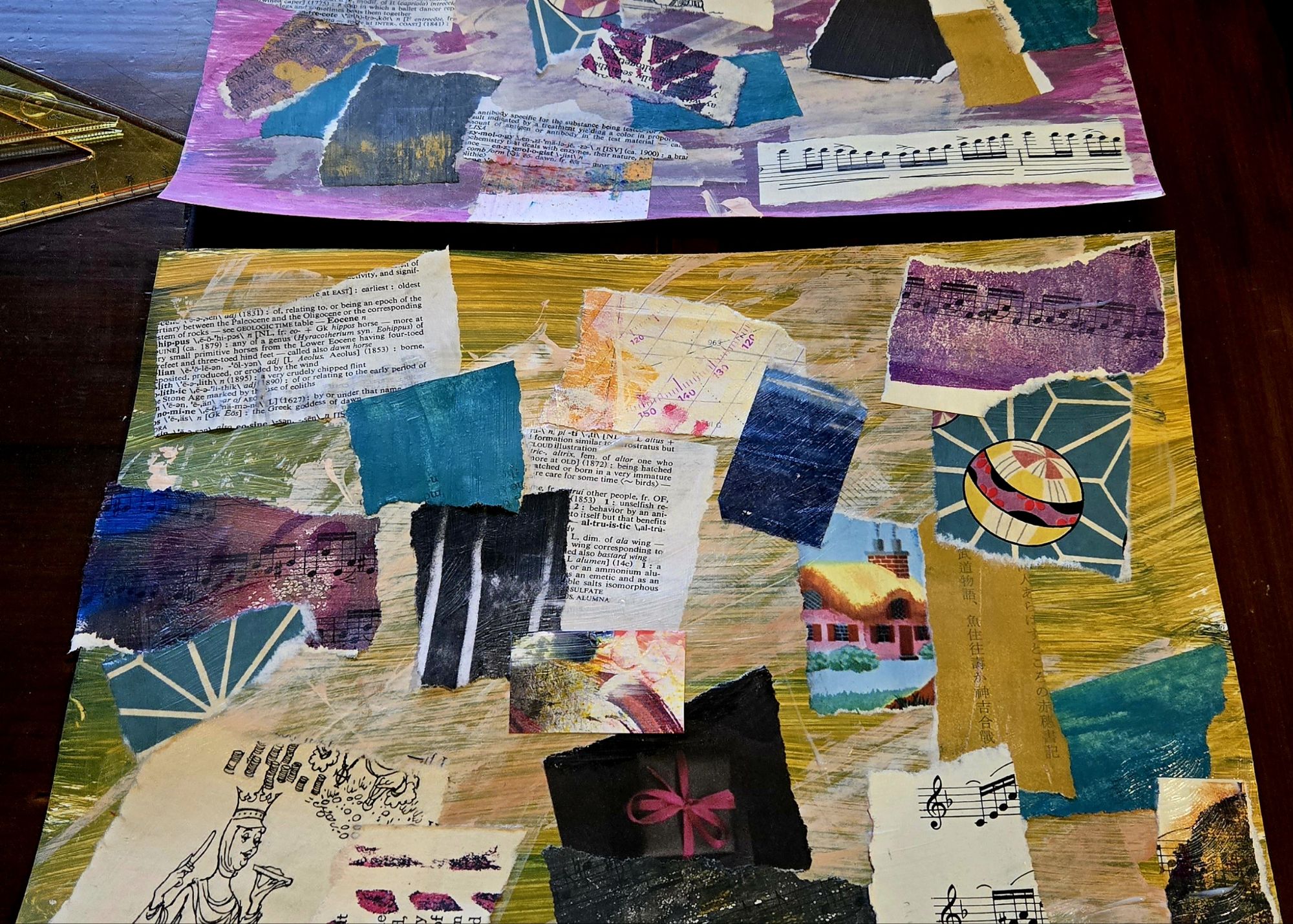
The above photo is a project I’m working on for my field study group on Gabriola – something I conceived of two days ago and now need to get finished before we meet at the end of the month. I don’t want to say yet what it is, but as you can see, it involves making a bit of a mess in the studio as I paint backgrounds and layer collage on with acrylic gel medium. These pages will get a lot more layers before they are “finished” and then cut up into smaller pieces for the end-product I am working towards.
Around two and half years ago I started seeing someone for mental health help – someone I still see even though I’m much better than I was when I started down this road. As part of that exploration, I also took an 8-week class focused on managing anxiety through creating through the arts council here. It was very inexpensive (perhaps even free, but I made a donation), and met once weekly in the arts centre with a counsellor (a different one from mine) and an artist. In that class, we did a bunch of abstract mark-making exercises (collage, paint, crayons) while paying attention to bodily sensations and breathing. What was really great about it for me was that it was not focused on “making art” but on using the tools of art making to tune into the body. I don’t think I kept a single end result of those classes – but I was turned on to a bunch of techniques that I felt I could “do” without a lot of pressure on myself.
Though I have been a maker of things for a long time, until recently I always focused on functional making like home textiles and clothing. While I do not deny there is some “art” in intricate weaving and sewing, my love of those activities was rooted in the fact that they result in beautiful, usable things that I could otherwise not afford to purchase (who can afford handmade/tailored clothing after all?)
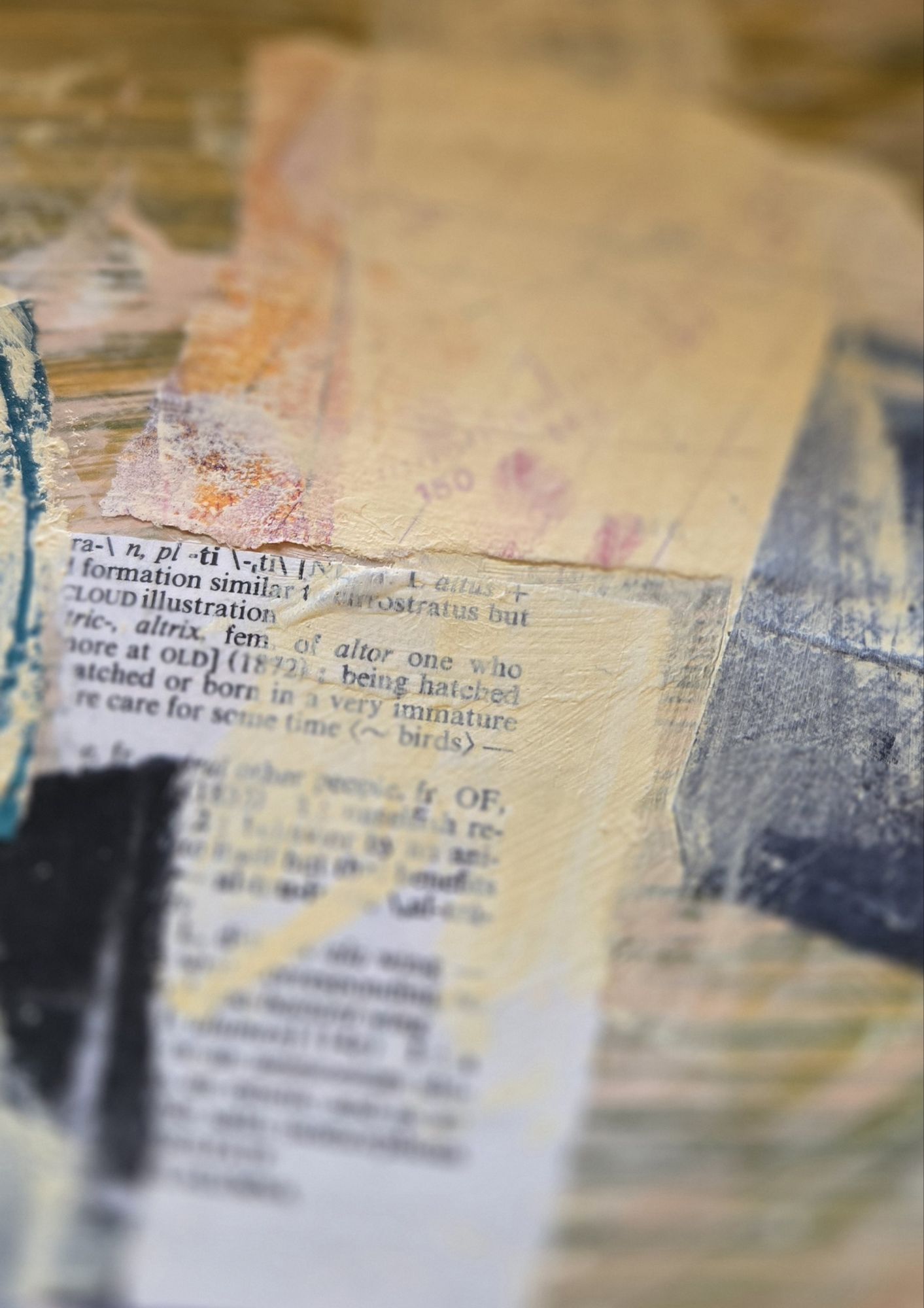
After taking the arts council class though, I had an increasing interest in working with other materials, and without a particular end game in mind. Over the last couple of years that has taken me in different exploratory directions – both into functional paper craft (bookmaking) as well as watercolour painting and mixed media. While I do not think of what I’m doing as art in any way (throwing things on the wall and seeing what sticks is more like it), I have found a real love for making a mess in my studio using all the different bits and pieces that come my way. It’s super tactile, uses mostly recycled/found materials, and allows me to be expressive without worrying about accuracy or representation. What I particularly love is the wabi-sabi of it all, the fact that beauty emerges from some fairly random, layered processes with only minimal overthinking/overcriticizing on my part.
I’m excited to see how this particular project comes together, which will involve photocopying this work when it’s done and using the copies to create something for my field school group. Right now it’s in the mess stage, but with a few more layers and processing, I think it’ll turn out to be something more coherent at the end. I’ll share here when that happens!
Post #3305: What next?

The last few days have been a blur of house guests and a weekend-long community event that took over the arts hall with the textile/social/art event Refugia. I’m so grateful for the day off work today to recover from it all and nurse the mild cold I picked up. I slept nearly ten hours from last night until this morning and am puttering in the kitchen with some pressure canning (pinto beans) and dehydrating (apple rings). I have laundry in the dryer and plans to even maybe get the garlic planted before my afternoon workout. We’ll see. It’s nice just taking it easy – something I don’t do often enough.
I’ve been thinking a lot about retirement lately—what I’ll want to do, and what it might be like to live by my own schedule all the time (or at least most of it, there will always be family needs and other musts to attend to, I’m sure). In my entire working life, which began at age 15, I’ve never taken more than two weeks off in a row, except for one month in 1994, when I went to Indonesia. I never took a “gap year” to travel, and I’ve never income-averaged my salary to take an extended break. From 15 until (almost) 53, I’ve lived by the schedules of school and work, fitting everything else around them.
On one hand, I’ve been fortunate with good health, steady work, and family stability that I’ve never had to take extended time off. On the other, I have little idea what it means to live in a less structured way. I’m also very tired of working. Still, I can thank young Megan for prioritizing a job with a good pension above all else, because soon—two and a half years from now, or maybe even sooner—I’ll have the chance to discover what life feels like out of harness, something many people never get to do.
The maybe sooner is what has me thinking about this so actively at the moment, as the government budget announcement last week introduced a program that may allow me to retire a year and a half earlier than planned—by the end of 2026 instead of mid-2028. This is far from a done deal at the moment, first the budget must be voted on, and then the initiative itself explained in more detail—but it’s been an interesting possibility to toy with. What does one do when they aren’t forced into the structure of work? How does one make a structure of their own, that supports one’s own interests and activity?
On a very surface level, I’m not worried about this as I have a lot I want to do, a community of people with whom I work, and a strong dose of internal discipline. But as my shadow knows, there are a lot of things work is covering up for, giving me an excuse not to do or think about. Being busy is one way to avoid the self. Making a lot of noise covers up the quieter questions. And so on. As much as I have always craved freedom from work and routine, it makes me anxious as hell. It’s definitely a case of feeling all the feelings right now.
Having been a union rep for so much of my career, I spent a lot of time talking to people at all stages of their working life, so I know that transitions like this are a process and that my feelings are not unusual. Whether I go in a year or in two and a half years—the unpacking of feelings and fears will be part of the self work that comes with the flow from one part of a life to another.
In the meantime, life goes on and it’s simply nice to have a day off work to recover and rest after a remarkable weekend of people and ideas.
Post #3304: Mobility work

Each time I take a “break” from working out—as I did for most of October—I’m reminded how much stiffer my body feels without daily movement. It’s not just a minor twinge here and there, but a deeper problem: sitting at my desk all day leaves my hips so tight that I can barely walk properly for a minute or two after standing up. And don’t get me started on my hips being so sore at night I can barely sleep!
When I’m getting to the gym three or four times a week, with a walk or two thrown in, those problems pretty much disappear. I’m still young enough at 52 (and lucky not to have any chronic pain conditions) that a little maintenance goes a long way when it comes to keeping my body moving well. What that does mean is working out isn’t *optional* any longer, without a good routine I feel every one of my years!
I’ve decided to add a bit more mobility work on a consistent basis to see if that also helps keep things limber–starting with this most excellent book on biomechanics Becoming a Supple Leopard by Kelly Starrett. I’ve had it in my home gym for awhile, and I consult it regularly when form-checking my major lifts – but I’ve never run one of the programs in the back which gives an outline for incorporating about 15 minutes of mobility work into one’s day.
I’m currently on day two of exercises, so I can’t say much about the overall benefits of this approach, but it did remind me to get the lacrosse ball out and roll my feet while resting in between weight lifting sets – and that alone is a great way to open up the foot and ankle mobility. I’m also practicing sitting in a deep squat every other day to work on the hips (the hip thing is also related to perimenopause, but HRT hasn’t knocked it back completely – hence the stretching).
I’ve never been a person with great flexibility, so I have no designs on being able to do impossible yoga poses or anything – but as retirement looms on the horizon, I’d like to be able to glide there rather than limp. A small goal really, but also one that has an everyday quality of life aspect to it.
Post # 3303: Playing a new fiddle
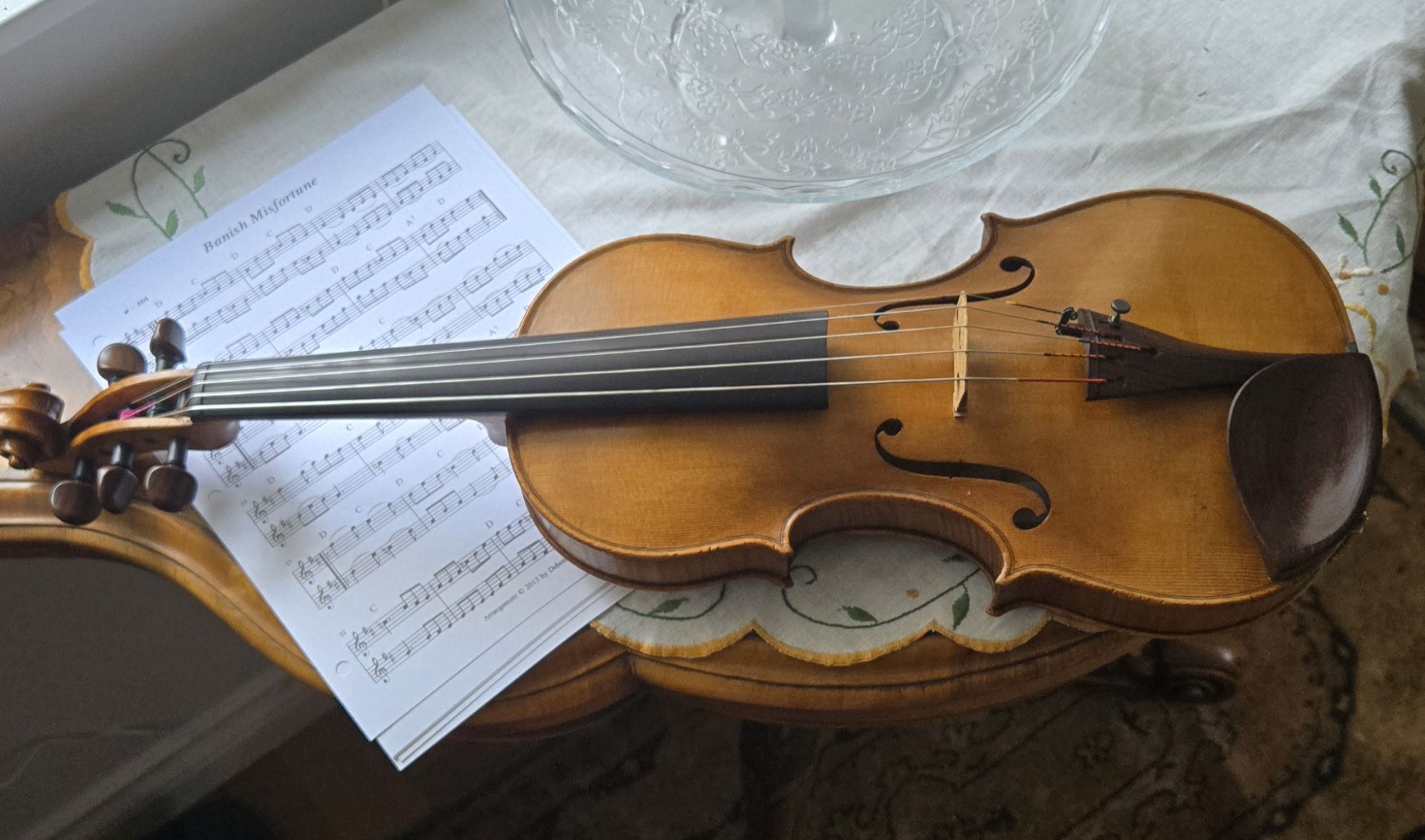
I’ve spent the past month purchasing a new violin — a process that moved much faster than I expected when I first started looking at the end of the summer. Though I’ve played on and off for most of my life (starting at the age of three), I’ve never owned a professional-quality instrument. When I was twelve, my family could only afford to spend about $1,000 on what became my “adult” violin and bow (a factory-made Stainer copy that is about 100 years old now), and as an adult, I’ve never made upgrading a priority. About fifteen years ago I did purchase a 5-string electric-acoustic instrument (a David Gage Realist) which gave me more range and a bigger sound, but it’s still “student-grade” and never really made the cut in terms of warmth and responsiveness.
After committing earlier this year to pay off my credit card debt (which I’ve pretty much done), I decided to start setting aside money for a new fiddle — something to mark my retirement in two and a half years. A milestone gift to myself, because honestly, I’m not getting any younger, and when exactly am I allowed to have a good-quality instrument anyway? (A friend of mine, a dozen years older, advised me this summer that we never know how long we have, and urged me to just put a new instrument on credit and go for it. Only a couple of weeks later, a musician friend of ours passed away suddenly after a catastrophic heart attack. How long, indeed.)
I started looking at instruments in September and quickly realized what a monumental task it would be to find and choose the right one. There are violin shops, private professional sellers, and about a thousand instruments on Marketplace at any given time (many of them total garbage, but some decent – you just have to meet a lot of weird people to find out which is which). I wasn’t sure if I wanted a standard instrument with four strings, or another five-string because I knew that one priority was a smaller and lighter instrument than my Realist due to anterior shoulder issues I’ve had for years (quick fact: 70% of violinists have some degree of muscular-skeletal damage by the time they are in college). Far from being a fun research project, the idea of having to meet a bunch of people and try a thousand instruments stressed me out.
And then I stumbled onto the website of Laura Wallace, a luthier who works (in part) with local wood and custom builds violins and violas. Boxes I didn’t know were on my internal checklist were suddenly ticked: female luthier, local to the west coast, using island maple and spruce. Intriguing! I also saw that her waitlist for a new instrument was at least 18 months, which fit within the timeframe that I wanted to purchase.
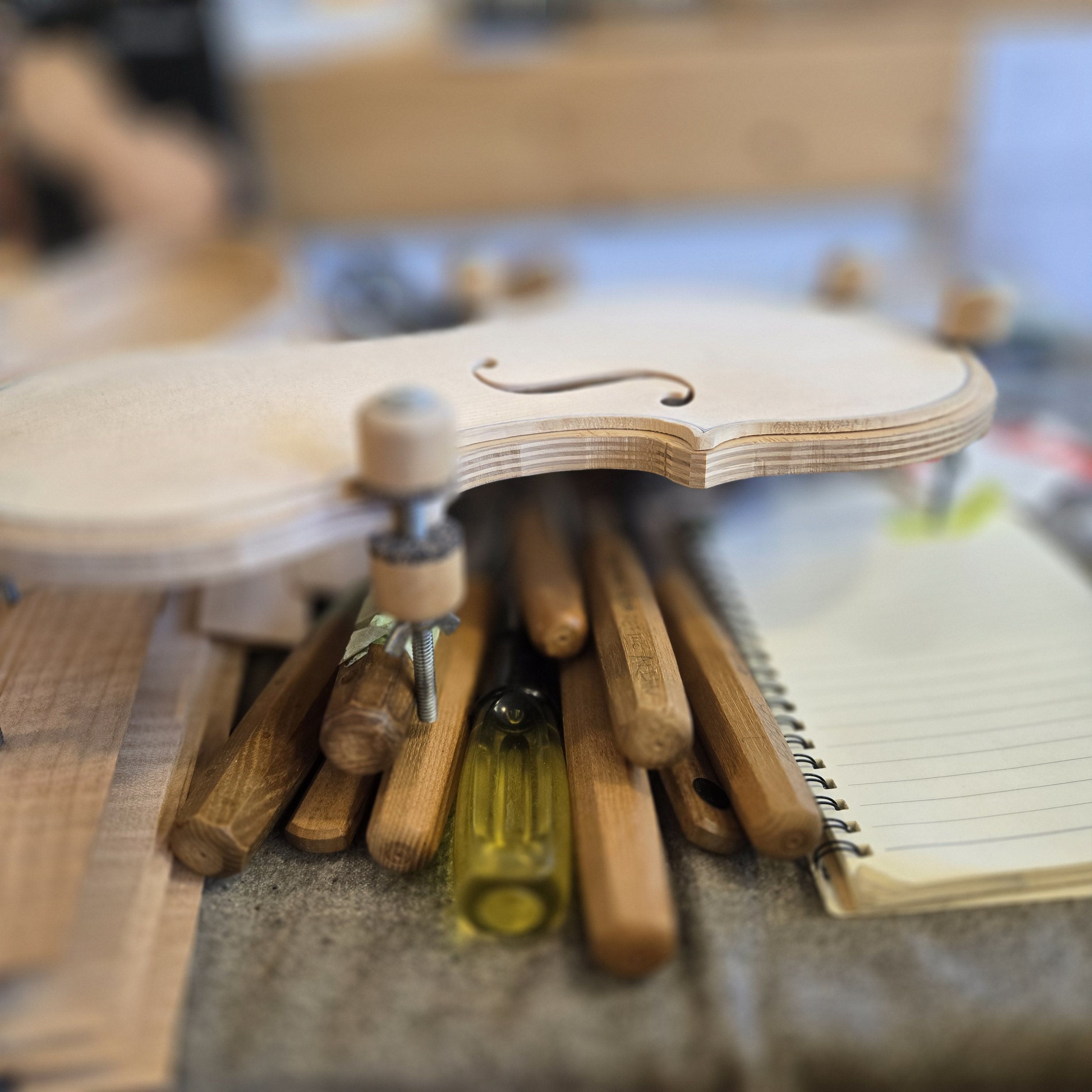
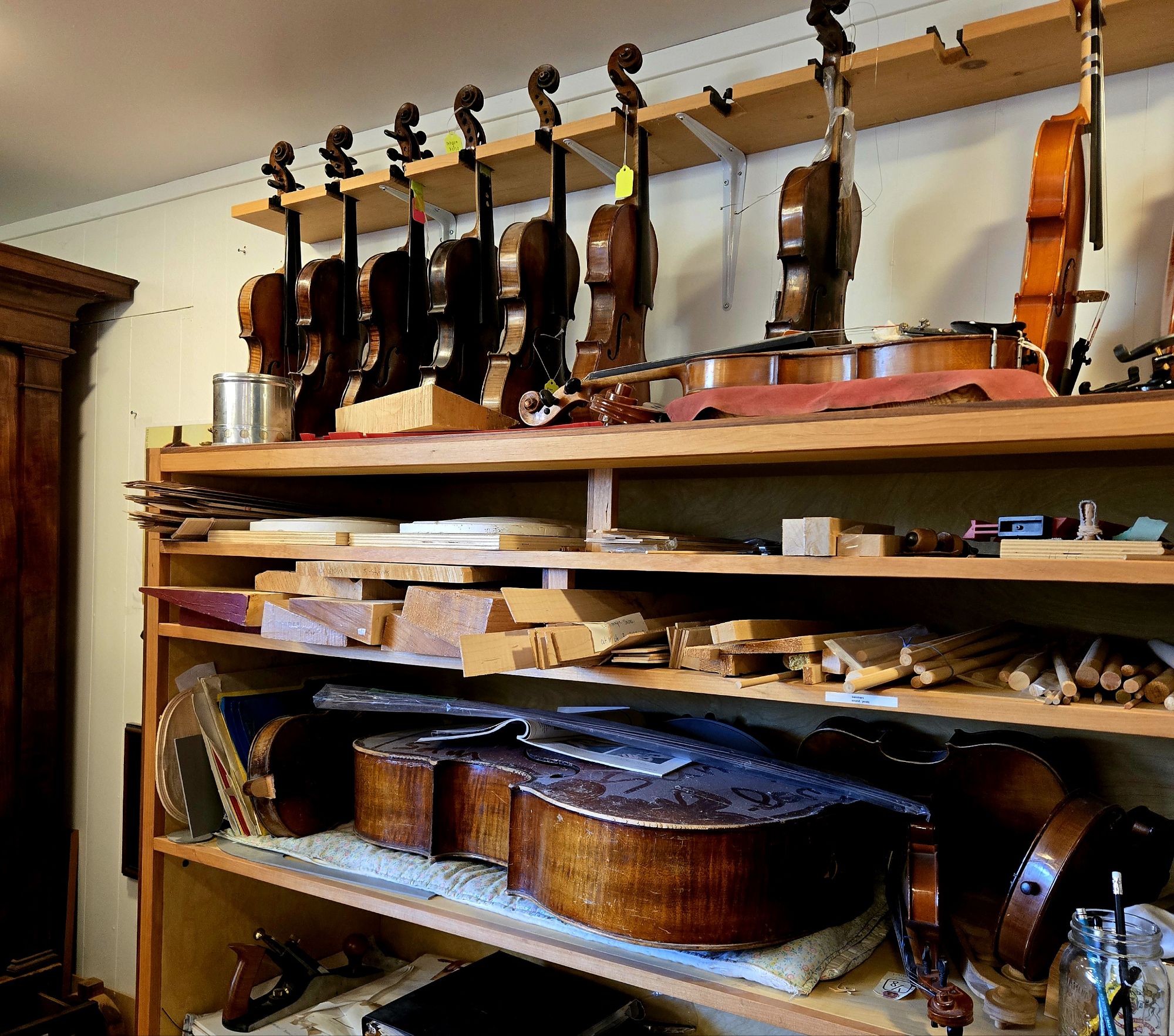
So I made an appointment for early October and took the journey to Powell River (two ferry rides and a drive) to meet Laura who turned out to be a delightful human being. I spent two hours in her workshop trading fiddle gossip and comparing the three instruments she had for me to look at with the ones I had brought (I needed to hear mine to know what hers sounded like).
One of the violins was a custom build for a fiddler in Victoria, one was made in 2019 and had just been returned as a downpayment on a new custom instrument, and one was a newer four-string (2022) also available for purchase. All of them are beautiful instruments, but from the very moment I tried all three, only one of them really captivated me – the 2019 build.
I’ll speak more to the instrument in a moment, but before I go on any further, there is a little bit of woo in this story – as there really should be in any tale involving the purchase of an instrument that is to fit within the hollows of the body. A fiddle isn’t just an object to those of us who play, especially if one has played their whole life. We are raised with it as an extension of ourselves and the body adapts around it accordingly (there are several studies that show the neuroscience implications of this, and of course the aforementioned muscular-skeletal damage). We are in a deep relationship to our instrument, and though I’m sure the same can be said for most musicians, violin and fiddle players have always seemed a bit *more* in this regard. When I came into Laura’s studio and said, “do you want to hear my violin story?” she knew exactly what I meant. Violinists and fiddle players always have a story.
I digress. One of the slightly mystical parts of this particular tale is that while I was waiting in the ferry line to Powell River, my mother sent me a somewhat astonished message. She had just woken up, because the YouTube app on her phone had started playing music of its own accord. As she laid there, a bit groggy, she knew it was me playing even though she’d not heard the recording before. When she rolled over to look at her phone, it *was* a video of me playing a song on the beach with a neighbour (something we recorded during the pandemic) – which I had totally forgotten about. Of course there are lots of algorithmic reasons that YouTube might connect my mother to my music, but the timing of it was….. odd. I hadn’t told my parents I was purchasing a new instrument at all and she had no idea I was on my way to go look at fiddles that day. Her phone just happened to spit up a video from three years ago at that moment I was to board the boat.
The second bit of fortune involved in all this is that the day I contacted Laura looking for an instrument that fit some smaller specifications I had in mind, was the same day the first owner of the 2019-fiddle contacted her to arrange a trade in for a different build. This first owner is also a woman of small stature and she had the instrument custom made for her proportions which are apparently similar to mine. Not a terribly dramatic coincidence, but just another bit of timing which gave me a nudge.
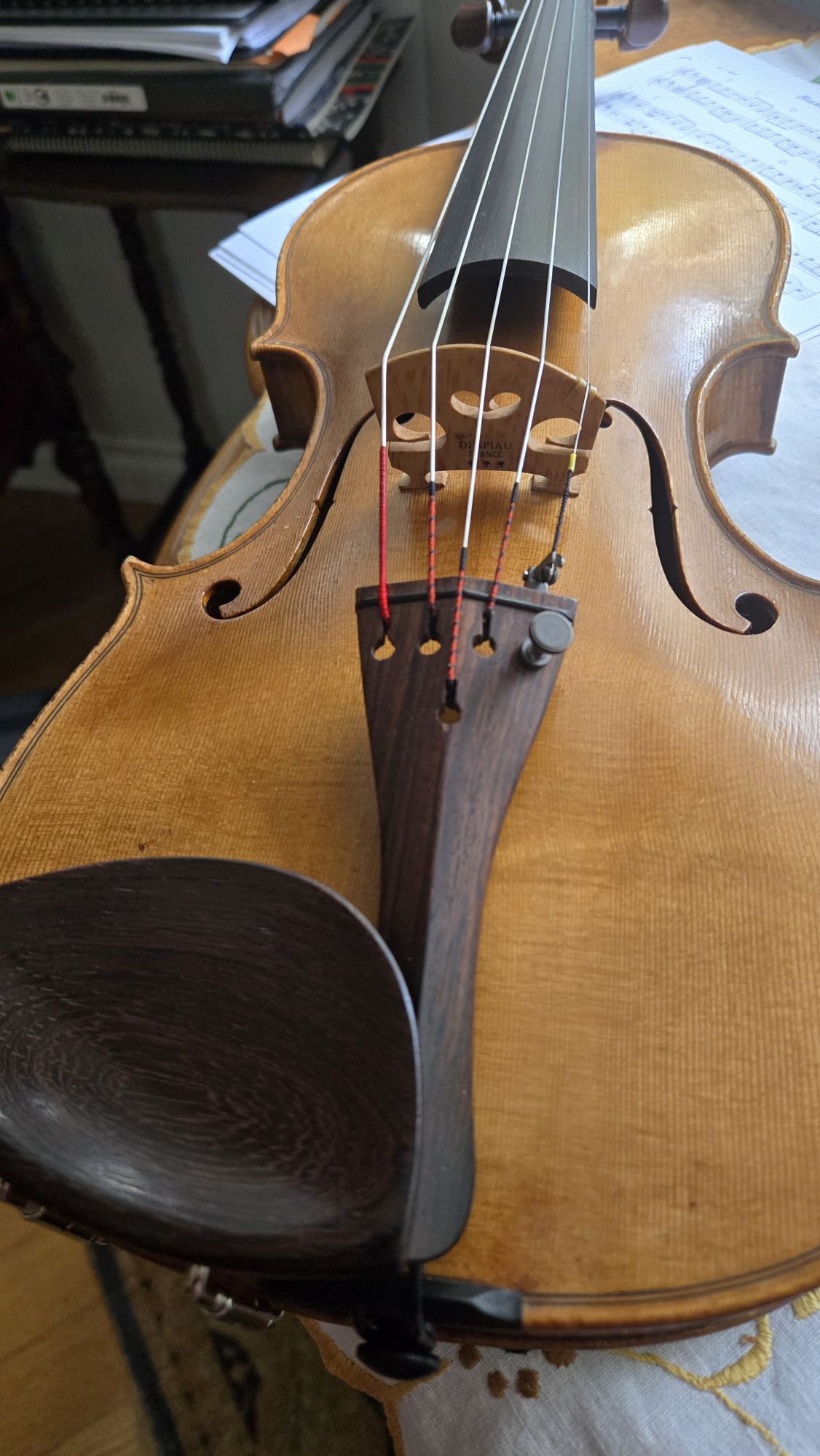
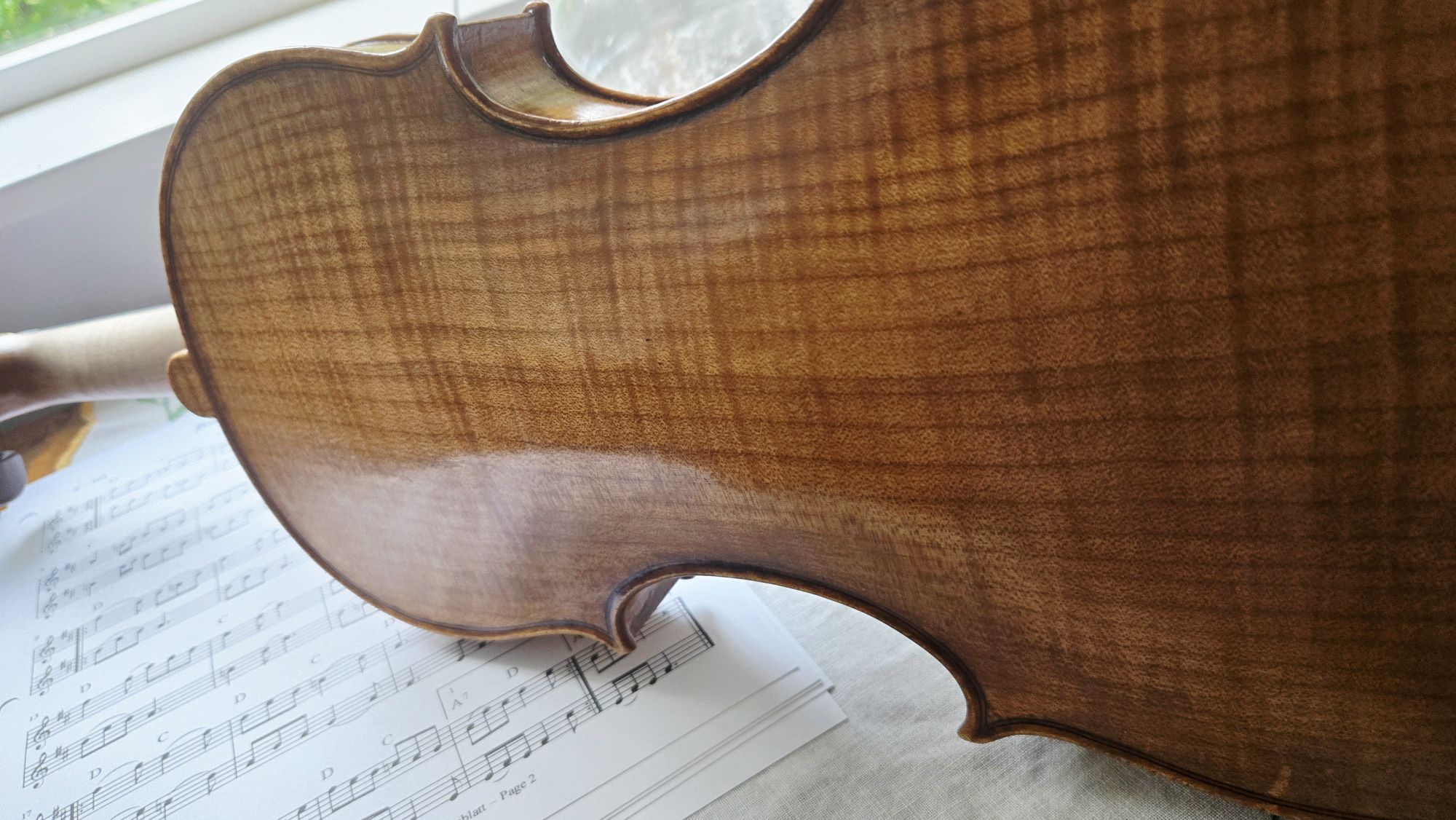
I like these kinds of nudges, but I also was entranced by the sweet voice of this instrument, which carries a warmth and body unlike anything had the privilege to play before. Not only that, but the proportions are a perfect fit to my body. It is an Amati copy, slightly smaller than a typical Strad, and the custom build choices resulted in smaller proportions which somehow don’t reduce the sound (which really carries). The violin is made from Vancouver Island Big Leaf Maple (back) and Haida Gwaii Sitka Spruce (front), and finished in a subtle way (not overly antiqued or high gloss).
Now remember, I had met Laura to discuss a custom-build which would be ready in 18-24 months. Trying the three violins was just a way for me to find out about the sound of her instruments – with no intention of walking away with anything. But the fact there was an instrument already made with all my choices – and that I felt magnetically drawn to……
So I brought it home for two weeks to try out, during which time I confirmed a few things important to me. One, the sound is impressive. The sweetness wasn’t a mirage of the studio (or my excitement) and Brian confirms that. I sound like a much better player instantaneously. Two, my left shoulder did not tire out within fifteen minutes of playing and everything just *fits*. And three, it’s just a lot less work to get a good sound out of it in both home and performance environments than my other instruments (I took it to the open mic to test).
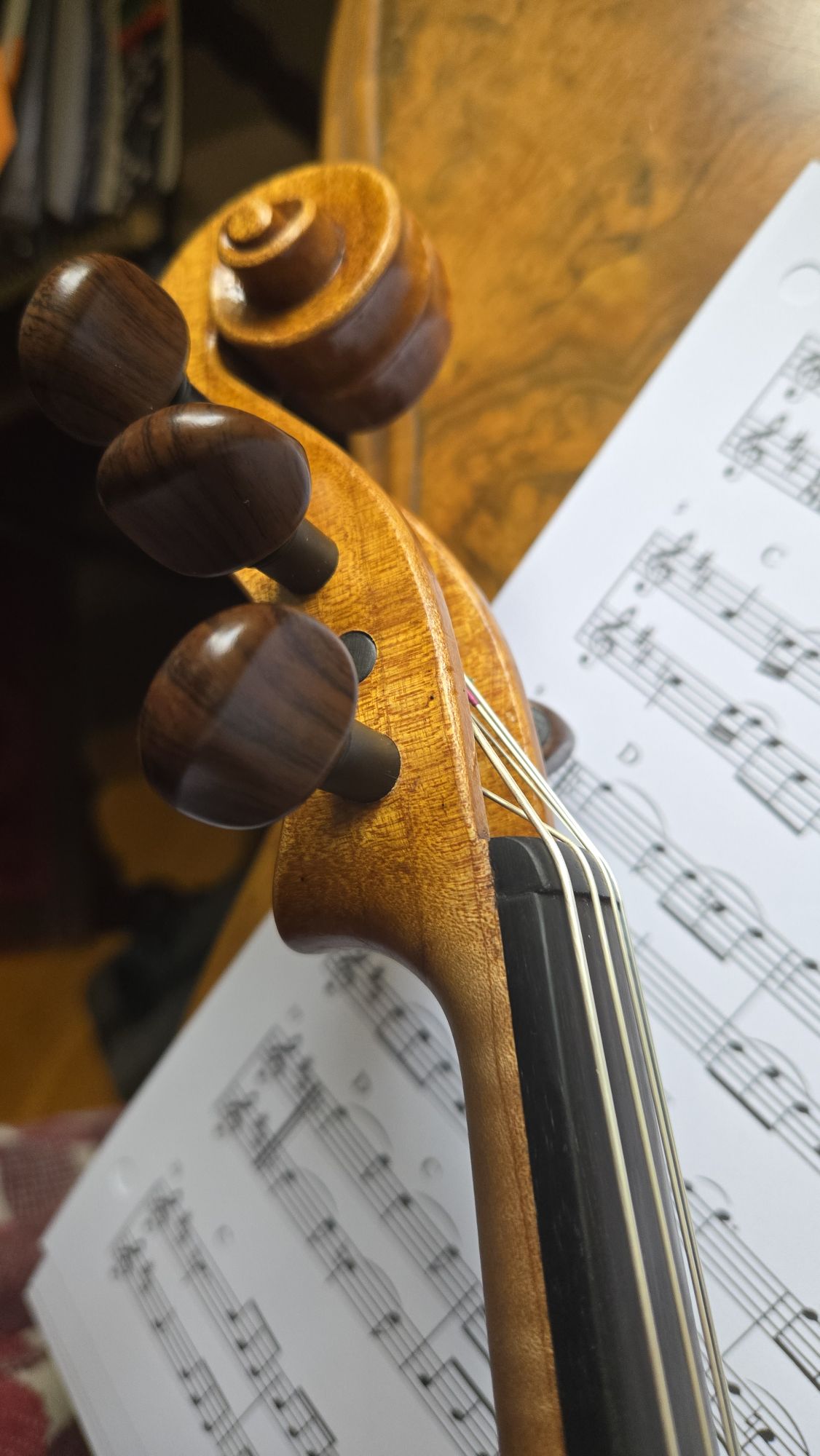
After the trial period, I reluctantly returned it to Laura – but only because I wanted some final changes to the fittings! Specifically, a rosewood chinrest (to match to custom-drilled tailpiece) and the installation of Wittner mechanical tuners to replace the friction tuners.
Luckily, we were only parted for a little over a week and a friend returning from Powell River was able to pick up my new fiddle from Laura and bring it to me on Saturday. Can I just say now that I am grateful to the fates that brought us together? Because it does feel a bit fated to be holding this instrument two years earlier than I expected to be.
So that’s the story of my new fiddle, and while it means I’m in debt again, I’m not sorry about it at all. How can one walk away from their perfect match?


 Red Cedar