Red Cedar
More apocalypse, less angst
Getting plastic out of my life.
 It probably comes as no surprise to anyone who reads this blog that I am a wee bit concerned about the ecological state of the world these days. Or more truthfully: since the age of 14 – I have agitated, argued, fought, and scrapped over the treatment of our planet. I have stood in front of logging trucks, registered concern at public officials in community meetings, and picketed outside of mining corporation offices. And I have recycled, composted, reused, repurposed, and regifted many times in lieu of throwing more trash in the garbage dump.
As you might have noticed, it has hardly done a stick of good. Whether collective or individual action, it seems that the powers that be are just much bigger and better at raping and pillaging than I am at saving my small corner of things. Downright depressing, yes. But I haven’t given up yet.
One thing I have noticed in particular in the last couple of years is that when I take a small environmental action in public people around me often comment or ask me about it. It used to happen when I pulled out my cloth bag for groceries instead of taking plastic in the store. When I scan my stylish metal water bottle at airport security, I am asked where I picked it up. And in Vancouver, the ultimate impressive (enviro-dork) maneuver is pulling out a pair of my own chopsticks instead of using yet another pair of disposable ones. Not only do people notice, but those who are paying attention to what’s going on often follow suit with their own environmental acts.
Lately I’ve been on a kick to scourge as much plastic from my life as possible. Not only because it’s environmentally horrendous and dependent on our quickly depleting oil sources, but also because of its toxicity when used to store, heat, or freeze food. Plus, plastic waste is a real killer of birds, fish, and marine mammals who eat the colourful stuff in lieu of food and then die. No matter how you slice it, plastic is some pretty nasty stuff. (And no, I don’t think the solution is to make corn-based bio-plastic either. We are having enough trouble feeding people without turning food products into more consumer waste).
I haven’t quite managed to eliminate all plastic from my life (totally unsure what to do about my desire for manufactured yogurt for example) – but here are some handy items that have helped me to get as far as I have.
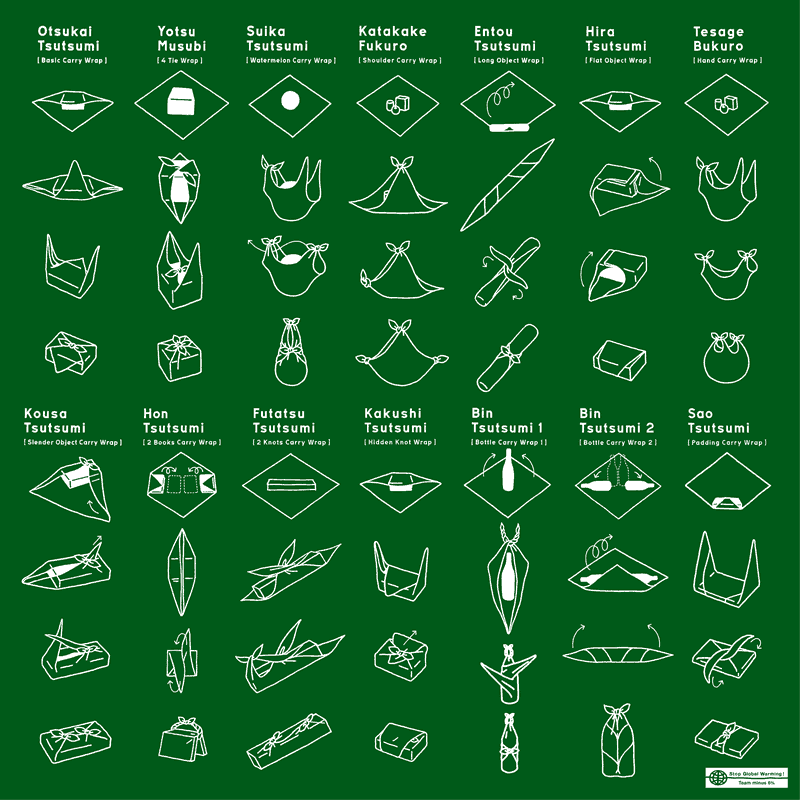 Furoshiki – Pronounced “furoshkee”, this japanese wrapping cloth is the ultimate answer to plastic shopping bags. Easy to make, all you need is a hemmed square of cloth to your specifications (usually 1.5-2 feet per side), and a quick lesson on the multiple methods for tying the cloth. To promote its use, the Japanese government has produced a handy PDF for guidance. Furoshiki makes an excellent bag substitute, but is also great for gift wrap, protecting books or breakables in transport, or even as a baby carrier. The nice thing about furoshiki as opposed to other bag substitutes is a piece of cloth may have multiple purposes and folds up really small to fit in your purse or jacket pocket.
Mason Jars – Certainly not as exciting as a piece of cloth for folding, mason jars are pretty ubiquitous particularly as a lot of spaghetti sauces are now packaged in them. Far superior to the plastic container, I’ve started doing most of my food storing the way my grandmother did. Because mason jars can be both frozen and boiled without breaking, they are the safest glass to use for your food leftovers and they don’t leave nasty plastic toxics in your food! Plus they come in multiple sizes. For easy dinner heat-ups make individual soup or stew portions and freeze in the jar size of your choice. For a quick thaw simply place the jar in a saucepan of boiling water for ten minutes. Because these jars seal well and are also super durable I use them for taking leftovers to work and don’t have to worry about leakage or broken glass.
Sigg Bottles – Although a mason jar makes an excellent substitute for plastic drinking bottles, when it comes to hiking, I’ve become a huge fan of the Sigg aluminium and stainless steel water bottles. The aluminium ones are lighter weight than the standard plastic nalgene bottles and hold slightly more liquid. And despite the fact they are prone to denting, they hold up to really regular and extreme use. The stainless steel are a little heavier, but really durable. I’ve been super bummed out ever since I lost my uber-stylish Sigg canteen in a taxi cab – by far one of the nicest water bottles I ever owned.
Alternatives for Garbage Bin Lining – I find the whole concept of purchasing plastic bin liners for garbage really odd having grown up in a house where we simply used biodegradable paper sacks from grocery shopping. Normally I use plastic garbage bags for a bin liner, but since I’ve been bringing less bags into the house I often don’t have one when I need it. I’ve recently realized that you don’t really need to use a bin liner at all, or a simple piece of cardboard on the bottom of the bin will do the trick. Really, it just means that you have to rinse out the garbage can after you empty it into the municipal bin. Wrapping garbage that may be biodegradable in a plastic bag really just defeats the purpose.
At first it feels awkward to switch towards more environmentally-sound consumer practices, it’s true. But once you get past the initial discomfort (I remember when grocery stores acted like wanting to use your own cloth bag was a big headach) your whole life does feel lighter and less cluttered. I recently went out of town for work and forgot my reusable mug and sigg bottle for water which mean that for three days I was using disposable items in lieu. Shocking to me the amount of waste I generated even in that short period – I found it truly disturbing to add that much to the landfill!
Which isn’t to say I’m perfect at all, it’s hard to forgo plastic and our society really isn’t set up to assist in that process. But recent decisions like the Liquor Board of Ontario to stop providing plastic bags will hopefully help to turn the tide away from consumer waste and towards more sane alternatives (and by that I don’t mean switching to paper!)
Insite gets a reprieve.
 Well this is exciting. A little good news for a change. Once again the BC Supreme Court has found Canadian drug laws to be unconstitutional. It’s not the first time it’s happened, but in this case it will grant Insite (Vancouver’s safe injection site) a reprieve until next summer when the courts expect to see the federal government ammend the law in order to recognize the injection site as a health care facility which would enshring the province’s jurisdiction (in Canada drug laws are federal, but the provision of health services is provincial). Further the court maintained that refusing accomodate for the health needs of addicts is a violation of Charter rights.
Since opening in 2003, Insite has been living on borrowed time. Time-limited exemptions granted by Health Canada to “pilot” the site ran into trouble as soon as Harper’s Conservatives were elected, and no amount of research on positive effects or lobbying by the Vancouver Police Department has changed that. (For the record – the VPD supports the injection site, but the police union does not.) No matter that the site has managed over 1000 overdoses with no deaths, or can document a reduction in needle sharing (drastically lowering rates of disease transmission) in regular Insite users – the Conservative government is yet again taking the unrealistic position of prohibition. And we all know how well that has worked over the past several decades of decline in the downtown eastside.
Fortunately the BC Supreme Court has taken that decision out of the government’s hands, at least for now. Small consolation when you have to rely on the court system to protect you from the government. But still it’s a rather large victory for Canada’s poorest zip code, and I’m glad to get the news.
Oh, the romantic things I say.
Have you ever noticed that when you fall in love your brain chemicals change in such a way as to create the illusion of soulmates or destiny? Cause that’s how I feel about you even though I don’t believe in fate or anything.
Just for the sake of allusions, it would be much simpler if I did believe in something. It seems like every declaration of love turns into an endless series of qualifying remarks. 😉
Inventing delusions.
And so the saga of Fournier ends with an errant balloon worth hundreds of thousands of euros drifting away into the sky, untethered from its gondola. If you have been following along at all you will know that Fournier is the French adventurer who aimed to jump from the edge of the earth’s atmosphere 40 km up, has attempted to do so 2 other times (both of which were thwarted by weather and/or equipment failure – not unlike this third attempt), and has spent his entire life savings plus millions more dollars in the process. Stated purpose? Well scientific research of course. Apparently his main interest was to gather data to help astronauts and others in aerospace careers who may have to survive a freefall from high altitude. Though you would think that if there was any real merit in discovering this information NASA or some other agency would be funding it.
Although Fournier isn’t an inventor, something about his story in the past few days has made me think again of Troy Hurtubise, the Canadian inventor whose Ursus bear suit inspired the National Film Board documentary Project Grizzly. (If you want the song version of the documentary – download the Flying Folk Army’s Troy and the Bear here.) Done more than a decade ago, the documentary is considered a cult-classic and has been widely enjoyed by many over the years. Except Hurtubise himself who felt the film made him look foolish, and didn’t take him seriously as an inventor. And that’s a fair criticism really, though having heard Hurtubise interviewed on a number of occasions (CBC does almost annual interviews with him) I can’t say that he doesn’t sound half-crazed most of the time when he talks. Between that and the testing his projects on himself to the degree of suffering serious injury, and you’ve got a classic case of self-obsession that’s hard to witness without snickering.
From bear suits onward, Hurtubise now fashions himself as an inventor of military technologies, despite the fact that he has been bankrupted at least once and lost his scrap metal business as a result of his failure to sell more than the occasional prototype. By far his strangest claim to date is the invention of an “Angel Light” device that could not only see through solid metal walls, but also detect stealth technology. Though he claims to have created and tested this device, he also maintains that he had to dismantle it and has since sold it to the French (though his recent bankruptcy seems to belie this fact).
A lot of fringe inventors seem to have the same characteristics – mostly men, they possess an obession bordering on mania, a willingness to give up everything in pursuit of their own vision, a huge capacity for self-denial when it comes to the critiques of others… and for some reason extremely poor business judgement also seems to come with the territory. My Great-Great-Uncle Gustave (inventor of the world’s first airplane before the Wright Brothers even) was one of these people. He obsessed, he bankrupted his family, he injured himself repeatedly, he lost all of his belongings in lawsuits against him (including his airplanes), and he ignored his family responsibilities for most of his life.
Now granted, he was successful in creating what he set out to, but he still died a bitter and broken man unrecognized for his achievements. Which is exactly what will happen to Hurtubise after he has destroyed all of his significant relationships, exactly what has probably already happened to Fournier since I can not believe that someone who cared about his significant relations would choose such a death course adventure. What is that impulse anyway? To be the first? To be famous? A refusal to grow up and take responsibility? I’m not sure, but it’s interesting/odd/infuriating/funny/sometimes depressing to watch these men in their continual quests for attention. (“Pay attention to me! Pay attention to me!”)
Since I don’t really have a conclusion for this post, I am going to leave you with this clip from the TV show American Inventor. Marc Griffin is the epitome of deluded and obsessed inventor, a man who lost his marriage and is living in his car in a quest to make “Bulletball” an Olympic sport. Fournier may be painted as an intrepid adventurer, but he is no less deluded or juvenile in his quest for recognition than the Griffins and Hurtubises of this world.
Returned.
Thank the goddess I’m back from Ottawa! Which also means back to blogging here with a little more substance than I am able to muster when I’m away from my desk. Though I’m not sure about what just now. I’m all focused on the new blog project I mentioned last week: Viaduct. Hopefully to be launched in a couple of weeks once we get some graphics and writing going on.
I’m a bit down at the moment, having come off a fairly poor week of bargaining and another long stretch away from home – but I’m working on it and I’ll be fine in no time.


