Red Cedar
More apocalypse, less angst
Uribe's hope. Harper's handout.
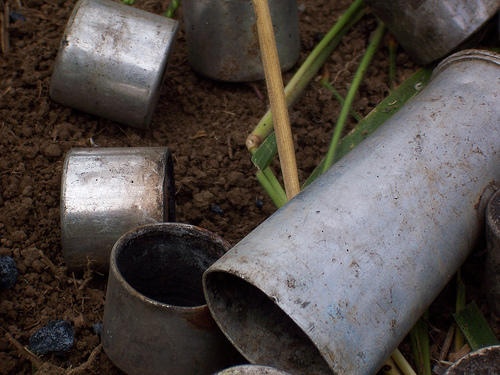 I’m not surprised, but I am deeply disturbed that a “free trade” pact with Colombia has been rammed ahead by Harper’s Conservatives despite decades of government-sponsored human rights abuse and civil war. And while Harper is trying to paint this as “all in the past,” let’s recognize that the parliamentary “fact-finding” committee has not even had a chance to report back yet. Not to mention human rights organizations and labour organizations have done extensive fact-finding over the past several years and consistently turn up evidence of severe human rights abuse.
Trade unionists are still being killed at an alarming rate, opposition politicians and their allies are gunned down in the streets, the paramilitary organizations have been restyled as workers co-operatives and are being used to bust-up unionized workplaces… and the government has yet to formulate a plan to deal with the millions of those displaced by la violencia and living shanties outside the country’s big cities. The photograph above is one I took in 2006 in the indigenous community of La Maria just outside Cali where three weeks previously a peaceful encuentro of 15,000 people was set up by government forces. Not only did they kill one of the local leaders, but police forces camped in the community for two days after shelling it repeatedly with tear gas, destroyed the medical clinic, community store, and community office – and kept the people terrorized during that time with the threat of force and more artillery. That photograph is of a handful of the thousands of spent teargas shells that littered the coffee growing fields after the attack. And of course it has not changed in the two years since I was there. I currently have friends living in hiding out of fear from death threats – people who have simply spoken in public about their rights to decent working conditions and humane treatment in their cities.
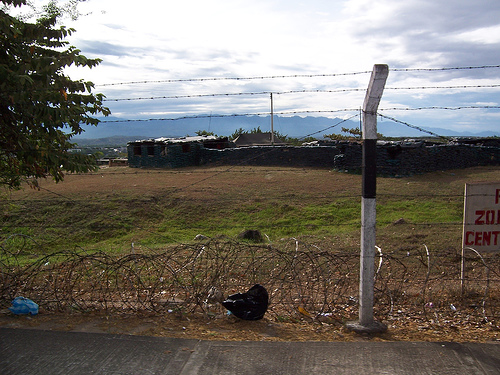 Government fact-finding mission or no, anyone who has spent time in Colombia in the past several years can attest to this: there is no shortage of current documentation of murder, physical disfigurement (acid burns being a favourite), unjust confinement, political rape, and kidnapping.
But of course human rights are just collateral damage in this ideological war and there is no doubt that this agreement has more to do with legitimizing Colombia as a South American power than actually getting goods cheaper or having a bigger market. As pointed out in the CBC article above, over 75% of goods coming into Canada from Colombia are already duty-free, so there wasn’t much of a need from Uribe’s economic perspective to ink this deal (because it doesn’t really expand markets for them). And on the flip side, Canadian mining companies have been running roughshod in Colombia, Guatemala and the rest of South America for decades since environmental and labour conditions in those countires are somewhat favourable to making a lot of money without responsible investment back into the region. So really, the deal will do little for Canadian corporate interests.
It will, however, give Uribe the legitimacy he craves as he continues to gut social programs and have his political opponents murdered. And it gives Canada and the US a stronghold in the region for their interests. The lines are being drawn – Canada having signed with Peru, Colombia and soon Chile will use this block against the more leftist currents of Venezuala, Argentina and Bolivia. And quite frankly it’s sick for Harper to pretend that our government is up to anything more than political meddling. Pretending to use “improved human rights” as a criteria for an fta is insulting to the thousands of Canadians who have worked for human rights in Colombia, and insulting to the people who withstand the violence of Uribe’s government year in and year out.
I had hoped we could just stay out of the US’s game in South America, as we mostly have in the past, but it seems that Harper is bound and determined to pull Canada onto the far right side of the conflict down there. How long before our troops get committed to the border between Colombia and Venezuala? I suppose stopping that will depend on getting this government out as quickly as we can.
Love and bunnies. Or not.
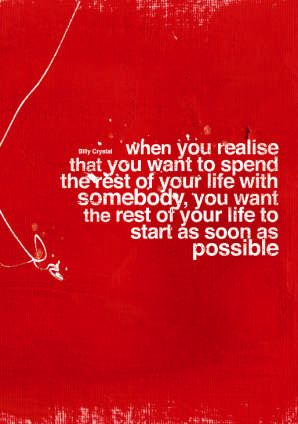 On Friday morning I went over to Vancouver Island to do some union speaking, caught the 10 am ferry and settled in to do some work on the laptop during the crossing. Unfortunately, I miscalculated my seat and found that instead of a peaceful corner in which to chill out, I was surrounded by tour bus Americans on their way to the island. Overweight, obnoxious, loud, pretty rude in a way they obviously thought was amusing. Nothing better than the seniors bus tour coming right out of Couer D’Alene in their constellation. I didn’t move though, because I wanted the table and window so I did my best to tune them out for most of the ride, though at one point I caught this conversation between an older couple (late sixties) beside me:
Him: Hm. This coffee is pretty good. (After bringing them both cups from the cafeteria).
Her: While that’s one thing you did right today I guess. (In the snappiest, most derisive tone you can imagine).
Of course every exchange during the ride was like this. He would make some observation and she would either ignore him or answer as though it caused her great pains to do so. Well beyond fondly bickering old couple, this pretty much horrified me, particularly as I imagine this pattern of communication has been going on for decades.
The concept of long term relationship frightens me for exactly this reason, and lately I’ve been a little more attuned to discovering clues that prove romantic partnerships don’t have to turn out this way. Unfortunately they seem few and far between.
Brian and I are still very much in the honeymoon phase of our relationship, not even having made a year yet; we spend a lot of time gazing at each other and we never fight – two signs that the reality of each other hasn’t quite sunk in. And as much as I love this phase of things, the fuzzy bunny happiness of it all, I am also highly aware that it does end. And then you have to somehow keep going. And I have no idea what that looks like in real life.
See, I didn’t have really positive relationship role models between my obsessive-neurotic-controlling father and my depressive-passive-agressive mother. While I love them both, the behaviours they manifested as partners to each other and as parents was less than ideal in many respects. They just made 44 years together, which is impressive until I count at least half of those spent in something approximating abject misery (on my mother’s part) and frustrated anger (on my father’s). Acknowleged, it has gotten better in the last few years in that they co-exist without tormenting each other too much, and have the home and travel companionship they wanted in retirement.
To be fair, it’s not like they had great models growing up themselves, and while my mother was a perpetual advocate of relationship counseling it was only the rare time she could convince my father to go. On the other end, it was the observation that my husband and I were sliding in the same trap after four years that encouraged me to leave him when I was still in my twenties, and while Brian fared a few years longer with his ex they didn’t exactly live in wedded bliss.
And besides just this immediate experience there is just lots and lots of evidence out there that many people are in unhappy relationships with any number of justifications (the kids, finances, school, property ownership, spite etc). Whole bulletin boards on the Internet are dedicated to “I hate my husband/wife”, 3/4s of the self-help section at Chapters is devoted to relationship-repair manuals, and a quick perusal on Craigslist casual encounters will prove that many many people are looking to cheat at any given time.
Even though I can name a handful of couples who have made ten years happily (my former bandmates Jon and Alison come to mind immediately – they are one of the most well-adjusted couples I know), it seems the odds are so much greater that a relationship will either be miserable or end after some acceptable period of misery. And I don’t want it to be that way. I don’t want to stick out decades of unhappiness just to have someone hold my hand when I’m seventy and putting my lipstick on all funny. At the same time I am realistic about the fact that every marriage (to use the term loosely) has bumps and divots along the way and that there are times when you stick out difficulty rather than immediately suggesting “we try an open relationship to see if that helps”, or leaving.
I guess what I want ultimately is some assurance that it’s possible to have a relationship that continues to be mainly positive into the far-away future. Because I’m not overly-fond of the idea that I might have to go back to dating someday, and besides that Brian is exactly who I want and I hate the thought of giving him up. Secretly, I just don’t believe it’s possible to be mostly happy with anyone – and I suppose that might be the problem right there. If I can’t believe in it, then how can I live it?
There is no question to me right now that Brian is the person I want to build a life with. We got lots in common, we want to do well by each other, and we get along easily no matter what we are doing (cooking, laundry, road trips, hanging out with friends). The thought of getting to a point where I want to post on the “I have my husband” Internet forum actually physically pains me, even though I recognize the ways in which people get to that place (I saw it in my own mother). But I want to know that I am different, that this is different, and that somehow we will be saved from the ravages of emotional time that hardens and wears us away.
I suppose it’s like anything good. You want guarantees, but there are few. And I always know I can leave rather than be miserable. But I’d rather neither of those choices which means working on a third way which might just be what love is.
Thoughts?
Dinner Tuesday.
Brian and I will be doing the second piece in our East Van Institutions series at Viaduct starting tomorrow – Dinner at Nick’s Spaghetti House around 6:30 or so. If any of you neighbour types want to join us for some gluey pasta and picture taking, let me know by email!
Hope, politics & music.
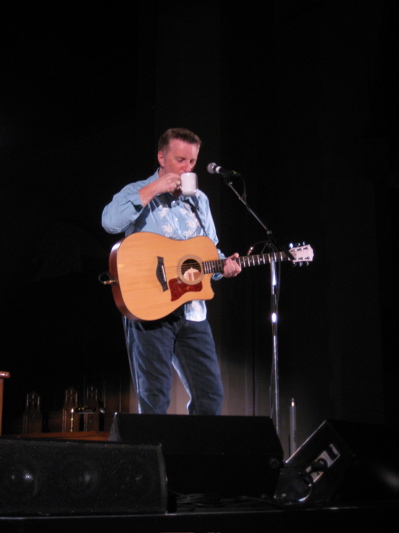 After the Iron Maiden fiasco of last Tuesday (okay, not really a fiasco, but I got really skeeved out by the crushing number of men at the stadium – I get nervous around large crowds of either gender in absence of counterbalance) Brian and I switched musical tacks on Thursday and went to check out Billy Bragg at St. Andrews-Wesley downtown. I’m not sure why that venue since he normally plays at the Commodore when he’s in town, but I’m guessing it had something to do with his tour schedule and availability of a music hall to play in.
I’ve seen Billy Bragg four times over the years (the first time more than a decade ago at the UVIC SUB), always in a slightly different formation – with his own band, fronting Wilco during the Mermaid Avenue tour, and solo. Thursday’s show was a solo affair, and because seating at the cathedral was general we lined up early to get seats close to the front – which I was so happy about. We had close to the best seats in the place, six pews back from the stage and right on the aisle. And our location coupled with Bragg’s banter definitely made it feel like a very intimate show to me (despite the fact well over 1000 people were crammed in to the church). It really was the best, and most political show I’ve seen him do – and while I felt that he went on a little too much about the inspiration of Obama, I was equally heartened to hear him fess up to his mistake in supporting Tony Blair. God knows why after the Labour Party experience in England Bragg is still a social democrat, but there it is. Hope springs eternal and all that.
At one point during the show he talked about going to his first political demonstration in 1978 which was a Rock Against Racism concert where The Clash was featured and how the band was the motivating factor behind his decision to attend. Which in fact made The Clash responsible for a great deal of his life trajectory, because of this one concert and how being a part of that crowd bouyed the nascent political consciousness of Bragg at the age of 19. He felt for the first time that he was not alone in wanting to see the world change in dramatic ways and believed his would be the generation to do it.
What touches me about this story is my own similar experience at the age of fourteen. Except in my case it was the music of Billy Bragg handed off to me by a friend on a copied cassette. Talking to the Taxman About Poetry was the album, and I received it coincident with the first demonstration I attended which was one of the annual Peace Marches (which in the 80s were really anti-nuke rallying points). And like he said on Thursday night, it’s not that the band itself is what makes you an activist. It’s not that you hear a piece of music and change your mind about things. But to hear your own thoughts and desires coming at you off the bootlegged tape, or on the local university station late at night – you recognize you aren’t alone no matter how alienating your existence might seem. And that might help you hold on to your ideas just a little bit harder than you would otherwise.
I suppose now it must be different for burgeoning activist kids with the Internet and all. You can find other people like you from all over and connect with them in a way that was impossible when I was a youth. It really was things like the campus radio stations, the traded import albums, and the occasional demonstration that gave you a small glimmer of the world outside the one you lived in. And while I won’t pin my life trajectory on any particular individual or band, the fact that people were making alternative culture around me was certainly a factor in my believing you could change the world and then acting on that belief.
It was hard not to think about this stuff at last week’s show between Bragg talking about his experience with The Clash and playing a number of his classics. New England, Power in a Union, Great Leap Forward, were mixed in with stuff from his new album, some Guthrie numbers and a song which was his own version of a Clash number (and yes, he channeled Joe Strummer right there, I’m sure of it). Almost two hours of banter, music and tea-drinking.
Near the end of the night I saw the activist kids that I used to be. At the encore they came up, the middle teens so excited to see Bragg for the first time and dancing right in front for the final few numbers. Dyed hair and hip clothes, this music still reaching out to the alienated ones who want to change the world. It continues, thankfully, cause I can’t imagine where we would be if it didn’t.
And while I am cynical about the hope that springs eternal in the social democrats, I will confess my own social change version of the same. Even after 21 years of activism I am still convinced that positive social change will come, somehow, in the future. (Though I also believe we may go through a lot of social/ecological hell to get there). It seems as naive to me as Bragg’s faith in Obama, and yet there it is. At the very least having some great music to listen to along the way is essential.
(above photo stolen from Lindsay who was at the show and took pictures and youtube video even.)
Viaduct subs.
Since Viaduct is mostly a sporadic affair, you might consider subscribing to an email feed that will alert you to new posts when they happen. To do this, please go here and punch in your email address and captcha. You can also reach this page at Viaduct by clicking on the Subscribe button. Simple, yes?


 Red Cedar