Red Cedar
More apocalypse, less angst
Post #3197: Bodies are weird experiments

I’ve been wanting to write a post about weight lifting and yoga for awhile now – but everytime I start working on it I think “who am I to write about fitness?”. It’s not like I have any expertise in this field. But what I do have is a body, and at 47 I now have a long off-and-on-relationship with different types of exercise. Whether or not I always use it, I have had a gym membership for most of the last twenty years. I have taken classes of all kinds, used cardio machines, been a regular bicycle commuter riding 12-20 km per day, done a lot of long-distance backpacking and hiking, and am a pretty regular walker – but I have also gone through fallow periods where I do very little at all which means that rebuilding my fitness is also a regular occurrence in my life. Each time I refashion my fitness regime, and as my body ages, I learn new things about how I *work*, what my physical and mental being responds to, what fits into my life at a given time and is sustainable and so on. It’s from the perspective of my own journey I have expertise, which might square with yours or might not.
Since moving to Gabriola four years ago, my activity has been up and down. When I first came here I had been cycle-commuting in the city every day and in pretty good shape. I told myself that I didn’t need to join the gym even though I was transitioning to working from home almost-full-time, because I would get a lot of outdoor activity now that I lived in a rural area.
Ha! Nope. After a few months of very little activity, I had an incident where my bad shoulder was so creaky that I could barely do up my bra one morning. Hie thee to a regular yoga class!
I had always loathed yoga (being naturally unbendy) but the class fit into my work schedule and as someone with perpetual joint stiffness I knew I needed to work on joint mobility as I moved through middle age. Fortunately I encountered an excellent teacher this time around and since then, yoga has been a constant part of my fitness journey. I’ve done as little as one class per week, and as much as yoga every day stretches of several months at a time.
Yoga has really helped me repair my joint mobility, improve my posture, though my flexibility still leaves a lot to be desired (I still can’t get my heels down in Downward Dog). But even when I am practicing daily, I am not able to get enough time in to develop the strength needed for inverted poses or arm balances. My yoga teacher is a woman of incredible physicality and she claims that all we need is yoga to develop in this way, but from what I can tell, to get as buff (and agile) as her, it would require hours per day of dedicated practice.
I joined the gym on Gabriola just over two years ago now, dipping my toe in regular gym workouts for the first eight months of that and then falling off again until last fall when I signed up for a dedicated group training session once a week. In that class the trainer introduced me to power lifting and that has been a game changer! For close to a year now I’ve been at the gym three or more times per week, rarely missing a heavy lifting session. My husband started lifting in January and has been equally dedicated since then. During the time of quarantine, we made a gym in our garage and kept meeting with a trainer (physically distanced) to get coaching on our form and progress – which was a nice distraction for us and the trainer!
Even though I have strength-trained before – free weights/machines/body weight – power lifting has been quite possibly the single most physically transformative thing I have done in my life. In the very first weeks of deadlifts, weighted squats, and bench presses – I noticed a new alignment in my body, even as I was struggling to put any additional weight on the 45-pound bar. Although my deadlifts progressed quickly at the outset (I went from from the 45 pound bar to 115 pounds in the first month as I figured out my maximum load at the time), my bench presses stayed at the low end for weeks, my weighted squats were not much better. But even so, it seemed to me that I was standing taller, seeing muscles develop more rapidly than I expected, and had more power in all the other exercise I was doing.
At the same time, I noticed that my yoga practice started to accelerate. While training at the gym did little to improve my flexibility, my mobility and strength were supercharged with the addition of heavy lifting into my weeks. Improvements to leg and shoulder strength have given me more ability to attempt poses (that are still) challenging to me like crow and upward bow and improved my abilities in all other poses. Suddenly I could do several salutations with full chaturanga in a row!
It’s not only that weight lifting improved my yoga, either! I am convinced after slowing down to one class per week of yoga in July (from 4+ times per week in the spring), that yoga improves my weight lifting. When I slacked off on the yoga I noticed several things within about three weeks:
- my joints were stiffer all the time, especially my hips and lower back, so everytime I went to the gym the warm-up seemed more arduous
- looking in the mirror I started to believe that my muscles were looking bulky, especially in the upper arms, which I was not keen on at all – whether they looked that way, or just felt more contracted and I internalized that, it wasn’t what I wanted to feel about my upper body development
- I felt shorter and more squat throughout my body – again, this must be a perceptual difference but I started to feel unhappy about how I looked even though my weight and physique stayed basically the same.
I reintroduced just thirty minutes of daily yoga practice in early August and within five days of that, all the above feelings dissipated. I believe that yoga supports my weight lifting through helping keep my muscles lean and long, creating space in my joints, and loosening up the lower back with regular spinal twisting. This gives me a greater range of motion to bring to the lifting. Yoga also supports the use of the muscular development through a range of motion. Lifting introduces a limited motion to the muscle – mostly up down, sometimes across the body – whereas yoga flows into and through movements which utilizes the large muscles but also supports the development of the stabilizing smaller muscles in addition to stretching everything out. Core development in both strength training and yoga are mutually reinforced through both types of activity which I also notice.
Right now my ideal workout week is structured this way:
- yoga 6 x per week (30 minutes 5 days, 2 hours on Saturday)
- weight training 3-4 x per week split into sessions focused on
- upper body push
- upper body pull
- core and agility
- lower body
- walking (8-10 km) or another outdoor activity like kayaking 2 x per week
I’m not sure I have ever gotten all that into a single week since other things (like work) get in the way – but it’s my aspirational schedule I do manage to fit most of it in. I would like to get more cardio in during my strength days but that is hit and miss depending on how I feel. I do throw some treadmill, elliptical, or rowing machine into my gym days, but feel like I should get a HIIT class or two in as well.
But – whatever! Ten months after coming to powerlifting, four years after coming to yoga, I can see fundamental shifts in the way my body looks and operates and I’m at the point where I notice each time I tweak something. It continues to motivate me, and even on days when I really don’t feel like exerting myself I am rewarded during a workout by noticing something new about myself. This week it was the fact that I suddenly noticed forearm definition, coupled by accidentally loading the barbell up twenty pounds heavier than I meant to and going from 197 to 217 on my dead lift! (That just goes to show how much lifting is in the head, not the arms/back/legs).
At this middle age I didn’t think I would be writing about a transforming body except to lament the loss of skin elasticity, but instead I’ve used the stats for women in peri-menopause as a kind of spur to nudge myself with. During the quarantine and pandemic weirdness it went from feeling like a good thing to do, to downright essential in order to keep my equilibrium. It’s my hope now to keep it up and keep experimenting with my body to keep it healthy and limber.
Post 3196: Lazy Sourdough Advice

I am breaking my long silence here with a post about sourdough. The lazy person’s guide to sourdough, that is. I know I’m not the only one with a low fuss approach to breadbaking, but lately I’ve been asked by a few people for resources and I don’t know that I have one place I would send people to, so I’m going to post all my advice here, with links to additional resources I’m aware of.
Getting started
By now, there has been so much press on sourdough that I’m sure you are aware that to make sourdough you need some sourdough starter to begin. Starter is simply flour and water, fermented over time in the right conditions. You can get starter from someone you know, or you can make your own. I highly recommend getting some from someone you know, but if you can’t do that then this Sourdough Bootcamp by the Boreal Gourmet is an excellent resource for both developing a new starter and using up the discard in the process.
The big thing with developing the starter, and sourdough fermentation in general is that it takes time and there is no getting around that. A recipe may tell you that in two days your starter should be doing x, but in your particular kitchen at a certain time of year it may only take one day, or it might take three. It’s way more important to learn about your starter and what it should look like when it’s ready to bake with, then to pay attention to the timing other people tell you.
Starter maintenance
Once you get some starter happening, you shouldn’t have anymore discard going forward and it’s really easy to maintain in the refrigerator. If you bake everyday, keep it on the counter, but in my house once or twice a week is more normal. Maintaining starter requires that you have a couple of clean quart-sized mason jars (preferably with the wide mouth opening), and a kitchen scale.
I tend to mix up about 300-600 grams of starter whenever I start to get low. To do this, I weigh the starter in my jar out into a clean jar, and then to that jar I add an equal amount of water and flour. So if there is 100 grams of starter in my jar, I add 100 grams of water and 100 grams of flour. I use all-purpose flour for my starter, but any flour should work with varying results. (This ratio of 1:1:1 makes a 100% hydration starter, just in case you get into fancier recipes that call for specified hydration ratios.)
Once I’ve added the flour and water to the old starter, I stir it up into a paste, put a lid back on the jar and keep it in the fridge. It will slowly activate in the cold temperatures, but whenever I want to bake I have to get it more activated on the counter. Starter kept in the fridge like this will last a long time, but should be fed once a month or so if you are not actively baking with it. If you let your starter go for say — 2 years — without touching it, it will require a lot of work to reactivate it (ask me how I know). A healthy, active starter has lots of big bubbles and a slight curvature at the top. A non-active starter looks a lot like white glue and after time it will separate and liquid rises to the top. At any point you can reactivate your starter by stirring the liquid back down and feeding it a few times.
Baking with your starter
Baking sourdough takes more planning than other kinds of bread might, but not too much effort overall. My baking tends to take two days, but there is not too much fussing in those two days.
In short form these steps are:
- mix starter (6 am)
- mix dough/knead dough (2 pm)
- dough rise 1 (rest of the day)
- shape (9 pm)
- dough rise 2 (overnight)
- bake (am next day or day after that!)
With more info (also, the full recipe below contains this info in slightly different form so you have it all in one place):
- First thing in the morning (6 am), take 60 grams of starter out of jar, mix with 60 g of water and 60 g of flour. Mix into a paste, cover, and leave on counter for 6-8 hours.
- Mid-afternoon (2 or 3 pm): Mix starter with other bread dough ingredients (recipe below) until everything is moistened. Cover and leave for thirty minutes. After the thirty minutes is up I “knead” my dough in the Kitchen Aid mixer with the dough hook for five minutes until it forms a recognizable, malleable ball.
- Put the dough ball into a lightly-oiled bowl, cover with beeswax wrap or plastic wrap and let rise. I usually let this rise go until 9 pm/bedtime. You want that ball to have doubled and be bubbly inside. If it’s not, then leave it out on the counter overnight.
- Before bed I stretch and fold the loaf a couple of times and then form it into a loaf and put it in the boule or whatever form I want to use. If you don’t have a lined boule, you can use a bowl dusted with rice flour.
- Once the loaf is shaped, I cover it with plastic and put it in the fridge overnight. The loaf can stay in the fridge until an hour before you want to bake. Sometimes I just leave it overnight, sometimes I leave it a whole additional 24 hours until the day after – the longer you leave it, the more sour flavour you get.
- When I am ready to bake, I take the shaped loaf out and preheat the oven to 500 degrees with the lidded baking vessel inside (you can use a lidded casserole dish, a cast iron dutch oven, a terracotta romertopf (my favourite) – anything that will get hot and has a lid). Leave the vessel in the oven for one hour as everything gets nice and hot.
- Once the hour is up, pop the loaf onto a piece of parchment, score it and transfer to the baking vessel and put the lid on. Turn the oven heat down to 450, bake with the lid on for twenty minutes, remove the lid and bake for another twenty minutes, then turn the oven off and open the door a crack and leave the loaf in a final 20 minutes.
- An hour after the loaf comes out of the oven it is ready to eat.
My (current) favourite lazy sourdough recipe
There are a million sourdough recipes on the Internet and some fancy-schmancy books out there – and I am sure many of these professional bakers have recipes far better than mine – but I am after a tasty loaf with minimal effort and mess – and this is what have found works for me (the steps above are the same as the ones described in this recipe). The first time you make this, you might want to just use all all-purpose flour to see the process without getting too fussy – but branching out with different flours makes for a much more satisfying flavour profile. I’m sharing here my favourite so far:
Ingredients
- 1 cup of unbleached, all-purpose flour (plus a bit more)
- 1 cup of durum flour (this is a key ingredient as it really provides a boost to the rise given its high protein content)
- 1 cup of dark rye flour
- 1 ¼ cups lukewarm water
- 3/4 cup active 100% hydration sourdough starter
- 1 big tablespoon honey
- 2 teaspoons salt
- Mix everything together in your stand mixer until just combined, then let sit for 15 minutes.
- Using the dough hook, knead for 5 minutes.Add more flour if necessary to bring the dough together.
- Transfer to a bowl with a light coating of oil. Cover with beeswax wrap (or plastic wrap) and let rise for three or four hours on the counter. Turn and fold the dough a couple of times during this phase if you feel like it (I often don’t because I am really lazy about baking and often forget), adding a bit more flour if you want to firm up the dough at all.
- Sprinkle some flour on your working surface and turn the dough out for shaping. Shape your dough and place seam side down in a cloth-lined bowl or batard. Make sure your cloth is coated in a non-glutinous flour – like rice flour – so your dough doesn’t stick.
- Cover with beeswax wrap or plastic and put in the fridge for at least 8 hours and up to 18 hours.
- Remove the loaf from the fridge at least one hour before you want to bake and let it come up to room temperature.
- When you are ready to bake, preheat the oven to 500 degrees. If you are baking with a cast iron dutch oven or a clay romertopf (my go-to for oblong loaves), put the baking vessel in the oven to preheat.
- While the oven heats up, place a square of parchment on your working surface and gently tip your load out of the batard or bowl. Slash the top of your loaf with a razor blade or serrated knife.
- When the oven and baking vessel are heated take the vessel out and, using the parchment paper as a sling, lower the bread loaf into the pot or pan. Put the heated lid back on the baking vessel and put the whole thing back in the oven.
- Turn down heat to 450 and bake for 20 minutes with the lid on. Remove the lid and bake another 20 minutes. When the timer goes off, turn the oven heat off entirely and leave the bread in the oven another 20 minutes with the door open a crack.
- Remove from oven to a cooling rack and do not cut for at least one hour.
Hydration and crumb
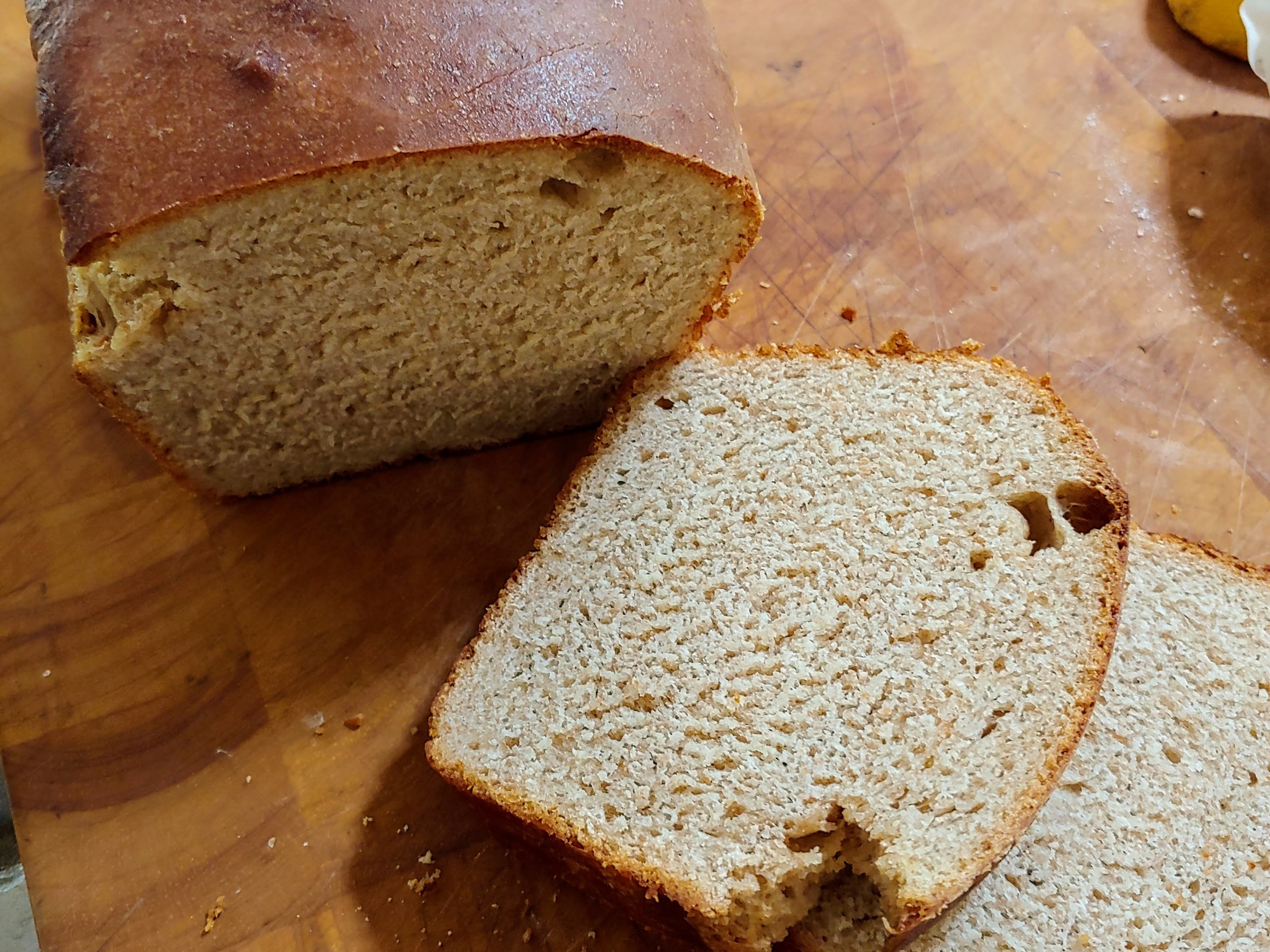
I am not going to get into hydration math here, but just want to say that the loaf above is a low-hydration loaf that produces a tight crumb (by which I mean, the dough is stiffer to work with, and it doesn’t have a ton of holes in it when you cut it open). Low hydration tends to make a tighter crumb, and many sourdough purists are big believers in high-hydration/open crumb. I have worked a bit with high-hydration doughs and found that I just don’t have the time or patience for the mess that can ensue. Also, for everyday eating with eggs or cheese toast, I prefer my bread with less holes in it.
For a good discussion of hydration and how it impacts your bread (and your experience baking bread), I recommend this blog post at True Sourdough
If you get into sourdough in some more intense way – then I would recommend Sarah Owens’ book Sourdough: Recipes for Rustic Fermented Breads, Sweets, Savories, and More which is full of wonderful flour, fruit, vegetable combinations with which you can really go down the bread rabbit-hole. Her book also includes lots of beautiful recipes for discard and starter like cookies and pastry all made with whole grains.
Why Sourdough?
Why make sourdough at all when commercial yeast is so readily available? For me it’s about being able to take two simple ingredients – flour and water – and turning that into something delicious and non-replicable. Every time you make a loaf it is different for one reason or another, every time you feed your starter, the taste can change ever so slightly or it might take longer to double in volume. The taste profile of sourdough is complex and ever changing, and I can honestly say that the best breads I have ever eaten (I’m looking at you Breitenbush Hotsprings and Willows Inn), the ones that have brought me great joy, have all been sourdoughs. With the recipe above, I have figured out the process and the recipe that works best for me, fits into my work days and results in something that brings the great pleasure of high end food into my home.
As I mentioned at the top, sourdough takes time and your kitchen temperature, bacteria, and ingredients are going to influence how much time it takes. I have had so many “failures” with sourdough, and they were all related to paying attention to the recipe rather than my own observed experience.
What really changed things for me is that once I found a recipe that worked for me (around my work schedule and that wasn’t demanding of my time), I made it over and over again. I changed the flours, I add more or less water, tried different timing on the rise and different scoring techniques. This is how you make a recipe yours and also learn how dough works, how different ingredients impact texture and taste, and what flavours you are working to develop in your bread.
I bake once or twice a week (or when guests are here, every day because people devour this bread a loaf at a time), and find the technique above just fits into my life. Perhaps you have more time and inclination towards more nuanced technique and if so – there are a million resources out there! But if not, my lazy advice above stands in for a damned good loaf of bread. Promise!
Post #3195: All the little jobs
These days at home have been great for getting at all the little jobs, and the big ones, around the house. I’ve been baking all the bread of course, cleaning out closets, changing high-up light bulbs, and this past weekend started washing the studio windows and scrubbing the pollen and algae off the deck railings. This turned out to be a big job, needing an extender pole that I don’t have, so I am only one-third of the way into the project of sprucing up my studio exterior. Inside the studio I have also been cleaning, something I do several times per year (though I’ve never done the interior windows before). Within the next couple of weeks I should have a pretty nice space both inside and out to hang out in.
Like most everyone, I expect I’ll be spending a lot of time at home this summer and so I’m taking the time that I normally don’t have to spruce things up a bit. I’m even going to invest in a new chair for my studio deck.
I’m also looking at my weaving loom and thinking that it’s time to weave off the project that has been on it for months (the fabric is destined to become a sauna towel for my partner) and decide on some smaller skill-building projects for the summer. I sold my big loom in early March, so at the moment I only have the small Julia loom which is portable enough that it can be moved onto the deck in nice weather. With the deck cleaned up, I might actually do that this year.
Incidentally, I am in the market for a larger loom again. I had been looking at very wide (60 inches) and tall swedish countermarch looms in the fall, but since then I’ve done some thinking and have decided that a Louet Spring is the most likely candidate for my weaving needs now, and into the future. I realized that if – for example – we decided to downsize and rented out my studio space I don’t want to deal with finding space for or selling a room-sized loom. The Louet Spring is a fairly expensive purchase, and these looms rarely turn up used – so it will be a year or more before I have the money together to make the order. Before that happens, I hope to be able to travel to Salt Spring Island to try one out at Jane Stafford’s studio. So many contingencies.
On a podcast the other day, I heard the psychologist Mark Epstein remark that the people in his practice who are doing the best these days are those who can treat this time a bit like a meditation retreat – dissolving their expectations into present-moment work like cleaning, mending, and tending (my interpretation of his words). This, of course comes from a privileged place of having a home to retreat into, and not having significant tasks in caring for others – but it is exactly the place I find myself. If I think about the future, or the things I am missing and have had to cancel – I get very anxious. On the other hand, if I allow myself to sink fully into a cleaning task like my windows, I become deeply satisfied with my present moment and space, which frees me up from what might come next. And because the external pressures to travel, to see people, to work away from the home are alleviated – our lives at home feel much more integrated. There is no here and away, this and that life. There is only here and the 95% of activities that take place within our home and garden sphere.
Today I’m going into town to get my car serviced and pick up some things from London Drugs. This will be my first trip that involves errands and shops in over two months and it feels strange to venture away from home to go do things outside of my sphere. I worry that it’s just the beginning of the end of this time focused in one place – and though I would also like to visit friends and family freely again, I’m not quite ready to bring this time of home tending to an end. We will see what the summer brings, but I do expect it will be a quiet one, and that’s okay with me.
Post #3194: Improving on Instagram

It’s May 6th and I am well-into my @memademay2020 goals, one of which included improving my selfies on Instagram. A big part of participating in the online sewing community involves taking photos of self-made clothing and posting them on various social media, Instagram in particular. As much as I find the act of taking photos of myself annoying, and often somewhat depressing, this is the main way that makers interact online these days. I can blog all I want, but I don’t get nearly the interaction with other folks interested in sewing as I do on Instagram.
Up until this month I have shown off my sewing in one of two ways 1) On a dressmaker’s dummy or 2) With a mirror-selfie. In both instances I’ve been using my iPad or phone camera and I rely heavily on the Instagram filter “Mayfair” to smooth out the poor lighting and resolution issues. That works, and lots of people do this sort of thing to great effect – but I’ve never been overly happy with this presentation and because my studio is often a mess, my backgrounds are cluttered. On the one hand, my studio has great light because it is all windows, on the other, there is no blank white wall to photograph against.
So each day so far this month I’ve been playing with a different element of making a decent self-portrait. On May 1st, I got organized around using a tripod, on the 2nd and 3rd I took photos in my zendo of a specific aspect of my life (meditation practice), on day 4 I added the element of holding something (my morning coffee), and yesterday I swapped out the iPad for my real camera. You can see all these experiments over at @Birdsongworkshop.
Today I started playing around with a backdrop comprised of a room divider and a sheet that I can use for those days when I just don’t feel like leaving the studio (or when the weather precludes it). Up top you can see my experiments using the dressmaking form – first with the bookshelf as backdrop, then with lighting from the behind, and in the center is the one I settled on liking the best which deployed only natural light and the use of better photo editing tools.
Sadly, by the time it came to take my actual selfie, the light was a bit weird and also I had to contend with the fact I don’t like photographing myself enough to spend hours doing it. So while I am fine with this basic backdrop for use some of the time, I need to go back to composition, camera angle and height, and lighting and work on that some more. Plus I’d like to take some more in situ shots on days when I am not working and have more time and access to the outside world.
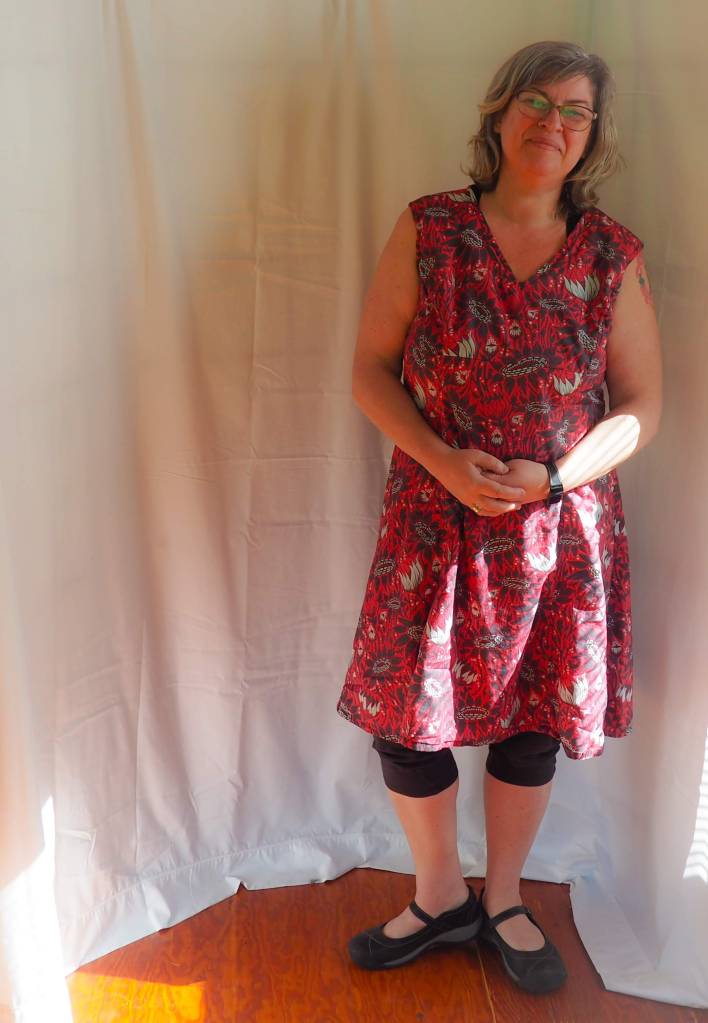
Now, I know I am not a very photogenic person which to a large degree is why I dislike this whole process so much. I am not comfortable or natural with a camera on me, and my features are much better appreciated in person than in a photo. But at the same time, why does that matter so much to me? Having taken lots of portraits of other people over the years I know that some people do not come across well in pictures, no matter how good looking they are in real life – it’s not a shortcoming to take a bad photo. Except I worry in this digital, image-obsessed world that it is and that so often we edit ourselves out of that bigger picture for no good reason at all.
I am reminded of Vivienne McMaster’s work on selfies as self-compassion and acceptance and that I have materials from one of her e-courses i bought years ago kicking around. I think I might have to take a look at that work again as I go through this process of scrutinizing myself through the lens and trying to create images that feel authentic and acceptable for showing off my the sewing, weaving, and knitting projects that I wear! It’s a bit of work to be sure, but preferable to being represented by a dressmaking form online 🙂
Stay tuned for more progress. I’m figuring this out one day at a time.
Post #3193: Turning things over

I’m having trouble with words these days. Or maybe it’s an issue of focus. The writing isn’t happening at all. This is a problem when you have a blog and a newsletter – so I’m still trying to eke something out that I can send for the latest installment of Comfort for the Apocalypse. But I’m not beating myself up about it. Things like canning, sewing, gardening, and offering support to those around me are taking precedence right now – as are working out, reading, and getting rest. I see what I’ve prioritized in the last few weeks, and I can’t argue with myself about it. It’s just what makes sense right now.
I’ve been posting a lot on Instagram and last week changed the name of my account to Birdsong Workshop to better reflect the diversity of things that happen in my home and studio. Birdsong Textiles felt a bit too weaving specific, and since it’s only one of the things happening here I thought a change was in order. There is a lot of sewing content right now, but I will start to include canning, cooking, and gardening content as well. Not being out in the world as much, I have more time to document little bits of our life here on Gabriola and something about Instagram appeals to me greatly in these times. I suppose it’s because I think of it as friendly social media and curate my feed to weed out political memes specifically (I get a lot of that content in all other parts of my life).
On the weekend I went through my closets and drawers and purged them of everything too large, worn out, or not my style. I also went through the shoes and removed everything I can no longer wear due to my Morton’s neuroma (basically, anything that narrows my toe-box is out these days and probably forever). While I have been quietly sewing a new spring/summer wardrobe that fits my smaller body, I had a rule that no new clothes could go into circulation until the old were cleaned out. When I was done I had a pile of “garbage” (some of which has been cut up into quilt squares), a bag of give-aways, an armload of me-mades that I am going to attempt altering down in size, and a small stack of clothes that are too big and also too complicated to alter that I’m not ready to let go of yet.

Even in these times I have a great feeling of refresh as the garden comes to life and the house gets aired out on warmer days. A new routine has emerged that involves daily yoga and workouts in my garage, trading on the local barter board (sourdough starter for kale, rhubarb crowns for canned chutney), and a weekly bread bake on Sundays. It’s not what I thought April would be, though in a lot of ways it’s better. The removal of external expectation that I be *other* places has been a bit of a gift.
But still, not everything is quite right inside my island bubble. I have trouble with focus and a hard time caring about things not concretely important, I am worried about a future where this virus is always a possibility because we can’t develop immunity but also about everything going “back to normal”. I don’t want to return to racing around all the time, but I would like to be able to go to a restaurant or an open mic again. I don’t mind working out at home, but I do miss going to my gym!
These times highlight my planning mind – one that switches easily from the logistics of work travel to maximizing food stores and community connections. Given that spring is the season of thinking ahead, I am well into turning over all of the things in my life although I don’t know exactly what I’m preparing for next.


 Red Cedar