Red Cedar
More apocalypse, less angst
Working on it….
In a temperate climate that doesn’t get much snow (like ours), January/February are the best months for looking at the garden’s “bones” and thinking about what structure might best support new plant growth come the growing season. With the ground frozen and most foliage dead (and cleaned out), this really is the best time to find out what’s going on out there and look for opportunities to get a few tasks done before the real work of March and April being. Yesterday was my day for doing that – so let the spring cost tally begin! After all the work we put in last spring and summer, you would think that the work out back is done – but alas! Not only do I see room for improvement, but I also want to start keeping bees this year – so there’s more prepping to do and that starts about now.
In order of priority and timing the spring projects include:
- Ordering Bees for spring pick-up. Timing: Now. Cost $135.
- Ordering seeds and mushroom plugs. Timing: Now. Cost $100 (or less)

- Trellis over the herb garden, and grape arbor over the garden bench (two separate projects). Timing: Whenever the ground isn’t frozen. Cost $50 or less if I can scavenge some of what I need.
- Irrigation for backyard beds. I’m planning on using the Lee Valley irrigation set-up but haven’t mapped out specific needs yet. Timing: March. Cost $150-$300
- Sinking a bathtub to contain the bamboo. Timing: March. Cost: Pretty much free.
- Backyard mulch. Timing: March (after irrigation set-up). Cost: $150
- Drill mushroom logs and install in woodland garden area. Timing: April. Cost: After the cost of the mushroom plugs, free.
- Finishing the top-bar hive construction. Timing: by April. Cost: Under $25 in wood.
Total spring costs: $650-700
Now, those are the “must-haves”. Other projects that are not spring dependent include:

- Planter boxes alongside the hot tub gazebo. Either purchase or build. Cost: Up to $200 if purchased.
- Water collection system. I plan to install some type of rainbarrels at the side of our house. Depending on which way we go (DIY or not) this will cost either $50 or $150.
- Firewood shed for the side of the house. Can’t decide whether to build a little wood structure of buy one of the prefab plastic “storage sheds” by Rubbermaid. Also wondering about doing a rack like this with a roof instead. Potential cost $50-$400 depending on which way we go.
These projects will happen as cash-flow allows.
And of course, that isn’t even getting started on the front yard which is also in a state of needing some help about now – our first plan of action to be digging in a pond once the ground is ready to be dug. I think this year we will be lucky to get in the pond, some border plants on that, and a couple of raised beds for winter veggie gardening (I have totally given up on our backyard for winter veggies as it gets almost no light after the September long weekend). Just as the backyard has been a multi-year project, so will the front yard take some time to come together. Again, I’m thinking bones… the pond and a couple of structured beds first…. a pathway or two…. So many things to do in the next few months but I’m excited to have another spring of projects to continue towards my goal of having a private oasis, a food-producing backyard, honeybees and an example of healthy, urban space.
The Gazebo

For the sake of showing off – here is the gazebo we built over the hot tub in December. I notice from the angle of this photo that it doesn’t look exactly square – but in fact it is. I’m looking forward to the spring when everything doesn’t look quite so bleak out back – and in particular have great plans for growing vines up and around this thing. The new gazebo gives us a lot more privacy anyhow – and really enhances the hot-tubbing experience!

Riders of the Capitalist Apocalypse
According to Slavoj Žižek, the four riders are:
- Ecological Crises
- Consequences of the biogenetic revolution
- Imbalances within the system itself (problems with intellectual property; forthcoming struggles over raw materials, food and water)
- Explosive growth of social divisions and exclusions
Also in the introduction to Living In The End Times
I am quite excited to get into this book which I ordered before Christmas and am just now getting around to reading.
Waterfront location
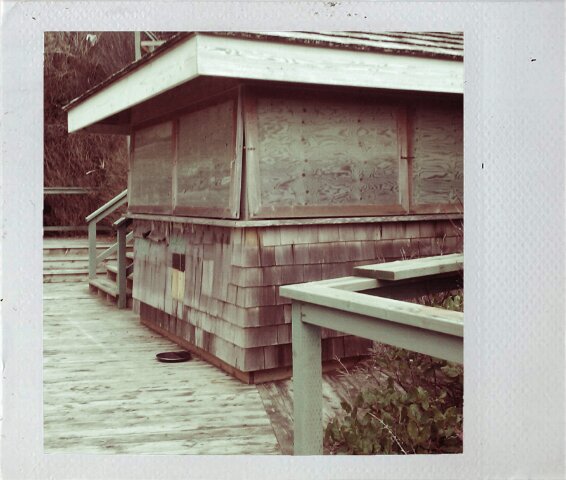
You would think this is an old broken-down beachhouse until you realize the concrete path winding down to this beachfront is unbroken and almost-new. The coast weathers things like that. Only three years old and part of a development that never got off the ground it’s just another abandoned place of the type I love – markers of decay, our inability to get it up anymore in the final arousal of capitalism.
I envision a North America where shiny highrises are replaced with broken glass and tattered blinds blowing in and out of the holes that were once homes. Which is not to say I relish misery… but an end to acquisition of the ruthless kind. Wild coasts turned golf courses. Forests mowed under for freeways. I think we’ve had enough of that. Catastrophe seems the only way out of this mess sometimes, doesn’t it?
A Garden Story
A short video about the Garden of Eden – destroyed 25 years ago this month in NYC. Inspiring and tragic.


 Red Cedar